

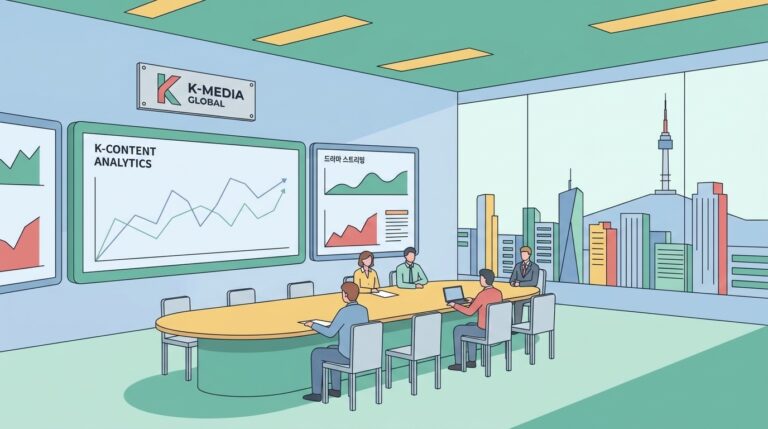
Navigating the Business of K-Dramas: Seasonal Formats and Actor Appearance Fees
Phase 1: Empathy (Story-Driven Opening)
안녕하세요! 매일한글 에디터입니다.
Imagine sitting in a high-stakes media boardroom in Yeouido or Gangnam. The table is filled with entertainment executives, producers, and talent agencies discussing the upcoming slate for a blockbuster streaming series. You hear terms like “시즌제” (seasonal production model) and “출연료” (actor appearance fees) thrown around alongside heated debates on production ROI.
If you’ve moved past everyday conversational Korean and are diving into professional networking, industry discussions, or high-level analysis of K-Wave business (한류 콘텐츠 비즈니스), you’ve likely realized that standard textbook dialogues fall short. Analyzing how Korean dramas transitioned from traditional 16-episode live-shoot miniseries to multi-season global franchises requires sophisticated vocabulary and strategic nuances.
This guide was built directly from feedback from advanced learners and industry insiders. By mastering these C2-level idioms and business concepts, you will articulate complex market dynamics with precision, cultural intelligence, and undeniable fluency.
Phase 2: Core Expressions Deep Dive
1. 몸값을 높이다
- Pronunciation: [Mom-gaps-eul nop-i-da] (Sounds like: mom-GAP-seul NOPE-ee-da; rhymes with raising the price tag on talent)
- Meaning:
- Literal: To raise one’s body value.
- Nuance: To increase one’s market value, leverage, or guarantee fee in the industry.
- K-Culture Moment: Used frequently in entertainment news headlines when top-tier actors negotiate multi-million won fees per episode for global OTT (Over-The-Top) platforms.
- Editor’s Insight: While ‘몸값’ literally translates to ‘body price,’ in business contexts it refers exclusively to commercial worth or salary leverage. Using it shows high-level familiarity with Korean media parlance.
- Situation Spectrum: Casual ⚠️ | Semi-formal ✅ | Formal ✅
- 🤔 Think About It: How does your native language express talent leverage compared to the Korean physical metaphor of ‘몸값’?
2. 시즌제에 물꼬를 트다
- Pronunciation: [Si-jeun-je-e mul-kko-reul teu-da] (Sounds like: see-jeun-je-eh mool-KKO-reul teu-da; ‘mul-kko’ means a water gate in irrigation)
- Meaning:
- Literal: To open the water gate for a seasonal system.
- Nuance: To pave the way or open the floodgates for adopting multi-season production formats.
- K-Culture Moment: Describing pioneering dramas like Voice, Hospital Playlist, or Squid Game that broke the traditional single-season Korean drama convention.
- Editor’s Insight: ‘물꼬를 트다’ is a rich literary idiom used in executive speeches and journalism to describe breaking new ground or initiating an unstoppable trend.
- Situation Spectrum: Casual 🚫 | Semi-formal ✅ | Formal ✅
- 🤔 Think About It: Why do you think metaphorical imagery rooted in agriculture (like water gates) remains so prestigious in modern Korean business language?
3. 흥행 보증 수표
- Pronunciation: [Heung-haeng bo-jeung su-pyo] (Sounds like: heung-haeng bo-JEUNG soo-pyo; ‘su-pyo’ means cashier’s check)
- Meaning:
- Literal: A bank check that guarantees a box-office hit.
- Nuance: A bankable star or reliable hit-maker whose presence guarantees commercial success.
- K-Culture Moment: Referring to A-list stars like Song Kang-ho or Jun Ji-hyun, whose participation secures immediate broadcast sales and overseas licensing deals.
- Editor’s Insight: Calling someone a ‘보증 수표’ highlights financial reliability. In negotiations, it justifies high actor fees (출연료).
- Situation Spectrum: Casual ✅ | Semi-formal ✅ | Formal ✅
- 🤔 Think About It: Does your culture evaluate creative star power using financial terminology like ‘guarantee check’?
Phase 3: Textbook Korean vs. Real Korean
Situation 1: Explaining an actor’s sudden fee increase
- 📖 Textbook Korean: 이 배우는 인기 많아서 출연료가 올랐습니다. (This actor is popular, so their performance fee increased.)
- 🗣️ Real Korean (C2): 이 배우는 글로벌 인지도를 바탕으로 몸값을 대폭 올렸습니다. (Capitalizing on global recognition, this actor significantly raised their market value.)
- 💡 Why the Difference? C2 discourse replaces basic connectors like ‘인기 많아서’ with strategic industry expressions like ‘글로벌 인지도를 바탕으로’ and ‘몸값을 올렸다’.
Situation 2: Discussing multi-season renewals
- 📖 Textbook Korean: 드라마 시즌 2를 만드는 것이 보통입니다. (It is common to make Drama Season 2.)
- 🗣️ Real Korean (C2): 한국 드라마 시장도 이제 시즌제 제작이 완전히 자리를 잡았습니다. (Seasonal production has now fully established its footing in the Korean drama market.)
- 💡 Why the Difference? Advanced speakers use ‘자리를 잡다’ (take root/establish) to discuss structural market shifts instead of simple active verbs.
Phase 4: K-Culture Deep Dive & Non-Verbal Manners
4-1. Nunchi & Business Gestures
In Korean media contract negotiations, direct financial confrontation is avoided. When discussing high ‘출연료’ (appearance fees), executives use measured nods and polite indirect language such as “조율이 필요한 부분입니다” (That is an area requiring fine-tuning). Maintain direct eye contact while nodding slowly to signal diplomatic disagreement without breaking harmony.
4-2. Cultural Code Analysis: The Seasonal Shift
Historically, Korean TV relied on 16-episode miniseries written on the fly based on live viewer feedback. Today, global OTT investments have introduced pre-production (사전제작) and multi-season intellectual property (IP) models. This shift guarantees longer stability for crews but dramatically elevates top actor costs, forcing production companies to balance talent budget against international licensing rights.
Phase 5: Real-Life Roleplay Scenario
Setting: Negotiation room between Production Vice President (Min-woo) and Top Agency Director (Soo-jin).
- Min-woo: 이번 작품은 시즌제로 기획 중이라 배우님의 장기 출연이 필수적입니다.
(I-beon jak-pum-eun si-jeun-je-ro gi-hoek jung-i-ra bae-u-nim-ui jang-gi chul-yeon-i pil-su-jeok-im-ni-da.)
🎭 (Leaning forward slightly with a respectful hands-folded posture)
“Since this project is planned as a seasonal series, the actor’s long-term commitment is essential.” -
Soo-jin: 저희 배우도 대본을 긍정적으로 봤습니다만, 최근 글로벌 흥행으로 몸값이 많이 오른 상태입니다.
(Jeo-hui bae-u-do dae-bon-eul geung-jeong-jeok-eu-ro bwat-seum-ni-da-man, choe-geun geul-lo-beol heung-haeng-eu-ro mom-gaps-i man-i o-reun sang-tae-im-ni-da.)
🎭 (Smiling subtly, holding a pen lightly)
“Our actor viewed the script favorably, but their market value has risen significantly due to recent global hits.” -
Min-woo: 물론 그분은 흥행 보증 수표시죠. 하지만 회당 출연료가 예산을 초과하면 제작비 압박이 큽니다.
(Mul-ron geu-bun-eun heung-haeng bo-jeung su-pyo-si-jyo. Ha-ji-man hoe-dang chul-yeon-ryo-ga ye-san-eul cho-gwa-ha-myeon je-jak-bi ap-bak-i keum-ni-da.)
🎭 (Adjusting glasses, gesturing toward the budget proposal)
“Of course, they are a surefire hit guarantee. However, if the fee per episode exceeds our budget, production costs will be under immense pressure.” -
Soo-jin: 시즌 1의 성공이 담보된다면 러닝 개런티 방식으로 조율하는 건 어떨까요?
(Si-jeun il-ui seong-gong-i dam-bo-doen-da-myeon reo-ning gae-reun-ti bang-sik-eu-ro jo-yul-ha-neun geon eo-tteol-kka-yo?)
🎭 (Nodding invitingly)
“If the success of Season 1 is secured, how about adjusting through a backend royalty profit-share model?” -
Min-woo: 좋은 제안입니다. 시즌제에 물꼬를 트는 차원에서 전향적으로 검토해보겠습니다.
(Jo-eun je-an-im-ni-da. Si-jeun-je-e mul-kko-reul teu-neun cha-won-e-seo jeon-hyang-jeok-eu-ro geom-to-hae-bo-get-seum-ni-da.)
🎭 (Extending a hand for a firm handshake)
“That’s a great proposal. To pave the way for this seasonal model, we will proactively review it.” -
Soo-jin: 감사해요. 서면으로 세부 조건을 전달해 주시면 빠르게 피드백 드리겠습니다.
(Gam-sa-hae-yo. Seo-myeon-eu-ro se-bu jo-geon-eul jeon-dal-hae ju-si-myeon ppag-reu-ge pi-deu-baek deu-ri-get-seum-ni-da.)
🎭 (Bowing head slightly with hands together)
“Thank you. Please forward the detailed terms in writing, and we will provide quick feedback.” -
Min-woo: 네, 해외 판권 계약 건도 함께 정리해서 보내드리겠습니다.
(Ne, hae-oe pan-gwon gye-yak geon-do ham-kke jeong-ri-hae bo-nae-deu-ri-get-seum-ni-da.)
🎭 (Filing the papers into a folder cleanly)
“Yes, I will organize and send the overseas distribution licensing terms together as well.” -
Soo-jin: 양측 모두에게 윈윈이 되는 프로젝트가 되길 기대합니다.
(Yang-cheuk mo-du-e-ge win-win-i doe-neun pro-jek-teu-ga doe-gil gi-dae-ham-ni-da.)
🎭 (Standing up with a warm business smile)
“I look forward to this becoming a win-win project for both parties.”
🔀 Interactive Branching Points
How would you respond if the agency demands a 50% appearance fee increase for Season 2?
* Option A: “절대 불가능합니다. 예산 오버입니다.” (Absolute rejection)
* ❌ Bad: Too direct and rude for Korean business culture. Ruins negotiations.
* Option B: “시즌 1의 성과와 해외 판권 수익에 연동하여 인상률을 재조율하시죠.” (Performance-linked counter proposal)
* ✅ Best: Strategic, professional C2 nuance that preserves face and protects profit.
* Option C:
Frequently Asked Questions (FAQ)
Q: What does "몸값을 높이다" mean in Korean and how do you pronounce it?
A: In Korean, "몸값을 높이다" is pronounced [Mom-gaps-eul nop-i-da] and means: Literal: To raise one's body value.
Q: What does "시즌제에 물꼬를 트다" mean in Korean and how do you pronounce it?
A: In Korean, "시즌제에 물꼬를 트다" is pronounced [Si-jeun-je-e mul-kko-reul teu-da] and means: Literal: To open the water gate for a seasonal system.
Q: What does "흥행 보증 수표" mean in Korean and how do you pronounce it?
A: In Korean, "흥행 보증 수표" is pronounced [Heung-haeng bo-jeung su-pyo] and means: Literal: A bank check that guarantees a box-office hit.






