

Phase 1: Empathy (Storytelling Opening)
안녕하세요! I’m your Daily Hangul editor and your personal Korea cultural navigator! 🌸
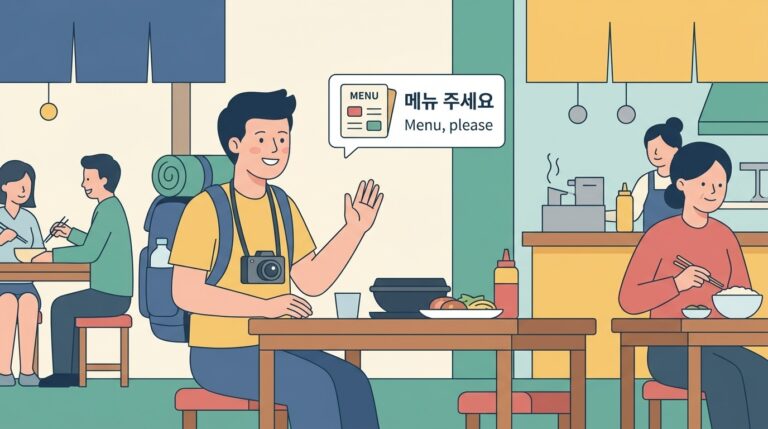
Picture this: You’ve just arrived in Seoul after a long flight. You walk into a cozy, mouth-watering local restaurant filled with the golden sizzle of Samgyeopsal or the fragrant steam of Kimchi Stew. Your stomach rumbles. You sit down at a wooden table, but… wait, where is the menu?
You glance around. The servers are busy zipping between tables, patrons are happily eating, and you feel that sudden wave of panic: “How do I get their attention without sounding rude? What do I actually say to ask for a menu?”
If you’ve ever felt frozen in a Korean restaurant, don’t worry! You’re definitely not alone. Over 80% of beginner Korean learners tell us that their very first real-world challenge in Korea isn’t passing a language test—it’s ordering food confidently!
In today’s guide, we’re going to master the single most useful magic phrase for dining out: “메뉴판 주세요” (Menupan juseyo – Can I have the menu, please?). By the end of this lesson, you’ll step into any Korean eatery like a seasoned local. Ready? Let’s dive in!
Phase 2: Deep Dive into 3 Core Expressions
1. 메뉴판 주세요 (Menupan juseyo)
- Pronunciation: [Me-nyu-pan ju-se-yo] (Sounds like “Menu-pan” + “Jew-say-yo”)
- Meaning: Direct: “Please give menu board” | Nuance: “Could I have the menu, please?”
- K-Culture Moment: You’ll hear this in almost every K-Drama scene where characters walk into a neighborhood Bunsik (snack bar) or local Gukbap shop!
- Editor’s Insight: 메뉴판 (Menupan) consists of “Menu” + “Pan” (board/plate). 주세요 (Juseyo) is Korea’s magic phrase meaning “please give me.” Put them together, and you have the ultimate polite request!
- Situation Spectrum: Casual ⚠️ | Semi-formal ✅ | Formal ✅
- 🤔 Think About It: Why is “주세요” (juseyo) such a versatile word in Korean daily life? How does your language express polite requests?
2. 저기요! (Jeogiyo!)
- Pronunciation: [Jeo-gi-yo] (Rhymes with “Yuh-gee-yo”, but starts with a soft ‘J’)
- Meaning: Direct: “Over there!” | Nuance: “Excuse me!” (to grab staff attention)
- K-Culture Moment: The iconic call echoed across busy Korean BBQ joints when patrons need extra side dishes or a menu!
- Editor’s Insight: While calling “Over there!” in English might sound abrupt, in Korea “저기요” is standard, friendly, and respectful when calling a server.
- Situation Spectrum: Casual ✅ | Semi-formal ✅ | Formal ⚠️
- 🤔 Think About It: In many Western cultures, making eye contact is preferred over calling out. How does calling a server out loud feel to you?
3. 메뉴판 있으세요? (Menupan isseuseyo?)
- Pronunciation: [Me-nyu-pan is-seu-se-yo]
- Meaning: Direct: “Do you have a menu board?” | Nuance: “Do you happen to have a menu?”
- K-Culture Moment: Used in trendy Seongsu-dong cafes or quiet aesthetic bistros when you want to ask very gently.
- Editor’s Insight: Adding -으세요 (-euseyo) shows extra politeness toward the listener’s action or possession.
- Situation Spectrum: Casual 🚫 | Semi-formal ✅ | Formal ✅
- 🤔 Think About It: How does asking “Do you have…?” change the vibe compared to directly saying “Give me…”?
Phase 3: Textbook Korean vs. Real Korean
Situation 1: Asking for the menu
- 📖 Textbook Korean: 메뉴판을 주십시오. (Menupaneul jusipsio.)
- 🗣️ Real Korean: 저기요, 메뉴판 주세요~ (Jeogiyo, menupan juseyo~)
- 💡 Why is it different? Textbook phrases like “주십시오” sound like military commands or official announcements. Real Koreans use the warmer, softer “~주세요” in everyday dining!
Situation 2: Inquiring politely
- 📖 Textbook Korean: 실례지만 메뉴판을 볼 수 있을까요? (Sillyejiman menupaneul bol su isseulppayo?)
- 🗣️ Real Korean: 여기 메뉴판 좀 주세요! (Yeogi menupan jom juseyo!)
- 💡 Why is it different? While textbook Korean tries to translate long English indirect phrases, native speakers prefer crisp, polite, direct combinations like 여기 (here) + 메뉴판 (menu) + 좀 (please/softener) + 주세요 (give).
Phase 4: K-Culture Deep Dive & Non-Verbal Manners
4-1. Nunchi (눈치) & Gestures
When calling a server in Korea, combine “저기요!” with a slight raise of your hand (around chest or shoulder level—no wild waving needed!) and a gentle head nod. This shows quick Nunchi (social tact) and respect for their busy workload.
4-2. The Magic Call Button (벨)
In many modern Korean dining spots, you won’t even need to say “저기요”! Look closely at the side or center of your wooden table. See a small round button labeled 벨 (Bel)? Pressing it emits a soft chime in the kitchen, notifying the staff to come to your table!
Phase 5: Real-Life Roleplay Scenario
Setting: A vibrant Korean BBQ restaurant in Hongdae, Seoul.
Characters: You (Hungry Traveler) & Minwoo (Friendly Restaurant Staff NPC)
- Minwoo (Server): 어서 오세요! 몇 분이세요? (Eoseo oseyeo! Myeot bun-iseyo?)
🎭 [Smiling warmly near the entrance]
(Welcome! How many people?) -
You: 두 명이요! (Du myeong-iyo!)
🎭 [Holding up two fingers with a smile]
(Two people!) -
Minwoo (Server): 이쪽에 앉으세요. (I-jjoge anjeuseyo.)
🎭 [Guiding you to a cozy window table]
(Please sit right here.) -
You: 감사합니다. 저기요, 메뉴판 주세요! (Gamsahamnida. Jeogiyo, menupan juseyo!)
🎭 [Raising hand slightly]
(Thank you. Excuse me, can I have the menu please?) -
Minwoo (Server): 아, 여기 있습니다! (A, yeogi isseumnida!)
🎭 [Handing over a laminated menu]
(Ah, here you go!) -
You: 감사합니다! 추천 메뉴 있으세요? (Gamsahamnida! Chucheon menyu isseuseyo?)
🎭 [Looking at the menu eagerly]
(Thank you! Do you have any recommended dishes?) -
Minwoo (Server): 삼겹살이 제일 잘 나갑니다! (Samgyeopsal-i jeil jal nagamnida!)
🎭 [Pointing enthusiastically at the top item]
(Pork belly is our most popular dish!) -
You: 좋네요! 그걸로 주세요. (Joh-neyo! Geugeollo juseyo.)
🎭 [Nodding happily]
(Sounds great! Give us that please.)
🔀 Interactive Branching Point
When you sit at the table and need the menu, what do you say?
- Option A: “저기요! 메뉴판 주세요!” (Jeogiyo! Menupan juseyo!)
- 🏆 Best Choice: Perfect! Super polite, natural, and effective.
- Option B: “야! 메뉴판!” (Ya! Menupan!)
- 🚨 Risk / Bad Choice: “Ya!” is extremely rude slang for calling close friends aggressively. Never use this with restaurant staff!
- Option C: “여기 메뉴판 어디 있어요?” (Yeogi menupan eodi isseoyo?)
- ⚠️ Okay Choice: Means “Where is the menu here?” Works, but sounds a bit blunt compared to directly asking for one.
Phase 6: 10-Second Emotion Shadowing Drill
Practice these aloud! Pay attention to pauses marked by /:
[😊 Polite & Friendly]
저기요 / 메뉴판 / 주세요!
(Jeogiyo / menupan / juseyo!)-
[🥺 Super Hungry & Pleading]
저기요~ / 메뉴판 / 좀 / 주세요!
(Jeogiyo~ / menupan / jom / juseyo!) -
[✨ Bright & Confident]
여기 / 메뉴판 / 있으세요?
(Yeogi / menupan / isseuseyo?)
Phase 7: K-Culture Mini Dictionary
- 메뉴판 (Menupan) | Noun | Menu board / Physical menu.
- 벨 (Bel) | Noun | Table call button commonly installed on dining tables.
- 주문 (Jumun) | Noun | Order. (e.g., “주문할게요” = I’d like to order!)
- 물은 셀프 (Mureun Selpeu) | Phrase | “Water is self-service”—look out for this sign near water dispensers!
Phase 8: Traveler’s Survival Kit
TOP 3 Dining Survival Expressions
- 메뉴판 주세요 (Menupan juseyo) — Can I get the menu, please?
- 이거 주세요 (Igeo juseyo) — Give me this one, please. (Point & say!)
- 계산해 주세요 (Gyesanhae juseyo) — Check, please!
💡 Editor’s Travel Note
Before heading out to explore Korea’s culinary treasures, make sure to check menu photos and reviews using the 네이버 지도 앱 다운로드. It’s Korea’s #1 navigation app and shows updated menu prices!
Phase 9: “One Step Deeper” (Thinking Question)
Korean dining culture moves fast, driven by the famous Palli-palli (빨리빨리 – hurry, hurry) spirit. Saying “저기요, 메뉴판 주세요” clearly and promptly helps staff serve you faster and keeps the energy of the restaurant flowing smoothly. Language in Korea is deeply tied to efficiency and shared courtesy!
💬 Your Turn: Have you ever tried ordering food in another language? What made you feel nervous, and how did you overcome it? Share your thoughts in the comments below!
Phase 10: FAQ & Common Mistakes
Q: Is calling out “저기요” (Jeogiyo) considered rude in Korea?
A: Not at all! In Korea, servers are often busy across large dining rooms. Calling “저기요” in a friendly, medium voice is expected and welcomed.
Q: What if I see a round button on the table?
A: If there’s a 벨 (Bel) on your table, press it! You don’t need to shout “저기요”—a staff member will come directly to you when they hear the chime.
Q: How can I ask specifically for an English menu?
A: Simply ask: “영어 메뉴판 있어요?” (Yeong-eo menupan isseoyo? – Do you have an English menu?).
🚨 Common Mistakes TOP 3
- **Calling servers “오빠” (Oppa) or







