

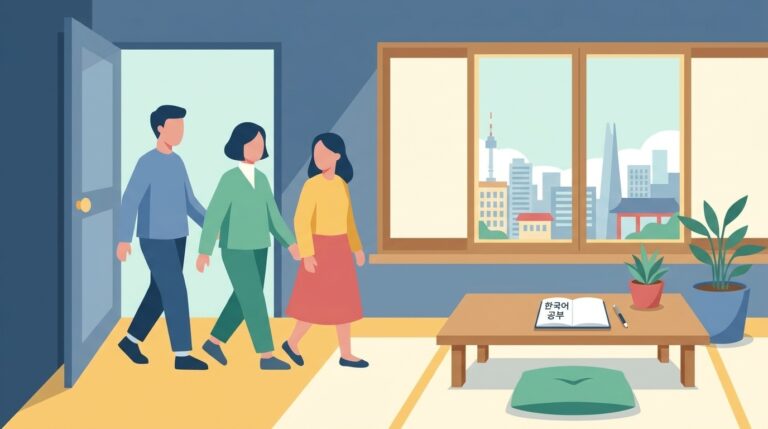
Phase 1: 공감 (스토리 몰입형 오프닝)
안녕하세요! 매일한글 에디터입니다. Have you ever been invited to a Korean friend’s housewarming party, known as 집들이 (Jipdeuri)? You take off your shoes at the entrance, hand over a gift, and then stand in the middle of the living room wondering: Is it rude to look into the bedroom? Should I compliment the lighting? How do I ask for a quick house tour without sounding intrusive?
If you’ve felt that awkward hesitation, don’t worry—you are definitely not alone! Many Korean learners feel nervous during their first house tour because home is a private space in Korea, yet housewarming parties are explicitly held to share that space with friends. In this guide based on real experiences of Korean learners, you will learn 3 easy, warm phrases to tour any Korean apartment like a polite, enthusiastic friend. Let’s make your next housewarming invitation fun and stress-free!
Phase 2: 핵심 표현 3선 심층 분석
1. 집이 너무 좋아요! (Jip-i neo-mu jo-a-yo!)
- Pronunciation: Jeep-ee noh-moo joh-ah-yoh! (Sounds like saying “jeep” with a bright pitch!)
- Meaning: Literal: “The house is too good!” | Real Niuance: “Your place is so wonderful!”
- K-Culture Moment: You often hear this expression in K-Dramas like Home Town Cha-Cha-Cha when guests walk through the front entrance and admire the cozy living room setup.
- Editor’s Insight: Although ‘너무’ (neo-mu) originally meant “too much” in negative contexts, modern Koreans use it overwhelmingly as a friendly, enthusiastic amplifier for positive feelings.
- Situation Spectrum: Casual ✅ | Semi-formal ✅ | Formal ⚠️
- 🤔 Think About It: In your home culture, do you praise the entire house immediately upon entering, or do you comment on specific items first?
2. 방 구경해도 돼요? (Bang gu-gyeong-hae-do dwae-yo?)
- Pronunciation: Bahng goo-gyeong-hae-doh dwae-yoh? (‘Bang’ rhymes with ‘song’, ‘dwae’ like ‘dweller’)
- Meaning: Literal: “May I sightsee the rooms?” | Real Niuance: “Can I take a quick look at the other rooms?”
- K-Culture Moment: Seen in reality shows like I Live Alone (나 혼자 산다) when friends visit a newly renovated apartment and ask permission to check out the master bedroom or study.
- Editor’s Insight: Korean etiquette values asking before stepping into closed spaces. Using ‘구경하다’ (to look around) makes the request sound curious and cheerful rather than intrusive.
- Situation Spectrum: Casual ✅ | Semi-formal ✅ | Formal 🚫
- 🤔 Think About It: How do guests in your country ask to see private spaces in a house?
3. 인테리어가 정말 예뻐요! (In-te-ri-eo-ga jeong-mal ye-ppeo-yo!)
- Pronunciation: In-teh-ree-aw-gah jeong-mahl yeh-ppew-yoh!
- Meaning: Literal: “The interior is really pretty!” | Real Niuance: “I love your interior design and decor!”
- K-Culture Moment: Popular in Korean home-cafe vlogs when visitors praise minimalist lighting, wooden furniture, or aesthetic cozy rugs.
- Editor’s Insight: Koreans love using loan words like ‘인테리어’ (interior decor). Combining it with ‘정말’ (really) makes your compliment sound sincere and modern.
- Situation Spectrum: Casual ✅ | Semi-formal ✅ | Formal ✅
- 🤔 Think About It: Why do you think modern housing and interior decor have become such a popular conversation topic among young Koreans?
Phase 3: 교과서 한국어 vs 진짜 한국어
Situation 1: Expressing admiration for a clean apartment
- 📖 교과서 한국어: 이 집은 매우 깨끗하고 아름답습니다. (I jip-eun mae-u kkae-kkeut-ha-go a-reum-dap-seumnida.)
- 🗣️ 진짜 한국어: 와, 집 진짜 넓고 깨끗하다! (Wa, jip jin-jja neolp-go kkae-kkeut-ha-da!)
- 💡 왜 다를까? Textbook Korean uses formal, literary words like ‘아름답습니다’ (beautiful), while native speakers react with natural exclamations like ‘와’ (wow) and ‘진짜’ (really) to sound authentic and friendly.
Situation 2: Asking to see the rest of the house
- 📖 교과서 한국어: 방을 보여 주시겠습니까? (Bang-eul bo-yeo ju-si-get-seumnida-kka?)
- 🗣️ 진짜 한국어: 다른 방도 구경해도 돼요? (Da-reun bang-do gu-gyeong-hae-do dwae-yo?)
- 💡 왜 다를까? Asking “Will you show me?” sounds like a official tour guide request. Asking “May I look around?” keeps the mood casual and relaxed.
Phase 4: K-Culture 딥다이브 & 비언어적 매너
4-1. 눈치 (Nunchi) & House Tour Gestures
- Shoe Placement: Place your shoes neatly pointing toward the exit door after taking them off at the 현관 (gyeong-gwan) entryway.
- Door Etiquette: If a room door is fully closed, always wait for the host to open it first rather than barging in.
- Reactions: Nod gently and make soft exclamations like “와~” (Wow~) while softly clapping your hands when entering a neat room.
4-2. Culture Code Analysis: The Jipdeuri Spirit
In modern Korea, 집들이 (Jipdeuri) is a meaningful rite of passage. Young adults work hard to set up their independent space. Bringing practical gifts like toilet paper (휴지 – symbol of smooth success) or detergent (세제 – symbol of bubbling prosperity) shows deep affection. Commenting warmly on their home decor validates all their hard work!
Phase 5: 실전 롤플레이 시나리오
Setting: You are visiting your Korean friend Minjun’s new studio apartment in Seoul for his housewarming gathering.
Characters: 민준 (Minjun – Host) & You (Guest)
- Turn 1 (민준): 어서 와! 집 찾기 안 힘들었어? (Eo-seo wa! Jip chat-gi an him-deul-eot-seo? / Welcome! Was it hard to find my place?)
- Turn 2 (You): 🎭 Giving gifts with a warm smile 아니요, 금방 찾았어요! 집이 너무 좋아요! (A-ni-yo, geum-bang cha-ja-seo-yo! Jip-i neo-mu jo-a-yo! / No, I found it right away! Your place is so wonderful!)
- Turn 3 (민준): 고마워! 들어와서 편하게 앉아. (Go-ma-wo! Deul-eo-wa-seo pyeon-ha-ge an-ja. / Thank you! Come in and sit comfortably.)
- Turn 4 (You): 🎭 Looking around the cozy living room 와, 인테리어가 정말 예뻐요! (Wa, in-te-ri-eo-ga jeong-mal ye-ppeo-yo! / Wow, the interior design is really pretty!)
- Turn 5 (민준): 그래? 내가 조명이랑 가구를 신경 좀 썼지! (Geu-rae? Nae-ga jo-myeong-i-rang ga-gu-reul sin-gyeong jom sseot-ji! / Really? I put some thought into the lighting and furniture!)
- Turn 6 (You): 🎭 Pointing gently toward the open room 혹시 방 구경해도 돼요? (Hok-si bang gu-gyeong-hae-do dwae-yo? / By any chance, may I take a look at the rooms?)
- Turn 7 (민준): 그럼! 이쪽이 내 침실이야. 들어와서 봐. (Geu-rom! I-jjok-i nae chim-sil-i-ya. Deul-eo-wa-seo bwa. / Of course! This side is my bedroom. Come in and take a look.)
- Turn 8 (You): 🎭 Nodding enthusiastically 방도 진짜 따뜻하고 좋다! (Bang-do jin-jja tta-tteut-ha-go jo-ta! / The room is really warm and nice, too!)
🔀 인터랙티브 분기점 (Interactive Choice)
What would you say after looking at Minjun’s cozy desk setup?
- Option A: “이 의자 어디서 샀어요? 진짜 편해 보여요!” (Where did you buy this chair? It looks really comfy!)
- Option B: “집이 생각보다 작네요.” (The house is smaller than I thought.)
- Option C: “서랍장 열어봐도 돼요?” (Can I open your dresser drawers?)
Feedback:
* Best Choice (Option A): 🎉 Perfect! Complimenting functional decor items shows great interest and gives the host a chance to proudly share their shopping story.
* Bad Choice (Option B): 🚫 Ouch! Pointing out the small size of someone’s home ruins the celebratory atmosphere.
* Risk Choice (Option C): ⚠️ Dangerous! Opening drawers or private storage without permission crosses personal boundaries in Korea.
Phase 6: 10초 감정 섀도잉 드릴
Practice reading these with proper feeling and natural pauses (/ indicates a pause):
[😊 Bright & Happy]와~ / 집이 너무 좋아요! (Wa~ / jip-i neo-mu jo-a-yo!)[🤔 Polite & Curious]혹시 / 다른 방도 / 구경해도 돼요? (Hok-si / da-reun bang-do / gu-gyeong-hae-do dwae-yo?)[💖 Impressed & Warm]조명이랑 인테리어가 / 정말 예뻐요! (Jo-myeong-i-rang in-te-ri-eo-ga / jeong-mal ye-ppeo-yo!)
Phase 7: K-Culture 미니 사전
- 집들이 (Jipdeuri) | Housewarming party | A gathering held to celebrate moving into a new home with loved ones.
- 휴지 (Hyuji) | Toilet paper / Tissue | A standard housewarming gift representing smoothly unrolling good fortune.
- 인테리어 (Interior) | Interior decor | Used broadly to describe home setup, aesthetic aesthetic items, and furniture.
- 햇살 (Haetsal) | Sunlight | Frequently complimented when an apartment gets lots of natural sunlight (햇살 맛집).
Phase 8: 여행자를 위한 생존 키트
Survival Expressions TOP 3
- 신발 벗어요? (Sin-bal beot-seo-yo?) – Do I take my shoes off?
- 화장실 어디예요? (Hwa-jang-sil eo-di-ye-yo?) – Where is the restroom?
- 초대해 주셔서 감사합니다! (Cho-dae-hae ju-seo-seo gam-sa-ham-ni-da!) – Thank you for inviting me!
Editor’s Travel Note
When visiting a Korean friend’s residence, navigating complex residential addresses can be tricky. Make sure to download the Naver Map App Navigation to find apartment complex building numbers (동/호수) easily!
Phase 9: 한 발 더 깊이 (생각 질문)
In Korean culture, inviting someone to your home is a gesture of deep trust and intimacy. Korean apartments are modern personal sanctuaries, so host hospitality involves offering drinks and slippers while guest hospitality involves warm praises. Giving compliments about lighting, space, and warmth shows that you value the host’s lifestyle and effort.
💬 Your Turn: What is the most important housewarming etiquette in your home culture? Share your thoughts in the comments below!
Phase 10: FAQ & 오해 방지
Q: Can I take photos of my friend’s house during a housewarming party?
A: Yes, but always ask first! Say “사진 찍어도 돼요?” (Can I take a picture?) before snapping photos for social media.
Q: Should I bring a gift even if my host said ‘Just bring yourself’?
A: Absolutely! In Korea, coming empty-handed is considered awkward. Bringing a small pack of toilet paper, candles, or fruit shows great etiquette.
Q: Is it okay to walk barefoot in a host’s house?
A: Wearing socks or provided indoor slippers is preferred over walking barefoot on hard floors.
🚨 Common Mistakes Warning
- ❌ Mistake 1: Entering the home with outdoor shoes on. ➔ Correct Action: Remove shoes at the entryway (현관) instantly.
- ❌ Mistake 2: Opening closed bedroom or closet doors without asking. ➔ Correct Action: Always ask “방 구경해도 돼요?” first.
- ❌ Mistake 3: Sitting on the bed without invitation. ➔ Correct Action: Sit on sofa or floor cushions provided by the host.
Phase 11: 액션 미션 & 참여 유도
- 🥉 Bronze Mission: Practice saying “집이 너무 좋아요!” 3 times out loud.
- 🥈 Silver Mission: Write a comment using “인테리어가 정말 예뻐요!” on a Korean home decor post.
- 🥇 Gold Mission: Use these 3 house tour phrases next time you visit a friend’s place in Korea!
🎮 K-Culture Mission: Watch a video on YouTube or Instagram with the hashtag #집들이 and spot how many times people compliment the decor!
Phase 12: 인터랙티브 퀴즈 챌린지
Q1. How do you politely ask to see other rooms in a friend’s house?
Click to see answer
Answer: “방 구경해도 돼요?” (Bang gu-gyeong-hae-do dwae-yo?)
Explanation: Using ‘구경하다’ (look around) makes the request sound friendly and natural!
Q2. True or False: Toilet paper is a traditional Korean housewarming gift that wishes smooth success.
Click to see answer
Answer: True! (참입니다!)
Explanation: Unrolling toilet paper symbolizes matters unrolling smoothly in the new home.







