

Phase 1: Empathy
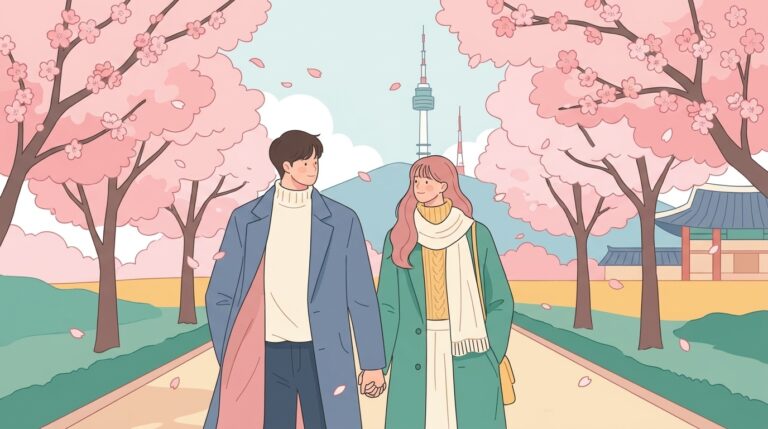
안녕하세요! 매일한글 에디터입니다. (Hello! I’m your lead editor at Daily Hangul.) Every spring in Korea, as soon as the soft pink cherry blossom petals start flattering down the streets of Yeouido and Seokchon Lake, one iconic melody echoes endlessly from cafes, taxis, and cosmetics shops. Yes, we are talking about Busker Busker’s legendary track, ‘Cherry Blossom Ending’ (벚꽃 엔딩)! Often dubbed as the ultimate ‘Spring Carol’ (봄 캐럴) or ‘Cherry Blossom Zombie’ because it resurrects on music charts every March without fail, this song encapsulates the sweet, nostalgic vibe of Korean springtime.
However, if you have ever listened to the song while reading the lyrics, you might have felt confused. Why are people singing about ‘walking together in a wind that blows cherry blossom leaves’ with such specific emotional grammar? You understand individual words like ‘봄’ (spring) or ‘바람’ (wind), but connecting them into genuine conversational nuance feels tricky. Don’t worry! Based on real student feedback from our Daily Hangul community, we’ve broken down the exact phrases, cultural contexts, and real-world spoken Korean hidden inside this eternal spring anthem. Mastering these expressions will not only upgrade your listening skills but also help you talk about spring dates, seasonal feelings, and outdoor walks like a real local!
Phase 2: Core Expressions Deep Dive
1. 흔날리는 벚꽃 잎이 (Heonnallineun beotkkot ip-i)
- Pronunciation: [Heon-nal-li-neun beot-kkot ip-i] (Sounds like hun-nah-lee-neun buht-kkot ee-pee)
- Meaning: “Fluttering cherry blossom petals…”
- Literal: Cherry blossom leaves that scatter in the wind.
- Nuance: Captures the romantic, poetic visual of petals swirling gently through the air.
- K-Culture Moment: Seen in almost every K-Drama romantic climax where the lead couple walks beneath blooming trees while cherry blossom leaves float gently over them.
- Editor’s Insight: The verb ‘흩날리다’ combines ‘흩어지다’ (to scatter) and ‘날리다’ (to fly). It’s used when small light objects like snow, petals, or ashes swirl softly in the breeze.
- Situation Spectrum: Casual (✅) / Semi-formal (✅) / Formal (⚠️)
- 🤔 Think About It: How does your native language describe falling petals? Korean focuses on the movement in the wind (‘흩날리다’) rather than just ‘falling’.
2. 둘이 걸어요 (Duri georeoyo)
- Pronunciation: [Du-ri geo-reo-yo] (Sounds like doo-ree guh-ruh-yoh)
- Meaning: “Let’s walk together, just the two of us.”
- Literal: Two people walk.
- Nuance: A soft, warm invitation suggesting intimacy and shared emotion during a scenic stroll.
- K-Culture Moment: Used when inviting your crush or partner to leave a loud group and go for a quiet walk in a nearby park.
- Editor’s Insight: Adding ‘둘이’ (two people) creates a warm, sweet boundary around the pair, making a simple walk feel like a special date.
- Situation Spectrum: Casual (✅) / Semi-formal (✅) / Formal (🚫)
- 🤔 Think About It: Why does Korean conversation often emphasize the number of people (‘둘이’, ‘셋이’) when making casual plans?
3. 바람이 불면 (Barami bulmyeon)
- Pronunciation: [Ba-ra-mi bul-myeon] (Sounds like bah-rah-mee bool-myuhn)
- Meaning: “When the wind blows…”
- Literal: If/when the wind blows.
- Nuance: Sets up a poetic conditional moment that triggers memories, romance, or seasonal feelings.
- K-Culture Moment: Frequently heard in ballad lyrics and daily chatter when setting the scene for nostalgic outdoors weather.
- Editor me Insight: The pattern ‘-면’ (if/when) creates a mood of anticipation. In springtime conversation, wind isn’t just weather; it’s the magical force that brings down the petal rain!
- Situation Spectrum: Casual (✅) / Semi-formal (✅) / Formal (✅)
- 🤔 Think About It: Is wind viewed as uncomfortable or romantic in your home country during spring?
Phase 3: Textbook Korean vs. Real Native Korean
Situation 1: Suggesting a spring walk
- 📖 Textbook: “날씨가 좋으니 함께 산책을 할까요?” (Since the weather is good, shall we take a walk together?)
- 🗣️ Real Native: “날씨 진짜 대박이다! 우리 꽃구경 갈래?” (The weather is amazing! Want to go look at blossoms?)
- 💡 Why the difference? Native Koreans rarely use generic ‘산책’ (walk) in spring; they specifically use ‘꽃구경’ (blossom viewing) to capture the unique seasonal excitement.
Situation 2: Expressing romantic excitement about spring weather
- 📖 Textbook: “봄 바람이 매력적입니다.” (The spring wind is charming.)
- 🗣️ Real Native:
Frequently Asked Questions (FAQ)
Q: What does "흔날리는 벚꽃 잎이 (Heonnallineun beotkkot ip-i)" mean in Korean and how do you pronounce it?
A: In Korean, "흔날리는 벚꽃 잎이 (Heonnallineun beotkkot ip-i)" is pronounced [Heon-nal-li-neun beot-kkot ip-i] and means: "Fluttering cherry blossom petals..."
Q: What does "둘이 걸어요 (Duri georeoyo)" mean in Korean and how do you pronounce it?
A: In Korean, "둘이 걸어요 (Duri georeoyo)" is pronounced [Du-ri geo-reo-yo] and means: "Let's walk together, just the two of us."
Q: What does "바람이 불면 (Barami bulmyeon)" mean in Korean and how do you pronounce it?
A: In Korean, "바람이 불면 (Barami bulmyeon)" is pronounced [Ba-ra-mi bul-myeon] and means: "When the wind blows..."







