

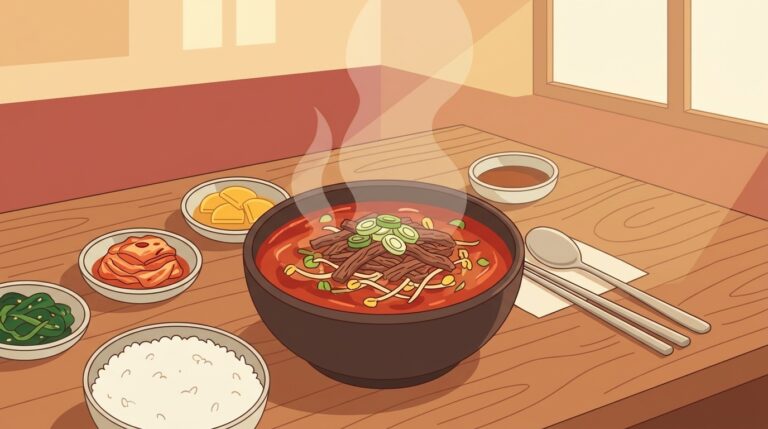
Phase 1: 공감 (Empathy & Storytelling)
안녕하세요! 매일한글 에디터입니다. Have you ever taken a steaming spoon of red, aromatic Yukgaejang (육개장 – shredded beef soup with scallions) on a chilly night in Seoul, taken a bite, and felt a wave of rich, spicy comfort hit your soul? You want to tell the restaurant owner how incredible it tastes, but all you can remember is “매워요!” (It’s spicy!).
Saying “매워요” to a local Korean foodie when eating Yukgaejang is like calling a complex gourmet dish just “hot.” You miss out on capturing the soul-warming depth, the scallion oil aroma, and that iconic Korean feeling of satisfaction! Many B2 intermediate learners get stuck at basic flavor adjectives when describing Korean soups and stews (국/찌개). Based on feedback from hundreds of our adult learners at Daily Hangul, mastering nuanced flavor descriptions like 얼큰하다 (deeply spicy and refreshing) is the exact turning point where locals stop treating you like a tourist and start welcoming you as a true K-Food insider.
Today, let’s unlock the sensory vocabulary needed to describe Yukgaejang like a native!
Phase 2: 핵심 표현 3선 심층 분석 (3 Core Expressions)
1. 얼큰하다 (Eolkeun-hada)
- Pronunciation: [Eol-keun-ha-da] (Sounds like “All-keun-ha-dah”, with a sharp ‘k’ sound in the middle)
- Meaning: Literal: To be spicy | Real Niuance: Deeply, complexly spicy, satisfying, and refreshing (not painful spice, but soothing warm spice)
- K-Culture Moment: Seen frequently in K-Dramas whenever characters eat hot soup after a long day or in cold weather and let out a satisfied sigh.
- Editor’s Insight: Unlike 맵다 (which simply means spicy/capsaicin pain), 얼큰하다 implies a thick broth infused with red pepper powder, garlic, and scallion oil that warms your chest.
- Situation Spectrum: Casual (✅) / Semi-formal (✅) / Formal (✅)
- 🤔 Think About It: Does your native culture have a single word that describes food being simultaneously spicy and refreshing?
2. 국물이 깊다 (Gungmuri gipda)
- Pronunciation: [Gung-mu-ri gip-da] (Notice the nasal sound ‘gung’ instead of ‘guk’ due to sound transformation)
- Meaning: Literal: The soup/broth is deep | Real Niuance: The broth has been simmered for hours, creating a rich, flavorful flavor base
- K-Culture Moment: Popularly used in culinary shows like Delicious Rendezvous when food critique hosts evaluate beef broth base.
- Editor’s Insight: Depth (깊이) in Korean cuisine reflects time and devotion. Calling a soup’s broth “deep” is one of the highest compliments you can pay to a chef!
- Situation Spectrum: Casual (✅) / Semi-formal (✅) / Formal (✅)
- 🤔 Think About It: Why do you think Korean food culture values broth simmered for long hours so deeply?
3. 속이 풀리다 (Sogi pullida)
- Pronunciation: [So-gi pul-li-da] (Soft ‘p’ sound with fluent ‘l’ link)
- Meaning: Literal: The inside/stomach unties | Real Niuance: My stomach feels soothed, untangled, or relieved (especially after eating hot soup or recovering from a hangover)
- K-Culture Moment: In K-Dramas, characters drinking the morning after a night out eating a hot bowl of Yukgaejang and instantly saying this phrase.
- Editor’s Insight: Korean food philosophy views stomach tension (속이 꼬이다) as stress/discomfort. Warm spicy soup “unties” (풀다) that knot.
- Situation Spectrum: Casual (✅) / Semi-formal (✅) / Formal (⚠️ – standard honorifics required)
- 🤔 Think About It: How does your language connect digestive comfort with emotional relief?
Phase 3: 교과서 한국어 vs 진짜 한국어 (Textbook vs. Real Korean)
Scenario 1: Reacting to the First Bite of Yukgaejang
- 📖 교과서 한국어: 이 국은 매우 매워서 맛있습니다. (This soup is very spicy, so it is delicious.)
- 🗣️ 진짜 한국어: 와, 국물이 진짜 얼큰하고 깊네요! (Wow, the broth is so deeply spicy and rich!)
- 💡 왜 다를까?: Textbook sentences rely on simple conjunctions and basic adjectives like 맵다. Real Koreans express flavor through rich sensory combinations like 얼큰하다 and 깊다 to convey texture and depth.
Scenario 2: After Drinking Hot Broth on a Cold or Tired Day
- 📖 교과서 한국어: 따뜻한 국물을 먹으니 건강해집니다. (Eating warm soup makes me healthy.)
- 🗣️ 진짜 한국어: 캬~ 매콤한 국물 마시니까 속이 싹 풀려요! (Kyah~ drinking this spicy broth completely unties my stomach!)
- 💡 왜 다를까?: Native speakers naturally use exclamations (캬~) and functional verbs like 속이 풀리다 to describe physical sensation rather than abstract health statements.
Phase 4: K-Culture 딥다이브 & 비언어적 매너 (Culture & Manner)
4-1. 눈치 (Nunchi) & Gestures
When eating Yukgaejang in Korea, non-verbal cues amplify your appreciation:
1. The “Siwon-hada” Sigh: After taking a piping hot spoonful, breathe out slightly with an open mouth and say “어우~ 얼큰하다!” (Aow~ so deeply spicy!). This shows the cook you are enjoying the warmth.
2. Two-Handed Spooning (Respectful Tasting): If the restaurant owner (이모님) asks how it tastes, hold your spoon’s handle gently with one hand while holding your other hand under it as support while nodding gently.
4-2. Cultural Code: The Soul Food Status of Yukgaejang
Yukgaejang holds a special place in Korean culture. Traditionally served at family gatherings and funerals because its red color was believed to ward off bad luck, it evolved into the ultimate daily comfort food. In modern city life, workers flock to local soup joints on rainy or stressful days to achieve a sense of bodily warmth and release (해장 effect).
Phase 5: 실전 롤플레이 시나리오 (Roleplay Scenario)
Setting: A 40-year-old popular Yukgaejang restaurant in Jongno, Seoul. You are sitting at a low wooden table, talking to the friendly owner (이모님).
- 이모님: 손님, 주문하신 얼큰한 육개장 나왔습니다! 뜨거우니까 조심해요.
- (Son-nim, ju-mun-ha-sin eol-keun-han yuk-gae-jang na-wat-seub-ni-da! Tteu-geo-u-ni-kka jo-sim-hae-yo.)
- “Customer, here is your spicy Yukgaejang! It’s hot, so be careful.”
- 🎭 Action: Places a boiling earthenware pot (뚝배기) in front of you with steam rising.
- Learner: 와, 냄새부터 진짜 대박이네요! 잘 먹겠습니다.
- (Wa, naem-sae-bu-teo jin-jja dae-bag-i-ne-yo! Jal meok-get-seub-ni-da.)
- “Wow, even the smell is totally amazing! I will enjoy this meal.”
- 🎭 Action: Pick up chopsticks and spoon, breathing in the rich scallion aroma.
- 이모님: 우리 집은 파랑 고기를 많이 넣고 오래 끓여서 국물이 남달라요.
- (U-ri ji-beun pa-rang go-gi-reul ma-ni neo-ko o-rae kkeul-rhyeo-seo gung-mu-ri nam-dal-ra-yo.)
- “We put lots of scallions and beef and simmer it for a long time, so our broth is special.”
- Learner: (한 스푼 먹고) 캬~ 국물이 정말 얼큰하고 깊은 맛이 나네요!
- ((Han seu-pun meok-go) Kya~ gung-mu-ri jeong-mal eol-keun-ha-go gi-peun ma-si na-ne-yo!)
- “(Takes a spoon) Kyah~ the broth is really deeply spicy and rich!”
- 🎭 Action: Take a sip, close eyes briefly, and smile brightly.
- 이모님: 어머, 외국분인데 ‘얼큰하다’는 말도 아네! 입에 좀 맞아요?
- (Eo-meo, oe-guk-bu-nin-de ‘eol-keun-ha-da’-neun mal-do a-ne! I-be jom ma-ja-yo?)
- “Oh my, you’re a foreigner but you even know the word ‘Eolkeun-hada’! Does it suit your palate?”
- Learner: 네! 뜨겁고 매콤해서 속이 싹 풀리는 느낌이에요.
- (Ne! Tteu-geop-go mae-kom-hae-seo so-gi ssak pul-li-neun neuk-kim-i-e-yo.)
- “Yes! It’s hot and spicy, so it feels like my stomach is completely untied!”
- 이모님: 아이구 잘 먹네! 밥 부족하면 말해요, 더 줄 테니까.
- (A-i-gu jal meok-ne! Bap bu-jok-ha-myeon mal-hae-yo, deo jul te-ni-kka.)
- “Aigoo, you eat so well! Tell me if you need more rice, I’ll give you extra.”
- Learner: 감사해요 이모님! 완뚝 할게요!
- (Gam-sa-hae-yo i-mo-nim! Wan-ttuk hal-ge-yo!)
- “Thank you auntie! I’ll finish the whole bowl!”
- 🎭 Action: Give a thumbs up playfully.
🔀 Interactive Choice Point
How would you respond if the owner asks: “매운데 괜찮아요?” (Is it spicy, are you okay?)
- Option A: “괜찮아요. 매워도 맛있어요.” (Standard standard answer – safe, basic)
- Option B: “조금 매운데 국물이 얼큰해서 자꾸 들어가요!” (Native expression – vibrant & complimenting)
- Option C: “너무 매워서 못 먹겠어요.” (Direct complaint – buzzkill)
Feedback:
* Best (Option B): Excellent! You used 얼큰해서 자꾸 들어가요 (It’s deeply spicy so I keep eating!), making the owner extremely proud of her cooking!
* Risk (Option A): Polite and safe, but misses an opportunity to show off your intermediate B2 nuance.
* Bad (Option C): Very direct. While honest, it shuts down the friendly rapport. Instead say, “제 입에는 조금 매운데 맛있어요!” (It’s a bit spicy for me, but delicious!).
Phase 6: 10초 감정 섀도잉 드릴 (Emotion Shadowing Drill)
Practice these lines out loud with exact rhythm (/ = pause) and emotion:
[😋 Expressing Deep Satisfaction]
와… / 국물이 / 진짜 얼큰하다!
(Wa… / gung-mu-ri / jin-jja eol-keun-ha-da!)-
[😮 Savoring Comfort]
뜨거운 국물 마시니까 / 속이 / 싹 풀리네요.
(Tteu-geo-un gung-mul ma-si-ni-kka / so-gi / ssak pul-li-ne-yo.) -
[😍 Complimentary & Excited]
이 집 육개장은 / 진짜 깊은 맛이 / 나요!
(I jip yuk-gae-jang-eun / jin-jja gi-peun ma-si / na-yo!)
Phase 7: K-Culture 미니 사전 (Mini Dictionary)
- 해장 (Hae-jang): Hangover soup/cure. The practice of eating warm broth to relieve bodily fatigue or hangovers.
- 국물 (Gung-mul): Broth/Soup fluid. In Korean food, broth is considered the essence of the dish.
- 파기름 (Pa-gi-reum): Scallion oil. The fragrant oil created by frying green onions; the flavor base of authentic Yukgaejang.
- 이모님 (I-mo-nim): Literally ‘Auntie’. Friendly, respectful title used for women running casual Korean diners.
Phase 8: 여행자를 위한 생존 키트 (Traveler’s Survival Kit)
Survival Expressions TOP 3
- 덜 매운 육개장 있어요? (Deol mae-un yuk-gae-jang it-seo-yo?)
- Pro Tip: Use this if you are sensitive to heat! (Is there a less spicy Yukgaejang?)
- 국물 좀 더 주실 수 있나요? (Gung-mul jom deo ju-sil su it-na-yo?)
- Pro Tip: Owners often give extra broth for free if asked politely at informal diners.
- 밥 말아 먹으면 맛있어요! (Bap ma-ra meok-eu-myeon ma-sit-seo-yo!)
- Pro Tip: Mentioning that dipping rice into soup tastes good instantly proves your foodie status.
Editor’s Travel Note
When hunting for the most authentic Yukgaejang in Seoul, skip big fast-food chains and search for local spots on map apps. You can 네이버 지도 앱 다운로드 (Download Naver Map App) to check real customer reviews with key adjectives like #얼큰한국물 or #깊은맛.
Phase 9: 한 발 더 깊이 (One Step Deeper)
In Korean culture, food is deeply tied to emotional warmth and communal healing. The phrase 속이 풀리다 goes beyond physical digestion—it reflects the Korean mindset that sharing hot, soul-nourishing broth melts away daily burdens and stress. When you appreciate the depth of Yukgaejang, you are participating in a century-old Korean ritual of warmth and hospitality.
💬 Your Turn: Have you tried Yukgaejang or any Korean soup before? How did you describe the taste in your own language? Tell us in the comments below!
Phase 10: FAQ & 오해 방지 (FAQ & Common Mistakes)
Q: What is the exact difference between ‘맵다’ and ‘얼큰하다’?
A: 맵다 is a general term describing spiciness (capsaicin heat). 얼큰하다 specifically describes hot, liquid broth dishes that possess a rich, savory, and soothing spiciness.
Q: Can I use ‘얼큰하다’ to describe sweet spicy foods like Tteokbokki?
A: No! 얼큰하다 is almost exclusively reserved for warm soups, stews, and hot noodle broths (국/찌개/짬뽕). For Tteokbokki, use 매콤하다 (sweetly spicy).
Q: Is ‘속이 풀리다’ only used when hungover?
A: Not at all! While often used for hangover remedies, you can use it whenever a warm, savory meal relaxes your body after stress or cold weather.
🚨 Common Mistakes TOP 3
- ❌ Saying “이 국은 시원해요!” and expecting cold soup.
- 👉 Correct Action: Remember that in soup contexts, 시원하다 means refreshing/clearing, NOT temperature cold!
- ❌ Mispronouncing 국물 as [Guk-mul].
- 👉 Correct Action: Pronounce it naturally as [Gung-mul] using nasal sound rule.
- ❌ Using ‘얼큰하다’ for cold salad.
- 👉 Correct Action: Save 얼큰하다 strictly for hot, spiced broths.
Phase 11: 액션 미션 & 참여 유도 (Action Mission)
- 🥉 Bronze: Say “얼큰하다!” out loud 3 times using emotion shadowing.
- 🥈 Silver: Leave a comment describing your favorite soup using 국물이 깊어요.
- 🥇 Gold: Visit a local Korean soup restaurant or order Yukgaejang and use at least one intermediate flavor expression to the staff!
🎮 K-Culture Mission: Watch a scene in a K-Drama where characters eat 국밥 or 육개장. Listen closely for the sigh and the word 시원하다 or 얼큰하다!
Phase 12: 인터랙티브 퀴즈 챌린지 (Quiz Challenge)
Quiz 1. Situation Judgment
You just swallowed a warm spoonful of rich Yukgaejang broth at a restaurant. Which expression is MOST natural?
A) 이 국물 참 달콤하다!
B) 와, 국물이 정말 얼큰하고 깊네요!
C) 이 국물은 시고 쓸씁니다.
🔍 정답 및 해설 보기 (Click to see Answer)
Answer: B) 와, 국물이 정말 얼큰하고 깊네요!
Explanation: Yukgaejang broth is characterized by its deep, rich, and refreshing spiciness (얼큰하고 깊은 맛).
Quiz 2. Fill in the Blank
“뜨거운 육개장을 먹으니까 스트레스가 빠지고 (속이 ___요)!”
Fill in the blank with the correct verb form for “stomach gets unknotted/soothed”.
🔍 정답 및 해설 보기 (Click to see Answer)
Answer: 풀려
Explanation: The phrase 속이 풀리다 (stomach unties/feels relieved) becomes 속이 풀려요 in casual polite style.
Quiz 3. True / False Culture Quiz
True or False: Koreans only say 시원하다 (refreshing) when drinking iced cold water.
🔍 정답 및 해설 보기 (Click to see Answer)
Answer: False!
Explanation: Koreans frequently say 시원하다 when eating hot, savory soup because it refers to the inner refreshing sensation in the throat and chest!







