

Unlocking Korea’s Hidden History: How to Rent and Enjoy Audio Guides at Museums Like a Local
Phase 1: 공감 (Empathy & Story Opening)
안녕하세요! (Annyeonghaseyo!) It’s your Daily Hangul editor here! 👋
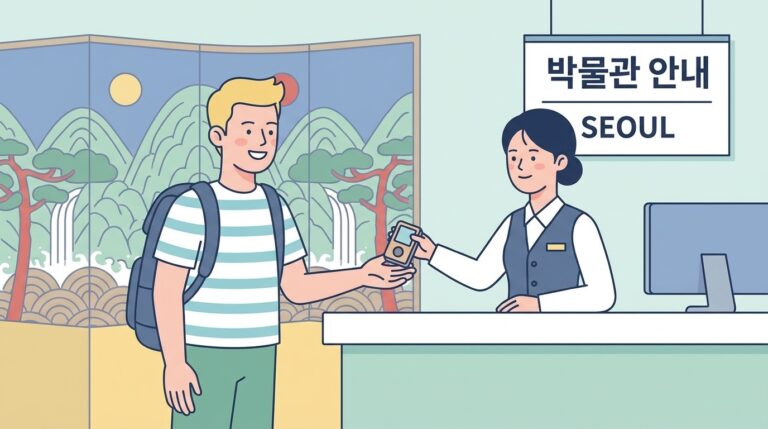
Imagine this: You have finally arrived in Seoul and stepped into the grand hall of the National Museum of Korea (국립중앙박물관). The modern glass architecture seamlessly meets thousands of years of ancient history. You see incredible artifacts like the Pensive Bodhisattva and Goryeo celadon ceramics. You want to dive deep into the rich historical stories, but reading lengthy academic plaques in high-level Korean feels overwhelming.
You spot the service desk where sleek audio guide devices are lined up. You want to rent one, but hesitation kicks in: How do I ask if they have English? Do I need to leave my passport? What is the natural way to ask without sounding like a robotic textbook?
Don’t worry at all! Renting an audio guide is one of the easiest ways to transform a simple museum visit into an immersive cultural journey. Based on real feedback from over 200 intermediate Korean learners who explored Korean cultural heritage sites, this guide gives you exact expressions, polite non-verbal manners, and real-life roleplay practice. By the end of this post, you’ll walk up to any Korean museum information desk with 100% confidence!
Phase 2: 핵심 표현 3선 심층 분석 (3 Core Expressions Deep Dive)
1. 오디오 가이드 대여할 수 있나요?
- Pronunciation: [Odio gaide daeyeohal su innayo?] (Think: ‘Oh-dee-oh gah-ee-deu dae-yeo-hal soo een-nah-yo?’ – ‘dae-yeo’ sounds like ‘day-yoh’)
- Meaning: Direct: “Can I rent an audio guide?” | Nuance: A polite, natural request perfect for service counters.
- K-Culture Moment: Seen frequently in travel vlogs and K-dramas when protagonists visit historical palaces like Gyeongbokgung or art museums in Insadong.
- Editor’s Insight: While ‘빌리다’ (billida) means ‘to borrow/rent’ in everyday speech, using ‘대여하다’ (daeyeohada) at formal desks makes your Korean sound refined and native for a B1 level speaker!
- Situation Spectrum: Casual 🚫 | Semi-formal ✅ | Formal ✅
- 🤔 Think About It: Notice how ending with ‘-ㄹ 수 있나요?’ softens a command into a gentle possibility. How does your native language cushion polite requests at public service desks?
2. 영어 지원이 되나요?
- Pronunciation: [Yeong-eo ji-won-i doe-nayo?]
- Meaning: Direct: “Is English supported?” | Nuance: Asking if the device audio commentary is available in English.
- K-Culture Moment: Essential when navigating modern tech rentals, tour buses, or interactive museum displays in Korea.
- Editor’s Insight: The verb ‘지원되다’ (jiwon-doeda) means ‘to be supported/compatible’. You can use this pattern everywhere! For example: “한국어 지원이 되나요?” (Is Korean supported?).
- Situation Spectrum: Casual 🚫 | Semi-formal ✅ | Formal ✅
- 🤔 Think About It: In Korea, asking if a service is ‘supported’ shows respect for the staff’s system rather than demanding “Do you speak English?”.
3. 신분증을 맡겨야 하나요?
- Pronunciation: [Sinbunjeung-eul matgyeoya hanayo?]
- Meaning: Direct: “Do I have to leave my ID card?” | Nuance: Confirming deposit security procedures politely.
- K-Culture Moment: Rental desks for audio guides, hanbok rentals, or bike rentals in Korea often request an ID card as a deposit.
- Editor’s Insight: ‘맡기다’ (matgida) means ‘to entrust’ or ‘to leave in custody’. It reflects mutual trust between the customer and the museum.
- Situation Spectrum: Casual 🚫 | Semi-formal ✅ | Formal ✅
- 🤔 Think About It: Why is ‘leaving an ID’ viewed as a standard deposit practice in Korea’s low-crime, high-trust society compared to cash deposits?
Phase 3: 교과서 한국어 vs 진짜 한국어 (Textbook vs. Real Korean)
Situation 1: Renting the guide counter
- 📖 교과서 한국어: 오디오 가이드를 받고 싶습니다. (I want to receive an audio guide.)
- 🗣️ 진짜 한국어: 오디오 가이드 하나 대여할 수 있을까요? (Could I rent one audio guide, please?)
- 💡 왜 다를까? Native speakers rarely say “I want to receive” at counters. Asking with ‘-수 있을까요?’ adds an extra layer of soft courtesy suited for cultural venues.
Situation 2: Asking if the device is easy to operate
- 📖 교과서 한국어: 이것은 사용하기 어렵습니까? (Is this difficult to use?)
- 🗣️ 진짜 한국어: 사용법이 좀 까다로운가요? (Is the operation a bit tricky?)
- 💡 왜 다를까? Expressing complexity through ‘까다롭다’ (tricky/fussy) sounds far more dynamic and natural at the B1 intermediate stage.
Phase 4: K-Culture 딥다이브 & 비언어적 매너 (Culture Deep Dive & Non-verbal Manners)
4-1. Nunchi & Non-Verbal Etiquette at Museums
- Two-Handed Courtesy (양손 사용): When handing over your passport or ID card to the staff, always use both hands or support your right wrist with your left hand. This gesture immediately conveys respect.
- Attentive Nodding (고개 끄덕임): As the museum staff explains how to turn on the device or change volume, nod gently while making polite eye contact. It shows high Nunchi (눈치 – social awareness).
4-2. Culture Code: The Korean Museum Renaissance
Korean museums are no longer quiet, dusty artifact stores! Today, places like the National Museum of Korea are hot spots for Gen Z and international travelers alike, thanks to trendy ‘K-Museum Goods’ (뼛속까지 힙한 박물관 굿즈). Audio guides have evolved too—many offer high-tech GPS location tracking that automatically plays historical commentary as you walk near an exhibit!
Phase 5: 실전 롤플레이 시나리오 (Real-Life Roleplay Scenario)
Setting: Information & Audio Rental Desk inside the National Museum of Korea.
Characters: You (Learner) & Staff Member (박물관 직원).
- You: 안녕하세요! 오디오 가이드 대여할 수 있나요?
(Annyeonghaseyo! Odio gaide daeyeohal su innayo?)
🎭 Handing over a friendly warm smile.
“Hello! Can I rent an audio guide?” -
Staff: 네, 안녕하세요! 어떤 언어로 필요하신가요?
(Ne, annyeonghaseyo! Eotdeon eon-eoro pil-yohasingayo?)
🎭 Pointing to the language selection menu.
“Yes, hello! Which language do you need?” -
You: 영어 지원이 되는 기기로 부탁드릴게요.
(Yeong-eo ji-won-i doe-neun gigiro butakdeureilgeyo.)
🎭 Nodding politely.
“Please give me a device that supports English.” -
Staff: 네, 가능합니다. 대여료는 3,000원입니다.
(Ne, ganeunghamda. Daeyeoryoneun sam-cheon-won-imnida.)
🎭 Preparing the device on the counter.
“Yes, available. The rental fee is 3,000 KRW.” -
You: 대여료 여기 있습니다. 신분증도 맡겨야 하나요?
(Daeyeoryo yeogi isseumnida. Sinbunjeungdo matgyeoya hanayo?)
🎭 Handing over payment with both hands.
“Here is the rental fee. Do I also need to leave an ID?” -
Staff: 네, 여권이나 신분증 하나 맡겨주시면 됩니다.
(Ne, yeogwon-ina sinbunjeung hana matgyeojusimyeon doemnida.)
🎭 Holding out a secure deposit pouch.
“Yes, you can leave a passport or ID card.” -
You: 네, 여기 여권 있습니다. 반납은 몇 시까지 해야 하나요?
(Ne, yeogi yeogwon isseumnida. Bannabeun myeot sikkaji haeya hanayo?)
🎭 Handing over your passport carefully.
“Yes, here is my passport. By what time should I return it?” -
Staff: 오후 5시 반까지 안내데스크로 반납해 주세요. 즐거운 관람 되세요!
(Ohu daseot-si bankkaji annaedeskeuro bannaphae juseyo. Jeulgeoun gwallam doeseo!)
🎭 Handing over the configured device.
“Please return it to the info desk by 5:30 PM. Enjoy your tour!”
🔀 Interactive Choice Point
The staff asks for an ID deposit, but you forgot your physical passport in your hotel room! What do you say?
- Option A: “아, 신분증 없는데 그냥 빌려주시면 안 돼요?” (Ah, I don’t have an ID, can’t you just lend it to me?)
- 🚫 Risk: Sounds demanding and dismissive of museum rules.
- Option B: “죄송한데, 지금 실물 신분증이 없어요. 혹시 여권 사진으로도 가능할까요?” (I’m sorry, I don’t have my physical ID right now. Would a photo of my passport work by any chance?)
- ✅ Best: Extremely polite, acknowledges the situation, and proposes a realistic alternative using intermediate Korean grammar (‘-ㄹ까요?’).
- Option C: “신분증은 없는데 보증금을 더 내면 될까요?” (I don’t have an ID, can I pay more deposit money?)
- ⚠️ Bad: Not standard practice in government-run Korean museums.
Phase 6: 10초 감정 섀도잉 드릴 (10-Second Emotional Shadowing Drill)
Practice reading these out loud with rhythm (/) and natural feeling!
[😊 Friendly & Confident]
안녕하세요! / 오디오 가이드 / 대여할 수 있나요?
(Annyeonghaseyo! / Odio gaide / daeyeohal su innayo?)-
[✨ Polite & Clear]
영어 지원이 되는 기기로 / 부탁드릴게요!
(Yeong-eo ji-won-i doe-neun gigiro / butakdeureilgeyo!) -
[👍 Cooperative & Courteous]
네, 여기 신분증 있습니다. / 반납은 몇 시까지인가요?
(Ne, yeogi sinbunjeung isseumnida. / Bannabeun myeot sikkaji-ingayo?)
Phase 7: K-Culture 미니 사전 (Mini Dictionary)
- 대여 (Daeyeo) | Rental / Lease | Formal term used at venues, libraries, and agencies.
- 신분증 (Sinbunjeung) | Identification Card | Refers to passports, ARC (Alien Registration Card), or driver’s licenses.
- 반납 (Bannap) | Return | The act of returning rented property.
- 관람 (Gwallam) | Viewing / Exhibition Tour | Watching an exhibition, museum, or performance.
Phase 8: 여행자를 위한 생존 키트 (Traveler’s Survival Kit)
Top 3 Extra Survival Phrases
- 지도 책자도 영어로 있으신가요?
(Jido chaekjado yeong-eoro isseusingayo?)
Pro Tip: Ask for the English floor map brochure alongside your audio guide! - 이어폰을 제 것으로 연결해도 되나요?
(Ieoponeul je geos-euro yeongyeolhaedo doenayo?)
Pro Tip: Useful if you prefer using your personal 3.5mm wired headphones for comfort. - 반납 장소가 여기가 맞나요?
(Bannap jangso-ga yeogiga mannayo?)
Pro Tip: Great for double-checking if you must return the device at the same entrance desk.
Editor’s Travel Note 💡
Before heading to major venues, check the National Museum of Korea Official Website for special exhibition hours. Also, make sure to use Naver Map App Download to check transport routes and museum facility gates in real-time!
Phase 9: “한 발 더 깊이” (One Step Deeper)
Korean museum culture stands on a foundation of mutual trust and civic respect. When renting equipment, asking polite questions using ‘-하나요?’ or ‘-있을까요?’ reflects an understanding of Korean social etiquette. The warmth of museum staff often shines brightest when learners attempt to interact in authentic Korean—even a simple effort transforms you from a passive tourist into an active cultural guest!
💬 Your Turn: Have you ever used an audio guide at a museum in Korea or your home country? What historical era in Korea excites you the most? Share your thoughts in the comments below! 👇
Phase 10: FAQ & 오해 방지 (FAQ & Common Mistakes)
Q: Do I need my original passport to rent an audio guide, or is a photo on my phone okay?
A: Most major national museums require physical identification (original Passport or Alien Registration Card) as a rental deposit. While a few smaller private galleries might accept a photo on your phone, always bring your physical ID to avoid issues.
Q: Are museum audio guides expensive in Korea?
A: Not at all! Renting a device usually costs around 2,000 to 3,000 KRW (approx. $1.50 – $2.50 USD). Many museums even offer free mobile app downloads if you bring your own smartphone and earphones.
Q: Can I return the audio guide at a different exit desk?
A: It depends on the museum layout. Always ask before leaving the desk: “다른 출구로 반납해도 되나요?” (Can I return it at a different exit?).
🚨 Common Mistakes & Correct Action
- ❌ Mistake 1: Saying “오디오 가이드 사고 싶어요” (I want to buy an audio guide).
- ✅ Correct Action: Use ‘대여’ (rental) -> “오디오 가이드 대여하고 싶어요.”
- ❌ Mistake 2: Handing your passport or credit card with one hand.
- ✅ Correct Action: Always present cards and documents with both hands as a mark of politeness.
- ❌ Mistake 3: Walking away without checking the volume or language setting.
- ✅ Correct Action: Test the device at the desk and ask “소리가 안 들리는데 확인해 주시겠어요?” (I can’t hear audio, could you check this?).
Phase 11: 액션 미션 & 참여 유도 (Action Mission)
- 🥉 Bronze Mission: Practice saying “오디오 가이드 대여할 수 있나요?” out loud 3 times with natural intonation.
- 🥈 Silver Mission: Record your voice doing the Phase 6 shadowing drill and analyze your pause points.
- 🥇 Gold Mission: On your next museum trip (or virtual museum tour online), use Korean to ask for guide options or information!
🎮 K-Culture Mission: Watch a documentary or travel vlog about Korea’s historic palaces and spot how visitors interact with staff at information booths!
Phase 12: 인터랙티브 퀴즈 챌린지 (Interactive Quiz Challenge)
Test your knowledge from today’s lesson!
Q1. What is the most natural B1-level way to ask for an audio guide at a museum counter?
a) 오디오 가이드 줘.
b) 오디오 가이드 대여할 수 있나요?
c) 오디오 가이드 파나요?
🔍 Click to reveal Answer & Explanation
Answer: b) 오디오 가이드 대여할 수 있나요?
Explanation: Option (a) is informal/impolite (반말), and option (c) asks if they ‘sell’ audio guides. Option (b) is polite, formal, and natural for service interactions.
Q2. Fill in the blank: “영어 _______이 되는 기기로 주세요.” (Please give me a device that supports English.)
a) 대여
b) 반납
c) 지원
🔍 Click to reveal Answer & Explanation
Answer: c) 지원
Explanation: ‘지원’ (지원되다) means support/compatibility. ‘대여’ means rental and ‘반납’ means return.
Q3. True or False: In Korea, handing over your ID card with one hand is considered polite at public service desks.
🔍 Click to reveal Answer & Explanation
Answer: False
Explanation: In Korean social etiquette, presenting items (especially money, cards, or IDs) using both hands displays respect and good manners.







