

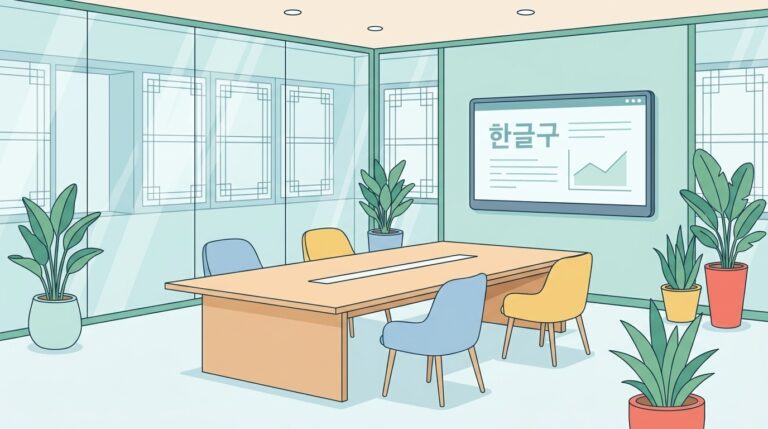
Phase 1: Welcome to the Korean Office!
안녕하세요! 매일한글 에디터입니다. (Hello! This is your Daily Hangul editor.)
Picture this: You are at your modern office in Gangnam, Seoul. Your manager asks you to set up an urgent team catch-up for 2 PM. You walk up to the admin desk or check the internal app, but your mind goes blank. How do you ask to reserve a conference room in polite, natural Korean without sounding like a translated textbook robot?
Many foreign professionals and interns in Korea panic when handling daily administrative tasks in Korean. Booking a meeting room sounds intimidating, but it actually relies on just a few simple, repeating patterns! Based on real feedback from international team members working in Seoul, this guide gives you the exact phrases, cultural nuances, and confidence you need to manage meeting rooms like a native teammate. Let’s make your Korean office life smooth and stress-free!
Phase 2: Core Expressions Deep Dive
1. 회의실 예약하고 싶은데요 (Hoe-ui-sil ye-yak-ha-go sip-eun-de-yo)
- Pronunciation: [hoe-ui-sil ye-yak-ha-go sip-eun-de-yo] (Sounds like: way-ee-seel yeh-yahk-hah-go seep-eun-day-yo)
- Meaning: Direct: “I want to reserve a meeting room…” | Nuance: “Hi, I’d like to book a meeting room, if possible.”
- K-Culture Moment: In office dramas like Misaeng or Start-Up, you often hear employees soft-launching requests with “~인데요 (-inde-yo)” to sound polite and indirect.
- Editor’s Insight: Ending a sentence with “~인데요” softens your tone. It gives the listener room to respond smoothly rather than sounding demand-like.
- Situation Spectrum: Casual 🚫 | Semi-formal ✅ | Formal ✅
- 🤔 Think About It: Why do you think Korean business culture prefers soft sentence endings over direct commands?
2. 몇 시에 예약할 수 있나요? (Myeot si-e ye-yak-hal su in-na-yo?)
- Pronunciation: [myeot si-e ye-yak-hal su in-na-yo] (Sounds like: myot see-eh yeh-yahk-hahl soo een-nah-yo)
- Meaning: Direct: “At what time can I reserve?” | Nuance: “What time slots are available for reservation?”
- K-Culture Moment: Used frequently when checking real-time schedules on shared team whiteboards or booking apps in tech startups.
- Editor’s Insight: Using “~ㄹ 수 있나요?” adds a gentle tone of checking possibility rather than demanding a time slot.
- Situation Spectrum: Casual 🚫 | Semi-formal ✅ | Formal ✅
- 🤔 Think About It: How does asking for availability in Korean compare to your native language’s polite forms?
3. 2시부터 3시까지 사용 가능할까요? (I-si-bu-teo sam-si-kka-ji sa-yong ga-neung-hal-kka-yo?)
- Pronunciation: [i-si-bu-teo sam-si-kka-ji sa-yong ga-neung-hal-kka-yo] (Sounds like: ee-see-boo-teo sahm-see-kkah-jee sah-yong gah-neung-hahl-kkah-yo)
- Meaning: Direct: “Is use possible from 2 to 3?” | Nuance: “Would it be possible to use it from 2 PM to 3 PM?”
- K-Culture Moment: Standard polite request used in corporate Slack chats or face-to-face admin requests.
- Editor’s Insight: “~가능할까요?” (Is it possible?) is the gold standard for polite workplace inquiries in Korea.
- Situation Spectrum: Casual 🚫 | Semi-formal ✅ | Formal ✅
- 🤔 Think About It: Notice how time ranges use “부터 (from)” and “까지 (until)”. Simple and clear!
Phase 3: Textbook Korean vs. Real Korean
Situation 1: Asking if a room is booked
- 📖 Textbook Korean: 회의실이 비어 있습니까? (Is the meeting room empty?)
- 🗣️ Real Korean: 혹시 회의실 지금 비어 있나요? (Is the meeting room open right now by any chance?)
- 💡 Why is it different? Adding “혹시 (by any chance)” softens the question dramatically, making you sound considerate and natural in a fast-paced office.
Situation 2: Confirming a booking
- 📖 Textbook Korean: 예약을 완료했습니다. (I completed the reservation.)
- 🗣️ Real Korean: 예약해 뒀습니다! (I’ve got it booked for us!)
- 💡 Why is it different? “~해 두다” indicates an action done in advance for future convenience, perfect for team collaboration.
Phase 4: K-Culture Deep Dive & Mannerisms
4-1. Nunchi (눈치) & Office Gestures
When requesting a room from an office manager or colleague, hold your hands neatly in front of you or make a gentle two-handed gesture toward the schedule screen. Avoid pointing with a single index finger! Making light eye contact accompanied by a slight head nod shows attentiveness and warmth.
4-2. Cultural Code: Shared Space Etiquette
In Korean corporate culture, leaving a meeting room spotless is crucial. Before leaving, wipe down whiteboards, push in chairs, and clear away paper cups. This reflects Jeong (공동체 의식 / care for the community), ensuring the next team enters a clean room without delay.
Phase 5: Real Roleplay Scenario
Setting: Office Admin Desk at a tech firm in Pangyo.
Characters: You (A2 Korean Learner) & Minji (Friendly Office Manager NPC).
- You: 안녕하세요! 회의실 예약하고 싶은데요. (🎭 Holding a laptop gently with both hands and smiling)
- Minji: 네, 안녕하세요! 몇 시에 필요하신가요?
- You: 2시부터 3시까지 사용 가능할까요? (🎭 Checking your phone calendar)
- Minji: 아, 2시에는 A회의실이 이미 예약되어 있어요. 3시는 어떠세요?
- You: 아, 그래요? 그럼 3시로 예약할 수 있나요? (🎭 Nodding softly with understanding)
- Minji: 네, 가능합니다! 몇 분이서 사용하시나요?
- You: 4명이서 사용할 거예요. (🎭 Holding up four fingers politely)
- Minji: 알겠습니다. B회의실로 3시에 예약 도와드렸습니다!
🔀 Interactive Choice Point
Minji asks if you need a projector. How do you respond?
– Choice A: 필요 없어요. (I don’t need it.)
– Choice B: 아, 빔프로젝터도 사용 가능할까요? (Ah, would it be possible to use the projector too?)
– Choice C: 모르겠는데요. (I don’t know.)
Feedback:
– Best (Choice B): Super polite and natural! Using “~도 사용 가능할까요?” gets you the equipment effortlessly.
– Bad (Choice A): A bit too blunt for an office setup. Prefer “괜찮습니다, 감사합니다!” (It’s fine, thank you!).
– Risk (Choice C): Sounds indifferent or unprepared for your meeting.
Phase 6: 10-Second Emotion Shadowing Drill
Practice reading these out loud with full emotion!
[😊 Soft & Polite]안녕하세요! / 회의실 예약하고 싶은데요.[🤔 Curious & Gentle]혹시 / 2시에 / 사용 가능할까요?[👍 Grateful & Bright]아, 감사합니다! / 3시로 부탁드릴게요!
Phase 7: K-Culture Mini Dictionary
- 회의실 (Hoe-ui-sil) | Meeting room / Conference room. Used daily in office communications.
- 예약 (Ye-yak) | Reservation / Booking. Used for rooms, restaurants, and tickets.
- 빔프로젝터 (Bim-pro-jek-teo) | Beam projector. Essential office vocabulary for presentations.
- 사용 시간 (Sa-yong si-gan) | Usage time / Duration of use. Helpful for scheduling windows.
Phase 8: Office Survival Kit
Survival Expressions TOP 3
- 몇 시가 비어 있나요? (Myeot si-ga bi-eo in-na-yo?) – What time is open?
- Pro Tip: Use when you have flexible meeting options.
- 예약 변경할 수 있을까요? (Ye-yak byeon-gyeong-hal su is-seul-kka-yo?) – Could I change the reservation?
- Pro Tip: Essential when schedule conflicts happen.
- 감사합니다, 잘 쓸게요! (Gam-sa-ham-ni-da, jal sseul-ge-yo!) – Thank you, we will use it well!
- Pro Tip: A warm sign-off as you collect the room key or confirmation.
Editor’s Travel & Work Note
When navigating Korean business environments or looking up locations, check the Naver Map App Download Page for real-time office navigation and local workplace amenities.
Phase 9: One Step Deeper
In Korean workplaces, communication is deeply rooted in mutual consideration and soft phrasings. Rather than stating demands directly, Korean speakers frequently use tentative endings like “~인데요” or questions like “~가능할까요?”. This gives the recipient space to adjust schedule constraints comfortably. Understanding this phrasing shows your team that you respect workplace harmony.
💬 Your Turn: Have you ever tried booking a room or restaurant in Korea? What expression was most helpful? Share your thoughts in the comments below!
Phase 10: FAQ & Common Mistakes
Q: Can I use “예약하고 싶어요” instead of “예약하고 싶은데요”?
A: Yes! “예약하고 싶어요” is grammatically correct. However, adding “~ㄴ데/인데요” sounds softer and more natural in a business context.
Q: What should I say if I need to cancel the booking?
A: You can say: “죄송하지만 회의실 예약 취소할 수 있을까요?” (I’m sorry, but could I cancel the meeting room reservation?).
Q: Is “회의실” the only word for meeting room?
A: You might also hear “미팅룸 (meeting room)” or “세미나실 (seminar room)” depending on company culture.
🚨 Common Mistakes Board
- Mistake 1: Saying “방 예약할게요” (I’m booking a room) -> Correct Action: Use “회의실” instead of “방” for offices.
- Mistake 2: Asking “너 몇 시에 비어?” to an office manager -> Correct Action: Always use polite endings like “몇 시에 가능할까요?”.
- Mistake 3: Forgetting to state group size -> Correct Action: Mention headcount early: “4명입니다” (It’s for 4 people).
Phase 11: Action Mission
- Bronze Mission: Read the 3 Core Expressions aloud 3 times today.
- Silver Mission: Write a mock text message reserving a meeting room for 2 PM and post it on your study social media.
- Gold Mission: Use “~사용 가능할까요?” in a real practice session with a native Korean tutor or colleague!
🎮 K-Culture Mission: Watch a scene from an office K-drama like Business Proposal or Misaeng, and listen for how characters ask for permissions using “~ㄹ까요?”.
Phase 12: Interactive Quiz Challenge
Test your knowledge with these quick questions!
Q1. How do you politely ask if 2 PM is available for a meeting room booking?
Click to reveal the answer
2시부터 사용 가능할까요? (Is it available from 2 o’clock?) – This uses the polite request form perfect for offices!
Q2. True or False: Leaving coffee cups and papers in the meeting room is acceptable if the next team is coming in immediately.
Click to reveal the answer
False! Cleaning up after your meeting is an important part of Korean office etiquette (Nunchi & Jeong).







