

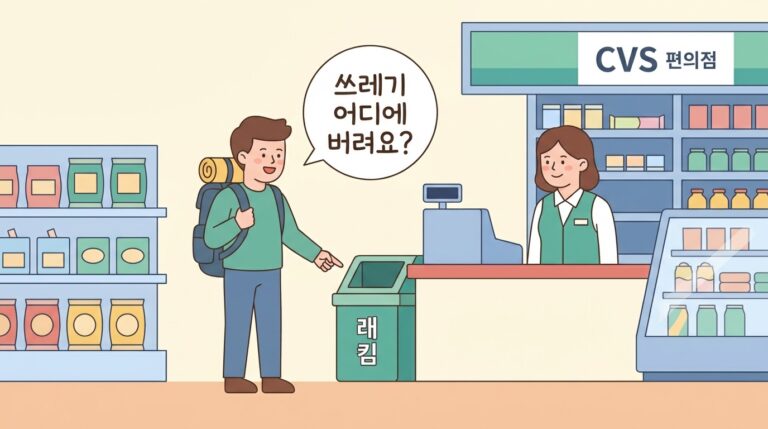
Don’t Hold onto Your Trash! How to Ask for Trash Cans in Korean Convenience Stores Like a Native
Phase 1: Empathy (스토리 몰입형 오프닝)
안녕하세요! 매일한글 에디터입니다.
Imagine this: You’ve just finished a delicious hot cup of Shin Ramyun and a spicy tuna triangular gimbap inside a brightly lit Korean convenience store like GS25 or CU. Your belly is full, but now you’re holding a messy ramen container, wooden chopsticks, and plastic wrapping. You step outside expecting to see a public street trash can, but… nothing! You walk one block, two blocks, but street trash bins are nowhere to be found.
This is one of the biggest culture shocks for travelers in Korea. Because public street trash cans were largely removed in major cities during the late 1990s to promote proper recycling, convenience stores are your ultimate oasis—not just for snacks, but for trash disposal!
However, many learners feel anxious about asking where to throw things away, worried they might sound rude or violate Korea’s strict waste separation rules. Based on feedback from hundreds of our intermediate learners who experienced this exact dilemma, this guide will give you the exact real-world phrases, polite cultural gestures, and confidence to clean up like a local without feeling awkward.
Phase 2: 핵심 표현 3선 심층 분석
1. 쓰레기통 어디에 있어요? (Sseuregitong eodie issoyo?)
- Pronunciation: [Ssuh-reh-gi-tong uh-di-eh iss-uh-yo?] (Think of ‘Ssuh’ like ‘su’ in ‘super’, ‘reh’ like ‘red’, ‘tong’ like ‘tongue’)
- Meaning: “Where is the trash can?” (Direct translation) / “Where can I find the trash bin around here?” (Natural nuance)
- K-Culture Moment: You see a character in a K-drama cleaning up their snack table at a local convenience store after a heart-to-heart midnight scene and turning to the cashier with this gentle question.
- Editor’s Insight: This is your gold-standard, versatile B1 sentence. It uses the polite ending
-요 (-yo), which strikes the perfect balance between respect and natural warmth. - Situation Spectrum:
- Casual (Friends): 쓰레기통 어디 있어? (⚠️)
- Semi-formal (Clerk/Strangers): 쓰레기통 어디에 있어요? (✅ Recommended)
- Formal (Official settings): 쓰레기통이 어디에 있습니까? (🚫 Too stiff for a store)
- 🤔 Think About It: In your home country, are public trash cans located everywhere on the street, or do people rely on private businesses to manage public waste?
2. 이거 버려도 돼요? (Igeo beoryeodo dwaeyo?)
- Pronunciation: [Ee-geo buh-ryuh-doh dwae-yo?]
- Meaning: “Can I throw this away?” (Direct) / “Is it okay if I throw this here?” (Natural nuance)
- K-Culture Moment: Handing an empty coffee cup or food tray to the store clerk when you aren’t sure if it belongs in their internal bin.
- Editor’s Insight: The grammar structure
-아/어도 돼요?(-a/eodo dwaeyo?) is a crucial B1 pattern used to ask for permission. Using it shows high cultural politeness because you are checking before making a mess. - Situation Spectrum:
- Casual: 이거 버려도 돼? (⚠️)
- Semi-formal: 이거 버려도 돼요? (✅ Recommended)
- Formal: 이것을 버려도 되겠습니까? (🚫 Overly polite for buying a snack)
- 🤔 Think About It: How does asking for permission change the impression you give to store staff in service-oriented societies?
3. 일반 쓰레기랑 분리수거함 어디에 있어요? (Ilban sseuregirang bunrisugeoham eodie issoyo?)
- Pronunciation: [Eel-ban ssuh-reh-gi-rang boon-ri-soo-guh-ham uh-di-eh iss-uh-yo?]
- Meaning: “Where are the general trash and recycling bins?”
- K-Culture Moment: Standing near the hot water station in a store with mixed items—plastic bottles, wooden chopsticks, and paper packaging.
- Editor’s Insight: Korean waste management distinguishes between ‘General Trash’ (일반 쓰레기) and ‘Recyclables’ (분리수거). Asking this specific question proves you understand Korean social responsibility!
- Situation Spectrum:
- Casual: 일반 쓰레기랑 분리수거함 어디 있어? (⚠️)
- Semi-formal: 일반 쓰레기랑 분리수거함 어디에 있어요? (✅ Recommended)
- Formal: 일반 쓰레기와 분리수거함이 어디에 있습니까? (⚠️ Formal setting only)
- 🤔 Think About It: Why do you think Korea places such a strong emphasis on precise recycling systems in public spaces?
Phase 3: 교과서 한국어 vs 진짜 한국어
Situation 1: Asking where the trash can is located
- 📖 교과서 한국어: “실례합니다. 쓰레기통이 어디에 있습니까?” (Excuse me. Where is the trash bin located?)
- 🗣️ 진짜 한국어: “저기요, 쓰레기통 어디 있어요?” (Excuse me, where’s the trash bin?)
- 💡 왜 다를까? Textbook Korean overuses the formal
-습니까ending and subject markers like-이/가. Native speakers omit markers in everyday speech and use soft저기요(excuse me) to get attention.
Situation 2: Asking if you can throw away trash brought from outside
- 📖 교과서 한국어: “이 물건을 여기에 버려도 괜찮습니까?”
- 🗣️ 진짜 한국어: “이것도 같이 버려도 돼요?”
- 💡 왜 다를까? Instead of using long dictionary words like
물건(object) or괜찮습니까(is it acceptable?), locals naturally contract words (이것을->이것도) and use the casual yet polite돼요?structure.
Phase 4: K-Culture 딥다이브 & 비언어적 매너
4-1. 눈치 (Nunchi) & Non-verbal Gestures
When asking store clerks for help in Korea, your posture speaks volumes before you even say a word:
1. Two-Handed Courtesy: Hold your trash bundled neatly with two hands, or point toward the waste area with an open palm rather than a single finger.
2. The Micro-Bow: Combine your question with a subtle nod of the head (about 15 degrees). This instantly shows respect without feeling overly dramatic.
3. Eye Contact Timing: Make brief eye contact to get attention, then glance gently down at the item you are holding so the clerk understands your intent immediately.
4-2. Cultural Code: The Art of 분리수거 (Bunrisugeo)
In Korean convenience stores, trash bins are usually tucked under the food prep bar or right beside the front exit. They are strictly divided into:
* 일반 쓰레기 (General Waste): Used napkins, wooden chopsticks, plastic wrap.
* 플라스틱 / 캔 / 페트 (Plastic/Cans/PET): Clean drink bottles and containers.
* 음식물 쓰레기 (Food Waste): Leftover broth or food scraps (often a designated bucket near the hot water machine).
Phase 5: 실전 롤플레이 시나리오
Setting: A bustling GS25 convenience store near Hongdae Station at 10 PM. You just finished hot cup noodles at the window counter.
NPC Character: Min-jun (Store Clerk, mid-20s, friendly but busy stocking items).
- Turn 1 (You): 저기요, 혹시 쓰레기통 어디에 있어요? (Jeogiyo, hoksi sseuregitong eodie issoyo? / Excuse me, by any chance where is the trash can?)
- Turn 2 (Min-jun):
🎭 Points under the microwave counter with a warm smile아, 쓰레기통은 저기 정수기 바로 아래쪽에 있어요! (A, sseuregitongeun jeogi jeongsugi baro araejjoge iss-eo-yo! / Ah, the trash bin is right below the water purifier over there!) - Turn 3 (You): 아, 감사합니다! 그런데 국물도 여기에 버려요? (A, gamsahamnida! Geronde gungmuldo yeogie beoryeoyo? / Ah, thank you! But do I throw the soup leftover here too?)
- Turn 4 (Min-jun):
🎭 Shakes head gently and points to a small bucket국물은 그 옆에 있는 통에 따라 버리시고, 용기는 플라스틱에 버려주세요. (Gungmureun geu yeope inneun tonge ttara beorisigo, yonggineun peurasutige beoryeojuseyo. / Pour the broth into that bucket next to it, and put the container in plastic recycling.) - Turn 5 (You): 아, 그렇군요! 나무젓가락은 일반 쓰레기 맞죠? (A, geureokgunyo! Namujeotgarageun ilban sseuregi matjo? / Ah, I see! Wooden chopsticks go to general trash, right?)
- Turn 6 (Min-jun):
🎭 Nods vigorously네, 맞아요! 잘 아시네요! (Ne, majayo! Jal asineyo! / Yes, that’s right! You know it well!) - Turn 7 (You): 친절하게 알려주셔서 감사합니다! 수고하세요! (Chinjeolhage allyeojusyeoseo gamsahamnida! Sugohaseyo! / Thank you for kindly letting me know! Keep up the good work!)
- Turn 8 (Min-jun):
🎭 Wave softly네, 안녕히 가세요! (Ne, annyeonghi gaseyo! / Yes, goodbye!)
🔀 Interactive Branching Choice
What would you do if you also had an empty milk carton bought from outside?
* Option A: Throw it silently into their store plastic bin without asking.
* Option B: Ask politely: “외부 쓰레기인데 이것도 같이 버려도 돼요?”
* Option C: Leave it on top of the counter for the clerk to handle.
Feedback:
* Option A (Risk): Convenience stores sometimes face issues with outside trash dumping. While small items are okay, doing it silently might trigger annoyance.
* Option B (Best): Perfect! Asking permission for outside trash demonstrates top-tier Korean etiquette.
* Option C (Bad): Leaving unhandled trash on counters without asking is considered extremely disrespectful in Korea.
Phase 6: 10초 감정 섀도잉 드릴
Repeat these sentences out loud, mimicking the tone and emotional cues provided!
[😊 POLITE & INQUIRING]
저기요 / 혹시 쓰레기통 / 어디에 있어요?
(Jeogiyo / hoksi sseuregitong / eodie issoyo?)-
[🤔 CURIOUS & CAUTIOUS]
이거 / 일반 쓰레기에 / 버리면 돼요?
(Igeo / ilban sseuregie / beoryeomyun dwaeyo?) -
[🙏 APPRECIATIVE & BRIGHT]
감사합니다! / 정돈하고 / 갈게요!
(Gamsahamnida! / Jeongdonhago / galgeyo!)
Phase 7: K-Culture 미니 사전 (핵심 키워드 4개)
- 분리수거 (Bun-ri-su-geo) | Waste Separation / Recycling | The systematic process of separating garbage into plastics, glass, paper, and vinyl.
- 일반 쓰레기 (Il-ban Sseu-re-gi) | General Waste | Non-recyclable daily waste that goes into official paid trash bags (Jongryangje bags).
- 음식물 쓰레기 (Eum-sik-mul Sseu-re-gi) | Food Waste | Organic food scraps collected separately to be processed into compost/feed.
- 수고하세요 (Su-go-ha-se-yo) | Keep up the good work | A common friendly parting phrase used when leaving stores or ending service interactions.
Phase 8: 여행자를 위한 생존 키트
Top 3 Survival Phrases
- 국물 버리는 데 어디예요? (Gungmul beorineun de eodiyeyo?) – Where do I dump the liquid soup?
- 이거 닦을 휴지 있어요? (Igeo dakk-eul hyuji issoyo?) – Do you have tissue to wipe this table?
- 봉투 필요 없어요. (Bongtu piryo opsoyo.) – I don’t need a plastic bag.
Editor’s Travel Note
When traveling around Seoul or Busan, finding your way around street facilities can be tricky because standard Google Maps lacks turn-by-turn walking directions in Korea. Make sure to complete your Naver Map App Download before navigating local convenience stores and transportation hubs!
Phase 9: “한 발 더 깊이” (생각 질문)
Why are public trash cans so scarce on Korean streets? Following the 1995 implementation of the Volume-based Waste Fee System (종량제), local governments drastically reduced street trash cans to prevent illegal dumping of household waste in public bins. This shifted urban life dramatically, making convenience stores essential community centers where civic responsibility, hospitality, and daily routines intersect.
💬 Your Turn: How does waste disposal work in public areas in your country? Have you ever felt lost trying to throw away trash while traveling abroad? Share your thoughts in the comments below!
Phase 10: FAQ & 오해 방지
Q: Can I throw away trash that I brought from outside into a convenience store trash bin?
A: Small items like a drink can or tissue you used on the way are usually fine if you buy something at the store. However, dumping whole bags of personal household garbage is illegal and heavily fined.
Q: What should I do if I can’t find a food waste bucket for my cup noodle broth?
A: Ask the clerk gently: “국물 어디에 버려요?” (Where do I pour the broth?). They will point you to a dedicated sink or fluid container behind or near the hot water bar.
Q: Is it okay to leave my trash on the eating table inside the store?
A: No! Korean convenience store eating zones are self-serve. You are expected to wipe down your table counter and dispose of your items in the designated recycling bins.
🚨 흔한 실수 (Common Mistakes) TOP 3
- Throwing unemptied soup containers directly into plastic bins: Always drain broth into the food waste sink first!
- Using formal
-습니까forms with store staff: Stick to comfortable, polite standard Korean (-요). - Throwing wooden chopsticks into plastic recycling: Chopsticks are wooden and go to 일반 쓰레기 (General Waste).
Phase 11: 액션 미션 & 참여 유도
- 🥉 Bronze Mission: Practice saying “쓰레기통 어디에 있어요?” 3 times out loud with natural inflection!
- 🥈 Silver Mission: Record yourself practicing the Phase 6 Shadowing Drill and share it on Instagram tagging
@DailyHangul! - 🥇 Gold Mission: Visit a local Korean convenience store on your next trip and successfully dispose of your food packaging using pure Korean!
🎮 K-Culture Mission: Watch a scene in a slice-of-life K-drama (like Work Later, Drink Now or Extraordinary Attorney Woo) set in a convenience store. Spot where the waste disposal station is located!
Phase 12: 인터랙티브 퀴즈 챌린지
Q1. What is the correct Korean term for general non-recyclable waste?
1) 분리수거
2) 음식물 쓰레기
3) 일반 쓰레기
4) 수고하세요
🔍 Click to reveal the Answer & Explanation!
Answer: 3) 일반 쓰레기 (Ilban Sseuregi)
Explanation: 일반 쓰레기 refers to general garbage like napkins and wooden chopsticks that cannot be recycled.
Q2. True or False: You should leave your empty noodle cups on the counter for store clerks to clean up.
🔍 Click to reveal the Answer & Explanation!
Answer: False!
Explanation: Convenience store eating spaces in Korea are self-service. Customers clean up after themselves using the designated sorting bins.







