

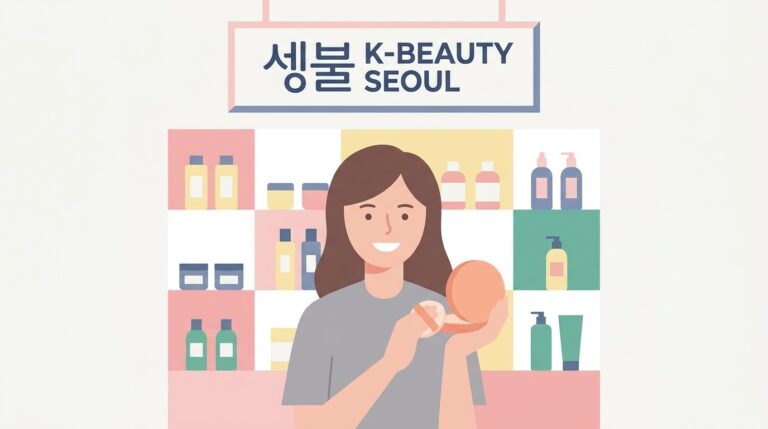
How to Find Your Perfect Korean Foundation Shade at Olive Young Without Panic
Phase 1: Empathy (Storytelling Opening)
안녕하세요! I’m your Daily Hangul editor!
Imagine this: You are standing inside a bustling Olive Young store in Myeongdong, Seoul. Bright lights illuminate glowing displays filled with sleek cushion compacts. You want to buy that viral Korean cushion foundation everyone on TikTok is talking about. But as you pick up a golden compact, you notice numbers like #19, #21, and #23 instead of names like ‘Ivory’ or ‘Buff’.
Suddenly, a friendly staff member approaches you with a warm smile and asks if you need help. Your mind goes completely blank! Is #21 too bright for you? Is #23 too dark? How do you ask them for your shade without relying on awkward hand gestures or pointing silently?
If you have ever felt nervous shopping for cosmetics in Korea, you are not alone! Based on real feedback from over 500 K-beauty loving learners in our Daily Hangul community, asking for foundation shades is one of the most common A2-level shopping challenges. But don’t worry! By the end of this short 3-minute guide, you’ll feel completely confident walking into any K-beauty store in Seoul and finding your dream shade like a local.
Phase 2: 3 Core Expressions Deep Dive
1. 몇 호예요? (Myeot ho-yeyo?)
- Pronunciation: Myeot ho-yeyo? (Sounds like “Mutt-ho-yeh-yo?”)
- Meaning: Direct: “What number is it?” | Natural: “What shade is this?”
- K-Culture Moment: Seen frequently in K-beauty Youtube GRWM (Get Ready With Me) vlogs when creators hold up compacts to show their viewers.
- Editor’s Insight: In Korea, cosmetic shades are expressed using 호 (ho), which means ‘number’. Instead of color names like ‘Vanilla’ or ‘Beige’, Korea uses standard shade numbers.
- Situation Spectrum: Casual ⚠️ | Semi-formal ✅ | Formal ✅
- 🤔 Think About It: Why do you think Korea uses standardized shade numbers (#21, #23) across different brands instead of descriptive color names?
2. 저한테 무슨 호수가 맞아 보여요? (Jeohante museun hosuga maja boyeoyo?)
- Pronunciation: Jeo-han-te moo-seun ho-soo-ga ma-ja bo-yeo-yo?
- Meaning: Direct: “To me, what shade number looks right?” | Natural: “Which shade do you think suits my skin tone?”
- K-Culture Moment: Used when seeking professional guidance from beauty consultants at K-beauty pop-up stores in Seongsu-dong.
- Editor’s Insight: Korean service staff love giving personalized recommendations! Asking this phrase shows trust in their expert judgment.
- Situation Spectrum: Casual 🚫 | Semi-formal ✅ | Formal ✅
- 🤔 Think About It: In your home country, do beauty advisors recommend shades directly, or do they expect you to choose independently?
3. 테스터 써봐도 돼요? (Teseuteo sseobwado dwaeyo?)
- Pronunciation: Te-seu-teo sseo-bwa-do dwae-yo? (Sounds like “Tester sir-bwa-do dway-yo?”)
- Meaning: Direct: “Is it okay if I try using the tester?” | Natural: “Can I try the tester?”
- K-Culture Moment: Asking staff before trying product samples on your jawline or wrist.
- Editor’s Insight: While testers are free to use, asking politely first reflects great manners and usually prompts staff to offer you hygienic cotton swabs or pads!
- Situation Spectrum: Casual ⚠️ | Semi-formal ✅ | Formal ✅
- 🤔 Think About It: Is testing cosmetics directly on your skin freely allowed and hygienic in your country’s stores?
Phase 3: Textbook Korean vs. Real Korean
Situation 1: Asking which shade fits you
* 📖 Textbook Korean: 어떤 파운데이션 호수가 저에게 어울립니까? (Eotteon paundeisyeon hosuga jeoege eoullimnikka?)
* 🗣️ Real Korean: 몇 호가 잘 맞을까요? (Myeot hoga jal majeulkkayo?)
* 💡 Why? Formal textbook endings like -ㅂ니까? sound stiff in everyday shops. Real Koreans prefer soft, conversational question endings like -ㄹ까요? (Shall it / might it).
Situation 2: Asking to test a product on your face
* 📖 Textbook Korean: 이 파운데이션을 제 피부에 시험해 보고 싶습니다. (I paundeisyeoneul je pibue siheomhae bogo sipseumnida.)
* 🗣️ Real Korean: 이거 얼굴에 발라봐도 돼요? (Igeo eolgure ballabwado dwaeyo?)
* 💡 Why? Native speakers use simple, vivid verbs like 발라보다 (to try applying/smearing) rather than abstract verbs like 시험하다 (to test).
Phase 4: K-Culture Deep Dive & Non-Verbal Etiquette
4-1. Nunchi (눈치) & Gestures
When asking for a foundation shade, lightly point or gently tap your jawline (턱선) with your index finger while maintaining polite eye contact.
* Etiquette Tip: Never apply testers directly from the bottle to your face using your fingers. Look around the counter for mini disposable spatulas, cotton pads, or Q-tips provided by the store!
4-2. Culture Code: The Korean Shade System & Personal Color
In Korea, base makeup revolves heavily around two primary shades: #21 (21호 – Light Beige) and #23 (23호 – Natural Beige). Recently, shade #19 (Very Light) and #25 (Warm Medium) have become popular too.
Furthermore, Korean beauty culture is deeply invested in Personal Color (퍼스널 컬러) analysis—dividing shades into Warm Tone (웜톤) and Cool Tone (쿨톤). If a shade #21 has a pink undertone, it’s called Cool 21; if yellow-based, it’s Warm 21!
Phase 5: Real-Life Roleplay Scenario
Setting: Olive Young Store in Hongdae
Characters: You (Customer) & Jieun (Friendly K-Beauty Staff NPC)
- Staff (Jieun): 안녕하세요! 도와드릴까요?
(Annyeonghaseyo! Dowadreilkkayo?)
🎭 Smiles warmly while holding a hand basket
“Hello! May I help you?” -
You: 네, 이 쿠션 파운데이션 몇 호예요?
(Ne, i kusyeon paundeisyeon myeot ho-yeyo?)
🎭 Points at a cushion compact display
“Yes, what shade is this cushion foundation?” -
Staff (Jieun): 이거 21호예요. 고객님 피부에 잘 맞을 것 같아요.
(Igeo isipsil-ho-yeyo. Gogaengnim pibue jal majeul geot gat-a-yo.)
🎭 Gently tilts her head while checking your skin tone
“This is Shade #21. I think it will fit your skin well.” -
You: 저한테 21호가 안 밝을까요?
(Jeohante isipsil-hoga an balgeulllkayo?)
🎭 Touches jawline hesitantly
“Won’t Shade #21 be too bright for me?” -
Staff (Jieun): 그럼 23호랑 같이 턱에 발라볼까요?
(Geureom isipsam-horang gachi teoge ballabolkkayo?)
🎭 Picks up a disposable cotton swab
“Then shall we try applying #23 together on your jawline?” -
You: 네! 테스터 써봐도 돼요?
(Ne! Teseuteo sseobwado dwaeyo?)
🎭 Nods happily
“Yes! Is it okay if I try the tester?” -
Staff (Jieun): 그럼요! 여기 솜으로 턱쪽에 발라보세요.
(Geureomyo! Yeogi someuro teok-jjoge ballaboseyo.)
🎭 Hands you a cotton pad with a small dab of foundation
“Of course! Apply it here on your jaw with this cotton pad.” -
You: 아, 23호가 자연스럽네요! 이걸로 주세요.
(A, isipsam-hoga jayeonseureopneyeo! Igeollo juseyo.)
🎭 Gives a bright smile
“Ah, #23 looks natural! I’ll take this one, please.”
🔀 Interactive Branching Choice
After trying shade #21 and feeling it might be slightly too light, what do you say?
- Choice A: “23호도 발라봐도 돼요?” (Can I try shade #23 as well?)
- Choice B: “너무 하얘요! 안 사요!” (Too white! I won’t buy it!)
- Choice C: Point at #23 and say nothing.
[Feedback Matrix]
- Choice A (BEST): ✅ PERFECT! Extremely polite and clear. Staff will happily swatch #23 for you.
- Choice B (BAD): 🚫 TOO BLUNT! Sounds aggressive and rude in Korean service culture.
- Choice C (RISK): ⚠️ CONFUSING. Staff might not understand whether you want to test it or buy it.
Phase 6: 10-Second Emotion Shadowing Drill
Practice saying these lines with pitch and emotion! The / symbol indicates a natural pause.
[😊 Friendly & Curious]
이거 / 몇 호예요?
(Igeo / myeot ho-yeyo?)-
[🥺 Polite & Seeking Help]
저한테 / 무슨 호수가 / 잘 맞을까요?
(Jeohante / museun hosuga / jal majeulkkayo?) -
[✨ Bright & Eager]
턱쪽에 / 한번 / 발라봐도 돼요?
(Teok-jjoge / hanbeon / ballabwado dwaeyo?)
Phase 7: K-Culture Mini Dictionary
- 쿠션 (Kusyeon) | Cushion Foundation | The iconic liquid foundation soaked in a sponge compact, invented in Korea!
- 호수 (Hosu) | Shade Number | The standardized numerical system (#19, #21, #23) used for makeup tone depth.
- 퍼스널 컬러 (Peoseoneol Keolleo) | Personal Color | The viral beauty trend in Korea analyzing personal undertones (Spring Warm, Summer Cool, etc.).
- 착색 (Chaksaek) | Staining / Pigmentation | Refers to how long cosmetic pigments stay on the skin after application.
Phase 8: Traveler’s Survival Kit
TOP 3 Survival Phrases
- 21호 있어요? (Isipsil-ho isseoyo?) – Do you have shade #21?
Pro Tip: Numbers for foundation shades are read using Sino-Korean numbers (21 = 이십일 I-sip-il). - 너무 어둡나요? (Neomu eodeumnayo?) – Is it too dark?
Pro Tip: Use this if you are worried a shade might look dull on your skin. - 추천해 주세요. (Chucheonhae juseyo.) – Please give me a recommendation.
Pro Tip: The ultimate magic phrase when you are overwhelmed by options!
Editor’s Travel Note
Before heading out for your K-beauty haul, make sure you download the Naver Map App to quickly locate nearby major Olive Young flagships. Remember to keep your passport handy—most major K-beauty shops offer immediate tax refunds at the register for purchases over 15,000 KRW!
Phase 9: “One Step Deeper” (Humanities Essay)
In modern Korean beauty culture, foundation is not meant to create a mask; it aims to achieve 자연스러운 피부 표현 (natural-looking skin expression). When you ask store staff for shade recommendations in Korea, you enter a culture that values hospitality through attentive service. Korean beauty consultants view matching your tone as a collaborative creative process rather than just a quick transaction.
💬 Your Turn: What foundation shade system does your country use, and do you prefer light brightening coverage or natural coverage? Let us know in the comments below!
Phase 10: FAQ & Common Mistakes
Q: How do I say shade numbers like 21 and 23 in Korean?
A: You must use Sino-Korean numbers followed by 호 (ho). 21 is 이십일호 (I-sip-il ho) and 23 is 이십삼호 (I-sip-sam ho).
Q: Is shade #21 identical across all Korean cosmetic brands?
A: Not always! A #21 in Brand A might lean pinkish (Cool), while #21 in Brand B might lean yellowish (Warm). Always ask to test on your jawline!
Q: Can I ask for free samples at K-beauty stores?
A: Yes! When paying at the register, politely ask: “샘플 좀 주실 수 있나요?” (Saemple jom jusil su innayo? – Could you give me a few samples?).
🚨 Common Mistakes Warning Board
- ❌ Mistake 1: Reading shade #21 using Native Korean numbers (“스물하나호” Seumul-hana ho).
👉 Correct Action: Always use Sino-Korean numbers: 이십일호 (I-sip-il ho). - ❌ Mistake 2: Asking for “Color” (컬러) when referring to foundation depth.
👉 Correct Action: Use 호수 (hosu) or 호 (ho) for foundation shade depth. - ❌ Mistake 3: Applying tester cushions directly onto your face with the shared puff.
👉 Correct Action: Use disposable cotton pads or Q-tips provided on the display shelf.
Phase 11: Action Mission & Engagement
- 🥉 Bronze Mission: Practice saying “21호 있어요?” out loud 3 times right now!
- 🥈 Silver Mission: Snap a photo of your favorite cushion foundation and post it on social media with the hashtag
#DailyHangul_Kbeauty! - 🥇 Gold Mission: Visit a local Korean cosmetics market or online store, and identify which shade (#21 or #23) suits your skin tone best using Korean phrases!
🎮 K-Culture Mission: Watch a YouTube K-beauty GRWM video today and leave a comment when you spot the word 호수 or 몇 호!
Phase 12: Interactive Quiz Challenge
Quiz 1 (Fill in the blank):
“What shade is this?” in Korean is “이거 몇 [ ____ ]예요?”
Click to reveal Answer & Explanation!
- Answer: 호 (or 호수)
- Explanation: In Korean makeup shopping, 호 (ho) is used to indicate shade numbers (e.g., 몇 호예요?).
Quiz 2 (True or False):
In Korean cosmetic foundation standards, shade #21 is darker than shade #23.
Click to reveal Answer & Explanation!
- Answer: FALSE
- Explanation: Standard Korean shade numbering goes lighter to darker. Shade #21 (Light Beige) is brighter/lighter than Shade #23 (Natural Beige).







