

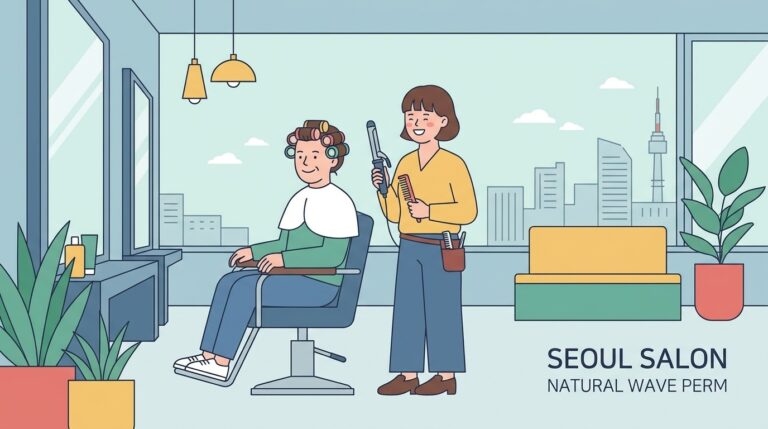
How to Ask for a Perm at a Korean Hair Salon Without Panic
Phase 1: Empathy Opening
안녕하세요! This is your Daily Hangul editor!
Picture this: You are standing outside a stylish, neon-lit hair salon in Hongdae or Gangnam. Through the glass, you see stylish people sipping iced coffees while getting effortless, K-drama aesthetic wave hairstyles. You desperately want those gorgeous, natural Korean soft waves—the iconic gwang-mo-bae look! You push open the door, step inside, and the designer smiles warmly: “안녕하세요! 어떤 스타일 원하세요?” (Hello! What style do you want?)
Suddenly, panic sets in. What if you say the wrong word and walk out looking like you got electrocuted, or end up with tight 1980s ajumma curls?
Don’t worry, my friend! You are not alone. Almost every foreigner in Korea fears getting a haircut or perm due to the language barrier. But getting a perm in Korea is actually one of the absolute best travel luxury experiences you can have! Based on real student feedback and years of living in Seoul, I’m going to teach you the exact, foolproof A1 Korean phrases you need to walk into any Korean salon with confidence and walk out looking like a K-drama star.
Phase 2: Key Expressions Deep Dive
1. 파마 하고 싶어요. (Pama hago sipeoyo.)
- Pronunciation: pah-mah hah-goh shee-peoh-yoh (Sounds like “Pa-ma” + “ha-go” + “ship-oh-yo”)
- Meaning: Literal: “I want to do a perm.” / Nuance: “I would like to get a perm, please.”
- K-Culture Moment: You’ll hear idols and actors say this in reality shows right before an exciting comeback hair transformation.
- Editor’s Insight: “파마” comes from “permanent wave”. In English, you get a perm, but in Korean, you do (하다) a perm. Combining it with “~하고 싶어요” (I want to do…) creates the ultimate beginner phrase for salon requests.
- Situation Spectrum: Casual: ⚠️ / Semi-formal: ✅ / Formal: ✅
- 🤔 Think About It: In English hair salons, we use passive verbs (“get my hair done”), but Koreans use active verbs (“do hair”). Why do you think Korean culture views hairstyling as an active process?
2. 자연스럽게 해주세요. (Jayeonseuroepge hae-juseyo.)
- Pronunciation: jah-yeon-seu-reop-ge hae-joo-seh-yo
- Meaning: Literal: “Please do it naturally.” / Nuance: “Please keep the curls loose and natural.”
- K-Culture Moment: This is the secret mantra used by K-beauty lovers to avoid overly tight curls.
- Editor’s Insight: “자연스럽게” (naturally) + “해주세요” (please do it for me). This is your ultimate safety phrase at any Korean hair salon!
- Situation Spectrum: Casual: ⚠️ / Semi-formal: ✅ / Formal: ✅
- 🤔 Think About It: Natural beauty is highly valued in modern K-beauty aesthetics. How does this concept of effortless beauty shape everyday Korean speech?
3. 얼마나 걸려요? (Eolmana geollyeoyo?)
- Pronunciation: eol-mah-nah geol-ryeo-yoh
- Meaning: Literal: “How much time takes?” / Nuance: “How long will it take?”
- K-Culture Moment: Asked while sitting comfortably in the salon chair sipping a complimentary iced Americano.
- Editor’s Insight: Korean perms are thorough and multi-stepped. Asking this helps you plan your next K-food adventure without feeling rushed!
- Situation Spectrum: Casual: ⚠️ / Semi-formal: ✅ / Formal: ✅
- 🤔 Think About It: Korea is famous for its fast-paced Pali-pali (quick quick) culture. Knowing how long a process takes builds mutual respect between you and the designer.
Phase 3: Textbook Korean vs Real Korean
Situation 1: Expressing your perm desire
- 📖 Textbook Korean: 저는 파마를 받고 싶습니다. (Jeoneun pamareul batgo sipseumnida.)
- 🗣️ Real Korean: 파마 하고 싶어요. (Pama hago sipeoyo.)
- 💡 Why is it different?: Textbook formulas are overly formal for salon consultations. The polite -yo ending strikes the perfect balance of friendliness and respect.
Situation 2: Showing your dream hairstyle photo
- 📖 Textbook Korean: 이 사진과 똑같이 만들어 주십시오. (I sajin-gwa ttokgachi mandeureo jusipsio.)
- 🗣️ Real Korean: 이 사진처럼 해주세요. (I sajin-cheoreom hae-juseyo.)
- 💡 Why is it different?: Real Korean speakers use the simple pattern “[Object] + 처럼 해주세요” (Please do it like this) when showing photos to hair stylists.
Phase 4: K-Culture Deep Dive & Non-verbal Manners
4-1. Nunchi & Gesture Guide
- The Photo Reveal: Always have 2-3 photos saved on your phone. Hold your phone with both hands and slightly tilt it toward your designer while saying “이 사진처럼 해주세요”.
- The Beverage Bow: When the staff brings you a complimentary drink and snack tray, nod your head gently and say “감사합니다” (Gamsahamnida).
4-2. Culture Code: The Pampered K-Salon Experience
Korean hair salons are renowned worldwide for luxury hospitality. Getting a perm in Korea isn’t just about hair—it includes an amazing scalp massage during shampooing, snacks, magazines, and heating pads for your stomach. Don’t be surprised when they give you a custom salon gown to wear over your clothes!
Phase 5: Real-Life Roleplay Scenario
Setting: A chic hair salon in Hongdae. Stylist Minji approaches you with a friendly smile.
- Stylist: 안녕하세요! 어떤 스타일 원하세요?
(Annyeonghaseyo! Eotdeon seutail wonhaseyo? / Hello! What style would you like today?)
🎭 Action: Smiling and handing you a comfortable salon gown. -
You: 안녕하세요! 저 파마 하고 싶어요.
(Annyeonghaseyo! Jeo pama hago sipeoyo. / Hello! I want to get a perm.)
🎭 Action: Lightly pointing to your hair with a warm smile. -
Stylist: 아, 파마요! 생각해 두신 스타일 있으세요?
(A, pamayo! Saenggakhae dusin seutail isseuseyo? / Ah, a perm! Do you have a style in mind?)
🎭 Action: Tilting head attentively to listen. -
You: 네, 이 사진처럼 해주세요.
(Ne, i sajin-cheoreom hae-juseyo. / Yes, please make it like this photo.)
🎭 Action: Showing your saved K-drama wave photo on your phone. -
Stylist: 이 스타일은 자연스러운 굵은 롤 파마예요.
(I seutaireun jayeonseuroeun gulgeun rol pamayeyo. / This style uses thick rollers for natural waves.)
🎭 Action: Gently checking your hair texture. -
You: 네, 자연스럽게 해주세요! 얼마나 걸려요?
(Ne, jayeonseuroepge hae-juseyo! Eolmana geollyeoyo? / Yes, please keep it natural! How long does it take?)
🎭 Action: Looking curious and leaning in slightly. -
Stylist: 두 시간 정도 걸려요. 음료수 드릴까요?
(Du sigan jeongdo geollyeoyo. Eumryosu deurilkolayo? / It takes about two hours. Would you like a drink?)
🎭 Action: Pointing to the salon’s complimentary drink menu. -
You: 네, 아이스 아메리카노 주세요. 감사합니다!
(Ne, aiseu amerakano juseyo. Gamsahamnida! / Yes, iced Americano please. Thank you!)
🎭 Action: Nodding politely with a big smile.
🔀 Interactive Branching Choice
What will you say when the designer asks what style you want?
* Choice A: Show a photo and say “자연스럽게 해주세요.” (Make it natural.)
* Choice B: Say nothing and just point to your head, saying “파마!”
* Choice C: Speak complex textbook sentence: “저는 파마 치료를 요구합니다.”
Feedback:
* Choice A (BEST ✅): Perfect! Your designer immediately understands your vision and creates gorgeous loose K-style waves.
* Choice B (RISK ⚠️): Danger! Without specifying “natural”, you might end up with tight retro curls.
* Choice C (BAD 🚫): Incorrect grammar!
Frequently Asked Questions (FAQ)
Q: What does "파마 하고 싶어요. (Pama hago sipeoyo.)" mean in Korean and how do you pronounce it?
A: In Korean, "파마 하고 싶어요. (Pama hago sipeoyo.)" is pronounced [pah-mah hah-goh shee-peoh-yoh (Sounds like "Pa-ma" + "ha-go" + "ship-oh-yo"] and means: Literal: "I want to do a perm." / Nuance: "I would like to get a perm, please."
Q: What does "자연스럽게 해주세요. (Jayeonseuroepge hae-juseyo.)" mean in Korean and how do you pronounce it?
A: In Korean, "자연스럽게 해주세요. (Jayeonseuroepge hae-juseyo.)" is pronounced [jah-yeon-seu-reop-ge hae-joo-seh-yo] and means: Literal: "Please do it naturally." / Nuance: "Please keep the curls loose and natural."
Q: What does "얼마나 걸려요? (Eolmana geollyeoyo?)" mean in Korean and how do you pronounce it?
A: In Korean, "얼마나 걸려요? (Eolmana geollyeoyo?)" is pronounced [eol-mah-nah geol-ryeo-yoh] and means: Literal: "How much time takes?" / Nuance: "How long will it take?"







