

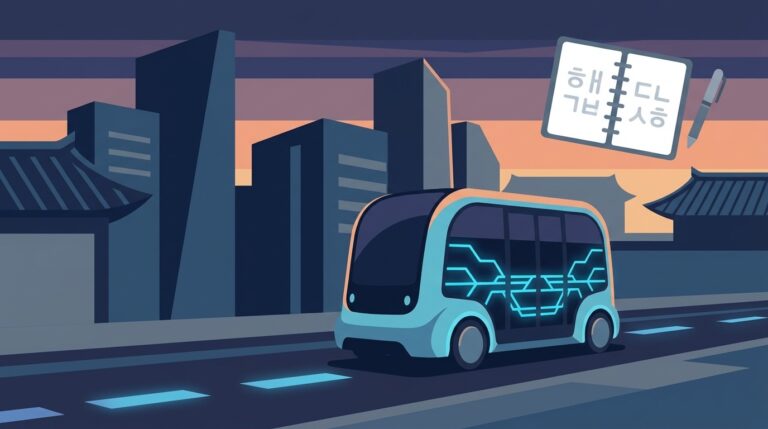
Debating Autonomous Cars in Korean: Master C2-Level Tech Discussions Like a Native
안녕하세요! 매일한글 에디터입니다. Welcome back to another high-level Korean deep dive with Daily Hangul!
Imagine sitting in a sleek, futuristic self-driving shuttle navigating the bustling streets of Sangam-dong or Pangyo Techno Valley in Seoul. The steering wheel turns effortlessly on its own. Your Korean colleague turns to you and asks, “자율주행차가 보행자를 감지하지 못해 사고가 난다면, 그 책임은 운전자에게 있을까요, 아니면 제조사에 있을까요?” (If an autonomous car fails to detect a pedestrian and causes an accident, does the liability rest with the driver or the manufacturer?)
At the C2 (Advanced) level, conversation moves far beyond ordering meals or asking for directions. You are expected to articulate complex stances, dissect ethical dilemmas, analyze regulatory frameworks, and critique cutting-edge innovations with linguistic sophistication. Today, we tackle the nuanced vocabulary surrounding autonomous vehicle test drives and the hot-button issue of safety controversies.
This guide is constructed from real-world debates among Korean tech leaders, legal analysts, and tech-savvy commuters. By mastering these expressions, you will gain the ultimate confidence to lead intellectual discussions in Seoul’s dynamic tech ecosystem!
Phase 2: Core Expressions Deep Dive
1. 안전성을 담보하다 (Anjeonseong-eul dambohada)
- Pronunciation: [An-jeon-seong-eul dam-bo-ha-da] (Think of dam-bo as “holding equity/guarantee” like in financial collateral).
- Meaning: Literally “to hold safety as collateral”; functionally means “to guarantee or secure safety.”
- K-Culture Moment: Frequently heard on Korean news programs like KBS News 9 or tech panel talk shows when discussing government approval for Level 4 autonomous vehicles.
- Editor’s Insight: While ‘안전을 보장하다’ (guarantee safety) is common, ‘담보하다’ elevates your speech to formal debate or executive boardroom levels. It implies robust evidence and systematic mechanisms.
- Situation Spectrum: Casual 🚫 | Semi-formal ⚠️ | Formal ✅
- 🤔 Think About It: Does your native language separate basic “safety guarantees” from institutional/legal assurances? How does using formal legal-economic terms change your rhetorical authority?
2. 책임 소재를 가리다 (Chaegim sojae-reul garida)
- Pronunciation: [Chae-gim so-jae-reul ga-ri-da] (So-jae means whereabouts/location; garida means to discern or sort out).
- Meaning: To determine where liability lies / To assign responsibility.
- K-Culture Moment: Used extensively in Korean legal K-dramas (like Extraordinary Attorney Woo) or tech op-eds when discussing AI algorithmic errors.
- Editor’s Insight: ‘소재’ literally means location. You are visually “locating where liability sits.” This is a favorite expression of Korean lawyers and tech journalists.
- Situation Spectrum: Casual 🚫 | Semi-formal ⚠️ | Formal ✅
- 🤔 Think About It: In your culture, is discussing liability seen as naturally tied to technological progress, or does legal caution slow down innovation?
3. 시기상조이다 (Sigisangjoida)
- Pronunciation: [Si-gi-sang-jo-i-da] (Rhymes with “She-key-sahng-jo-e-dah”).
- Meaning: To be premature / ill-timed / before its time.
- K-Culture Moment: Used by skeptical tech experts during panels on fully removing human steering wheels from urban taxis.
- Editor’s Insight: Four-character idiom origin (時機尚早). Expressing disagreement by directly saying “틀렸어요” (You’re wrong) can be abrupt in Korean business culture. Saying “아직은 상용화하기에 시기상조입니다” allows you to disagree politely and intellectually.
- Situation Spectrum: Casual ⚠️ | Semi-formal ✅ | Formal ✅
- 🤔 Think About It: How do high-context communication cultures like Korea soften disagreement when debating cutting-edge technology?
Phase 3: Textbook Korean vs. Real Native C2 Korean
Situation 1: Expressing skepticism about immediate deployment of autonomous cars
- 📖 Textbook Korean: 이 자율주행 차는 아직 위험해서 길에서 타면 안 됩니다. (This autonomous car is still dangerous, so we shouldn’t ride it on the road.)
- 🗣️ Real Native C2 Korean: 완벽한 센서 인식이 보장되지 않은 상태에서 상용화를 추진하는 것은 아직 시기상조라는 의견이 지배적입니다. (The prevailing view is that pushing for commercialization without guaranteed sensor recognition is premature.)
- 💡 Why the difference? C2 native speakers utilize passive/impersonal constructs like ‘의견이 지배적입니다’ (the prevailing view is) to project objective, analytical authority rather than personal fear.
Situation 2: Discussing who is responsible during a system glitch
- 📖 Textbook Korean: 사고가 나면 차 회사가 책임져야 합니까, 운전자가 책임져야 합니까? (If an accident happens, should the car company be responsible, or the driver?)
- 🗣️ Real Native C2 Korean: 시스템 오류로 인한 사고 발생 시, 책임 소재가 제조사와 운전자 중 누구에게 있는지 규명하는 법적 기준이 모호합니다. (In the event of an accident caused by a system error, the legal standards determining where liability lies between the manufacturer and the driver remain ambiguous.)
- 💡 Why the difference? Advanced discourse uses precise terminology like ‘책임 소재’ (locus of responsibility) and ‘규명하다’ (to investigate/determine clearly) to address systemic ambiguity.
Phase 4: K-Culture Deep Dive & Non-verbal Manners
4-1. Nunchi & Professional Tech Debate Etiquette
In Korean corporate or academic discussions regarding technology:
* The Nod of Acknowledgment: Before presenting a counter-argument, nod slightly and say “말씀하신 취지는 충분히 이해합니다만…” (I fully understand the point you’re making, but…).
* Hand Gestures for Data: When citing statistics during a test drive review, keep your palms facing slightly upward or flat toward the screen/brochure. Pointing with a single index finger at someone’s presentation slide can feel aggressive.
4-2. Culture Code: Korea’s Autonomous Driving Landscape
Korea presents a unique tech environment. Cities like Seoul and Sejong have established designated autonomous shuttle zones. However, Korean society places an exceptionally high emphasis on public safety and rapid infrastructure validation (Pali-pali meets high safety compliance). Korean tech consumers expect zero downtime and ultra-high reliability. Understanding this dual pressure—speed of innovation vs. perfectionist safety expectations—is key to grasping tech debates in Korea.
Phase 5: Interactive Roleplay Scenario
Setting: You are taking a test drive in a Level 4 autonomous prototype shuttle in Sangam-dong with Senior Tech Reviewer Min-woo (민우).
- Turn 1 (Min-woo): (운전석에서 손을 떼며 승리감에 찬 표정으로) 손을 완전히 놓고 시속 60km로 도심을 달리니 기분이 어떠세요?
(Hands-off the wheel with a triumphant expression: How do you feel cruising through the city center at 60 km/h with completely hands-free driving?) - Turn 2 (You): 🎭 [Nodding calmly while observing the digital dashboard] 기술적 완성도에 정말 감탄했습니다. 하지만 돌발 상황 시 제동 장치의 안전성을 완전히 담보할 수 있는지 궁금하네요.
(I’m truly impressed by the technological maturity. However, I wonder if the braking system’s safety can be fully guaranteed in unexpected emergency situations.) - Turn 3 (Min-woo): (고개를 끄덕이며 차분히 설명한다) 맞습니다. 보행자 무단횡단 같은 변수는 딥러닝 알고리즘으로 계속 학습 중이지만, 100% 안전을 장담하긴 어렵죠.
(Nodding and explaining calmly: Exactly. Variables like jaywalking pedestrians are continuously learned via deep learning algorithms, but 100% safety is hard to pledge.) - Turn 4 (You): 🎭 [Leaning forward slightly with a thoughtful tone] 만약 그런 예상치 못한 변수로 사고가 발생한다면 책임 소재는 어떻게 가려야 할까요?
(If an accident occurs due to such unexpected variables, how should the locus of liability be determined?) - Turn 5 (Min-woo): (한숨을 쉬며 핸들을 바라본다) 바로 그 지점이 법학계와 산업계가 가장 치열하게 대립하는 부분입니다.
(Sighing slightly and looking at the steering wheel: That is precisely the point where legal scholars and industry leaders clash most intensely.) - Turn 6 (You): 🎭 [Expressing nuanced judgment] 법적·제도적 장치가 마련되지 않은 상황에서 전면 상용화는 아직 시기상조라는 지적이 나오는 이유군요.
(That is why critics point out that full commercialization is premature in the absence of established legal and institutional frameworks.) - Turn 7 (Min-woo): (손가락으로 중앙 화면을 가리키며) 정확합니다! 그래서 저희도 단계적 실증 사업을 통해 데이터를 축적하고 있습니다.
(Pointing at the center screen: Exactly! That is why we are accumulating data through phased demonstration projects.) - Turn 8 (You): 🎭 [Smiling politely with a supportive closing statement] 기술 발전과 사회적 합의가 균형을 이루며 발전하길 기대해보겠습니다.
(I look forward to seeing technological progress advance in balance with societal consensus.)
🔀 Interactive Choice Point
Min-woo asks: “자율주행 사고 시, 운전자 과실이 없다면 소프트웨어 개발사에게 100% 배상 책임을 물어야 할까요?” (In an autonomous car accident, if there is no driver negligence, should the software developer bear 100% liability?)
- Option A: 무조건 개발사가 책임져야죠. 기술을 판 사람이 책임지는 게 당연합니다. (Bad: Too blunt, ignores legal complexity).
- Feedback: Too simplistic for C2 level. Reduces a complex socio-legal issue into a black-and-white blame game.
- Option B: 알고리즘의 결함을 입증하는 것이 전제된다면, 제조사 및 개발사의 책임 비율을 단계적으로 적용하는 것이 합리적입니다. (Best: Analytical, balanced, uses advanced legal vocabulary).
- Feedback: Outstanding C2 articulation! You logically condition liability on proof of algorithmic fault and propose a phased approach.
- Option C: 글쎄요, 너무 어려운 문제라 법원에서 알아서 할 일 같습니다. (Risk: Passive, dismisses conversation).
- Feedback: Avoids taking an analytical stance, cutting off intellectual exchange.
Phase 6: 10-Second Emotion Shadowing Drill
Practice these natural rhythm pauses (/) and emotional tone indicators:
- [🤔 진중하고 분석적인 어조 / Thoughtful & Analytical]
기술적 혁신은 놀랍지만 / 아직은 법적 책임 소재를 가리기엔 / 제도적 보완이 시급해 보입니다.
(Gisuljeok hyeoksin-eun nolrapjiman / ajigeun beopjeok chaegim sojae-reul garigien / jedojeok bo-wan-i sigeuphae boimnida.) -
[⚖️ 객관적이고 신중한 어조 / Objective & Cautious]
안전성이 완전히 담보되지 않은 상태에서의 급격한 상용화는 / 오히려 대중의 불신을 키울 수 있습니다.
(Anjeonseong-i wanjeonhi dambodeoji aneun sangtae-eseo-ui geupgyeokhan sangyonghwa-neun / ohireo daejung-ui bulsin-eul ki-ul su isseumnida.)
Phase 7: K-Culture Mini Dictionary
- 상용화 (Sangyonghwa) | Commercialization | The process of making prototype technology available for public market consumption. Frequently paired with ‘시기를 앞당기다’ (accelerate the timeline).
- 실증 단지 (Siljeung danji) | Designated Testing Zone / Proving Ground | Specific real-world urban zones in Korea designated by municipal governments for testing autonomous shuttles.
- 윤리적 딜레마 (Yunlijeok dillema) | Ethical Dilemma | Refers commonly to the “Trolley Problem” in self-driving algorithms.
- 기술적 한계 (Gisuljeok han-gae) | Technological Limitation | Used when explaining current sensor failures during heavy rain or snow in Korean weather.
Phase 8: Tech Traveler’s Survival Kit
Top 3 Expressions for Riding Autonomous Bus Prototypes in Seoul
- 이 노선은 자율주행으로만 운행되나요? (Is this route operated exclusively via autonomous driving?)
- 비상시 운전자가 수동 제어로 개입합니까? (Does a human driver intervene manually in emergencies?)
- 실증 시범 운행 구간은 어디까지인가요? (How far does the demonstration test route extend?)
Editor’s Travel Note
When visiting Seoul, you can actually board late-night autonomous buses (A348 or A21) operating around Hapjeong, Dongdaemun, and Gangnam! Check realtime arrival routes using the 서울시 자율주행버스 탑승 가이드 확인하기 system. Ensure you keep your seatbelt fastened at all times during test rides.
Phase 9: One Step Deeper (Reflection Essay)
한국 사회는 세계 최고 수준의 IT 인프라를 바탕으로 신기술 도입에 매우 열정적이지만, 동시에 ‘안전’에 관해서는 단 한 번의 사고도 용납하지 않는 매우 엄격한 잣대를 적용합니다. 이는 ‘빠르게(Pali-pali)’ 발전하면서도 위험요소를 철저히 배제하려는 사회적 역동성 때문입니다. 자율주행 기술을 둘러싼 논쟁 역시 단순히 기술의 유무를 넘어, 인간의 생명과 직결된 안전성 기준을 어디에 둘 것인가에 대한 깊은 사회적 고민을 반영하고 있습니다.
💬 Your Turn: What is the legal or cultural stance on autonomous vehicle liability in your home country? Share your thoughts in Korean in the comments below!
Phase 10: FAQ & Common Mistakes
Q: Can I use ‘책임지다’ instead of ‘책임 소재를 가리다’?
A: Yes, in casual speech! However, ‘책임지다’ means “to take responsibility/pay for damage.” ‘책임 소재를 가리다’ specifically means “to investigate and determine who legally holds responsibility.” For high-level policy or tech discussions, the latter is vastly preferred.
Q: Is ‘시기상조’ used only in technical contexts?
A: Not at all! It can be used for business expansions, personal marriages, or political reform whenever you want to express that an action is premature.
Q: How do I express “software glitch” in high-level Korean?
A: You can use ‘소프트웨어 오류’ (software error) or ‘시스템 결함’ (system flaw/defect).
🚨 Common Mistakes TOP 3
- ❌ Mistake: 자율주행차 사고는 차 회사 잘못이에요. (Too basic/childish)
- ✅ Correct Action: 사고의 원인이 시스템 결함에 있다면 제조사의 책임 비율이 높아질 수 있습니다.
- ❌ Mistake: 안전을 보장하세요! (Sounds like a direct command/demand)
- ✅ Correct Action: 무엇보다 승객의 안전성을 담보하는 조치가 선행되어야 합니다.
- ❌ Mistake: 아직 너무 빨라요. (Vague)
- ✅ Correct Action: 대중화 단계로 접어들기에는 아직 시기상조라는 평가가 우세합니다.
Phase 11: Action Mission
- 🥉 Bronze Mission: Read Phase 6 Shadowing Drills out loud 3 times focusing on correct pause markers (
/). - 🥈 Silver Mission: Write a 2-sentence opinion in Korean about autonomous car safety on your social media using ‘안전성을 담보하다’.
- 🥇 Gold Mission: Engage in a conversation with a native speaker or language partner regarding AI technology and successfully use ‘책임 소재를 가리다’ and ‘시기상조입니다’.
- 🎮 K-Culture Mission: Watch a news clip or tech review on YouTube featuring “서울 자율주행 버스” and spot at least 2 key terms learned today!
Phase 12: Interactive Quiz Challenge
Question 1: Fill in the blank
자율주행 사고 발생 시, 사고 원인을 조사하여 _________________를 명확히 규명해야 합니다.
1) 시기상조
2) 책임 소재
3) 안전성 담보
Question 2: True or False (Culture & Nuance)
‘아직 상용화하기에는 시기상조입니다’라는 표현은 상대방의 의견을 거칠고 무례하게 비판할 때 주로 사용된다. (True / False)
🔍 Click here to reveal Answers & Explanations!
Question 1 Answer: 2) 책임 소재
* Explanation: To investigate the cause of an accident and clearly determine where liability lies, ‘책임 소재’ (locus of responsibility) is the correct term.
Question 2 Answer: False
* Explanation: ‘시기상조’ is a refined, diplomatic idiom used to politely express that a timing is premature, helping avoid direct or aggressive confrontation in professional settings.






