

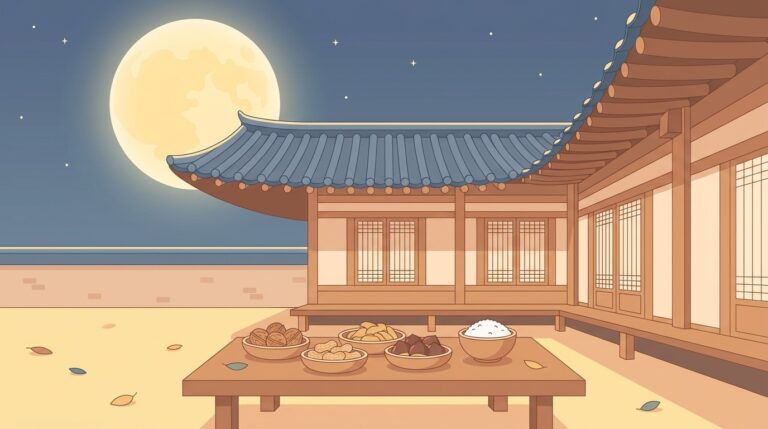
Phase 1: Empathy (스토리 몰입형 오프닝)
안녕하세요! 매일한글 에디터입니다.
Imagine standing under the brilliant silver glow of the year’s very first full moon in Korea—Jeongwol Daeboreum (정월 대보름). Around you, family and friends gather with broad smiles, handing you a hard walnut, a chestnut, and a peanut. Someone whispers, “자, 올 한 해도 무사태평하도록 부럼 깨물자!” You bite down on the walnut with a crisp CRACK sound, but suddenly pause. Did you just crack your tooth, or did you successfully ward off bad luck? More importantly, how do you express these intricate lunar customs and wishes for sound health using natural, high-level Korean without sounding like a dated history textbook?
As advanced learners (C1 level), you already know basic vocabulary like ‘밤’ (chestnut) or ‘달’ (moon). However, navigating the nuanced cultural etiquette of Bureom Kkaegi (부럼 깨기)—from wishing someone good health to gracefully negotiating traditional festivities—requires a sophisticated grasp of Korean honorifics, idioms, and emotional undertones. Based on real feedback from advanced learners who felt lost during traditional holiday gatherings, this guide will serve as your ultimate cultural compass. Let’s master the art of cracking nuts and invoking good fortune like a true native!
Phase 2: 핵심 표현 3선 심층 분석
1. 만사형통하시길 바랍니다 (Man-sa-hyeong-tong-ha-si-gil ba-ram-ni-da)
- Pronunciation: [Man-sa-hyeong-tong-ha-si-gil ba-ram-ni-da] (Pronounced smoothly like Mahn-sah-hyung-tong, flowing seamlessly without abrupt pauses)
- Meaning: Direct: “I hope ten thousand matters pass through smoothly.” vs. Real Niuance: “May everything go smoothly and all your wishes come true in the coming year.”
- K-Culture Moment: Commonly heard in historical K-Dramas during New Year assemblies or spoken by company CEOs and elders during Jeongwol Daeboreum toast speeches.
- Editor’s Insight: While beginners use “새해 복 많이 받으세요,” C1 learners elevate their elegance with ‘만사형통’ (萬事亨通). It reflects the Sino-Korean philosophical view that harmony yields complete success.
- Situation Spectrum: Casual (🚫) / Semi-formal (⚠️ – 만사형통하세요) / Formal (✅ – 만사형통하시길 바랍니다)
- 🤔 Think About It: How does your culture express wishes for universal prosperity, and how does it compare to the Korean concept of obstacle-free flow (형통)?
2. 부럼을 깨물다 (Bu-reom-eul kkae-mul-da)
- Pronunciation: [Bu-reom-eul kkae-mul-da] (Think of the satisfying munch-crack sound of biting into a crisp hazelnut)
- Meaning: Direct: “To bite down on seasonal nuts.” vs. Real Niuance: “To perform the ritualistic nut-cracking on the first full moon to ward off boils, skin diseases, and bad luck.”
- K-Culture Moment: Featured in Korean variety shows where cast members try cracking hard walnuts with their teeth (or hands) to test their luck and stamina for the year.
- Editor’s Insight: ‘부럼’ refers to hard-shelled nuts (walnuts, pine nuts, chestnuts, peanuts), but it also shares an ancient linguistic link with ‘부럼/부럼증’ (boils/skin problems). Biting them symbolizes keeping skin healthy all year.
- Situation Spectrum: Casual (✅) / Semi-formal (✅) / Formal (✅)
- 🤔 Think About It: Why do you think ancient Koreans connected the crunching sound of nuts with scaring away evil spirits?
3. 액운을 물리치다 (Aek-un-eul mul-li-chi-da)
- Pronunciation: [Aeg-un-eul mul-li-chi-da] (Strong emphasis on mul-li, like forcefully pushing back an unwanted wave)
- Meaning: Direct: “To repel bad luck.” vs. Real Niuance: “To actively ward off misfortune and clear the path for auspicious energy.”
- K-Culture Moment: Used in fantasy K-Dramas or traditional cultural documentaries when explaining rituals like Daljip Taeugi (burning moon houses) or Bureom Kkaegi.
- Editor’s Insight: C1 speakers distinguish between simple ‘운이 좋다’ (to be lucky) and the proactive verb ‘물리치다’ (to defeat/repel). It highlights human agency in ritualistic practices.
- Situation Spectrum: Casual (⚠️ – 액운을 물리쳐요) / Semi-formal (✅) / Formal (✅)
- 🤔 Think About It: In your native language, is bad fortune seen as something passive to endure, or something active to be repelled?
Phase 3: 교과서 한국어 vs 진짜 한국어
Scenario 1: Wishing someone well during the First Full Moon festival
- 📖 교과서 한국어: 정월 대보름에 부럼을 깨서 건강해지기를 원합니다. (I want you to be healthy by cracking nuts on Jeongwol Daeboreum.)
- 🗣️ 진짜 한국어: 올 한 해 부럼 깨물고 만사형통하시고, 부럼처럼 단단하고 건강하게 보내세요!
- 💡 왜 다를까?: Native Korean speakers rarely state cause-and-effect strictly like textbooks. They blend traditional ritual verbs (‘부럼 깨물다’) with elegant Sino-Korean blessing idioms (‘만사형통’) to construct warm, rhythmic wishes.
Scenario 2: Politely declining an extra hard walnut due to dental concerns
- 📖 교과서 한국어: 이가 아파서 호두를 깰 수 없습니다. (I cannot crack the walnut because my tooth hurts.)
- 🗣️ 진짜 한국어: 마음은 굴뚝같지만, 치아가 좀 약해서 밤이나 땅콩으로 대신해야겠어요.
- 💡 왜 다를까?: Direct refusal sounds abrupt in Korean social settings. Using the idiom ‘마음은 굴뚝같지만’ (My heart is like a chimney [eager], but…) softens the refusal and demonstrates high emotional intelligence (Nunchi).
Phase 4: K-Culture 딥다이브 & 비언어적 매너
4-1. 눈치(Nunchi) & Non-Verbal Manners
When handed nuts during Jeongwol Daeboreum, never immediately crack a hard walnut with your front teeth—it can look unrefined or risk injury! Instead, use both hands to receive the nut, make eye contact, smile warm-heartedly, and say your blessing phrase before cracking it using a nutcracker or biting lightly on softer nuts like peanuts. If someone offers to buy your heat on the morning of Daeboreum by calling your name, remember Nunchi: yell “내 내고 내 더위 사가라!” (Buy my heat!) before they can sell theirs to you!
4-2. Cultural Code Analysis: The Philosophy of Ohang & Ogokbap
Jeongwol Daeboreum is not just about nuts. Koreans prepare Ogokbap (five-grain rice) paired with dried winter vegetables (Mugun-namul). This stems from the Five Elements philosophy (오행 – Ohang), aiming for physical balance after a cold winter. Cracking nuts (Bureom) creates a loud noise meant to startle away lingering winter demons. Today, even modern urbanites purchase sleek pre-packaged Bureom sets at convenience stores to maintain this ancient sense of community connection.
Phase 5: 실전 롤플레이 시나리오
Setting: A cozy traditional Hanok guesthouse in Jeonju during Jeongwol Daeboreum. You are joining the house landlord, Grandma Sun-ja (NPC), and other guests for the evening lunar circle.
Characters:
* Grandma Sun-ja (NPC): A warm-hearted, traditional host who loves sharing cultural folklore.
* You (Learner): An advanced Korean learner showing respect and cultural expertise.
Dialogue Script
- Grandma Sun-ja: 자, 어서 오게! 오늘이 일 년 중 달이 가장 크다는 정월 대보름 아닌가. 부럼 좀 깨물어야지?
(Ja, eoseo o-ge! On-eul-i il nyeon jung dal-i ga-jang keu-da-neun jeong-wol dae-bo-reum a-nin-ga. Bu-reom jom kkae-mul-eo-ya-ji?)
“Welcome! Today is Jeongwol Daeboreum, the biggest moon of the year. Shall we crack some nuts?”
🎭 Hands you a wooden tray filled with walnuts, peanuts, and chestnuts. -
You: 어머, 어르신! 이렇게 정성스럽게 부럼을 준비해 주셔서 정말 감사합니다.
(Eeo-meo, eo-reu-sin! I-reoh-ge jeong-seong-seureop-ge bu-reom-eul jun-bi-hae ju-syeo-seo jeong-mal gam-sa-ham-ni-da.)
“Oh, ma’am! Thank you so much for preparing these seasonal nuts with such care.”
🎭 Receives the tray with both hands, bowing head lightly in gratitude. -
Grandma Sun-ja: 별말씀을! 첫째 부럼은 깨물면서 올 한 해 만사형통하고 부럼(부스럼) 안 나게 해 달라고 비는 거라네. 호두 한 번 깨볼 테인가?
(Byeol-mal-sseum-eul! Cheot-jae bu-reom-eun kkae-mul-myeon-seo ol han hae man-sa-hyeong-tong-ha-go bu-reom an na-ge hae dal-la-go bi-neun geo-ra-ne. Ho-du han beon kkae-bol te-in-ga?)
“Don’t mention it! Biting the first nut is to wish for smooth sailing and clear skin all year. Want to try this walnut?”
🎭 Hands you a sturdy local walnut with a proud smile. -
You: 네! 올 한 해 액운은 싹 물리치고, 어르신께서도 늘 건강하시길 바라겠습니다.
(Ne! Ol han hae aek-un-eun ssak mul-li-chi-go, eo-reu-sin-kkae-seo-do neul geon-gang-ha-si-gil ba-ra-get-seum-ni-da.)
“Yes! I’ll sweep away all bad luck this year, and I wish you perpetual good health as well.”
🎭 Puts the walnut gently into a nutcracker tool with a confident look. -
Grandma Sun-ja: 아이구, 말이라도 고마워라! 딱 소리가 나게 깨물어야 잡귀가 깜짝 놀라 달아나지!
(A-i-gu, mal-i-ra-do go-ma-weo-ra! Ttak so-ri-ga na-ge kkae-mul-eo-ya jap-gwi-ga kkam-jjak nol-la dal-a-na-ji!)
“Oh, your words are so lovely! It needs to make a crisp crack sound so evil spirits get startled and run away!”
🎭 Claps her hands with delight. -
You: (딱! 소리를 내며) 드디어 깨졌네요! 이 소리 들으시고 나쁜 기운은 다 도망갔겠어요.
(Ttak! so-ri-reul nae-myeo Deu-di-eo kkae-jyeot-nae-yo! I so-ri deu-reu-si-go na-ppeun gi-un-eun da do-mang-gat-get-seo-yo.)
“(Crack!) It finally cracked! Hearing this noise, all negative energy must have fled already.”
🎭 Shows the clean half-split walnut shell proudly. -
Grandma Sun-ja: 허허, 손재주가 보통이 아니네! 내일 아침 일찍 내 더위 사갈 생각은 말게나!
(Heo-heo, son-jae-ju-ga bo-tong-i a-ni-ne! Nae-il a-chim ilg-jjik nae deo-wi sa-gal saeng-gag-eun mal-ge-na!)
“Haha, you’re quite skillful! Just don’t plan on selling me your summer heat tomorrow morning!”
🎭 Winks humorously. -
You: 하하, 어르신! 내일 아침엔 제가 한발 먼저 “내 더위 사가라” 하고 외칠 지도 몰라요!
(Ha-ha, eo-reu-sin! Nae-il a-chim-en je-ga han-bal meon-jeo “nae deo-wi sa-ga-ra” ha-go oe-chil ji-do mol-ra-yo!)
“Haha, ma’am! I might just beat you to it tomorrow morning and shout ‘Buy my heat!’ first!”
🎭 Laughs together warmly under the moonlight.
🔀 Interactive Choice Point
When Grandma Sun-ja offers you a second, extremely tough whole nut, how do you respond?
- Option A: “이거 너무 딱딱해서 제 이가 부러질 것 같아요. 안 먹을래요.” (It’s too hard, my tooth might break. I won’t eat it.)
- Option B: “어르신, 마음은 굴뚝같지만 제 치아가 조금 약해서요, 부드러운 땅콩으로 더위도 물리치고 부럼도 깨겠습니다!”
- Option C: “괜찮습니다! 제 이빨은 진짜 튼튼하니까 씹어 보겠습니다!” (It’s fine! My teeth are super strong so I’ll chew it!)
Detailed Feedback:
- 🏆 Best Choice (Option B): Perfect C1 response! You used elegant softening idioms (‘마음은 굴뚝같지만’), prioritized personal safety without hurting the host’s feelings, and wove in cultural themes (‘더위 물리치고’).
- 🚫 Bad Choice (Option A): Too blunt. Telling an elder “안 먹을래요” sounds childish and breaks the warm atmospheric etiquette.
- ⚠️ Risk Choice (Option C): While enthusiastic, using the casual word ‘이빨’ (teeth, often used for animals) in front of elders is grammatically improper (use ‘치아’ or ‘치아 건강’). Plus, breaking teeth on walnuts is a real holiday risk!
Phase 6: 10초 감정 섀도잉 드릴
Practice these sentences out loud, paying strict attention to the emotion tags and slash marks (/) representing natural pausing intervals!
[😊 기쁘고 활기차게]올 한 해 / 액운은 싹 물리치고, / 만사형통하시길 / 진심으로 바랍니다!
(Ol han hae / aek-un-eun ssak mul-li-chi-go, / man-sa-hyeong-tong-ha-si-gil / jin-sim-eu-ro ba-ram-ni-da!)-
[🥺 위트 있고 재치 있게]마음은 굴뚝같지만 / 치아가 조금 약해서 / 땅콩으로 대신할게요!
(Mae-um-eun gul-ttuk-gat-ji-man / chi-a-ga jo-geum yak-hae-seo / ttang-kong-eu-ro dae-sin-hal-ge-yo!) -
[😆 장난스럽고 신나게]내일 아침에 만나면 / 제가 먼저 / “내 더위 사가라!” 하고 / 외칠 거예요!
(Nae-il a-chim-e man-na-myeon / je-ga meon-jeo / “nae deo-wi sa-ga-ra!” ha-go / oe-chil geo-yeo-yo!)
Phase 7: K-Culture 미니 사전 (핵심 키워드 4개)
- 정월 대보름 (Jeongwol Daeboreum) | The First Full Moon Festival | The 15th day of the first lunar month, marking the first full moon after Lunar New Year. Celebrated with wishes for health, harmony, and good crops.
- 부럼 (Bureom) | Seasonal Hard Nuts | Nuts with hard shells eaten on Daeboreum. Symbolizes sound teeth and clear skin free of boils (buseureom) throughout the year.
- 더위팔기 (Deowi-palgi) | Heat Selling Tradition | A fun custom on the morning of Daeboreum where you call a friend’s name; if they answer, you shout “내 더위 사가라!” to sell them your summer heat burden.
- 오곡밥 (Ogokbap) | Five-Grain Rice | Rice made with sticky rice, millet, sorghum, red beans, and black beans, shared with neighbors to wish for universal prosperity and nutritional balance.
Phase 8: 여행자를 위한 생존 키트
Survival Expressions TOP 3
- “부럼 깨기 세트 어디에 있나요?”
- Romanization: Bu-reom kkae-gi se-teu eo-di-e in-na-yo?
- Pro Tip: Ask this at convenience stores or traditional markets in mid-February to find pre-packaged nut assortments.
- “이 밤/호두는 어떻게 깨 먹어야 하나요?”
- Romanization: I bam/ho-du-neun eo-tteoh-ge kkae meog-eo-ya ha-na-yo?
- Pro Tip: Perfect for asking market vendors for nutcrackers or peeling tips.
- “올 한 해도 만사형통하세요!”
- Romanization: Ol han hae-do man-sa-hyeong-tong-ha-se-yo!
- Pro Tip: Universal, high-level blessing phrase to send via KakaoTalk to Korean colleagues during the holiday.
Editor’s Travel Note
When traveling in Korea during Jeongwol Daeboreum, visit traditional Hanok villages (Jeonju or Namsangol Hanok Village in Seoul). You can participate in public Daljip Taeugi (burning straw moon houses) and free nut-cracking events. To navigate your way smoothly to these traditional cultural zones, download the 네이버 지도 앱 다운로드 for real-time walking and public transit routes. Remember to carry a small cotton pouch to store your cracked nut shells so you keep historical sites spotless!
Phase 9: “한 발 더 깊이” (생각 질문)
Korean seasonal customs like Bureom Kkaegi reflect a deeply rooted agrarian philosophy where individual health is inseparable from community harmony. By making a loud crunching sound together under the same moon, ancient Koreans cleared collective anxieties and welcomed a shared spring. Language acts as the bridge for this warmth—blessings are not framed as personal gains, but as holistic flow (‘만사형통’). How does your own native culture celebrate seasonal transitions, and what acoustic or culinary traditions do you use to bring people together?
💬 Your Turn: Share your favorite traditional holiday custom in the comments below using the expression 만사형통하시길 바랍니다!
Phase 10: FAQ & 오해 방지
Q: Do I actually have to bite hard walnuts with my teeth during Bureom Kkaegi?
A: Absolutely not! While the ancient ritual was called ‘깨물다’ (to bite), modern Koreans prioritize dental health. It is completely acceptable and common to use nutcrackers (호두 까개) or simply crack lighter nuts like peanuts or roasted chestnuts with your hands or teeth.
Q: Can I use “만사형통하세요” with close friends in casual settings?
A: Yes, but it may sound slightly grand or dramatic, similar to saying “May all your grand endeavors flourish!” among close buddies. For friends, a casual variation like “올해 하는 일 다 잘풀려라!” (May everything you do unpack smoothly this year!) works best.
Q: What happens if I forget to sell my heat (“더위팔기”) before noon?
A: Traditionally, heat selling is only valid before sunrise or during early morning hours on Daeboreum day. Don’t worry if you miss it—it’s just a lighthearted, playful joke among friends!
🚨 Common Mistakes Warning
- Mistake: Using ‘이빨’ when wishing an elder healthy teeth.
- Correction: Use ‘치아’ or ‘치아 건강’. Say: “어르신, 치아 건강도 꼭 챙기세요!”
- Mistake: Misinterpreting ‘부럼’ as a disease name.
- Correction: ‘부럼’ refers to the nuts themselves eaten to prevent skin boils (‘부스럼’).
- Mistake: Saying “새해 복 많이 받으세요” in late spring.
- Correction: Jeongwol Daeboreum is the last festival of the traditional New Year cycle. Use event-specific greetings like “대보름 달맞이 잘 하시고 만사형통하세요!”
Phase 11: 액션 미션 & 참여 유도
Action Mission 3-Step Challenge
- 🥉 Bronze Mission: Pronounce “만사형통하시길 바랍니다” three times using our Phase 6 shadowing drill audio guidance.
- 🥈 Silver Mission: Post a picture of your favorite nut or full moon on Instagram, tagging
@DailyHangulwith the caption: “올 한 해 액운 물리치기 완료!” - 🥇 Gold Mission: Send a KakaoTalk greeting to a Korean acquaintance or online tutor wishing them 만사형통 for Jeongwol Daeboreum!
🎮 K-Culture Mission: Watch a scene from a traditional Korean drama or documentary featuring Jeongwol Daeboreum. Spot whether the characters eat Ogokbap or crack Bureom, and drop your finding in the comments!
Phase 12: 인터랙티브 퀴즈 챌린지
Question 1: Situation Judgment
You are attending a Jeongwol Daeboreum feast at a friend’s house. The host offers you a plate of walnuts. Which response demonstrates the best C1-level fluency and cultural etiquette?
* A) “나 호두 안 먹어요.”
* B) “감사합니다! 올 한 해 액운도 물리치고 만사형통하라는 의미로 맛있게 깨물겠습니다.”
* C) “이빨이 부러질 것 같으니까 다른 거 주세요.”
🔍 정답 및 해설 보기 (Click to view answer)
Correct Answer: B
Explanation: Option B seamlessly connects the cultural meaning of repelling bad fortune (‘액운을 물리치다’) with Sino-Korean blessings (‘만사형통’), showing exemplary linguistic and cultural mastery.
Question 2: Fill in the Blank
“마음은 ( )같지만, 제가 치아가 좀 약해서 단단한 호두 대신 땅콩으로 부럼을 깰게요.”
* A) 굴뚝
* B) 호두
* C) 보름달
🔍 정답 및 해설 보기 (Click to view answer)
Correct Answer: A
Explanation: The idiom ‘마음은 굴뚝같다’ means “I wish I could do it so eagerly (like smoke rising from a chimney), but circumstances prevent me.”
Question 3: True / False Cultural Quiz
During Jeongwol Daeboreum, selling your summer heat (‘더위팔기’) can be done at any time of the year whenever the weather gets hot. (T/F)
🔍 정답 및 해설 보기 (Click to view answer)
Correct Answer: False
Explanation: ‘더위팔기’ is an exclusive morning fun custom reserved specifically for the morning of Jeongwol Daeboreum!







