

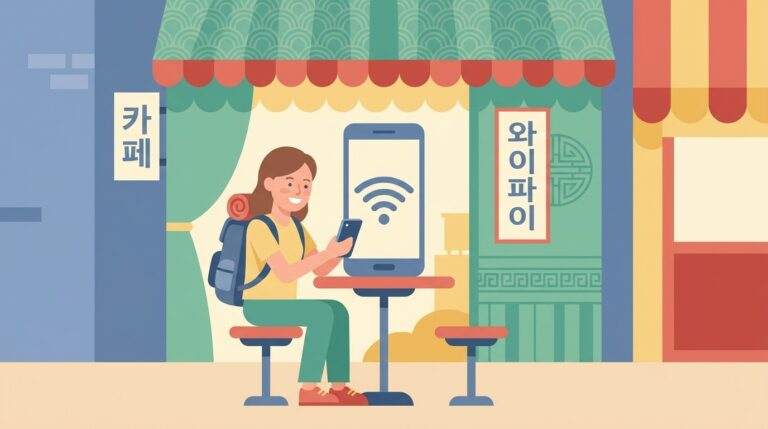
Phase 1: Oh No, Out of Data! 😱
안녕하세요! (Annyeonghaseyo!) I’m your lead editor at Daily Hangul. Imagine this: You’ve just landed at Incheon Airport, or you’re exploring the bustling streets of Hongdae. You want to check Naver Map for that trendy café you saved on Instagram, but suddenly… your screen loads forever. “No Internet Connection.” You checked your phone, and your roaming data ran out! Don’t panic! Korea is one of the most connected countries in the world, and asking for Wi-Fi or explaining that you don’t have data is super easy once you know a few simple phrases. Today, based on feedback from hundreds of beginner travelers just like you, we will learn how to master the phrase “데이터가 없어요” (I don’t have data) and get connected in seconds!
Phase 2: Key Expressions Deep Dive 💡
1. 데이터가 없어요 (De-i-teo-ga eop-seo-yo)
- Pronunciation: [De-i-teo-ga eop-seo-yo] (Sounds like day-a-toe-gah up-seoh-yoh – imagine ‘up’ in the sky!)
- Meaning: Literal: “Data does not exist.” / Real Nuance: “I ran out of phone data” or “I don’t have cellular data right now.”
- K-Culture Moment: You often hear characters in K-dramas saying this when they need to borrow someone’s hotspot or ask for a Wi-Fi password at a convenience store!
- Editor’s Insight: In Korean, 없어요 (eop-seo-yo) means “to not have” or “does not exist.” You can attach it to almost anything you lack!
- Situation Spectrum: Casual (🚫 데이터 없어) / Semi-formal (✅ 데이터가 없어요) / Formal (✅ 데이터가 없습니다)
- 🤔 Think About It: In English, you say “I don’t have data” focusing on ‘I’. In Korean, the focus is often on ‘Data’ itself (“Data isn’t there”). Isn’t that neat?
2. 와이파이 비밀번호가 뭐예요? (Wa-i-pa-i bi-mil-beon-ho-ga mwo-ye-yo?)
- Pronunciation: [Wa-i-pa-i bi-mil-beon-ho-ga mwo-ye-yo?]
- Meaning: Literal: “Wi-Fi secret number is what?” / Real Nuance: “What is the Wi-Fi password?”
- K-Culture Moment: Almost every Korean café prints the Wi-Fi password at the bottom of the paper receipt. Just look for 비번 (bi-beon)!
- Editor’s Insight: 비밀번호 (bi-mil-beon-ho) is password, but locals shorten it to 비번 (bi-beon) in casual chats.
- Situation Spectrum: Casual (⚠️ 비번 뭐야?) / Semi-formal (✅ 와이파이 비밀번호가 뭐예요?) / Formal (✅ 와이파이 비밀번호를 가르쳐 주시겠습니까?)
- 🤔 Think About It: Why do you think Koreans love fast Wi-Fi so much? The fast-paced culture called ‘Palli-Palli’ (Hurry-hurry) is deeply rooted here!
3. 와이파이 켜 주세요 (Wa-i-pa-i kyeo ju-se-yo)
- Pronunciation: [Wa-i-pa-i kyeo ju-se-yo]
- Meaning: Literal: “Please turn on Wi-Fi.” / Real Nuance: “Could you turn on the Wi-Fi router / hotspot, please?”
- K-Culture Moment: Used when asking a friend to turn on their phone hotspot (에그/핫스팟).
- Editor’s Insight: Adding 주세요 (ju-se-yo) at the end turns any request into a polite “please do it for me.”
- Situation Spectrum: Casual (🚫 켜 줘) / Semi-formal (✅ 켜 주세요) / Formal (✅ 켜 주시겠어요?)
- 🤔 Think About It: Sharing data via hotspot is a true sign of friendship in Korea!
Phase 3: Textbook Korean vs. Real Native Korean 🗣️
- Asking for Wi-Fi
- 📖 Textbook: 와이파이 연결을 할 수 있습니까? (Wa-i-pa-i yeon-gyeol-eul hal su is-seum-ni-ka? – Can I connect to Wi-Fi?)
- 🗣️ Real Native: 와이파이 돼요? (Wa-i-pa-i dwae-yo? – Does Wi-Fi work here?)
- 💡 Why the difference?: Natives prefer short, efficient phrases. 돼요? (dwae-yo?) literally means “Is it okay/does it work?” and is extremely versatile!
- Asking for the password
- 📖 Textbook: 비밀번호를 말씀해 주시겠습니까? (Bi-mil-beon-ho-reul mal-sseum-hae ju-si-get-seum-ni-ka?)
- 🗣️ Real Native: 비밀번호 어디 있어요? (Bi-mil-beon-ho eo-di is-seo-yo? – Where is the password?)
- 💡 Why the difference?: In cafés, passwords are usually written somewhere on the wall, menu, or receipt, so asking where it is makes more sense than asking what it is.
Phase 4: K-Culture Deep Dive & Mannerisms 🇰🇷
4-1. Nunchi (눈치) & Gestures
When saying “데이터가 없어요”, slightly tilt your smartphone toward the other person with a slight smile or a sheepish expression. You can point at the empty signal bar at the top of your screen. Showing your screen non-verbally explains your situation instantly!
4-2. Culture Code: Free Wi-Fi Heaven
Korea is famous for Public Wi-Fi (Public WiFi Free). From buses and subway stations to convenience stores and tiny street carts, almost everywhere offers access. Look for signs with the Wi-Fi icon or search for networks starting with Public WiFi!
Phase 5: Real-Life Roleplay Scenario 🎭
Setting: A cozy café in Seongsu-dong. You just sat down and need Wi-Fi to message your friend.
Characters: You (A1 Learner), Min-ji (Friendly Café Staff)
- Turn 1 (You): 저기요… 저 데이터가 없어요. (Jeo-gi-yo… jeo de-i-teo-ga eop-seo-yo.)
- 🎭 Action: Pointing politely at your phone screen with a slight smile.
- Translation: Excuse me… I don’t have data.
- Turn 2 (Min-ji): 아, 정말요? 와이파이 쓰세요! (A, jeong-mal-yo? Wa-i-pa-i sseu-se-yo!)
- 🎭 Action: Nodding warmly and pointing to the receipt counter.
- Translation: Oh, really? Please use our Wi-Fi!
- Turn 3 (You): 와이파이 비밀번호가 뭐예요? (Wa-i-pa-i bi-mil-beon-ho-ga mwo-ye-yo?)
- 🎭 Action: Tilting head slightly with an inquiring smile.
- Translation: What is the Wi-Fi password?
- Turn 4 (Min-ji): 영수증 밑에 있어요! (Yeong-su-jeung mit-e is-seo-yo!)
- 🎭 Action: Handing over the paper receipt and pointing at the bottom line.
- Translation: It’s at the bottom of the receipt!
- Turn 5 (You): 아, 여기 있네요! 감사합니다. (A, yeo-gi in-ne-yo! Gam-sa-ham-ni-da.)
- 🎭 Action: Looking at the receipt and nodding gratefulness.
- Translation: Oh, here it is! Thank you.
- Turn 6 (Min-ji): 아니에요~ 천천히 하세요. (A-ni-e-yo~ cheon-cheon-hi ha-se-yo.)
- 🎭 Action: Waving hands playfully.
- Translation: No problem~ Take your time.
- Turn 7 (You): 와이파이 잘 돼요! (Wa-i-pa-i jal dwae-yo!)
- 🎭 Action: Giving a thumbs-up.
- Translation: Wi-Fi works great!
- Turn 8 (Min-ji): 다행이에요! 맛있게 드세요. (Da-haeng-i-e-yo! Mas-it-ge deu-se-yo.)
- 🎭 Action: Smiling brightly.
- Translation: What a relief! Enjoy your drink.
🔀 Interactive Branching Choice
What if you can’t read the password on the receipt because it’s too small?
* Option A: Say “글씨가 작아요. 읽어 주세요!” (The font is small. Please read it for me!) ➔ BEST CHOICE ✅ Polite and direct! Staff will gladly help.
* Option B: Say “이거 나빠요.” (This is bad.) ➔ BAD CHOICE 🚫 Sounds rude and confusing!
* Option C: Just leave the café silently. ➔ RISK ⚠️ You won’t get connected!
Phase 6: 10-Second Emotion Shadowing Drill ⏱️
[🥺 Worried & Helpless]- 데이터가 / 없어요… (De-i-teo-ga / eop-seo-yo…)
[❓ Curious & Hopeful]- 와이파이 / 돼요? (Wa-i-pa-i / dwae-yo?)
[😊 Relieved & Happy]- 아! / 비밀번호 / 찾았다! (A! / Bi-mil-beon-ho / cha-jat-da! – Ah! Found the password!)
Phase 7: K-Culture Mini Dictionary 📚
- 핫스팟 (Hat-seu-pot) | Mobile Hotspot | Sharing your cellular data connection with another device.
- 비번 (Bi-beon) | Password | Shortened slang for 비밀번호 (Bi-mil-beon-ho).
- 에그 (Eog-geu) | Pocket Wi-Fi | Portable router rented by travelers in Korea.
- 충전 (Chung-jeon) | Charging | Asking to charge your phone battery: “충전해 주세요” (Please charge this).
Phase 8: Traveler’s Survival Kit 🧰
Survival Expressions TOP 3
- 데이터 없어요. (De-i-teo eop-seo-yo.) – I have no data.
- 와이파이 비밀번호 알려주세요. (Wa-i-pa-i bi-mil-beon-ho al-ryeo-ju-se-yo.) – Please let me know the Wi-Fi password.
- 콘센트 어디 있어요? (Kon-sen-teu eo-di is-seo-yo?) – Where is an electrical outlet?
Editor’s Travel Note
Before heading to Korea, make sure you download Naver Map and KakaoMap! You can search for locations offline if you save them beforehand. Check out the guide on Naver Map Download and Setup to prepare your trips smoothly without using extra data!
Phase 9: One Step Deeper 🧠
In Korea, offering Wi-Fi or letting friends connect to your personal phone hotspot is seen as a small act of hospitality (정 – Jeong). Koreans are extremely generous with digital connectivity because staying connected keeps everyone safe and in touch smoothly. Next time someone shares their hotspot with you, a sincere “고마워요!” (Thank you!) goes a long way!
💬 Your Turn: Have you ever run out of internet data while traveling abroad? Share your story in the comments below!
Phase 10: FAQ & Common Mistakes ❓
Q: Can I use public Wi-Fi on Korean subways?
A: Yes! Free public Wi-Fi is available on most subway lines and buses across major cities like Seoul and Busan.
Q: What if the Wi-Fi network requires a Korean phone number?
A: Look for networks labeled Public WiFi Free which usually require only a simple agreement click without phone registration!
Q: Is “데이터 없어요” polite enough for elders?
A: It is polite for general staff and friends. For elders, you can say “데이터가 없습니다.” (De-i-teo-ga eop-seum-ni-da).
🚨 Common Mistakes TOP 3
- Saying “인터넷 없어요” (I don’t have internet) ➔ While understandable, Koreans specifically say 데이터 없어요 for phone cellular data.
- Mispronouncing Wi-Fi ➔ Say Wa-i-pa-i, not Wee-Fee!
- Asking for “Password” as “패스워드” ➔ Use 비밀번호 or 비번 instead.
Phase 11: Action Missions 🎯
- Bronze Mission: Practice saying “데이터가 없어요” out loud 3 times facing a mirror.
- Silver Mission: Record your voice asking “와이파이 비밀번호가 뭐예요?” and post it on your Instagram Story or TikTok!
- Gold Mission: Visit a local Korean store or restaurant and successfully ask for Wi-Fi in Korean!
🎮 K-Culture Mission: Watch a scene in a modern Korean drama set in a café and spot the Wi-Fi password written on the wall menu or receipt!
Phase 12: Interactive Quiz Challenge 🎲
Q1. How do you say “I don’t have data” in Korean?
1) 데이터 있어요
2) 데이터 없어요
3) 와이파이 없어요
Click to view Answer & Explanation
Correct Answer: 2) 데이터 없어요
Explanation: 없어요 (eop-seo-yo) means “do not have”, so “데이터 없어요” means “I don’t have data.”
Q2. What is the short slang word for 비밀번호 (Password)?
(Fill in the blank: 비___)
Click to view Answer & Explanation
Correct Answer: 비번 (Bi-beon)
Explanation: Koreans love shortening words! 비밀번호 becomes 비번.
Q3. True or False: You should always ask for “Wee-Fee” in Korea.
Click to view Answer & Explanation
Correct Answer: False
Explanation: In Korea, Wi-Fi is pronounced 와이파이 (Wa-i-pa-i)!







