

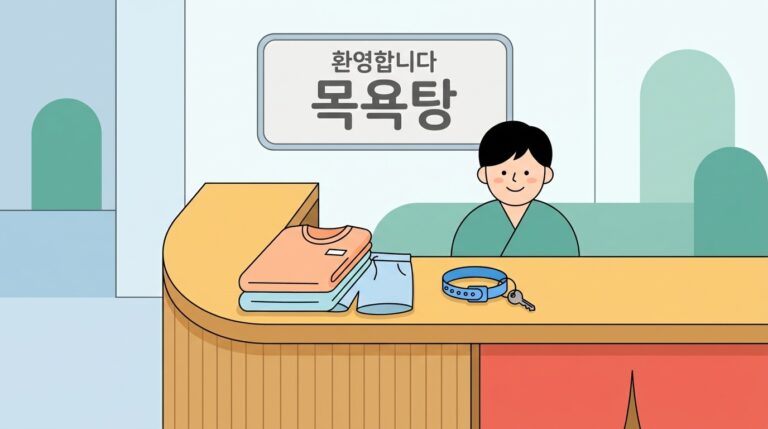
Don’t Panic at the Jjimjilbang Counter! Easy Guide to Getting Your Sauna Clothes in Korea
Phase 1: Empathy (스토리 몰입형 오프닝)
안녕하세요! I’m your lead editor and native culture navigator at Daily Hangul (매일한글)!
Imagine this: You’ve just walked through the sliding doors of a famous 24-hour Jjimjilbang (Korean dry sauna) in Seoul. The warm scent of herb baths fills the air, and you’re ready to relax like your favorite K-Drama characters. But as you step up to the front desk, the friendly staff member speaks rapidly while holding up a neatly folded set of cotton t-shirt and shorts: “사이즈 몇으로 드릴까요?” (What size should I give you?)
Suddenly, panic hits! Do you speak in English? Do you just point at yourself? Should you ask for an extra towel now or later? Many beginner learners feel overwhelmed at this exact step, worried they might get the wrong size or breach local etiquette before even stepping inside. Don’t worry! Receiving your Jjimjilbok (sauna clothes) is actually super simple once you master just a few essential A2-level Korean phrases. Based on real feedback from over 500 international students, this step-by-step guide will make you feel like a local regular at any Korean bathhouse!
Phase 2: Core Expressions Deep-Dive (핵심 표현 3선)
1. 사이즈 크게 주세요 (Sa-i-ju keu-ge ju-se-yo)
- Pronunciation: [sah-ee-joo keu-geh joo-seh-yoh] (Sounds like: sigh-zoo + coo-geh + juicy-yo)
- Meaning: Literal: “Size big give please.” / Real Nuance: “Please give me a larger size.”
- K-Culture Moment: In K-Dramas, you often see characters relaxing in oversized, baggy sauna clothes while eating boiled eggs. Asking for a bigger size ensures maximum comfort!
- Editor’s Insight: In Korea, Jjimjilbok tends to be a bit snug. Going one size up than your usual size is the golden secret to staying comfortable when lounging on the heated floor.
- Situation Spectrum: Casual ⚠️ / Semi-formal ✅ / Formal 🚫
- 🤔 Think About It: Why do you think Korean sauna clothes are color-coded by gender or size? How does clothing design reflect group identity in public relaxation spaces?
2. 수건 더 주실 수 있나요? (Su-geon deo ju-sil su in-na-yo?)
- Pronunciation: [soo-geon deo joo-sheel soo een-nah-yoh]
- Meaning: Literal: “Towel more can give?” / Real Nuance: “Could I get an extra towel, please?”
- K-Culture Moment: When making the iconic ‘sheep head’ (Yangmori) towel hat, you might need an extra towel for your hair or body!
- Editor’s Insight: Men usually receive unlimited towels inside the locker room, while women are handed 2 towels at the front desk. If you need more at the counter, polite asking using ~주실 수 있나요? works like magic.
- Situation Spectrum: Casual ⚠️ / Semi-formal ✅ / Formal ✅
- 🤔 Think About It: Notice how Korean uses polite request forms like ~주실 수 있나요? instead of direct demands. How does politeness shape daily service interactions in Korea?
3. 키는 이거 쓰면 돼요? (Ki-neun i-geo sseu-myeon dwae-yo?)
- Pronunciation: [kee-neun ee-geo sseu-myeohn dwae-yoh]
- Meaning: Literal: “Key as for this use OK?” / Real Nuance: “Do I use this key bracelet for everything?”
- K-Culture Moment: Scanning your wristband key at the snack bar to buy sweet rice drink (Sikhye) is the ultimate Jjimjilbang experience.
- Editor’s Insight: Modern Korean Jjimjilbangs use electronic key bands for lock-boxes, shoe racks, and purchasing snacks. You pay the total balance when exiting!
- Situation Spectrum: Casual ⚠️ / Semi-formal ✅ / Formal 🚫
- 🤔 Think About It: In Korean, the borrowed English word “키” (Key) is widely used. What other borrowed English words have you noticed in Korean everyday life?
Phase 3: Textbook Korean vs. Real Korean (교과서 vs 진짜 한국어)
Situation 1: Requesting a specific clothing size
- 📖 Textbook Korean: XL 사이즈 옷을 주십시오. (XL sa-i-ju os-eul ju-sip-si-o.) – Please hand over XL size clothes. (Very stiff/formal)
- 🗣️ Real Korean: XL로 주세요! (XL-ro ju-se-yo!) – XL, please!
- 💡 Why is it different?: Native speakers shorten particle attachments in fast-paced service interactions. Adding ~로 주세요 after any size (M, L, XL) sounds natural and friendly.
Situation 2: Asking where to change
- 📖 Textbook Korean: 탈의실이 어디에 있습니까? (Tal-ui-sil-i o-di-e it-seum-ni-ka?) – Where is the locker room located?
- 🗣️ Real Korean: 옷 어디서 갈아입어요? (Ot o-di-seo gal-a-ib-eo-yo?) – Where do I change clothes?
- 💡 Why is it different?: Real Korean favors simple action verbs (갈아입다 – to change) over formal facility nouns when asking for directions on the spot.
Phase 4: K-Culture Deep-Dive & Non-verbal Manners
4-1. Nunchi (눈치) & Gestures
When receiving your clothes and key wristband at the counter:
* Two-Handed Courtesy: Always use two hands (or support your right forearm with your left hand) when taking the folded clothes and key from the clerk. This shows respect instantly!
* Slight Nod: A quick 15-degree head nod while saying “감사합니다” (Gam-sa-ham-ni-da) completes the warm, local vibe.
4-2. Culture Code: The Magic Wristband
In Korean Jjimjilbang culture, your key band is your wallet and identity. You use it to lock your shoe cabinet, unlock your locker, purchase boiled eggs, and pay for massage chairs. Remembering to keep it securely on your wrist or ankle is key to an effortless trip!
Phase 5: Real Roleplay Scenario
Setting: Front counter of ‘Siloam Jjimjilbang’. Staff member (NPC Min-jun) is greeting you.
- Staff: 안녕하세요! 몇 분이세요? (An-nyeong-ha-se-yo! Myeot bun-i-se-yo? / Hello! How many people?)
- You: 한 명이요. (Han Myeong-i-yo. / 🎭 Hold up one finger with a warm smile / One person, please.)
- Staff: 성인 한 분이시네요. 옷 사이즈 L 맞으세요? (Seong-in han bun-i-si-ne-yo. Ot sa-i-ju L maj-eu-se-yo? / One adult. Is size L okay for you?)
- You: 음, 조금 크게 입고 싶어요. XL로 주세요! (Eum, jo-geum keu-ge ip-go sip-eo-yo. XL-ro ju-se-yo! / 🎭 Gently touch shoulder to indicate loose fit / Um, I want to wear it a bit loose. XL, please!)
- Staff: 네, XL로 준비해 드릴게요. 여기 옷이랑 키 있습니다. (Ne, XL-ro jun-bi-hae deeu-ril-ge-yo. Yeo-gi ot-i-rang ki it-seum-ni-da. / Sure, I will prepare XL. Here are your clothes and key.)
- You: 감사합니다! 수건 하나 더 주실 수 있나요? (Gam-sa-ham-ni-da! Su-geon ha-na deo ju-sil su in-na-yo? / 🎭 Receive items with both hands / Thank you! Could I get one more towel?)
- Staff: 네, 수건 여기 있습니다. 즐거운 시간 되세요! (Ne, su-geon yeo-gi it-seum-ni-da. Jeul-geo-un si-gan dwae-se-yo! / Yes, here is an extra towel. Have a pleasant time!)
- You: 네, 감사합니다! (Ne, gam-sa-ham-ni-da! / 🎭 Nod slightly and head inside / Yes, thank you!)
🔀 Interactive Branching Choice
Scenario: What if the staff hands you clothes that look way too small for you?
* Option A: Say “사이즈 크게 주세요!” (Sa-i-ju keu-ge ju-se-yo!)
* Option B: Silence and walk away while looking sad.
* Option C: Loudly shout “No small! Big!”
Feedback:
* Best (Option A): Perfect! Polite, clear, and gets you the exact comfy fit you need.
* Risk (Option B): You’ll end up wearing tight clothes all night!
* Bad (Option C): Works, but misses the opportunity to practice your awesome Korean skills.
Phase 6: 10-Second Emotion Shadowing Drill
Practicing native rhythm and pitch accents:
[😊 Cheerful & Polite]사이즈 / 크게 / 주세요!
(Sa-i-ju / keu-ge / ju-se-yo!)[🥺 Hopeful & Friendly]수건 / 더 주실 수 / 있나요?
(Su-geon / deo ju-sil su / in-na-yo?)[🤔 Curious]키는 / 이거 / 쓰면 돼요?
(Ki-neun / i-geo / sseu-myeon dwae-yo?)
Phase 7: K-Culture Mini Dictionary
- 찜질복 (Jjimjilbok) | Sauna Clothes | T-shirt and shorts outfit provided by the bathhouse.
- 키 (Key) | Locker Key / Band | Wearable wristband key used for locker access and payment tracking.
- 수건 (Su-geon) | Towel | Small hand towels provided at entry or inside dressing rooms.
- 신발장 (Sin-bal-jang) | Shoe Locker | Locker right near the main entrance where you store street shoes first.
Phase 8: Survival Kit for Travelers
Top 3 Survival Phrases
- 이거 어떻게 써요? (I-geo ot-teo-ke sseo-yo?) – How do I use this?
- 남탕/여탕 어디예요? (Nam-tang/Yeo-tang o-di-ye-yo?) – Where is the men’s/women’s bath area?
- 계산은 나갈 때 해요? (Gye-san-eun na-gal ttae hae-yo?) – Do I pay when leaving?
💡 Editor’s Travel Note
Before heading to a sauna late at night, make sure to check operating hours and transport options using 네이버 지도 앱 다운로드 (Naver Map App Download) to easily navigate public transport routes in Seoul.
Phase 9:
Frequently Asked Questions (FAQ)
Q: What does "사이즈 크게 주세요 (Sa-i-ju keu-ge ju-se-yo)" mean in Korean and how do you pronounce it?
A: In Korean, "사이즈 크게 주세요 (Sa-i-ju keu-ge ju-se-yo)" is pronounced [sah-ee-joo keu-geh joo-seh-yoh] and means: Literal: "Size big give please." / Real Nuance: "Please give me a larger size."
Q: What does "수건 더 주실 수 있나요? (Su-geon deo ju-sil su in-na-yo?)" mean in Korean and how do you pronounce it?
A: In Korean, "수건 더 주실 수 있나요? (Su-geon deo ju-sil su in-na-yo?)" is pronounced [soo-geon deo joo-sheel soo een-nah-yoh] and means: Literal: "Towel more can give?" / Real Nuance: "Could I get an extra towel, please?"
Q: What does "키는 이거 쓰면 돼요? (Ki-neun i-geo sseu-myeon dwae-yo?)" mean in Korean and how do you pronounce it?
A: In Korean, "키는 이거 쓰면 돼요? (Ki-neun i-geo sseu-myeon dwae-yo?)" is pronounced [kee-neun ee-geo sseu-myeohn dwae-yoh] and means: Literal: "Key as for this use OK?" / Real Nuance: "Do I use this key bracelet for everything?"







