

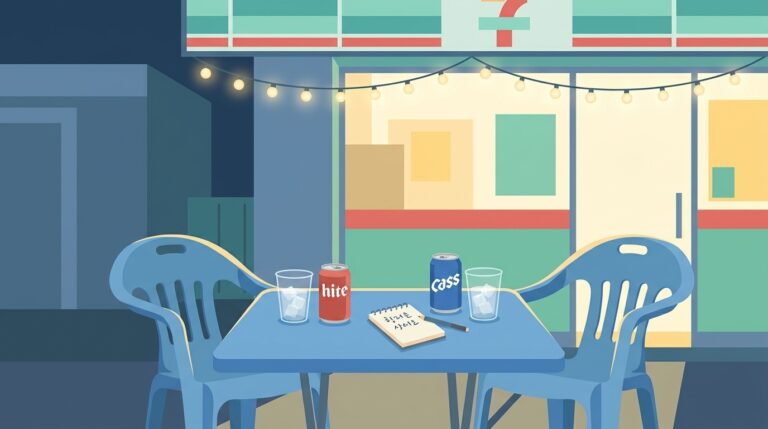
안녕하세요! (Hello!) I’m your Daily Hangul editor and your personal Korean culture guide. If you have ever walked past a Korean convenience store on a breezy summer evening, you have probably seen locals enjoying cold beer and snacks at the bright blue or yellow plastic tables outside. This delightful phenomenon is known as ‘Pyeon-maek’ (편맥 – Convenience Store Beer)!
However, for many foreign visitors and intermediate learners, taking a seat at these outdoor tables can evoke a slight wave of anxiety. “Am I allowed to drink here? Do I need to buy a certain amount? Where do I put my empty cans?” Don’t worry! Today, we are diving deep into the exact language, etiquette, and subtle cultural nuances you need so you can confidently sit down, pop open a cool draft can, and enjoy the vibe like a true Seoulite. This guide is crafted based on real learner feedback and my 10 years of experience navigating Korean local culture.
Phase 2: Core Expressions Deep Dive
1. 야외 테이블 이용해도 돼요? (Yae-oi tae-i-beul i-yong-hae-do dwae-yo?)
- Pronunciation: Yeah-way table ee-yong-hae-do dwae-yo? (Think of “Yeah” + “way” for 야외, and “table” pronounced with a Korean cadence).
- Meaning: Literal: “Is it okay to use the outdoor table?” | Nuance: A polite, natural way to confirm with the clerk whether the outdoor seating is open for customer use.
- K-Culture Moment: Seen in ambient K-dramas where characters grab a quick beer after a long workday and check with the store manager before sitting down.
- Editor’s Insight: Even though convenience store tables look public, some stores restrict their use late at night due to noise complaints from nearby residential areas. Asking this quick question shows high social intelligence (Nunchi).
- Situation Spectrum: Casual ⚠️ / Semi-formal ✅ / Formal 🚫
- 🤔 Think About It: How does asking permission before taking a outdoor seat reflect the Korean value of public etiquette and consideration for shopkeepers?
2. 4캔에 만 원 할인 적용돼요? (Sa-kaen-e man-won hal-in jeok-yong-dwae-yo?)
- Pronunciation: Sah-kaen-eh mahn-won hahl-in jeog-yong-dwae-yo? (Rhymes with “Sah-can”).
- Meaning: Literal: “Does the 4 cans for 10,000 won discount apply?” | Nuance: Checking if the selected craft or imported beers qualify for the classic bundled discount deal.
- K-Culture Moment: Friends hovering over the beer fridge, meticulously calculating combinations of IPA, Stout, and Lager to hit the bundle deal.
- Editor’s Insight: While inflation has pushed some bundles to 4 cans for 11,000 or 12,000 won, the phrase “4캔에 만 원” remains symbolic for convenience store beer deals.
- Situation Spectrum: Casual ✅ / Semi-formal ✅ / Formal 🚫
- 🤔 Think About It: Why are bundle promotions so central to Korean convenience store snack and drink shopping?
3. 치우는 건 분리수거함에 넣으면 되죠? (Chi-u-neun geon bun-ri-su-geo-ham-e neo-eu-myeon dwae-jo?)
- Pronunciation: Boon-ree-soo-guk-ham (Sounds like “Boon-ree-soo-geo”).
- Meaning: Literal: “For cleanup, I can just put it in the recycling bin, right?” | Nuance: Proactively confirming where to dispose of cans, plastic cups, and trash, demonstrating respect.
- K-Culture Moment: The heartwarming scene at the end of a night out where characters neatly separate plastic lids, aluminum cans, and food trash.
- Editor’s Insight: Cleanliness at outdoor convenience store tables is strictly self-serve. Showing that you intend to sort your trash instantly earns respect from store owners.
- Situation Spectrum: Casual ⚠️ / Semi-formal ✅ / Formal ✅
- 🤔 Think About It: How does Korea’s strict recycling (Bun-ri-su-geo) system shape social responsibility in shared spaces?
Phase 3: Textbook Korean vs. Real Korean
Situation 1: Asking if outdoor drinking is permitted
- 📖 Textbook: “밖에서 술을 마셔도 괜찮습니까?” (Is it acceptable to consume alcohol outdoors?)
- 🗣️ Real Korean: “여기 밖에서 마셔도 돼요?” (Can we drink out here?)
- 💡 Why the difference? The textbook phrase sounds like an official legal query! In reality, using semi-formal
-돼요?with simple vocabulary keeps the tone light and friendly.
Situation 2: Asking where to throw away empty beer cans
- 📖 Textbook: “쓰레기는 어디에 버려야 합니까?” (Where must I discard garbage?)
- 🗣️ Real Korean: “사장님, 치우는 건 어디에 둬요?” (Boss/Sir, where should I leave these when cleaning up?)
- 💡 Why the difference? Addressing the clerk politely as “사장님” (Sajangnim – literally ‘CEO/Boss’, commonly used for shop owners) instantly builds rapport and sounds natural.
Phase 4: K-Culture Deep Dive & Non-Verbal Manners
4-1. Nunchi & Gestures
When using convenience store tables, keep these subtle non-verbal cues in mind:
1. The Light Dip Bow: When asking the clerk if you can sit outside, hold your items slightly up and give a 15-degree head tilt.
2. Noise Calibration: Late-night Pyeon-maek is meant to be relaxed. Keep laughter at a moderate volume to avoid Nunchi glare from neighbors.
3. Table Wipe Down: Using a wet tissue to wipe your table before leaving is the ultimate sign of a courteous customer.
4-2. Culture Code: The ‘Pyeon-maek’ Phenomenon
In dramas like Work Later, Drink Now or Fight for My Way, convenience store tables act as sanctuary spots. They represent accessible, low-pressure spaces where honest conversations happen over affordable snacks like Nogari (dried young pollack) or Kkakdugi chips. Understanding this code helps you embrace the comforting, atmospheric side of everyday Korean night culture.
Phase 5: Real-Life Roleplay Scenario
Setting: A cool breeze blowing near the Han River GS25. You want to buy 4 cans of beer, an ice cup, and sit at the plastic outdoor table with a friend. Min-su, the friendly evening part-timer, is at the counter.
- You: 안녕하세요! 이 맥주 4캔이랑 얼음컵, 묶음 할인 적용돼요?
(An-nyeong-ha-se-yo! I maek-ju ne-kaen-i-rang eol-eum-keop, muk-eum hal-in jeok-yong-dwae-yo?)
🎭 [Holding 4 beer cans and a plastic ice cup, smiling warmly]
(Hello! Do these 4 beers and ice cup qualify for the bundle discount?) -
Min-su: 네, 맥주는 4캔에 11,000원 행사 맞고요, 얼음컵은 따로 결제하셔야 돼요!
(Ne, maek-ju-neun sa-kaen-e il-man-il-cheon-won haeng-sa mat-go-yo, eol-eum-keop-eun tta-ro gyeol-je-ha-syeo-ya dwae-yo!)
🎭 [Scanning the items quickly at the register]
(Yes, the beers are on the 4 for 11,000 won promo, but the ice cup is billed separately!) -
You: 아, 그렇군요! 그럼 같이 결제해 주세요. 혹시 밖에 야외 테이블 이용해도 돼요?
(A, geu-reot-gun-yo! Geu-reom gat-i gyeol-je-hae ju-se-yo. Hok-si bak-e yae-oi tae-i-beul i-yong-hae-do dwae-yo?)
🎭 [Nodding understandingly and pointing towards the outside blue table]
(Ah, I see! Please scan them together then. By the way, can we use the outdoor table outside?) -
Min-su: 그럼요! 편하게 앉으세요. 대신 11시 이후에는 파라솔 정리하니까 참고해 주세요.
(Geu-reom-yo! Pyeon-ha-ge an-jeu-se-yo. Dae-sin sib-il-si i-hu-e-neun pa-ra-sol jeong-ri-ha-ni-kka cham-go-hae ju-se-yo.)
🎭 [Handing over the receipt with a welcoming smile]
(Of course! Feel free to sit down. Just note that we fold the parasols after 11 PM.) -
You: 네, 알겠습니다! 치우는 건 다 마시고 안쪽에 있는 분리수거함에 넣으면 되죠?
(Ne, al-get-seub-ni-da! Chi-u-neun geon da ma-si-go an-jjok-e it-neun bun-ri-su-geo-ham-e neo-eu-myeon dwae-jo?)
🎭 [Taking the bag and asking reassuringly]
(Got it! For cleanup, we can just put everything in the indoor recycling bins when finished, right?) -
Min-su: 네! 캔이랑 플라스틱만 나눠서 버려주시면 감사하겠습니다.
(Ne! Kaen-i-rang pleu-ra-seu-tik-man na-nwo-seo beor-yeo-ju-si-myeon gam-sa-ha-get-seub-ni-da.)
🎭 [Giving a thumb up gesture]
(Yes! We’d appreciate it if you just separate cans and plastics.) -
You: 네! 깨끗하게 치우고 갈게요. 수고하세요!
(Ne! Kkae-kkeut-ha-ge chi-u-go gal-ge-yo. Su-go-ha-se-yo!)
🎭 [Bowing slightly and heading outside]
(Yes! We’ll clean up neatly before leaving. Have a good shift!) -
Min-su: 감사합니다! 좋은 시간 보내세요!
(Gam-sa-hab-ni-da! Jo-eun si-gan bo-nae-se-yo!)
🎭 [Waving goodbye cheerfully]
(Thank you! Have a great time!)
🔀 Interactive Branching Point
Scenario: You finish your drink at 10:50 PM. You want to handle your leftover ice and empty beer cans properly. What do you do?
- Option A: Throw the entire plastic ice cup (with remaining liquid ice) straight into the vinyl trash bag outside.
- Option B: Pour the leftover liquid ice into the designated liquid disposal sink inside, then crush the beer cans and toss them in the ‘CAN’ recycling bin.
- Option C: Leave everything on top of the blue table because convenience store workers clean the tables anyway.
🔍 Click here to see the Feedback & Result
- Option A (BAD 🚫): Trash bags with unpoured liquid will leak, creating a sticky mess and attracting bugs. The clerk will have to re-sort it.
- Option B (BEST ✅): Perfect! In Korea, liquid waste (Eum-sik-mul/Su-bun) must be emptied before plastic and metal containers are recycled. You are now officially a top-tier local customer!
- Option C (RISK ⚠️): Leaving trash behind causes convenience store owners to remove outdoor tables entirely due to complaints. Always clean up after yourself!
Phase 6: 10-Second Emotion Shadowing Drill
Practice these lines out loud with exact rhythm and feeling!
[😊 Excitement & Curiosity]
여기 / 밖에서 / 맥주 한 잔 / 해도 돼요?
(Yeo-gi / bak-e-seo / maek-ju han jan / hae-do dwae-yo?)-
[🥺 Polite Request]
혹시 / 얼음컵 / 하나만 / 더 주실 수 있나요?
(Hok-si / eol-eum-keop / ha-na-man / deo ju-sil su it-na-yo?) -
[👍 Warm Gratitude]
깨끗하게 / 치우고 가겠습니다! / 수고하세요!
(Kkae-kkeut-ha-ge / chi-u-go ga-get-seub-ni-da! / Su-go-ha-se-yo!)
Phase 7: K-Culture Mini Dictionary
-
편맥 (Pyeon-maek)
Translation: Convenience store beer
Usage: Abbreviation for 편의점 맥주 (Pyeon-ui-jeom Maek-ju). Used casually among friends: “오늘 날씨 좋은데 편맥 하자!” (The weather is great today, let’s do Pyeon-maek!). -
4캔 만 원 (Sa-kaen Man-won)
Translation: 4 cans for 10,000 Won deal
Usage: Iconic bundled pricing structure for beers in Korean convenience stores. -
분리수거 (Bun-ri-su-geo)
Translation: Waste sorting / Recycling
Usage: Essential social skill in everyday Korean life, separating paper, plastic, vinyl, glass, and metal cans. -
야장 (Ya-jang)
Translation: Outdoor open-air seating culture
Usage: Refers to dining or drinking at street-side outdoor tables during cool spring/autumn nights.
Phase 8: Traveler’s Survival Kit
TOP 3 Survival Phrases
- “야외 테이블 자리 있어요?” (Yae-oi tae-i-beul ja-ri it-eo-yo?) – Is there space at the outdoor table?
- “휴지 좀 얻을 수 있을까요?” (Hyu-ji jom eod-eul su it-eul-kka-yo?) – Could I get a few tissues?
- “쓰레기 어디에 버려요?” (Sseu-re-gi eo-di-e beor-yeo-yo?) – Where do I discard the trash?
Editor’s Travel Note
Before heading out on your night stroll, make sure to complete your Naver Map app download so you can easily spot 24-hour CU, GS25, or Seven-Eleven outlets with wide outdoor seating terraces near the Han River parks.
Phase 9: One Step Deeper
In Korean urban nightlife, convenience stores are more than retail hubs—they act as communal living rooms. The outdoor plastic table is a shared space where democracy and relaxation meet; anyone can enjoy a drink for under 5,000 won. However, this culture relies entirely on mutual respect. Because these stores exist within dense residential neighborhoods, keeping noise down and cleaning up your table ensures these outdoor spaces remain open for everyone.
💬 Your Turn: Have you ever tried drinking outside at a Korean convenience store? What is your favorite convenience store snack to pair with cold beer? Share your thoughts in the comments below!
Phase 10: FAQ & Common Mistakes
Q: Can I drink alcohol at any convenience store outdoor table in Korea?
A: Most stores permit it if they have designated outdoor tables set up. However, in certain municipal zones or residential quiet areas after 11 PM, drinking outdoors may be restricted. If unsure, asking “여기서 마셔도 돼요?” is always safe.
Q: Can I bring food bought from another store to the convenience store table?
A: Generally, no. It is considered courteous to consume products purchased from that specific store. Buying at least your drinks or main snacks there is standard etiquette.
Q: Do I need to show my physical passport to buy beer at convenience stores?
A: Yes! Korean convenience store cashiers strictly enforce age checks. Keep your physical passport or official foreign registration card handy when purchasing alcohol.
🚨 Common Mistakes TOP 3
- Leaving empty ice cups full of un-melted ice in general trash:
Correct Action: Empty remaining liquid/ice into a sink or drain before discarding the plastic cup in recycling. - Calling the employee loudly across the parking lot:
Correct Action: Walk up to the register counter and say “저기요~” (Excuse me) softly. - Assuming 4-can deals apply to any random 4 cans:
Correct Action: Check for the yellow or red event tags on the shelf showing which specific brands are eligible for the bundle.
Phase 11: Action Mission
- 🥉 Bronze Level: Practice saying “야외 테이블 이용해도 돼요?” aloud 3 times focusing on natural speed.
- 🥈 Silver Level: Next time you watch a K-drama, look out for a convenience store outdoor scene and spot how characters clear their cans.
- 🥇 Gold Level: Visit a local Korean convenience store, order a 4-can bundle with an ice cup, and successfully ask the clerk about outdoor seating in Korean!
🎮 K-Culture Mission: Find a K-pop idol vlog or K-drama where characters eat Hangang Ramyeon and drink beer at a convenience store table. Comment the title below!
Phase 12: Interactive Quiz Challenge
Q1. Situation Judgment: You want to ask the clerk if you can clear your table by putting trash in the recycling bin. Which sentence is most natural?
* A) 쓰레기 버리는 것을 허가해주십시오.
* B) 치우는 건 분리수거함에 넣으면 되죠?
* C) 쓰레기통이 어디 있는지 당장 말씀하세요.
Q2. Fill in the Blank:
“맥주 4캔 사면 ____ 할인 적용돼요?” (Does the bundle discount apply if I buy 4 beer cans?)
* A) 묶음 (muk-eum)
* B) 배달 (bae-dal)
* C) 환불 (hwan-bul)
Q3. True or False: In Korea, you can leave all empty cans and dirty food packages on outdoor convenience store tables because clean-up staff will handle it.
* (True / False)
💡 Click here for Answers & Explanations
- Q1 Answer: B | Sentence B is semi-formal, polite, and commonly used by native speakers.
- Q2 Answer: A | ‘묶음’ means ‘bundle’ or ‘package deal’.
- Q3 Answer: False | Convenience store tables are strictly self-service! Always sort and recycle your trash (Bun-ri-su-geo) before leaving.







