

Phase 1: 공감 (Empathy & Opening)
안녕하세요! 매일한글 에디터입니다.
Have you ever walked through the vibrant streets of Seongsu-dong or Hongdae in Seoul, mesmerized by the neon lights, trendy pop-up stores, and impossibly stylish outfits? Korea’s fashion scene moves at lightning speed. What is trending this week might be obsolete by next month. While fast fashion makes it easy to look like your favorite K-pop idol or K-drama protagonist without breaking the bank, it also brings up a serious debate in Korea today: the environmental footprint of ultra-fast consumption.
As an advanced learner (C1 level), you probably find simple shopping phrases like “이거 얼마예요?” (How much is this?) far too basic. You want to engage in meaningful conversations with eco-conscious Korean friends, express your values on sustainable living, or understand news discussions about greenwashing and clothing waste in Korea. Yet, discussing complex social topics in Korean often feels daunting due to nuanced vocabulary and cultural subtleties.
Don’t worry! This guide is crafted from real classroom feedback and discussions with native speakers. By the end of this article, you will comfortably express critical opinions on fast fashion and eco-friendly choices in authentic Korean—sounding natural, thoughtful, and articulate.
Phase 2: 핵심 표현 3선 심층 분석 (3 Core Expressions)
1. 유행을 타다 (Yuhaeng-eul Tada)
- Pronunciation: [yoo-haeng-eul ta-da] (Sounds like “you-hang-ale tah-dah”)
- Meaning: Literally “to ride a trend,” meaning to follow fashion trends or be sensitive to fleeting styles.
- K-Culture Moment: In Korean fashion vlogs, you’ll hear influencers say: “이 옷은 유행을 타지 않아서 오래 입을 수 있어요” (This clothing doesn’t follow short trends, so you can wear it for a long time).
- Editor’s Insight: While “유행을 따르다” means to actively follow a trend, “유행을 타다” implies that an item or style is susceptible to becoming outdated quickly. Using “유행을 타지 않는 디자인” (timeless design) is a key C1 phrase for discussing sustainable fashion.
- Situation Spectrum: Casual ✅ | Semi-formal ✅ | Formal ✅
- 🤔 Think About It: Does your native language compare trends to waves or vehicles you “ride”?
2. 가치 소비 (Gachi Sobi)
- Pronunciation: [ga-chi so-bi] (Sounds like “gah-chee saw-bee”)
- Meaning: Literally “value consumption,” referring to ethical spending where purchasing decisions reflect one’s personal values and eco-awareness.
- K-Culture Moment: Gen Z Koreans frequently post photos of upcycled bags or eco-beauty products with the hashtag #가치소비 on Instagram.
- Editor’s Insight: Combining “가치” (value) and “소비” (consumption), this buzzword highlights a conscious shift away from cheap, disposable fast fashion toward eco-friendly and ethical shopping.
- Situation Spectrum: Casual ✅ | Semi-formal ✅ | Formal ✅
- 🤔 Think About It: How has consumer behavior shifted toward value-based spending in your home country?
3. 지속 가능성 (Jisok Ganeung-seong)
- Pronunciation: [jee-sok gah-neung-seong] (Sounds like “jee-soak gah-noong-sung”)
- Meaning: Sustainability / Environmental durability.
- K-Culture Moment: Featured prominently in Korean TV documentaries and corporate ESG campaign announcements in Seoul.
- Editor’s Insight: An essential C1 noun phrase. While “친환경” (eco-friendly) is widely used in casual chats, “지속 가능성” adds academic and professional depth to your arguments regarding fashion industry ethics.
- Situation Spectrum: Casual ⚠️ | Semi-formal ✅ | Formal ✅
- 🤔 Think About It: How do Korean brands balance rapid aesthetic innovation with long-term environmental sustainability?
Phase 3: 교과서 한국어 vs 진짜 한국어 (Textbook vs. Real Korean)
Situation 1: Discussing purchasing eco-friendly clothes
- 📖 교과서 한국어: 저는 환경을 위해 친환경 옷을 구매하겠습니다.
- 🗣️ 진짜 한국어: 요즘은 환경을 생각해서 가치 소비를 하려는 편이에요.
- 💡 왜 다를까? Textbook Korean uses direct future actions (“구매하겠습니다”), whereas real Korean speakers express intentional personal tendencies using “~하는 편이에요” combined with modern terms like “가치 소비”.
Situation 2: Commenting on fast fashion’s rapid cycle
- 📖 교과서 한국어: 패스트 패션은 옷이 너무 빠르게 바뀝니다.
- 🗣️ 진짜 한국어: 트렌드가 너무 빨라서 금방 질리고 버려지게 돼요.
- 💡 왜 다를까? Native speakers focus on the emotional effect and consequences (“금방 질리다” – getting tired of something quickly) rather than stating a cold factual sentence.
Phase 4: K-Culture 딥다이브 & 비언어적 매너 (Culture Deep Dive & Manner)
4-1. 눈치 (Nunchi) & Non-verbal Cues
When discussing fast fashion vs. environmental sustainability in Korea, tone matters. If you criticize someone’s fast fashion outfit directly, it breaks harmony. Instead, practice Nunchi by focusing on industry practices rather than individual choices. Use subtle nods and reflective pauses (e.g., “음… 확실히 고민해 볼 문제네요”) to show intellectual humility.
4-2. Cultural Code: Eco-Pop-ups in Seongsu-dong
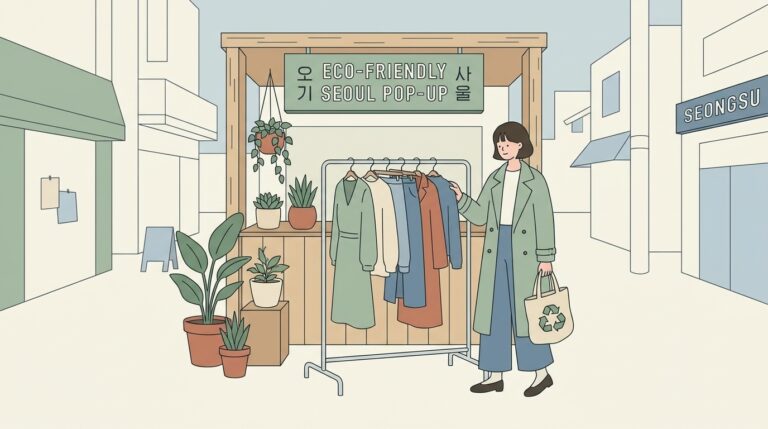
Seoul’s Seongsu neighborhood has transformed from shoe factories into a hub of eco-conscious pop-up shops. Brands now showcase upcycled garments made from recycled plastic or discarded traditional Hanbok fabrics. Expressing enthusiasm for these green spaces demonstrates your awareness of modern Korean youth culture.
Phase 5: 실전 롤플레이 시나리오 (Interactive Roleplay Scenario)
Setting: An upcycling fashion pop-up boutique in Seongsu-dong. You are chatting with Minjun (민준), a local brand manager.
- 민준: 안녕하세요! 저희 브랜드 업사이클링 재킷 둘러보고 계신가요?
(Hello! Are you taking a look at our brand’s upcycled jacket?) - Learner ( You ): 네! 디자인이 너무 예쁜데, 혹시 어떤 재료로 만들어졌나요?
(Yes! The design is so pretty, what material is it made of?) - 민준: 버려진 폐어망과 재활용 원단을 조합해서 만들었어요. 가격은 조금 비싸지만요.
(We made it by combining discarded fishing nets and recycled fabric. Though the price is a bit high.) - Learner ( You ): 🎭 [미소를 지으며] 가격이 조금 있더라도 지속 가능성을 생각하면 충분히 가치 소비인 것 같아요.
(Even if it’s a bit pricey, considering sustainability, it feels like a worthwhile value-based purchase.) - 민준: 와, 가치 소비라는 표현까지 알고 계시네요! 요즘 패스트 패션 문제는 어떻게 생각하세요?
(Wow, you even know the phrase ‘value-based consumption’! What do you think about fast fashion issues these days?) - Learner ( You ): 트렌드가 너무 빨라서 금방 질리고 쓰레기도 많이 생겨서 걱정이에요.
(I’m worried because trends change so fast that people get tired of clothes quickly and generate a lot of waste.) - 민준: 맞아요! 그래서 저희도 유행을 타지 않는 디자인을 계속 고민 중입니다.
(Exactly! That’s why we are continuously pondering timeless designs that don’t just follow short trends.) - Learner ( You ): 멋지네요! 환경도 지키고 스타일도 챙길 수 있어서 정말 뜻깊어요.
(Awesome! It’s really meaningful because we can protect the environment while staying stylish.)
🔀 Interactive Choice Point
Minjun asks: “패스트 패션을 완전히 줄이는 게 정말 가능할까요?” (Is it really possible to eliminate fast fashion entirely?)
- Option A: 당연히 가능하죠. 모두가 옷을 안 사면 돼요. (Of course. Everyone should just stop buying clothes.)
- Option B: 한 번에 바꾸기는 어렵지만, 소비자들의 가치 소비가 늘어나면 기업도 변할 것 같아요. (It’s hard to change overnight, but if ethical spending increases, corporations will adapt too.)
- Option C: 잘 모르겠어요. 패스트 패션이 저렴해서 좋은데요. (I don’t know. Fast fashion is cheap, so I like it.)
🔍 Check Choice Feedback
- Option A [Risk]: Too blunt and unrealistic. Might sound overly confrontational in Korean conversation.
- Option B [Best]: Balanced, highly articulate C1 level response showing deep social awareness.
- Option C [Bad]: Misses the context of the conversation and negates the boutique manager’s eco-friendly work.
Phase 6: 10초 감정 섀도잉 드릴 (10-Second Emotional Shadowing Drill)
Practice saying these lines with expressive pauses (/) and natural emotional delivery:
- [😊 Expressing thoughtful admiration]
요즘은 / 환경을 생각해서 / 가치 소비를 하는 편이에요.
(Yojoem-eun / hwangyeong-eul saenggakhaeseo / gachi sobi-reul haneun pyeon-ieyo.) -
[😟 Concern for environmental impact]
트렌드가 너무 빨라서 / 금방 질리고 / 쓰레기가 많이 나와요.
(Teurendeu-ga neomu ppallaseo / geumbang jilligo / sseuregi-ga mani nawayo.) -
[👍 Enthusiastic support]
유행을 타지 않는 / 지속 가능한 패션이 / 정말 필요한 것 같아요.
(Yuhaeng-eul taji anneun / jisok ganeung-han paesyeon-i / jeongmal piryohan geot gat-ayo.)
Phase 7: K-Culture 미니 사전 (Mini Dictionary)
- 업사이클링 (Eopsaikeulling): Upcycling. Recreating waste products into higher-value aesthetic goods.
- 제로웨이스트 (Jero-weisuteu): Zero Waste. A lifestyle movement minimizing waste packaging.
- 착한 소비 (Chakhan Sobi): “Good consumption.” Ethical spending that supports social causes or small eco-friendly businesses.
- 득템 (Deuktem): Getting a great item/find! Commonly used when finding a unique thrift store gem.
Phase 8: 여행자를 위한 생존 키트 (Traveler’s Survival Kit)
TOP 3 Survival Phrases
- 이거 재활용 소재로 만든 건가요?
(Is this made from recycled materials?)
Pro Tip: Use this when shopping in Seongsu vintage boutiques. - 오래 입을 수 있는 기본 아이템 추천해 주세요.
(Please recommend basic items that I can wear for a long time.) - 쇼핑백은 안 주셔도 돼요. 가방에 넣을게요.
(You don’t need to give me a shopping bag. I’ll put it in my tote.)
Editor’s Travel Note
Before heading to eco-conscious shopping areas in Seoul, download navigation apps to find hidden pop-ups easily. You can check the 네이버 지도 앱 다운로드 guide to navigate Seoul’s alleyways smoothly without getting lost.
Phase 9: 한 발 더 깊이 (One Step Deeper)
Historically, older generations in Korea prioritized frugal resource conservation summarized by the phrase “아껴쓰기” (frugal consumption born from post-war necessity). Today, young Koreans reframe this tradition as modern eco-awareness and self-expression through “가치 소비”. Caring for the environment is no longer just about saving money; it is about taking pride in one’s lifestyle choices and expressing identity through ethical fashion.
💬 Your Turn: How do people in your culture balance fast fashion trends with sustainability? Share your thoughts in Korean in the comments below!
Phase 10: FAQ & 오해 방지 (FAQ & Common Mistakes)
Q: Is “친환경” the same as “지속 가능성”?
A: Not quite. “친환경” (eco-friendly) is an adjective describing a product or feature (e.g., 친환경 소재 – eco-friendly material). “지속 가능성” (sustainability) is an abstract noun used for broader concepts, systems, and economic practices.
Q: Can I use “가치 소비” when buying cheap clothes on sale?
A: No. “가치 소비” specifically implies spending that aligns with moral, ethical, or environmental values, even if it costs more.
Q: How do I say “greenwashing” in Korean?
A: You can simply use the transliterated term 그린워싱 (Geurin-wosing) or explain it as 위장 환경 주의 (fake environmentalism).
🚨 Common Mistakes TOP 3
| Wrong Expression | Correct Action | Why? |
|---|---|---|
| 유행을 타다 (Used positively for making a trend) | Use 유행을 이끌다 (To lead a trend) | “유행을 타다” means being influenced by fleeting trends, not creating them. |
| 지속 가능한 옷 | Use 지속 가능한 패션 or 친환경 옷 | “지속 가능성” pairs better with abstract nouns like fashion, industry, or growth. |
| 가치를 소비하다 | Use 가치 소비를 하다 | “가치 소비” functions as a compound noun phrase. |
Phase 11: 액션 미션 (Action Mission)
- Bronze: Write a sentence using “가치 소비” in your Korean study notebook.
- Silver: Leave a Korean comment on an eco-fashion YouTube video or Instagram post using “유행을 타지 않는 디자인”.
- Gold: Visit a local thrift shop or eco boutique in Korea and ask the clerk about their recycled materials in Korean!
🎮 K-Culture Mission: Watch a fashion haul video on YouTube and spot how many times the creator uses the words “트렌드”, “소재”, or “오래 입다”!
Phase 12: 인터랙티브 퀴즈 챌린지 (Interactive Quiz)
1. Situation Quiz
Which phrase best fits this context? “I prefer buying timeless clothes that don’t go out of style quickly.”
* A) 유행을 잘 타는 옷
* B) 유행을 타지 않는 옷
* C) 유행을 버리는 옷
SHOW ANSWER & EXPLANATION
Correct Answer: B
Explanation: “유행을 타지 않는 옷” means timeless clothing that doesn’t blindly follow passing trends.
2. Fill-in-the-blank
환경을 생각해서 윤리적인 제품을 구매하는 행위를 ‘____ 소비’라고 합니다.
SHOW ANSWER & EXPLANATION
Correct Answer: 가치
Explanation: Combining “가치” (value) and “소비” (consumption) yields “가치 소비”.
3. True / False Culture Quiz
In Korea, telling someone directly that their fast fashion shopping is destroying the environment is considered good Nunchi.
SHOW ANSWER & EXPLANATION
Correct Answer: False
Explanation: Direct confrontation breaches social harmony (Nunchi). It is far better to discuss industry practices generally rather than shaming individual choices.







