

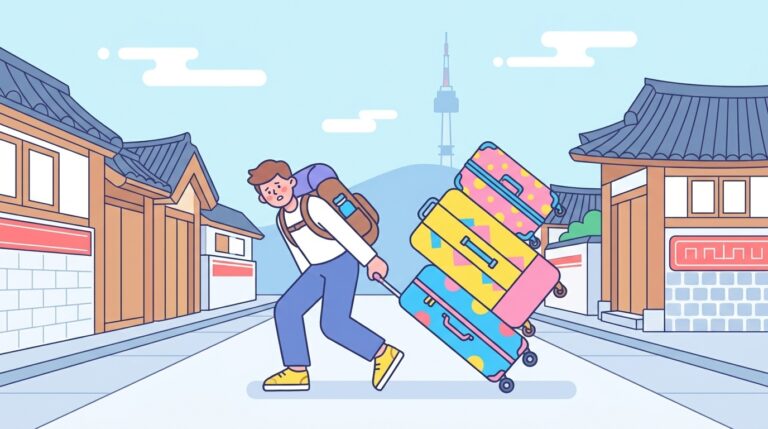
Overpacking for Your Korea Trip? How to Talk About Luggage Like a Local!
Phase 1: Empathy & Storytelling Opening
안녕하세요! 매일한글 에디터입니다. (Hello! This is your Daily Hangul Editor.)
Picture this: You are sitting on top of your open suitcase, frantically zipping it up while trying to fit three padded winter coats, four pairs of shoes, and an empty extra duffel bag just for your olive young K-beauty haul. You text your Korean buddy: “I think my luggage is way too heavy! What if I can’t carry it on the Seoul subway stairs?”
If you have ever stared at your packed luggage in sheer panic before heading to Incheon Airport, you are definitely not alone! Overpacking is practically a ritual for travelers coming to South Korea. But when you arrive, knowing how to express your luggage worries—whether asking a hotel receptionist to hold a heavy bag, asking a friend for help, or taking a luggage delivery service—will save your back and your trip.
In this lesson, curated from real feedback from hundreds of intermediate learners, you will master essential B1-level Korean expressions to talk about heavy bags and travel prep with confidence and cultural nuance!
Phase 2: Core Expressions Deep Dive
1. 짐이 너무 많아서 걱정이 돼요. (Jim-i neo-mu man-a-seo gok-jeong-i dwae-yo.)
- Pronunciation: [Jeem-ee noh-moo mahn-ah-suh guhk-jung-ee dway-yoh] (Sounds like “gym” + “e”)
- Meaning:
- Literal: Because there is too much luggage, it becomes a worry.
- Actual Nuance: “I’m really worried because I packed way too much stuff.”
- K-Culture Moment: Commonly heard in reality shows like Youth Over Flowers when cast members realize they brought giant suitcases for a backpackers’ trip.
- Editor’s Insight: Using
~아서/어서(because/so) connects the cause (too much luggage) directly with your emotion (worry), making your speech sound natural and fluid at a B1 level. - Situation Spectrum:
- Casual (
짐이 너무 많아서 걱정이야): ✅ - Semi-formal (
짐이 너무 많아서 걱정이 돼요): ✅ - Formal (
짐이 너무 많아 걱정이 됩니다): ⚠️ (A bit too formal for casual chat, but okay for official customer service)
- Casual (
- 🤔 Think About It: In English, you might say “I’m stressed about my bags.” Why do Koreans place the cause (
짐이 많아서) before the emotion (걱정)
2. 가방이 너무 무거워서 들 수가 없어요. (Ga-bang-i neo-mu mu-geo-wo-seo deul su-ga eop-seo-yo.)
- Pronunciation: [Gah-bahng-ee noh-moo moo-guh-wo-suh deul soo-gah uhp-suh-yoh]
- Meaning:
- Literal: The bag is too heavy so I cannot lift it.
- Actual Nuance: “My bag is so heavy I literally can’t carry/lift it!”
- K-Culture Moment: A scene in a K-drama where the male or female lead chivalrously steps in to carry a massive suitcase up the station stairs.
- Editor’s Insight:
~을 수 없다expresses inability. Adding가(수가 없다) adds emphasis: “I really can’t lift it!” - Situation Spectrum:
- Casual (
가방이 너무 무거워서 못 들겠어): ✅ - Semi-formal (
가방이 너무 무거워서 들 수가 없어요): ✅ - Formal (
가방이 너무 무거워 들기 어렵습니다): ✅
- Casual (
- 🤔 Think About It: Notice how Korean differentiates between carrying (
들다) and moving (옮기다). How does your native language handle these actions?
3. 캐리어 하나 더 챙겨야 할까? (Kae-ri-eo ha-na deo chaeng-gyeo-ya hal-kka?)
- Pronunciation: [Kae-ree-uh hah-nah duh chaeng-gyuh-yah hahl-kkah?]
- Meaning:
- Literal: Should I pack one more carrier?
- Actual Nuance: “Do you think I should bring an extra suitcase/luggage?”
- K-Culture Moment: Two friends chatting on KakaoTalk the night before flying to Jeju Island.
- Editor’s Insight: Koreans use the loanword
캐리어(carrier) specifically for wheeled suitcases. The verb챙기다is a powerful multi-purpose verb meaning “to pack / to take care of / to pack along.” - Situation Spectrum:
- Casual (
캐리어 하나 더 챙겨야 할까?): ✅ - Semi-formal (
캐리어 하나 더 챙겨야 할까요?): ✅ - Formal (
캐위어를 하나 더 준비해야 할까요?): ⚠️ (Formal contexts prefer수하물or가방)
- Casual (
- 🤔 Think About It:
챙기다reflects a caring, prepared mindset in Korean culture. What single verb in your language captures packing plus taking care of belongings?
Phase 3: Textbook Korean vs Real Korean
Situation 1: Expressing that your bag is extremely heavy
- 📖 Textbook Korean: 가방의 무게가 매우 나갑니다. (The weight of the bag is very high.)
- 🗣️ Real Korean: 가방 진짜 돌덩이에요! / 가방 터질 것 같아요! (My bag is literally a boulder! / My bag is about to burst!)
- 💡 Why the difference?: Native speakers love vivid visual metaphors like
돌덩이(boulder) or터지다(to burst/explode) when complaining playfully about luggage.
Situation 2: Asking a friend to carry or hold something
- 📖 Textbook Korean: 이것을 잠시 들어 주시겠습니까? (Would you please hold this for a moment?)
- 🗣️ Real Korean: 이것 좀 잠깐만 들어줄 수 있어? (Can you hold this for just a sec?)
- 💡 Why the difference?: Using
좀(short for 조금) softens requests dramatically, turning a stiff command into a friendly, natural favor.
Phase 4: K-Culture Deep Dive & Non-verbal Manners
4-1. Nunchi & Gestures for Heavy Bags
When you are struggling with heavy bags in public spaces like the Seoul Metro:
* The Tilt & Exhale: Leaning slightly forward while exhaling a subtle “휴~” (hyu~) communicates struggle without being loud or rude.
* Two-Handed Handover: If someone offers to help carry your suitcase, hand it over or accept it with both hands (or place one hand under your opposite elbow) to show polite gratitude.
* Nunchi in Elevators: Seoul subway elevators are primarily reserved for the elderly, disabled, and travelers with large bags. Give way gracefully if an elderly person approaches.
4-2. Culture Code: The “Extra Bag for Shopping” Phenomenon
In Korea, traveling light on the way to a destination and returning with full bags is standard practice due to vibrant shopping markets (Myeongdong, Seongsu, Hongdae). It is super common for Koreans to pack a foldable canvas bag (보조가방) inside their main luggage specifically for souvenirs and snacks.
Phase 5: Interactive Roleplay Scenario
Setting: You are at Hongdae Station with your Korean friend, Minjun (민준). You are facing a massive flight of stairs with a huge 28-inch suitcase.
- Turn 1 (Minjun): 하은아, 가방이 왜 이렇게 커? 안에 뭐 들었어?
- Rom: Ha-eun-a, ga-bang-i wae i-reo-kge keo? An-e mwo deul-eoss-eo?
- Eng: Haeun, why is your bag so big? What’s inside?
- 🎭 Action: Looking surprised at the massive suitcase.
- Turn 2 (You): 짐이 너무 많아서 걱정이야. 가방이 터질 것 같아!
- Rom: Jim-i neo-mu man-a-seo gok-jeong-i-ya. Ga-bang-i teo-jil geot gat-a!
- Eng: I packed way too much stuff, I’m worried. I think my bag might explode!
- 🎭 Action: Sighing dramatically and patting the luggage.
- Turn 3 (Minjun): ㅋㅋㅋ 쇼핑 많이 하려고 작정했구나? 내가 좀 들어줄까?
- Rom: Kkk, sho-ping man-i ha-ryeo-go jak-jeong-haess-gu-na? Nae-ga jom deul-eo-jul-kka?
- Eng: Lol, you’re totally determined to do heavy shopping, huh? Want me to carry it for a bit?
- 🎭 Action: Laughing and reaching out for the handle.
- Turn 4 (You): 정말? 가방이 너무 무거워서 들 수가 없는데 괜찮아?
- Rom: Jeong-mal? Ga-bang-i neo-mu mu-geo-wo-seo deul su-ga eop-neun-de gwaen-chan-a?
- Eng: Really? It’s so heavy I can barely lift it, are you sure you’re okay?
- 🎭 Action: Looking relieved but apologetic.
- Turn 5 (Minjun): 걱정 마! 나 운동하잖아. 계단 위까지 들어줄게.
- Rom: Gok-jeong ma! Na un-dong-ha-ja-na. Gye-dan wi-kka-ji deul-eo-jul-ge.
- Eng: Don’t worry! I work out, remember? I’ll carry it up the stairs for you.
- 🎭 Action: Flexing arms playfully and grabbing the luggage handle.
- Turn 6 (You): 와, 고마워! 다음에는 캐리어 하나만 챙겨야겠어.
- Rom: Wa, go-ma-wo! Da-eum-e-neun kae-ri-eo ha-na-man chaeng-gyeo-ya-geoss-eo.
- Eng: Wow, thank you! Next time I should really just bring one carrier.
- 🎭 Action: Bowing slightly with big smiling eyes.
- Turn 7 (Minjun): 그래, 보관함에 맡기거나 배송 서비스 써도 돼!
- Rom: Geu-rae, bo-gwan-ham-e mat-gi-geo-na bae-song seo-bi-seu sseo-do dwae!
- Eng: Yeah, or you can leave it in a locker or use a luggage delivery service!
- 🎭 Action: Pointing toward the station storage lockers.
- Turn 8 (You): 진짜 좋은 생각이네! 다음부터는 꼭 그렇게 할게.
- Rom: Jin-jja jo-eun saeng-gak-i-ne! Da-eum-bu-teo-neun kkok geu-reh-ge hal-ge.
- Eng: That’s a really great idea! I’ll definitely do that next time.
- 🎭 Action: Nodding enthusiastically.
🔀 Interactive Choice Point
Minjun offers to carry your heavy luggage up the stairs. How do you respond?
* Option A: “아니야, 괜찮아! 내가 들 수 있어.” (No, it’s fine! I can carry it.)
* Option B: “응, 고마워! 그럼 이것 좀 들어줘!” (Yeah, thanks! Then hold this!) [Hands over bag without hesitation]
* Option C: “진짜? 너무 고마워! 내가 나중에 맛있는 밥 사줄게!” (Really? Thank you so much! I’ll buy you a delicious meal later!)
Feedback:
* Best Choice: Option C! In Korean culture, accepting help warmly while offering a small favor back (like buying lunch or coffee) strengthens relationships and shows genuine gratitude.
* Bad Choice: Option B. While honest, handing over a heavy bag instantly without polite modesty can sound slightly blunt.
* Risk Choice: Option A. Politely refusing once is natural, but if you really need help, refusing completely might leave you struggling on 50 subway stairs alone!
Phase 6: 10-Second Emotional Shadowing Drill
Practice these lines with realistic emotion and correct pauses (/):
[🥺 Worried & Stressed]짐이 / 너무 많아서 / 걱정이 돼요… / 어떡하죠?
(Jim-i / neo-mu man-a-seo / gok-jeong-i dwae-yo… / eo-tteok-ha-jo?)-
[😫 Exhausted & Panting]가방이 / 너무 무거워서 / 더 이상 / 못 들겠어요!
(Ga-bang-i / neo-mu mu-geo-wo-seo / deo i-sang / mot deul-geess-eo-yo!) -
[💡 Excited & Relieved]다음부터는 / 보조가방을 / 하나 더 / 챙겨야겠어요!
(Da-eum-bu-teo-neun / bo-jo-ga-bang-eul / ha-na deo / chaeng-gyeo-ya-geoss-eo-yo!)
Phase 7: K-Culture Mini Dictionary
- 짐 (Jim) | Luggage / Baggage / Belongings
- Usage: Used for any packed bags, bundles, or heavy items you carry when traveling.
- 캐리어 (Kae-ri-eo) | Roller Suitcase
- Usage: Specifically refers to wheeled suitcases (e.g., 24인치 캐리어 = 24-inch suitcase).
- 물품보관함 (Mul-pum-bo-gwan-ham) | Luggage Storage Lockers
- Usage: Locker facilities found in almost all subway stations and train terminals in Korea.
- 짐 배송 서비스 (Jim Bae-song Seeo-bi-seu) | Luggage Delivery Service
- Usage: Services like TRIPPLE or SAFEX that deliver your heavy luggage directly from Incheon Airport to your Seoul hotel.
Phase 8: Traveler’s Survival Kit
Top 3 Survival Phrases
- 짐 좀 맡겨도 될까요? (Jim jom mat-gyeo-do doel-kka-yo?)
- Meaning: Can I leave/store my luggage here for a bit?
- Pro Tip: Use this at hotel front desks before check-in or after check-out.
- 엘리베이터가 어디에 있어요? (El-li-be-i-teo-ga eo-di-e iss-eo-yo?)
- Meaning: Where is the elevator?
- Pro Tip: Crucial when lugging 25kg suitcases in multi-level subway stations.
- 짐이 너무 많아서 택시를 타야겠어요. (Jim-i neo-mu man-a-seo taek-si-reul ta-ya-geoss-eo-yo.)
- Meaning: I have too much luggage so I should take a taxi.
Editor’s Travel Note
When traveling in South Korea with excessive luggage, navigating subway stairs can be tough. I highly recommend checking out Naver Map App Download to easily check station elevator locations in real-time. Also, consider booking Incheon Airport Luggage Delivery Services to send your heavy bags straight to your hotel so you can explore hands-free!
Phase 9: One Step Deeper (Thinking Question)
In Korean society, offering to carry heavy luggage for friends, elders, or even strangers stuck on subway stairs is rooted in the concept of Jeong (정) and Jeong-shin (공동체 의식 – community mind). Accepting help gracefully is just as important as offering it. Instead of stubbornly insisting “I can do it alone,” allowing others to assist creates a warm social connection.
💬 Your Turn: How does your culture view accepting help with heavy bags from friends or strangers? Do you prefer to handle everything yourself or share the load? Let us know in the comments below!
Phase 10: FAQ & Common Mistakes
Q: What is the difference between ‘짐’ and ‘가방’?
가방 means “bag” (backpack, handbag, suitcase as an object). 짐 means “luggage/baggage/cargo” (the collection of items you pack or carry). So inside your 가방, you have your 짐!
Q: Can I bring giant suitcases on public buses in Seoul?
While subways have plenty of room, city buses during rush hour can be extremely cramped. If you have two large 28-inch suitcases, bus drivers or passengers may find it inconvenient. Taking an airport bus (Limousine Bus) or taxi is much preferred.
Q: How do I say “overpacking” in natural Korean?
You can say 짐을 너무 많이 쌌어요 (I packed too much luggage) or jokingly say 짐이 이사하는 수준이에요 (My luggage is at a house-moving level!).
🚨 Common Mistakes TOP 3
- Saying “수하물” in casual conversations with friends
- Wrong: 친구야, 내 수하물이 너무 무거워.
- Correct Action: Use
짐or가방in casual speech.수하물is formal airline terminology.
- Confusing ‘들다’ (lift/carry) with ‘타다’ (ride)
- Wrong: 짐을 탔어요.
- Correct Action: Say
짐을 들었어요(I picked up/carried luggage).
- Forgetting ‘지 않다’ vs ‘못 하다’ for heavy luggage
- Wrong: 무거워서 짐을 안 들어요 (I don’t carry the bag out of choice).
- Correct Action: Say
무거워서 못 들겠어요(It’s so heavy I physically cannot carry it).
Phase 11: Action Mission & Engagement
Action Mission 3 Steps
- 🥉 Bronze Level: Record yourself saying “짐이 너무 많아서 걱정이 돼요” three times with realistic emotion.
- 🥈 Silver Level: Create a sample KakaoTalk message telling a virtual friend why your luggage is heavy and share it on your Instagram/X!
- 🥇 Gold Level: Next time you visit a hotel or cafe in Korea, ask “짐을 잠깐 맡길 수 있을까요?” in real life!
🎮 K-Culture Mission
Watch any Korean vlog or travel show (e.g., I Live Alone travel episode). Count how many times you hear the word 짐 or 무겁다! Drop your count in the comment section!
Phase 12: Interactive Quiz Challenge
Quiz 1. Situation Judgment
You have 3 heavy bags and cannot climb the subway stairs. What is the most natural Korean sentence to express your situation to a friend?
1. 짐이 너무 가벼워서 신나네요.
2. 가방이 너무 무거워서 들 수가 없어요.
3. 캐리어를 판매하고 싶습니다.
🔍 Click to see Answer & Explanation
Answer: 2. 가방이 너무 무거워서 들 수가 없어요.
Explanation: Option 1 means “My bag is so light I’m excited,” and Option 3 means “I want to sell my carrier.” Option 2 correctly uses ~해서 ~수 없다 to express that the bag is too heavy to lift!
Quiz 2. Fill in the Blank
Choose the correct verb for packing luggage: “내일 여행 가니까 짐을 미리 ( _____ ) 해야 돼.”
1. 챙겨야
2. 마셔야
3. 입어야
🔍 Click to see Answer & Explanation
Answer: 1. 챙겨야
Explanation: 짐을 챙기다 is the set phrase for packing/taking care of your belongings. 마시다 is to drink, and 입다 is to wear.
Quiz 3. True or False Culture Quiz
In Korea, 캐리어 refers to a phone service provider or air conditioner unit only.
* (True / False)
🔍 Click to see Answer & Explanation
Answer: False
Explanation: While “carrier” can mean telecom carriers in English, in Korean daily travel context, 캐리어 almost exclusively refers to a rolling suitcase!







