

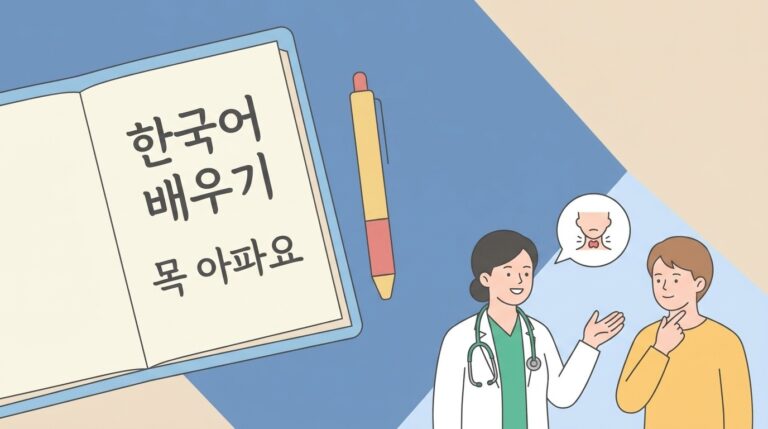
Phase 1: Empathy (Story-Driven Opening)
안녕하세요! This is your Daily Hangul editor, your trusted native cultural navigator! Imagine this scenario: You are having an amazing time exploring the neon-lit streets of Hongdae or cafe-hopping through Seongsu-dong. Suddenly, a chilly breeze hits, and by evening, your throat feels like sandpaper. You wake up the next morning with a swollen neck and a nagging cough that just won’t stop.
You head to a local Korean clinic (내과 or 이비인후과), but as you sit in the waiting room, panic sets in. How do you explain to the doctor that your throat is swollen, it hurts to swallow, and you’ve been coughing all night? Saying simply “아파요” (It hurts) might get you basic medicine, but pinpointing exact symptoms ensures you get the right prescription—and fast relief!
Don’t worry! Hundreds of our learners faced this exact moment before mastering today’s lesson. By the end of this guide, you will confidently express your throat and cough symptoms like a seasoned local, navigate Korean clinics smoothly, and get back to enjoying your K-adventure in no time!
Phase 2: Key Expressions Deep Dive
1. 목이 부었어요 (Moki bueosseoyo)
- Pronunciation: [Moki bueosseoyo] (Sounds like “Mok-ee boo-eoh-sseh-yo”)
- Meaning: Direct: “My neck/throat has swollen.” ➔ Actual Nuance: “My throat is swollen.”
- K-Culture Moment: Seen frequently in K-Dramas when a character comes down with a sudden fever after walking in the rain, prompting their friend to buy pyeon-ui-jeom (convenience store) warm drinks.
- Editor’s Insight: In Korean, ‘목’ refers to both the outer neck and inner throat. Context clarifies which one, but at a clinic, doctor automatically understands it as your throat!
- Situation Spectrum: Casual: 목 부었어 ⚠️ | Semi-formal: 목이 부었어요 ✅ | Formal: 목이 부었습니다 ✅
- 🤔 Think About It: In English, you say “I have a sore throat,” focusing on pain. Why do you think Korean focuses on the physical state (“swollen”) first?
2. 기침이 계속 나와요 (Gichimi gyesok nawayo)
- Pronunciation: [Gichimi gyesok nawayo] (Sounds like “Gee-chim-ee gyeh-sok nah-wah-yo”)
- Meaning: Direct: “Cough keeps coming out.” ➔ Actual Nuance: “I keep coughing non-stop.”
- K-Culture Moment: Idol livestream moments where a member apologizes mid-broadcast: “죄송해요, 기침이 계속 나와서…” (Sorry, because I keep coughing…).
- Editor’s Insight: Korean uses active verbs of emergence (“나오다” = to come out) for physiological reactions like coughing, sneezing, or tears.
- Situation Spectrum: Casual: 기침 계속 나와 ⚠️ | Semi-formal: 기침이 계속 나와요 ✅ | Formal: 기침이 계속 납니다 ✅
- 🤔 Think About It: How does phrasing body reactions as something “coming out” shift the focus from personal control to external physiological response?
3. 침을 삼킬 때 아파요 (Chim-eul samkil ttae apayo)
- Pronunciation: [Chim-eul samkil ttae apayo] (Sounds like “Cheem-eul sam-keel tteh ah-pah-yo”)
- Meaning: Direct: “It hurts when swallowing saliva.” ➔ Actual Nuance: “It hurts whenever I swallow.”
- K-Culture Moment: Essential medical phrase when describing severe tonsillitis during doctor consultation scenes in medical dramas like Hospital Playlist.
- Editor’s Insight: ~을 때 (when…) combined with specific actions gives doctors precise diagnostic clues.
- Situation Spectrum: Casual: 침 삼킬 때 아파 ⚠️ | Semi-formal: 침을 삼킬 때 아파요 ✅ | Formal: 침을 삼킬 때 아픕니다 ✅
- 🤔 Think About It: Notice how Korean specifies saliva (침) rather than food, emphasizing pain even during passive rest.
Phase 3: Textbook Korean vs. Real Korean
Situation 1: Explaining how long you’ve been sick
- 📖 Textbook: 저는 3일 동안 목의 통증을 느꼈습니다. (I felt pain in my throat for 3 days.)
- 🗣️ Real Korean: 삼 일 전부터 목이 계속 부어 있었어요. (My throat has been swollen since 3 days ago.)
- 💡 Why the difference? Koreans prefer starting points (~전부터) and state continuity (~어 있다) over rigid formal noun phrases like ‘통증을 느끼다’.
Situation 2: Asking for a stronger prescription or cough medicine
- 📖 Textbook: 기침 약을 처방해 주십시오. (Please prescribe cough medicine.)
- 🗣️ Real Korean: 기침이 좀 심한데, 기침 약도 같이 주세요. (My cough is a bit severe, so please include cough medicine too.)
- 💡 Why the difference? Using ~인데/생한데 softens requests, making your conversation natural and polite without sounding like an official demand.
Phase 4: K-Culture Deep Dive & Non-verbal Manners
4-1. Nunchi & Gestures
When explaining symptoms at a Korean medical clinic:
1. Gently touching your throat: Lightly place your fingertips on your upper neck while saying “목이 부었어요” to visually direct the physician.
2. Slight Bow: When entering the consultation room, a quick 15-degree head bow accompanied by “안녕하세요” sets a respectful tone.
3. Attentive Listening: Korean doctors work fast. Keep eye contact and nod slightly while they examine your throat with a tongue depressor.
4-2. Culture Code: ENT vs. Internal Medicine (이비인후과 vs. 내과)
In Western countries, you might visit a general practitioner first. However, in Korea, specialized clinics are extremely accessible! If your main symptom is a swollen throat, ear pain, or runny nose, head straight to an 이비인후과 (ENT Clinic). They have specialized equipment to spray soothing medication directly onto your swollen throat or offer warm steam nebulizer treatments right after your consultation!
Phase 5: Real Roleplay Scenario
Setting: Inside a cozy ENT clinic (이비인후과) near Sinchon station. Dr. Kim is reviewing your medical chart.
- Turn 1 (Doctor): 🎭 (Looks at chart and smiles gently) 안녕하세요, 어디가 불편해서 오셨나요?
(Annyeonghaseyo, eodiga bulpyeonhaeseo osyeonnayo? / Hello, what brings you in today?) - Turn 2 (You): 🎭 (Touching throat lightly with a strained voice) 며칠 전부터 목이 부르고 기침이 계속 나와요.
(Myeochil jeonbuteo moki bueotgo gichimi gyesok nawayo. / Since a few days ago, my throat has been swollen and I keep coughing.) - Turn 3 (Doctor): 🎭 (Nodding, grabbing a light indicator) 아, 그러세요? 침을 삼킬 때도 많이 아프신가요?
(A, geuraeseoyo? Chim-eul samkil ttae-do mani apeusingayo? / Ah, I see. Does it hurt a lot when you swallow saliva as well?) - Turn 4 (You): 🎭 (Nodding slowly) 네, 침 삼킬 때 제일 아파요.
(Ne, chim samkil ttae jeil apayo. / Yes, it hurts the most when I swallow.) - Turn 5 (Doctor): 🎭 (Gesturing to open mouth) 입 크게 벌려보세요. 아~ 해보세요.
(Ip keuge beollyeoboseyo. A~ haeboseyo. / Open your mouth wide, please. Say Ah~) - Turn 6 (You): 🎭 (Opening mouth wide) 아~~~
(A~~~ / Aaaaah~~~) - Turn 7 (Doctor): 🎭 (Examining with a tongue depressor) 목 안쪽이 많이 부었네요. 열도 조금 있고요. 약 처방해 드릴게요.
(Mok anjjogi mani bueonneyeo. Yeoldo jogum itgoyeo. Yak cheobanghae deurilgeyo. / Inside your throat is quite swollen. You also have a slight fever. I’ll write a prescription for you.) - Turn 8 (You): 🎭 (Bowing head slightly) 감사합니다, 선생님!
(Gamsahamnida, seonsaengnim! / Thank you, doctor!)
🔀 Interactive Branching Point
The doctor asks: “혹시 약 알레르기 있으신가요?” (Do you have any medicine allergies?)
- Choice A: “네, 페니실린 알레르기 있어요.” (Best Choice! Clear and direct.)
- Feedback (Best): Excellent! Medical staff will flag this on your prescription right away.
- Choice B: “없어요! 괜찮아요.” (Good Choice if you have no allergies.)
- Feedback (Good): Perfect. Simple and natural answer.
- Choice C: “몰라요. 아마도…”
- Feedback (Risk): Uncertainty might cause doctors to hesitate prescribing standard antibiotics. If unsure, say “특별히 없어요” (Nothing special/particular).
Phase 6: 10-Second Emotion Shadowing Drill
[😷 아프고 기운 없게]목이 / 너무 부어서 / 침 삼키기 / 힘들어요.
(Moki / neomu bueoseo / chim samkigi / himdeureoyo.)[😮💨 답답하고 피곤하게]밤마다 / 기침이 / 계속 나와서 / 잠을 못 잤어요.
(Bammada / gichimi / gyesok nawaseo / jameul mot jasseoyo.)[🙏 간절하고 예의 바르게]목 약 좀 / 세게 / 처방해 주실 수 있나요?
(Mok yak jom / sege / cheobanghae jusil su innayo?)
Phase 7: K-Culture Mini Dictionary
- 이비인후과 (I-bi-in-hu-gwa) | Ear, Nose, and Throat (ENT) Clinic | Go here for colds, sore throat, sinus issues, or ear pains.
- 처방전 (Cheo-bang-jeon) | Prescription paper | Take this paper given by the clinic clinic desk to a nearby pharmacy (약국).
- 약국 (Yak-guk) | Pharmacy | Usually located right next to or in the same building as clinics (marked with a large ‘약’ sign).
- 네뷸라이저 (Ne-byul-ra-i-jeo) | Nebulizer/Inhaler treatment | A steam-inhaling machine at Korean ENT clinics used immediately to soothe warm, inflamed airways.
Phase 8: Survival Kit for Travelers
TOP 3 Survival Phrases
- 가장 가까운 이비인후과가 어디예요? (Where is the nearest ENT clinic?)
- 목약하고 기침약 주세요. (Please give me throat and cough medicine – at pharmacies).
- 따뜻한 물 좀 얻을 수 있을까요? (Can I get some warm water?)
Editor’s Travel Note:
Need to find a doctor nearby? Use the 네이버 지도 앱 검색 가이드 by typing “이비인후과” or “내과”. Pharmacists in Korea can also give you over-the-counter medicine directly if you describe your throat symptoms using today’s key phrase: “목이 부르고 기침이 나와요!”
Phase 9: One Step Deeper
In Korea, caring for someone’s health is deeply tied to community affection. When a friend or colleague hears you coughing, you’ll rarely hear a simple “get well soon.” Instead, you’ll hear: “밥 꼭 챙겨 먹고 약 먹어!” (Make sure to eat meals before taking medicine!). Koreans believe warm food and proper rest are inseparable from medication. When showing concern, express warm food-related phrases alongside your warm wishes!
💬 Your Turn: Have you ever tried seeking medical care or buying cold medicine in another language? How did it feel? Tell us in the comments below!
Phase 10: FAQ & Common Mistakes
Q: Can I go directly to a pharmacy without visiting a doctor in Korea?
A: Yes! For mild throat pain or cough, go to any pharmacy (약국) and say “목이 부었어요”. The pharmacist will hand you over-the-counter pills (usually 3,000–5,000 KRW).
Q: What is the difference between 내과 (Internal Medicine) and 이비인후과 (ENT)?
A: While both treat colds, 이비인후과 specializes directly in throat, throat inflammation, coughs, and nasal treatments with dedicated machines.
Q: How much does a quick clinic visit cost for tourists without Korean national insurance?
A: Usually around 15,000 to 30,000 KRW (about $11–$22 USD) for consultation, plus 5,000–10,000 KRW for medication. Extremely affordable!
🚨 Common Mistakes
| Wrong Expression | Correct Action / Expression | Why? |
|---|---|---|
| 목이 많이 아파요 (Only saying this) | 목이 부었고 기침이 나와요 | Adding specific symptoms gets you precise medication! |
| 약 주세요 (At clinic desk) | Wait for prescription paper, then go to 약국 | Clinics diagnose; pharmacies issue medicine in Korea. |
| 목 구멍이 커요 | 목이 부었어요 | ‘커요’ means large; ‘부었어요’ correctly means swollen. |
Phase 11: Action Mission & Engagement
- 🥉 Bronze: Read today’s Phase 6 Shadowing Drill aloud 3 times with realistic sick emotions!
- 🥈 Silver: Leave a comment below using the phrase “기침이 계속 나와요” in a complete sentence.
- 🥇 Gold: Next time you visit a pharmacy or clinic in Korea, describe your symptoms using 2 or more phrases learned today!
🎮 K-Culture Mission: Watch a recent episode of your favorite K-drama. Listen closely during hospital/home scenes to spot anyone using the verb “부었다” (swollen) or “기침” (cough)!
Phase 12: Interactive Quiz Challenge
Question 1: How do you say “My throat is swollen” naturally in Korean?
1) 목이 커졌어요
2) 목이 부었어요
3) 목이 아프게 만들어요
Click to reveal Answer & Explanation
Answer: 2) 목이 부었어요
Explanation: ‘붓다’ (to swell) conjugates into ‘부었어요’ in past/present state form.
Question 2: Fill in the blank: “침을 삼킬 때 _____.” (It hurts when I swallow saliva.)
1) 예뻐요
2) 아파요
3) 바빠요
Click to reveal Answer & Explanation
Answer: 2) 아파요
Explanation: ‘아파요’ means ‘it hurts/painful’.
Question 3: True or False? You should go to an 이비인후과 (ENT) if your main cold symptoms are throat swelling and heavy cough.
Click to reveal Answer & Explanation
Answer: True!
Explanation: Korean ENT clinics possess specialized throat spray tools and nebulizers perfect for throat inflammation.







