

How to Treat Your Friend on Military Leave Like a Real Korean
Phase 1: Empathy (Storytelling Opening)
안녕하세요! 매일한글 에디터입니다. (Hello! I’m your Daily Hangul editor.)
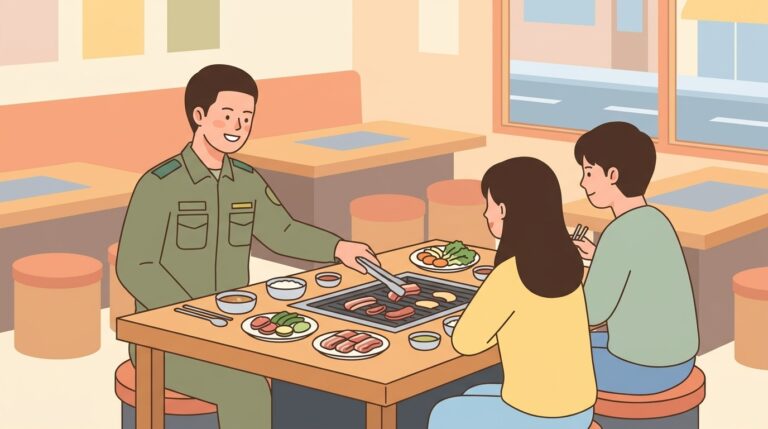
Picture this: Your close Korean male friend, who disappeared into the military a few months ago, suddenly texts you: “나 내일 휴가 나옴! (I’m coming out on leave tomorrow!)” You meet up at a busy restaurant in Hongdae. He appears wearing his freshly ironed military uniform, slightly short hair, and a mixture of extreme tiredness and pure excitement in his eyes. You want to show him support, buy him something great, and make him feel deeply cared for—but you realize standard textbook Korean feels too stiff. Phrases like “수고하십시오” (Work hard) feel like you’re his commanding officer, while “재미있게 노세요” (Have fun) sounds a bit tone-deaf to someone serving on the front lines.
In South Korea, military service (군대 문화) is a profound shared rite of passage. Taking care of a friend on leave (휴가 나온 군인 챙겨주기) is an art form rooted in empathy, respect, and warm affection (jeong). Over 500 intermediate learners in our Daily Hangul community have told us that learning how to speak naturally to friends in uniform built the strongest emotional bonds with their Korean peers. By the end of this guide, you will master the exact nuances, warmth, and gestures that make your Korean friend say, “와, 너 진짜 한국 사람 다 됐다! (Wow, you’ve really turned into a local!)”
Phase 2: Core Expressions Deep Dive
1. 맛있는 것 좀 사 줄게 (Hangul)
- Pronunciation: [Ma-shin-neun geot jom sa jul-ge] (Sounds like: “Mah-sheen-neun geot johm sah jool-geh”)
- Meaning: Direct translation: “I’ll buy you something delicious.” / Real Nuance: “You’ve been eating military food for months; today is my treat, order whatever you want!”
- K-Culture Moment: In K-Dramas, whenever a soldier gets his first 4-day leave (100-il hyuga), older friends immediately drag him to a barbecue spot or seafood place, declaring this exact line before handing him the menu.
- Editor’s Insight: In Korea, military food (jjan-bab) has improved, but nothing beats hot, grilled samgyeopsal or fried chicken outside the base. Saying “사 줄게” instead of asking “Do you want to split the bill?” is the ultimate expression of love.
- Situation Spectrum: Casual ✅ | Semi-formal ⚠️ (맛있는 것 사 드릴게요) | Formal 🚫
- 🤔 Think About It: In your culture, how do people support friends doing tough civic or military duties? Is treating them to a meal common, or do you prefer giving gifts?
2. 고생이 많다 (Hangul)
- Pronunciation: [Go-saeng-i man-ta] (Sounds like: “Goh-saeng-ee mahn-tah”)
- Meaning: Direct translation: “You have a lot of hardship.” / Real Nuance: “I acknowledge how tough your service is, and I truly respect your dedication.”
- K-Culture Moment: Said while patting the soldier’s shoulder warmly when meeting up or parting ways. You often hear older brothers or peers say this with a warm smile.
- Editor’s Insight: Unlike “수고하세요” (which can sound like an instruction to keep working), “고생이 많다” acknowledges past and ongoing hardship with empathy.
- Situation Spectrum: Casual ✅ | Semi-formal ✅ (고생이 많으세요) | Formal ✅ (고생이 많으십니다)
- 🤔 Think About It: Why does Korean culture place such heavy emphasis on acknowledging someone’s unseen hardship (gosaeng) during greetings?
3. 복귀 잘 해 (Hangul)
- Pronunciation: [Bok-gwi jal hae] (Sounds like: “Bohk-gwee jahl hae”)
- Meaning: Direct translation: “Return well.” / Real Nuance: “Have a safe trip back to base, don’t get hurt, and hang in there until your next leave!”
- K-Culture Moment: At the subway station entrance near dusk on the final day of leave, friends wave goodbye as the soldier prepares to take the train back to his base unit.
- Editor’s Insight: Soldiers feel a wave of melancholy called bokgwi-byeong (return sickness) on their last evening. Saying “잘 가” (Goodbye) sounds too casual; “복귀 잘 해” uses the proper military-related word bokgwi while delivering comfort.
- Situation Spectrum: Casual ✅ | Semi-formal ⚠️ (복귀 잘 하세요) | Formal 🚫
- 🤔 Think About It: Notice how Korean farewells often focus on the safety of the journey rather than just saying goodbye.
Phase 3: Textbook Korean vs. Real Korean
Situation 1: Asking how military life is going
- 📖 교과서 한국어: 군대 생활이 즐겁습니까? (Is military life enjoyable?)
- 🗣️ 진짜 한국어: 요즘 군 생활 할 만해? (Is military life manageable these days?)
- 💡 왜 다를까?: Nobody expects military service to be “fun” (jeul-geop-da). Asking if it’s “manageable” (hal man-hae) shows realistic sympathy and invites honest, relaxed conversation without pressure.
Situation 2: Paying for the food
- 📖 교과서 한국어: 제가 음식 값을 계산하겠습니다. (I will pay for the food bill.)
- 🗣️ 진짜 한국어: 오늘 먹고 싶은 거 다 시켜, 내가 쏠게! (Order whatever you want today, it’s on me!)
- 💡 왜 다를까?: “내가 쏠게” (I’ll shoot/treat) is the definitive friendly idiom used among peers. It brings energy and warmth to the table.
Phase 4: K-Culture Deep Dive & Non-verbal Manners
4-1. Nunchi & Gestures for Treating a Soldier
- The Stealth Pay (비밀 결사): Don’t argue over the bill at the table. Quietly excuse yourself to the bathroom near the end of the meal and pay at the counter. When your soldier friend pulls out his wallet, tap his shoulder and say: “이미 계산했어” (Already taken care of).
- Body Language: Give a warm shoulder squeeze or high-five. Avoid asking overly sensitive questions about military classified information or harsh punishment stories unless he brings them up first.
4-2. Culture Code Analysis: The Cravings of Leave
When soldiers leave base, their taste buds crave specific high-calorie, vibrant foods that military dining halls rarely perfect: crispy Korean fried chicken, sizzling samgyeopsal, extra-spicy tteokbokki, or trendy cafe desserts. In Korean youth culture, taking a soldier to a trendy Instagrammable cafe for dessert after a heavy meal is the ultimate comfort ritual.
Phase 5: Real Roleplay Scenario
Setting: A cozy BBQ restaurant in Seoul. You are meeting Min-woo, who is on his second 4-day leave (jajubaet-dae).
- Turn 1 (Min-woo): 🎭 (Adjusts his cap shyly and sits down) 야, 진짜 오랜만이다! 밖으로 나오니까 진짜 살 것 같아.
(Ya, jin-jja o-ren-man-i-da! Bak-eu-ro na-o-ni-kka jin-jja sal geot gga-ta.)
“Hey, it’s been so long! Being outside base makes me feel alive again.” -
Turn 2 (You): 🎭 (Smile warmly and hand him a glass of water) 민우야, 오랜만이야! 얼굴 보니까 좋다. 그동안 고생 많았지?
(Min-woo-ya, o-ren-man-i-ya! Eol-gul bo-ni-kka joh-ta. Geu-dong-an go-saeng man-at-ji?)
“Min-woo, long time no see! Great to see your face. You’ve been working hard, right?” -
Turn 3 (Min-woo): 🎭 (Sighs happily) 말도 마. 요즘 훈련이 많아서 힘들었는데, 오늘 너 만나니까 싹 풀린다.
(Mal-do ma. Yo-jeum hul-ryeon-i ma-na-seo him-deul-eon-neun-de, o-neul neo man-na-ni-kka ssak pool-rin-da.)
“Don’t even get me started. We had so many drills lately, but meeting you today washes it all away.” -
Turn 4 (You): 🎭 (Hand him the menu) 오늘 먹고 싶은 거 다 시켜. 내가 쏠 테니까 부담 갖지 말고!
(O-neul meok-go ship-eun geo da shi-kyeo. Nae-ga ssol te-ni-kka bu-dam gat-ji mal-go!)
“Order whatever you want today. It’s on me, so don’t feel burdened at all!” -
Turn 5 (Min-woo): 🎭 (Eyes wide with excitement) 진짜? 나 삼겹살 3인분에 물냉면까지 먹어도 돼?
(Jin-jja? Na sam-gyeop-sal sam-in-bun-e mul-naeng-myeon-kka-ji meok-eo-do dwae?)
“Seriously? Can I get 3 servings of pork belly plus cold noodles?” -
Turn 6 (You): 🎭 (Laughing cheerfully) 당연하지! 많이 먹고 힘내야지. 사이드 메뉴도 더 시켜!
(Dang-yeon-ha-ji! Ma-ni meok-go him-nae-ya-ji. Sa-i-deu me-nyu-do deo shi-kyeo!)
“Of course! Eat a lot and gain energy. Order extra side dishes too!” -
Turn 7 (Min-woo): 🎭 (Genuinely touched) 아, 감동이다… 역시 너밖에 없다. 진짜 잘 먹을게!
(A, gam-dong-i-da… Yeok-shi neo-bbaek-e eop-ta. Jin-jja jal meok-eul-ge!)
“Ah, I’m touched… As expected, you’re the best. I’ll enjoy every bite!” -
Turn 8 (You): 🎭 (Clinking glasses) 그래, 맛있게 먹고 남은 휴가도 재미있게 보내!
(Geu-rae, ma-shit-ge meok-go na-mun hyu-ga-do jae-mi-it-ge bo-nae!)
“Cheers, enjoy the meal and have fun for the rest of your leave!”
🔀 Interactive Choice Point
At the end of the meal, Min-woo tries to grab the bill. How do you respond?
- Option A: “어? 그래, 반반씩 낼까?” (Oh? Sure, shall we split 50/50?)
- Option B: “가만히 있어! 이미 아까 내가 결제했어. 군인은 돈 쓰는 거 아니야!” (Stay put! I already paid earlier. Soldiers shouldn’t spend money!)
- Option C: “너 군대에서 월급 많이 받잖아, 네가 내라!” (You earn good money in the army, you pay!)
Feedback:
* 🥇 Option B (Best): Perfect Korean culture move! Paying stealthily and adding “군인은 돈 쓰는 거 아니야” (Soldiers don’t spend money on leave) is legendary kindness.
* ⚠️ Option A (Bad): Not wrong, but misses a great cultural bonding opportunity.
* 🚫 Option C (Risk): High risk of hurting feelings! Military pay has risen, but service remains a sacrifice.
Phase 6: 10-Second Emotion Shadowing Drill
Practice saying these lines out loud with expressive pitch and emotion!
[😊 Welcoming & Caring]
민우야! / 고생 많았지? / 오늘 먹고 싶은 거 / 다 시켜!
(Min-woo-ya! / Go-saeng ma-nat-ji? / O-neul meok-go ship-eun geo / da shi-kyeo!)-
[🥺 Warm Farewell]
다치지 말고 / 건강하게 / 복귀 잘 해! / 또 연락해!
(Da-chi-ji mal-go / geon-gang-ha-ge / bok-gwi jal hae! / Tto yeon-rak-hae!)
Phase 7: K-Culture Mini Dictionary
- 휴가 (Hyu-ga) | Military Leave | Official period where a soldier is permitted to leave the base to meet family and friends.
- PX (피엑스 / P-X) | Post Exchange (Military Store) | Base retail store selling snacks and cosmetics at tax-free prices; soldiers often bring popular PX creams or snacks as gifts for friends.
- 군대리아 (Gun-dae-ri-a) | Military Burger | DIY burgers served in military mess halls; iconic topic for army memory banter.
- 전역 (Jeon-yeok) | Military Discharge | The official completion of military duty. Friends celebrate this with cake and party banners.
Phase 8: Traveler & Local Survival Kit
Top 3 Expressions
- 무사히 전역하자! (Mu-sa-hi jeon-yeok-ha-ja!) – Let’s get discharged safely without injuries!
- 휴가 며칠 남았어? (Hyu-ga myeo-chil na-mat-eo?) – How many days of leave do you have left?
- 충성! (Chung-seong!) – Loyalty! (Playful salute gesture used jokingly among close friends).
Editor’s Travel Note
When planning a meetup with a friend on leave, book popular restaurants in advance using 네이버 지도 앱 다운로드 to save your soldier friend from standing in long queues while wearing his uniform.
Phase 9: One Step Deeper
In Korean society, compulsory military service creates a unique shared empathy among men and their loved ones. When a young man enters the military, his entire social circle—friends, parents, and partners—collectively steps up to support him. Treating a friend on leave is not merely paying for food; it is an affirmation that his community remembers his sacrifice and eagerly awaits his return to civilian life.
💬 Your Turn: Have you ever had a friend undergo military or mandatory service? What custom do you have in your country to show them appreciation? Let us know in the comments below!
Phase 10: FAQ & Common Mistakes
Q: Can I ask my Korean friend about his rank or base location?
A: Yes! Asking about his rank (계급, e.g., 일병, 상병) or general area (e.g., 강원도) is completely normal and shows genuine interest.
Q: Should I salute my friend when I see him?
A: Doing a quick, playful salute while saying “충성!” with a big smile is a fun icebreaker among close friends!
Q: What is a good small gift to bring a soldier friend returning to base?
A: Portable snacks, hand cream, lip balm, or blister pads (대형 반창고) for military boots are thoughtful items they will love.
🚨 Common Mistakes TOP 3
- Saying “수고하세요” when parting ways.
Correction: Use “복귀 잘 해!” or “몸 조심히 들어가!”. - Asking sensitive military tactical questions.
Correction: Focus on his physical health, food cravings, and fun personal updates. - Letting the soldier pay the bill.
Correction: Quietly settle the bill before he notices!
Phase 11: Action Mission
- Bronze Mission: Say “맛있는 것 좀 사 줄게” out loud 3 times with warm intonation.
- Silver Mission: Text a Korean friend on leave: “휴가 잘 보내고 복귀 잘 해!”
- Gold Mission: Meet up with a Korean friend in uniform, treat him to his favorite meal, and stealthily pay the bill!
- 🎮 K-Culture Mission: Watch a scene from K-dramas like Crash Landing on You or D.P. and spot how soldiers interact during leave!
Phase 12: Interactive Quiz Challenge
Q1. What is the most natural way to say goodbye to a soldier returning to base?
👉 Click to reveal Answer & Explanation
Answer: 복귀 잘 해! (Bok-gwi jal hae!)
Explanation: “복귀” is the proper Korean term for returning to base. It shows care and understanding of his military context.
Q2. Fill in the blank: “오늘 먹고 싶은 거 다 시켜, 내가 _____!” (It’s my treat today!)
👉 Click to reveal Answer & Explanation
Answer: 쏠게 (ssol-ge)
Explanation: “내가 쏠게” is the widely used intermediate idiom for “It’s my treat!”
Q3. True or False: In Korea, it is customary to split the restaurant bill evenly when eating with a friend on military leave.
👉 Click to reveal Answer & Explanation
Answer: False
Explanation: Friends almost always treat the soldier on leave as a gesture of gratitude and friendship.







