

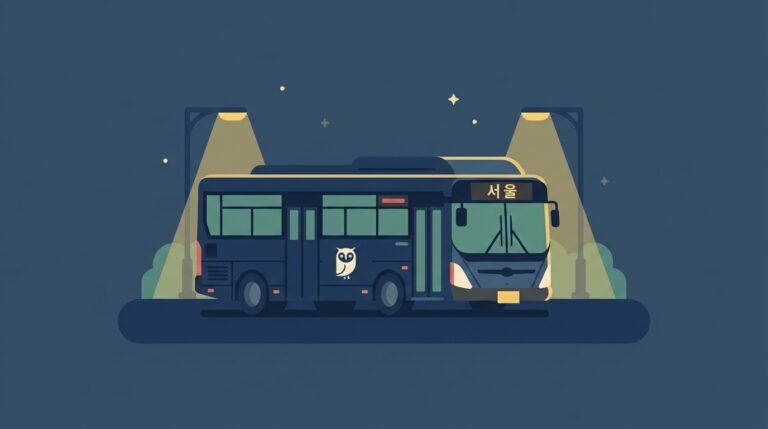
안녕하세요! 매일한글 에디터입니다. Have you ever found yourself standing on the vibrant streets of Hongdae or Gangnam at 1:30 AM, watching the neon signs glow while sudden panic sets in because the last subway train just departed? Taxis during midnight peak hours can be notoriously hard to hail, and dynamic surge pricing can quickly drain your budget. But here is the secret that true Seoulites rely on: Seoul’s legendary late-night transit system, affectionately known as the Owl Bus (올빼미 버스)!
As a C1 advanced learner, you already know basic transit vocabulary like 버스 (bus) or 지하철 (subway). However, navigating Seoul’s nocturnal arterial routes requires a deeper understanding of urban idioms, subtle social cues, and time-sensitive nuances. In this guide, derived directly from actual learner feedback and real native mobility patterns, we’ll dive deep into late-night bus terminology so you can move through Korea’s nighttime culture with absolute confidence and native finesse.
Phase 2: Core Expressions Deep Dive
1. 끊기다 (Kkeunkkida)
- Pronunciation: [Kkeun-kki-da] (Sounds like “clean-key-da” with a crisp, tense ‘k’ sound)
- Meaning: Literal: To be severed/cut off | Nuance: Service or connection has ended for the night.
- K-Culture Moment: Leaving a late-night street food vendor (포장마차) at 12:45 AM, checking your phone transit app, and realizing in shock: “지하철 끊겼어!”
- Editor’s Insight: While 끝나다 means “to finish,” native speakers specifically use the passive verb 끊기다 (to be cut) for transit lines, phone calls, and supply lines. It captures the sudden cut-off of a continuous flow.
- Situation Spectrum:
- Casual: ✅ (“막차 끊겼어!”)
- Semi-formal: ✅ (“버스가 끊겼네요.”)
- Formal: ✅ (“막차 운행이 끊겼습니다.”)
- 🤔 Think About It: Why does Korean conceptualize transport schedules as an uninterrupted thread (줄) that gets “cut” (끊기다) at midnight, rather than simply “stopping”?
2. 막차를 놓치다 (Makcha-reul notchida)
- Pronunciation: [Mak-cha-reul not-chi-da] (Note how ‘막’ creates a quick glottal stop before ‘차’)
- Meaning: Literal: To miss the final vehicle | Nuance: To miss your last regular transportation option before overnight fares apply.
- K-Culture Moment: A classic K-drama trope where the protagonist sprinted down subway stairs only to see the red tail lights disappear into the tunnel.
- Editor’s Insight: ‘막-‘ is a prefix meaning “final/last” in a series (e.g., 막차 = last ride, 막방 = last broadcast). ‘놓치다’ implies missing an opportunity due to timing.
- Situation Spectrum:
- Casual: ✅ (“나 막차 놓쳤어!”)
- Semi-formal: ✅ (“막차를 놓쳤어요.”)
- Formal: ✅ (“막차를 놓치고 말았습니다.”)
- 🤔 Think About It: Contrast ‘막차’ (last vehicle) with ‘첫차’ (first morning vehicle). How does Korean structure temporal endpoints so symmetrically?
3. 올빼미 버스를 갈아타다 (Ollppaemi beoseu-reul gara-tada)
- Pronunciation: [Oll-ppae-mi beo-seu-reul ga-ra-ta-da] (Feel the light bounce on ‘올빼미’)
- Meaning: Literal: To transfer to a night owl bus | Nuance: To smartly bypass midnight taxi wars by switching to designated ‘N-prefixed’ late-night bus routes.
- K-Culture Moment: Transferring at Jongno 3-ga at 2:15 AM after a late karaoke session, seamlessly tapping your transport card.
- Editor’s Insight: ‘갈아타다’ combines ‘갈다’ (to exchange) and ‘타다’ (to ride). Using this compound verb shows high-level fluency over simple ‘타다’.
- Situation Spectrum:
- Casual: ✅ (“올빼미 버스로 갈아타자.”)
- Semi-formal: ✅ (“올빼미 버스로 갈아타시면 돼요.”)
- Formal: ✅ (“올빼미 버스로 갈아타셔야 합니다.”)
- 🤔 Think About It: ‘올빼미’ (night owl) was officially chosen by Seoul citizens through a public contest. How does playful naming make urban infrastructure feel friendly?
Phase 3: Textbook Korean vs. Real Native Korean
Situation 1: Checking if late-night buses are running
- 📖 Textbook: 지금 심야 버스가 운행하고 있습니까? (Is the late-night bus operating right now?)
- 🗣️ 진짜 한국어: 지금 N버스 잡힐까요? / 아직 올빼미 다니죠? (Can we catch an N-bus now? / Owl buses are still running, right?)
- 💡 Why different?: Advanced native speakers rarely say full formal phrases like ‘운행하고 있습니까?’ in casual midnight conversations. They abbreviate Owl Buses to N버스 (Routes starting with ‘N’) and use dynamic verbs like 다니다 (to circulate) or 잡히다 (to catch/hail).
Situation 2: Celebrating making it onto the last transport
- 📖 Textbook: 다행히 버스를 탈 수 있었습니다. (Fortunately, I was able to ride the bus.)
- 🗣️ 진짜 한국어: 와, 턱걸이로 막차 탑승 성공! (Phew, barely made the last ride by the skin of my teeth!)
- 💡 Why different?: Real Koreans use metaphorical expressions like 턱걸이 (literally ‘chin-up’, meaning barely scraping by or clutching at the last moment) to express relief and excitement.
Phase 4: K-Culture Deep Dive & Non-Verbal Etiquette
4-1. Nunchi (눈치) & Late-Night Bus Etiquette
- The Silent Sanctuary: Riding an Owl Bus at 2:30 AM requires high-level 눈치 (situational etiquette). Unlike daytime buses filled with phone chatter, late-night buses are quiet sanctuaries for tired commuters, shift workers, and night owls. Keep phone voice levels muted to a whisper or stick to texting.
- The Card Tag Discipline: Even at 3:00 AM when you are exhausted, never forget to tag off (하차 태그). In Korea’s integrated transit system, failing to tag off on an Owl Bus triggers maximum distance surcharges when you tap into the subway the next morning!
4-2. Cultural Code: The ‘N-Bus’ Urban Lifeline
Introduced by the Seoul Metropolitan Government, the Owl Bus service (routes designated with ‘N’ such as N13, N26, N37) runs from 11:30 PM to 6:00 AM. It represents Seoul’s core identity as a safe, 24-hour global metropolis. Observing who rides these buses—from students finishing late study sessions to kitchen workers and office employees—offers a profound glimpse into the tireless dedication powering modern Korea.
Phase 5: Real-Life Roleplay Scenario
Setting: Hongdae Entrance Station Exit 8, 1:45 AM. Alex (C1 Learner) and Min-jun (Native Friend) just finished street performances.
- Alex: 🎭 [핸드폰 시계를 확인하며 당황한 표정으로] 민준아, 어쩌지? 지하철 벌써 끊긴 것 같은데?
(Min-jun, what should we do? I think the subway is already cut off!) - Min-jun: 🎭 [자연스럽게 네이버 지도를 켜며] 아, 진짜네. 15분 전에 막차 떠났어. 택시 잡을까?
(Ah, you’re right. The last train left 15 minutes ago. Shall we hail a taxi?) - Alex: 🎭 [고개를 저으며] 이 시간에 홍대에서 택시 잡기 하늘의 별 따기잖아. 다른 방법 없어?
(Hailing a taxi in Hongdae at this hour is like picking stars from the sky. Any other way?) - Min-jun: 🎭 [손가락으로 정류장을 가리키며] 그럼 올빼미 버스 타고 가자! N26번 타면 너희 집 근처까지 한 번에 가.
(Then let’s take the Owl Bus! If we take N26, it goes straight near your place.) - Alex: 🎭 [눈을 반짝이며] N26? 배차 간격은 얼마나 되는데?
(N26? What’s the dispatch interval?) - Min-jun: 🎭 [앱 화면을 보여주며] 한 25분 정도? 지금 정류장으로 걸어가면 딱 맞아.
(About 25 minutes? If we walk to the bus stop now, the timing is perfect.) - Alex: 🎭 [한숨을 쉬며 안도하는 목소리로] 다행이다! 택시비 폭탄 맞을 뻔했네. 턱걸이로 살았다!
(Thank goodness! I almost got hit with a taxi fare bomb. Saved by the skin of my teeth!) - Min-jun: 🎭 [웃으며 Alex의 어깨를 두드리며] 가자! 카드는 미리 꺼내두고!
(Let’s go! Keep your card ready in advance!)
🔀 Interactive Choice Point
When the N26 bus arrives packed with people at 2:05 AM, what do you say to the driver while tapping your card?
- Option A: “안녕하세요! 강남역 가는지 확인하고 타겠습니다!”
- Option B: “기사님, 혹시 이 버스 종로 거쳐서 가나요?”
- Option C: (말없이 조용히 카드를 대고 빠르게 빈자리를 찾아 들어간다)
Feedback:
- Option A (Bad): ❌ Too verbose for late-night bus boarding. Drivers prefer quick boarding so schedule timing remains precise.
- Option B (Risk): ⚠️ If the bus is full and doors are closing fast, long questions create delays. Check destination signs on the front glass instead.
- Option C (BEST): ✅ Perfect native etiquette! Late at night, swift card tapping and quiet entry respect the tired passengers and driver focus.
Phase 6: 10-Second Emotion Shadowing Drill
Practice reading these with proper dynamic pauses (/) and emotional tone:
- 🎭 [😱 Panic & Anxiety]
아 어쩌지? / 지하철 막차가 / 벌써 끊겼어! / 택시도 안 잡히는데…
(Ah, what to do? / The last subway train / is already cut off! / Taxis aren’t getting caught either…) -
🎭 [😌 Relief & Confidence]
걱정 마! / 올빼미 버스 타고 가면 / 택시비도 아끼고 / 금방 도착해!
(Don’t worry! / If we take the Owl Bus / we save taxi fares / and arrive in no time!)
Phase 7: K-Culture Mini Dictionary
- 올빼미 버스 (Ollppaemi Beoseu) | Owl Bus
- Midnight bus network operating in Seoul between 11:30 PM and 6:00 AM.
- N버스 (N-Beoseu) | N-Bus
- Colloquial term for Owl Buses, where ‘N’ stands for Night.
- 환승할인 (Hwanseung Hal-in) | Transfer Discount
- Korea’s integrated fare system that grants discounted rates when switching between subways and buses (including N-buses) within time limits.
- 막차 (Makcha) | Last Vehicle / Final Service
- Essential daily term referring to the last train or bus of any scheduled line.
Phase 8: Traveler’s Survival Kit
Survival Top 3 Expressions
- 이 버스 강남역 방향 맞나요? (Is this bus bound for Gangnam Station?)
- Pronunciation: [I beoseu gangnam-yeok bang-hyang mannayo?]
- Pro Tip: Ask swiftly as you step onto the first step.
- 다음 올빼미 버스 몇 분 뒤에 와요? (How many minutes until the next Owl Bus?)
- Pronunciation: [Daeum ollppaemi beoseu myeot bun dwie wayo?]
- Pro Tip: Useful when checking real-time bus stop digital displays.
- 내릴 때 카드 다시 대야 하죠? (I need to tap my card again when getting off, right?)
- Pronunciation: [Naeril ttae kadeu dasi daeya hajyo?]
- Pro Tip: Essential to avoid morning transfer penalty fees.
Editor’s Travel Note
Before heading out for night nightlife in Seoul, make sure to check route maps via the 네이버 지도 앱 다운로드 guide. Type N in the transit search bar to view all late-night bus routes passing through your current location in real time.
Phase 9: A Step Deeper (Humanities Thought)
Seoul’s Owl Bus network is more than a mere nocturnal convenience; it is a testament to modern urban equity and safety. In many global capitals, late-night travel forces a financial binary: expensive private taxis or unsafe walks. By integrating affordable, GPS-tracked late-night public buses into the existing smart transit grid, Korea ensures that nightlife workers, late-shift hospital staff, and budget-conscious travelers enjoy equal nocturnal mobility. This efficiency reflects a deep cultural value placed on collective civic welfare and seamless public safety.
💬 Your Turn: Have you ever experienced getting stranded late at night in a foreign city? How does Seoul’s N-Bus system compare to late-night transit in your hometown? Share your thoughts in the comments below!
Phase 10: FAQ & Common Mistakes
Q: Can I use my standard T-money card or climate card on Owl Buses?
A: Yes! Standard T-money, Cashbee, and foreign credit cards with contact-less transit functions (KB, Shinhan, Visa/Master transit) work automatically on Owl Buses. Note that special daytime tourist passes may have specific midnight rules, but standard prepaid transit cards are 100% accepted.
Q: Do Owl Buses cost more than regular daytime buses?
A: Slightly, but very reasonably. While a standard daytime city bus fare is 1,500 KRW, an Owl Bus fare is approximately 2,150 KRW. This is dramatically cheaper than late-night taxi surcharges which add 20%–40% premium rates.
Q: How frequently do Owl Buses run?
A: Depending on the specific route (e.g., N13, N26, N61), intervals range between 25 to 35 minutes. Because intervals are longer than daytime buses, checking live bus arrivals on navigation apps before stepping out is highly recommended.
🚨 Common Mistakes TOP 3
| Common Mistake | Why It Happens | Correct Action |
|---|---|---|
| 1. Forgetting to tap off (하차 태그) when exiting | Assuming late-night rides don’t calculate distance | Always tap off! Otherwise, maximum distance penalties apply on your next ride. |
| 2. Waiting at regular bus stops without checking ‘N’ route signs | Not all bus stops host Owl Bus stops | Look for the designated ‘N’ marker on the bus stop pole or check mobile maps. |
| 3. Trying to pay with large cash bills (e.g., 50,000 KRW) | Assuming drivers carry large cash change at night | Seoul buses are transitioning to cash-less buses. Always carry a transit card or smartphone NFC payment. |
Phase 11: Action Mission & Engagement
🎯 Action Mission 3 Steps
- 🥉 Bronze Level: Practice saying “막차 끊기기 전에 올빼미 버스 타자!” out loud 3 times until natural.
- 🥈 Silver Level: Open your navigation app, search route ‘N26’ or ‘N13’, and screenshot two major transfer hubs.
- 🥇 Gold Level: Next time you stay late in Korea, successfully ride an N-bus back to your accommodation without using a taxi!
🎮 K-Culture Mission
Watch a recent urban K-drama set in Seoul. Listen closely during night scenes for characters mentioning “막차” or arguing over taking an






