

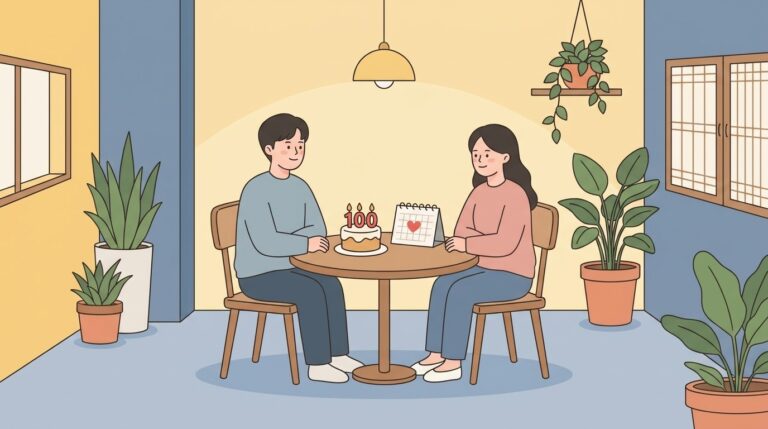
Never Forget Your Korean Anniversary: Count Days Like a Local!
Phase 1: Empathy
안녕하세요! Hello! I’m your Daily Hangul editor, your best Korean friend and local cultural navigator! Have you ever watched a K-Drama and noticed the main couple excitedly celebrating their “100th day” together? In Korea, anniversaries aren’t just about annual milestones like 1-year or 5-year marks. Korean couples and friends count days by 100s—100 days (백일), 200 days (이백일), and even 1000 days!
If you’re new to learning Korean, counting dates for anniversaries might feel confusing. Do you use Native Korean numbers or Sino-Korean numbers? How do you ask someone what day you’re celebrating today without sounding like a robotic dictionary? Don’t worry! Based on real feedback from hundreds of beginners just like you, I have created this super friendly, step-by-step guide. By the end of this post, you’ll be able to comfortably count days, wish your Korean friends a happy anniversary, and understand romantic K-Culture moments like a true local!
Phase 2: 3 Key Expressions Deep Dive
1. 오늘 우리 백 일이에요! (Oneul uri baek il-ieyo!)
- Pronunciation: [Oh-neul oo-ri baek eel-ee-eh-yo] (Sounds like ‘pack’ without the ‘p’ + ‘eel’)
- Meaning: Direct: “Today is our 100 day!” | Nuance: “Today is our 100th day anniversary!”
- K-Culture Moment: Seen in almost every romantic K-drama when the male lead gives his partner a cute flower bouquet or couple rings on their 100th day together.
- Editor’s Insight: ‘백’ (baek) means 100, and ‘일’ (il) means day. Combine them with ‘우리’ (uri – our) to show warm affection!
- Situation Spectrum: Casual ✅ | Semi-formal ✅ | Formal ⚠️
- 🤔 Think About It: Why do you think Korean culture prefers celebrating 100 days over waiting a whole year?
2. 오늘 무슨 날이에요? (Oneul mubeun nal-ieyo?)
- Pronunciation: [Oh-neul moo-seun nal-ee-eh-yo] (Sounds like ‘moo-seun’ rhymes with ‘person’)
- Meaning: Direct: “Today is what day?” | Nuance: “Is today a special occasion / anniversary?”
- K-Culture Moment: Used when someone comes to the office with fancy snacks or when a friend dresses up nicely.
- Editor’s Insight: Use this phrase whenever you sense something special is happening but aren’t sure why!
- Situation Spectrum: Casual ✅ | Semi-formal ✅ | Formal ✅
- 🤔 Think About It: How do people in your culture subtly ask if today is a special day?
3. 기념일 잘 챙기세요! (Ginyeomil jal chaeng-giseyo!)
- Pronunciation: [Ghee-nyeom-eel jal chaeng-ghee-seh-yo]
- Meaning: Direct: “Take care of the anniversary well!” | Nuance: “Have a wonderful anniversary celebration!”
- K-Culture Moment: Said to coworkers or friends before they go on a date for their anniversary.
- Editor’s Insight: ‘챙기다’ (chaeng-gida) means ‘to take care of / not to forget’. Caring for others’ special days is a big part of Korean bonding.
- Situation Spectrum: Casual ⚠️ | Semi-formal ✅ | Formal ✅
- 🤔 Think About It: How does caring about small dates build stronger community relationships?
Phase 3: Textbook Korean vs. Real Korean
Situation 1: Asking how many days you’ve been dating
- 📖 Textbook: 우리는 만난 지 며칠 되었습니까? (Urineun mannan ji myeochil doe-eot-seumnida?)
- 🗣️ Real Korean: 우리 만난 지 며칠 됐지? (Uri mannan ji myeochil dwaet-ji?)
- 💡 Why different? Beginners often learn heavy formal endings like ‘-습니까’, but in real conversations with friends or partners, soft conversational endings like ‘-됐지?’ sound natural and warm.
Situation 2: Celebrating a special day
- 📖 Textbook: 축하합니다. 오늘을 기념합시다. (Chuk-ha-ham-nida. Oneul-eul ginyeom-hapsida.)
- 🗣️ Real Korean: 오늘 축하해! 재미있게 놀자! (Oneul chuk-ha-hae! Jaemi-it-ge nol-ja!)
- 💡 Why different? ‘기념합시다’ sounds like an official corporate speech! Real Koreans simply say ‘축하해’ (Congratulations) and propose having fun together.
Phase 4: K-Culture Deep Dive & Non-verbal Manners
4-1. Nunchi & Gestures
When celebrating an anniversary or special date in Korea, body language matters!
* Handing gifts: Always hand over gifts or anniversary flowers with both hands (or one hand supporting your forearm) as a sign of respect.
* Making a heart: Make a finger heart (엄지 손가락과 검지 손가락으로 만든 하트) when taking photos at photo booths like Life Four Cuts (인생네컷).
4-2. Cultural Code: The ‘100-Day’ (백일) Tradition
Historically, ‘백일’ (100 days) comes from celebrating a newborn baby surviving their first 100 days safely. Nowadays, young Koreans adopted this concept for couples! Couples use special smartphone apps (like ‘Between’ or ‘D-Day counter’) to track day 100, 200, 300, and 1000.
Phase 5: Real Roleplay Scenario
Setting: Minji (Korean friend) and Alex (you) are at a aesthetic café in Seongsu-dong.
Character NPC: Minji (Enthusiastic Korean friend)
- Minji: 알렉스! 오늘이 무슨 날인지 알아? (Alex! Oneul-i mubeun nal-injie ara?)
- Translation: Alex! Do you know what day today is?
- 🎭 Action: Pointing excitedly at her phone calendar.
- Alex: 어… 오늘 무슨 날이에요? (Eeo… oneul mubeun nal-ieyo?)
- Translation: Uh… what day is today?
- 🎭 Action: Looking slightly nervous.
- Alex: 혹시… 백 일이에요? (Hoksi… baek il-ieyo?)
- Translation: By any chance… is it day 100?
- 🎭 Action: Tilting head curiously.
- Minji: 맞아! 우리 친해진 지 100일 된 날이야! (Maja! Uri chinhae-jin ji baek-il doen nal-iya!)
- Translation: That’s right! It’s been 100 days since we became close friends!
- 🎭 Action: Clapping hands joyfully.
- Alex: 와, 벌써 백 일이에요? 축하해요! (Wa, beolsseo baek il-ieyo? Chuk-ha-hae-yo!)
- Translation: Wow, already 100 days? Congratulations!
- 🎭 Action: Smiling brightly.
- Minji: 맛있는 거 먹자! 내가 쏠게! (Masinneun geo meok-ja! Naega ssol-ge!)
- Translation: Let’s eat something delicious! My treat!
- 🎭 Action: Giving a high five.
- Alex: 좋아요! 오늘 진짜 특별한 날이네요. (Jo-ha-yo! Oneul jin-jja teuk-byeol-han nal-i-ne-yo.)
- Translation: Great! Today is really a special day.
- 🎭 Action: Giving a finger heart.
- Minji: 응, 매일한글 덕분에 우리 매일 커뮤니케이션 잘 된다! (Eung, Daily Hangul deok-bune uri maeil communication jal doenda!)
- Translation: Yeah, thanks to Daily Hangul, our daily communication works so well!
- 🎭 Action: Laughing together.
🔀 Interactive Choice Point
Minji asks: “오늘 뭐 하고 싶어?” (What do you want to do today?)
- Choice A: “케이크 먹으러 가요!” (Let me eat cake!) -> [BEST ✅] Perfect! Cake is the quintessential celebration food in Korea.
- Choice B: “공부하러 가요.” (Let’s go study.) -> [RISK ⚠️] A bit too formal for a celebration day, though Minji will respect your zeal!
- Choice C: “집에 갈래요.” (I want to go home.) -> [BAD 🚫] Ouch! Ending the celebration too abruptly might hurt your friend’s feelings.
Phase 6: 10-Second Emotion Shadowing Drill
- [😊 Joyful & Excited] 오늘 / 우리 / 백 일이에요! (Oh-neul / oo-ri / baek il-ieyo!)
- [🤔 Curious & Soft] 오늘 / 무슨 / 날이에요? (Oh-neul / moo-seun / nal-ieyo?)
- [🥳 Warm & Congratulatory] 기념일 / 진짜 / 축하해요! (Gi-nyeom-il / jin-jja / chuk-ha-hae-yo!)
Phase 7: K-Culture Mini Dictionary
- 백일 (Baek-il) | 100-Day Anniversary | Celebrated by couples or babies reaching their 100th day mark.
- 커플링 (Couple-ring) | Matching Rings | In Korea, couples exchange matching rings often on their 100th day rather than waiting for engagement.
- D-Day (디데이) | Target Date Counter | Koreans use D-Day counters on smartphone widgets to track days left or passed since a date.
- 기념일 (Ginyeom-il) | Anniversary / Special Day | Any memorial or special date worth celebrating with food or gifts.
Phase 8: Traveler’s Survival Kit
Survival Expressions TOP 3
- 오늘 예약했어요. (Oneul yeyak-haesseo-yo) – I made a reservation for today.
- 사진 찍어 주세요! (Sajin jjigeo ju-se-yo!) – Please take a photo of us!
- 축하 케이크 있나요? (Chuk-ha cake in-na-yo?) – Do you have a celebration cake?
Editor’s Travel Note
When planning a special dinner date in Seoul for your anniversary, use local apps! Download the Naver Map App to search for trendy restaurants in Hongdae or Gangnam, and check reviews before visiting.
Phase 9: One Step Deeper
In many Western cultures, anniversaries are measured in years (1st year, 25th year). However, Korean culture values milestones of togetherness in smaller, shared increments like 100 days. This reflects the Korean cultural emphasis on Jeong (정 – deep emotional bonding) through frequent, shared care and attention. Counting 100 days reminds both people to appreciate the present connection continuously.
💬 Your Turn: What is the most unique anniversary tradition in your home country? Drop a comment below and share with our Daily Hangul community!
Phase 10: FAQ & Common Mistakes
Q: Do I use Native Korean numbers (하나, 둘, 셋) or Sino-Korean numbers (일, 이, 삼) for date counting?
A: For counting days like 100 days, use Sino-Korean numbers! 100 is 백 (baek), so 100 days is 백일 (baek-il). 200 days is 이백일 (i-baek-il).
Q: Can I use 백일 (baek-il) for wedding anniversaries?
A: No, wedding anniversaries are measured in years! You should use 년 (nyeon). For example, 1st anniversary is 1주년 (il-ju-nyeon).
Q: Is it rude if I forget a 100-day anniversary in Korea?
A: Among younger Korean couples, forgetting 100 days can lead to a cute disagreement! It is best to set a smartphone widget reminder.
🚨 Common Mistakes TOP 3
- ❌ Saying “백 날” (Baek nal) -> ✅ Say “백 일” (Baek il) for 100 days.
- ❌ Saying “축하합니다” to your close boyfriend/girlfriend -> ✅ Say “축하해~” to sound affectionate.
- ❌ Mixing Native numbers like “한 일” -> ✅ Use Sino-Korean numbers: “일 일”, “백 일”.
Phase 11: Action Missions
- 🥉 Bronze Mission: Practice saying “오늘 무슨 날이에요?” out loud 3 times in front of your mirror.
- 🥈 Silver Mission: Open your calendar and write down today’s date in Korean numbers!
- 🥇 Gold Mission: Leave a comment on this post celebrating a real or imaginary 100-day anniversary using Hangul!
🎮 K-Culture Mission: Watch a short K-Drama clip on YouTube and listen closely for the word “백일” or “기념일”!
Phase 12: Interactive Quiz Challenge
Q1. How do you say “100 days anniversary” in Korean?
Click to reveal answer!
Answer: 백일 (Baek-il). Remember that 백 means 100 and 일 means day!
Q2. Fill in the blank: “오늘 _____ 이예요?” (Is today a special day?)
Click to reveal answer!
Answer: 무슨 날 (mubeun nal). The full sentence is “오늘 무슨 날이에요?”.
Q3. True or False: In Korea, couple rings are only exchanged when getting married.
Click to reveal answer!
Answer: False! Young couples frequently exchange couple rings on their 100th day anniversary as a sign of commitment.







