

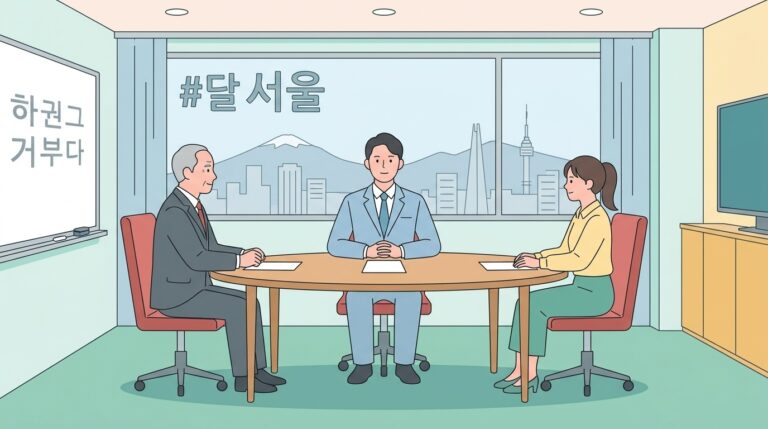
Master Workplace Mediation in Korea: Resolving Intergenerational Conflicts Like a Senior HR Executive
Phase 1: Empathy & Storytelling Opening
안녕하세요! 매일한글 에디터입니다. (Hello! This is your Daily Hangul Editor.)
Picture this scene from a sleek Gangnam corporate office straight out of a K-Drama: Director Park, a 50-something veteran who built his career through late-night overtime and endless hoesik (team dinners), is visibly flustered. On the other side of the glass conference room stands Yuna, a brilliant 20-something designer who just muted the department KakaoTalk group after 6:00 PM, citing her contractual right to disconnect. Director Park views Yuna’s boundary as a lack of team dedication; Yuna views Director Park’s evening texts as an invasive boundary breach.
As a C2-level Korean speaker navigating or managing professional environments in Korea, you aren’t just expected to translate words—you are expected to mediate workplace culture. Intergenerational conflict (세대 갈등) between the traditional Kkondae (boomer/꼰대) mindset and the rising MZ generation (MZ세대) is currently the single largest focus of corporate HR in Korea. Mediating these disputes requires high-level linguistic diplomacy, subtle honorific shifts, and deep empathy.
Based on real HR coaching cases from top Korean enterprises, this guide equips you with the exact linguistic nuance and emotional intelligence needed to bridge generational divides gracefully.
Phase 2: Deep Dive into 3 Essential Mediation Expressions
1. 접점을 찾다 (Jeobjeom-eul chatda)
- Pronunciation: [Jeob-jjeom-eul chat-da] (Pronounce ‘jeob’ firmly like ‘job’, followed by a sharp ‘jjeom’ similar to ‘jam’ with a crisp ‘t’ stop)
- Meaning: Literal: To find the point of tangency | Nuance: To find common ground or establish a win-win consensus through active negotiation.
- K-Culture Moment: Seen frequently in business K-dramas like Search: WWW or Agency, where C-level executives mediate clashes between traditional marketing teams and digital-native growth hackers.
- Editor’s Insight: This phrase elevates your command of Korean from merely proposing a solution to strategically aligning opposing visions without making either party feel compromised.
- Situation Spectrum: Casual 🚫 | Semi-formal ⚠️ | Formal ✅
- 🤔 Think About It: How does seeking ‘tangency’ (접점) differ from simply asking someone to ‘compromise’ (타협하다) in your culture?
2. 입장 차이를 줄이다 (Ipjang chairul jurida)
- Pronunciation: [Ip-jang cha-i-reul ju-ri-da] (Flow smoothly from ‘ip-jang’ with a relaxed ‘cha-i’, sounding like ‘leap-jong chai-rule’ spoken fluidly)
- Meaning: Literal: To narrow the gap in standing/position | Nuance: To reduce emotional and operational divergence between conflicting parties.
- K-Culture Moment: Used by seasoned HR directors in corporate meetings when balancing traditional seniority expectations with merit-based performance metrics.
- Editor’s Insight: Using 입장 (position/stance) acknowledges that both parties have valid, context-driven reasons for their behavior, shifting the blame away from personal flaws to positional perspectives.
- Situation Spectrum: Casual 🚫 | Semi-formal ✅ | Formal ✅
- 🤔 Think About It: In Korean workplace culture, acknowledging someone’s 입장 (stance) preserves their 체면 (face). How do you preserve face during conflicts in your native language?
3. 서로의 맥락을 이해하다 (Seoroui maengnageul ihaehada)
- Pronunciation: [Seo-ro-ui maeng-na-geul i-hae-ha-da] (‘Maeng-nak’ links softly into ‘maeng-na-geul’, feeling as smooth as ‘mang-na-geul’)
- Meaning: Literal: To understand each other’s context | Nuance: To empathize with the underlying cultural, historical, or generational background driving someone’s actions.
- K-Culture Moment: Commonly featured in modern corporate HR workshops aimed at helping senior managers understand Gen Z work philosophy.
- Editor’s Insight: C2 speakers know that 맥락 (context) is king in Korean high-context communication. Pointing out 맥락 gently shifts the conversation from subjective anger to objective background understanding.
- Situation Spectrum: Casual ⚠️ | Semi-formal ✅ | Formal ✅
- 🤔 Think About It: Korean is a high-context culture. How much unspoken context do you assume people understand in your daily management style?
Phase 3: Textbook Korean vs. Native Workplace Mediation Korean
Situation 1: Suggesting a compromise between a senior manager and a junior employee
- 📖 Textbook Korean: “두 사람은 서로 양보해서 합의를 도출해야 합니다.” (Both people must concede to each other to reach an agreement.)
- 🗣️ Native Advanced Korean: “양측의 시각차를 인정하고, 현실적인 접점을 찾아보는 건 어떨까요?” (How about acknowledging the difference in perspectives on both sides and exploring a realistic middle ground?)
- 💡 Why the difference? Textbook phrasing sounds dictatorial and aggressive. Native C2 phrasing uses soft question endings (-는 건 어떨까요?) and frame-reframing nouns like 시각차 (perspective gap) to soften the mediation.
Situation 2: Explaining a junior employee’s preference for digital communication to an older boss
- 📖 Textbook Korean: “젊은 직원들은 메신저를 더 좋아합니다.” (Younger employees prefer messaging apps.)
- 🗣️ Native Advanced Korean: “신입 사원 직원의 업무 효율성을 위한 소통 방식의 맥락을 고려해 주시면 좋겠습니다.” (It would be great if you could consider the context of communication methods geared toward the junior staff’s work efficiency.)
- 💡 Why the difference? Framing the issue around 업무 효율성 (work efficiency) and 맥락 (context) validates the junior employee’s choice professionally rather than framing it as youthful laziness.
Phase 4: K-Culture Deep Dive & Non-Verbal Etiquette
4-1. Nunchi (눈치) & Mediation Body Language
When mediating intergenerational conflict in Korea, non-verbal cues carry 60% of the message:
1. Eye Contact & Angles: Never lock intense, unbroken eye contact with a senior executive while correcting them; angle your upper body slightly (about 15 degrees) to express respect while maintaining firm, soft eye contact.
2. Hand Placement: Open-palm gestures aimed downward or flat on the table signify stability and neutrality. Avoid pointing fingers or using sharp pen-pointing gestures.
3. Nodding Nuance: Slow, deliberate nodding (고개 끄덕임) signals active listening, not agreement. Use this to reassure both sides that their 입장 (stance) has been fully received.
4-2. Cultural Code: The Evolution of Workplace Hierarchy
Korean organizational culture is undergoing a monumental transition from traditional 위계질서 (top-down hierarchy) to 수평적 조직문화 (horizontal organizational culture). While senior management values 충성심 (loyalty) and collective harmony (화합), junior workers prioritize 공정성 (fairness), clear operational boundaries, and personal time. Successful mediators frame solutions as win-win efficiency upgrades rather than emotional sacrifices.
Phase 5: Real-World Mediation Roleplay Scenario
- Setting: HR Executive Office at a Tech-Cosmetics Firm in Seongsu-dong.
- Characters:
- Mediator (You): C2 HR Lead balancing both perspectives.
- Team Lead Kim (Senior, 40s): Frustrated by junior staff leaving right at 6 PM.
- Ji-won (Junior, 20s): Stressed by unscheduled late-afternoon task assignments.
Dialogue (8 Turns)
- Team Lead Kim: 🎭 (Sighs, crossing arms) “요즘 젊은 직원들은 팀워크에 대한 개념이 좀 부족한 것 같아요. 6시 정각만 되면 인사도 없이 퇴근하니까요.”
(Yojum jeolmeun jikwondeureun timwoekue daehan gaenyeomi jom bujokhan geot gataeyo. 6si jeonggangman doemyon insado eopsi tgegunhanikayo.)
“I feel like younger employees these days lack a sense of teamwork. As soon as it hits 6 PM sharp, they leave without even saying goodbye.” -
Ji-won: 🎭 (Adjusts posture, looking determined) “퇴근 시간 10분 전에 급한 일을 주시니까 그런 거잖아요. 제 개인 시간도 보장받아야 합니다.”
(Tgegun sigan 10bun jeone geuphan ireul jusinikka geureon geojanayo. Je gaein sigando bojangbat-aya hamnida.)
“That’s because you assign urgent tasks 10 minutes before finish time. My personal time needs to be respected too.” -
Mediator (You): 🎭 (Leans forward slightly, placing hands calmly on table) “두 분 모두 팀을 생각하는 마음에서 나온 말씀이라는 걸 잘 알고 있습니다.”
(Du bun modu timeul saenggakhaneun maeumeseo naon malssimiraneun geol jal algo isseumnida.)
“I know very well that both of your points stem from a desire to care for the team.” -
Mediator (You): 🎭 (Turning gently to Team Lead Kim) “김 팀장님께서는 업무 리드타임의 예측 가능성을 중요하게 생각하시는 거죠?”
(Gim timjangnimkkeseoneun eommu rideutaimeui yeocheuk ganeungseongeul jungyohage saenggakhasineun geojyo?)
“Team Lead Kim, you prioritize the predictability of task lead times, correct?” -
Team Lead Kim: 🎭 (Nods reluctantly) “그렇죠. 갑작스러운 요청이 생겼을 때 빠르게 대응해야 하니까요.”
(Geureochyo. Gapjakseureoun yocheong-i saenggyeosseul ttae ppareuge dae-eunghaeya hanikayo.)
“That’s right. Because we need to respond quickly when sudden requests come up.” -
Mediator (You): 🎭 (Turning to Ji-won) “지원 씨 역시 업무 분장이 명확해야 집중해서 성과를 낼 수 있다는 뜻이고요.”
(Jiwon ssi yeoksi eommu bunjang-i myeonghwakhaeya jipjunghaeseo seongkwareul nael su ittaneun tteusigoyo.)
“And Ji-won, you are saying that clear task allocation enables you to focus and deliver results.” -
Ji-won: 🎭 (Softens tone slightly) “네, 맞습니다. 사전에 공유만 되면 저도 충분히 협조할 수 있습니다.”
(Ne, matseumnida. Sajeone gongyuman doemyon jeodo chungbunhi hyeopjohal su isseumnida.)
“Yes, exactly. As long as it is shared in advance, I am fully willing to cooperate.” -
Mediator (You): 🎭 (Smiling warmly) “좋습니다. 그럼 오후 4시 이후 긴급 업무 공유 프로세스를 새로 설계해서 두 분의 접점을 찾아보겠습니다.”
(Jotseumnida. Geureom ohu 4si ihu ginggeup eommu gongyu peuroseeseureul saero seolgyehaeseo du buneui jeobjeomeul chajabo-gesseumnida.)
“Great. Then let’s design a new urgent task notification process for after 4 PM to find common ground for both of you.”
🔀 Interactive Branching Points
Decision Point: How should you respond if Team Lead Kim insists on keeping daily spontaneous after-work check-ins?
- Option A: “팀장님, 요즘 시대에 퇴근 후 연락은 법적으로 문제가 될 수 있습니다.”
- Feedback (BAD): Threatening legal boundaries escalates defensiveness and destroys trust with senior management.
- Option B: “팀장님의 열정은 이해하지만, 젊은 직원들의 개인생활을 완전히 침해하는 행위입니다.”
- Feedback (RISK): Framing senior management’s engagement purely as ‘invasion’ causes face-loss (체면 손상).
- Option C: “팀장님의 신속한 소통 니즈와 직원의 업무 몰입도를 동시에 높이기 위해, 퇴근 전 5분 스탠드업 미팅으로 정례화하는 건 어떨까요?”
- Feedback (BEST): Reframes the desire for spontaneous communication into an organized business efficiency routine without taking sides.
Phase 6: 10-Second Emotion Shadowing Drill
Practice these exact mediation pauses and intonations out loud:
[😌 Calm & Neutral]
“양측의 / 입장 차이가 / 존재함을 / 먼저 인정해야 합니다.”
(Yangcheugui / ipjang chaira / jonjaehamul / meonjeo injeonghaeya hamnida.)
Pause naturally at slashes to maintain calm authority.-
[🤝 Empathetic & Persuasive]
“서로의 / 업무 맥락을 / 이해한다면 / 충분히 / 접점을 찾을 수 있습니다.”
(Seoroui / eommu maengnageul / ihaehandamyeon / chungbunhi / jeobjeomeul chajul su isseumnida.)
Deliver ‘접점을 찾을 수 있습니다’ with a steady, uplifting tone. -
[💡 Strategic & Professional]
“감정적 대립보다는 / 실질적인 / 업무 프로세스 개선에 / 집중해 봅시다.”
(Gamjeongjeok daeripbodaneun / siljiljeogin / eommu peuroseeseu gaesene / jipjunghae bopsida.)
Emphasize ‘집중해 봅시다’ firmly yet encouragingly.
Phase 7: K-Culture Mini Dictionary
- 꼰대 (Kkondae)
- Translation: Condescending senior / Boomer mindset
- Context: Refers to someone who enforces their past experiences and rigid hierarchy onto younger generations without empathy.
- MZ세대 (MZ Saedae)
- Translation: Millennials + Gen Z cohort
- Context: Used extensively in Korean media and HR to describe younger generations prioritizing work-life balance, transparency, and personal growth.
- 워라밸 (Woorabael)
- Translation: Work-Life Balance (Short for Work-Life Balance)
- Context: A central workplace value in Korea; often the flashpoint in generational disputes over overtime or off-hours contact.
- 소통의 물꼬를 트다 (Sotongui mulkkoreul teuda)
- Translation: To open the floodgates of communication
- Context: A high-level metaphorical expression used in corporate leadership to describe breaking long-standing communication blockades.
Phase 8: Business Professional Survival Kit
Top 3 Mediation Phrases
- “의도는 이해하나, 방식에서의 조율이 필요해 보입니다.” (I understand the intention, but adjustment seems necessary in the execution.)
- Pro Tip: Separates good intentions from flawed execution.
- “상호 존중의 틀 안에서 이야기해 봅시다.” (Let’s talk within the framework of mutual respect.)
- Pro Tip: Resets emotional boundaries when discussions get heated.
- “서로의 기대치를 명확히 정의해 볼까요?” (Shall we clearly define each other’s expectations?)
- Pro Tip: Shifts focus from past grievances to future expectations.
Editor’s Business Note
When managing team communication tools in Korean corporate culture, streamline business card sharing and executive networking by encouraging your team to use 리멤버 앱 설치 및 프로필 등록 (Remember App) to maintain polished digital professional etiquette across generational boundaries.
Phase 9: One Step Deeper (Reflection Essay)
Korean organizational culture sits at an unprecedented historical crossroads. For decades, rapid economic growth was fueled by 정 (affective attachment) and collective sacrifice under strict hierarchy. Today’s globalized workforce, however, demands clear boundaries and rational systems. True C2-level mastery of Korean is not merely using complex grammar; it is possessing the cultural literacy to honor senior workers’ historic contributions while championing the fair modern practices younger staff need to thrive. Mediation is ultimately the art of translating respect between generations.
💬 Your Turn: Have you ever mediated a cultural or generational conflict at work? What Korean phrase would you use to bridge the gap? Share your thoughts in the comments below!
Phase 10: FAQ & Common Mistakes
Q: How can I correct a senior manager’s aggressive tone without offending them?
A: Use the indirect honorific buffering technique: Start with positive affirmation of their effort (“팀장님의 노고에 깊이 공감합니다만…”), then pivot using business efficiency metrics rather than personal critique.
Q: Is it inappropriate to use slang like ‘꼰대’ or ‘MZ’ during formal HR mediation?
A: Absolutely avoid using ‘꼰대’ as it is pejorative. While ‘MZ세대’ is acceptable in academic or analytical contexts, in actual mediation, use neutral terms like ‘신입 사원’ (new hires) or ‘주니어급 직원’ (junior staff).
Q: What is the most effective verb ending for neutral HR mediation?
A: Utilize the soft proposal format -는 편이 바람직해보입니다 (It seems desirable to…) or -해보는 것은 어떨까요? (How about trying…) instead of imperative commands like -하십시오.
🚨 Common Mistakes Warning Board
- ❌ Mistake 1: Directly telling a senior manager “당신이 틀렸습니다” (You are wrong).
- ✅ Correct Action: Say “다양한 시각에서 재검토할 여지가 있어 보입니다” (There seems to be room for re-examination from various perspectives).
- ❌ Mistake 2: Dismissing a junior employee’s boundaries as “참을성이 부족하다” (Lacking patience).
- ✅ Correct Action: Say “업무 방식에 대한 명확한 기준을 제시하겠습니다” (I will present clear criteria for working methods).
- ❌ Mistake 3: Using casual 반말 (informal speech) with junior staff to seem friendly during formal mediation.
- ✅ Correct Action: Maintain crisp, respectful 존댓말 (formal speech) with both parties to ensure total neutrality.
Phase 11: Action Mission & Engagement
- 🥉 Bronze Mission: Record yourself reading the 3 key expressions from Phase 2 out loud with correct intonation.
- 🥈 Silver Mission: Write a 3-sentence mediation script in Korean applying “접점을 찾다” and post it in the comments.
- 🥇 Gold Mission: In your next Korean workplace meeting or language exchange, use “입장 차이를 줄이다” during a discussion.
🎮 K-Culture Mission: Watch an episode of a workplace K-Drama (e.g., Misaeng or Going to Work on a Good Day) and identify three moments where generational differences create friction. Write down how you would mediate them!
Phase 12: Interactive Quiz Challenge
1. Situation Judgment
Which response is most appropriate for an HR mediator when a senior boss complains that a junior staff member won’t attend optional weekend hiking trips?
- A) “주말 등산은 법적 의무가 아니므로 강요하지 마십시오.”
- B) “직원들의 주말 휴식이 월요일 업무 생산성으로 이어지는 맥락을 고려해 주시면 좋겠습니다.”
- C) “요즘 젊은이들은 원래 개인주의적이라 어쩔 수 없습니다.”
🔍 Click to view Answer & Explanation
Correct Answer: B
Explanation: Option B frames the junior employee’s weekend rest around 업무 생산성 (work productivity) and 맥락 (context), persuading the senior boss through business logic without causing confrontation.
2. Fill-in-the-Blank
Fill in the blank with the correct C2-level noun: “양측의 ________ 차이를 줄이기 위해 중재안을 마련했습니다.”
- A) 입장 (Position/Stance)
- B) 기분 (Feeling)
- C) 나이 (Age)
🔍 Click to view Answer & Explanation
Correct Answer: A) 입장
Explanation: “입장 차이” (difference in positions/stances) is the standard high-level business idiom used in formal mediation.
3. True / False Culture Quiz
T/F: In Korean mediation, nodding continuously always means you completely agree with the speaker’s arguments. (True / False)
🔍 Click to view Answer & Explanation
Correct Answer: False
Explanation: Nodding in Korean professional settings often signifies active listening (경청) and acknowledgment of the speaker’s feelings, not necessarily agreement with their stance.






