

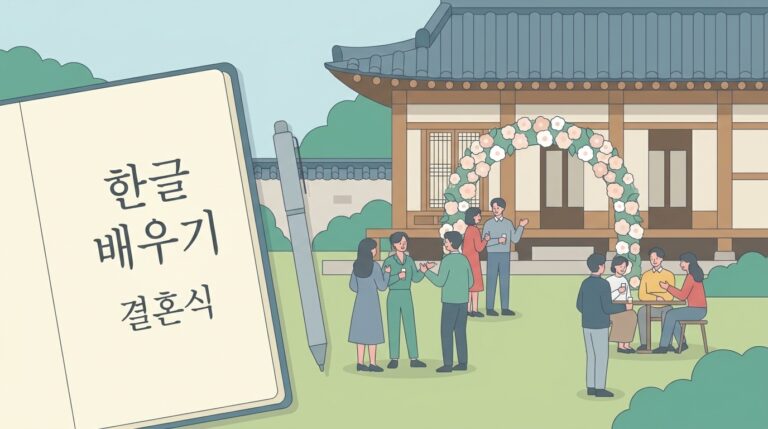
Navigating Modern Korean Weddings: Small Wedding Trends & Key Vocabulary
Phase 1: Empathy (Storytelling Opening)
안녕하세요! 매일한글 에디터입니다. (Hello! I’m your Daily Hangul editor.)
Imagine receiving an elegant digital wedding invitation (모바일 청첩장) from your Korean friend. Expecting a massive ceremony in a grand convention hall with hundreds of strangers, you dress up, only to find out it’s an intimate rooftop garden gathering with just thirty guests. Your friend beams and says, “저희, 스몰 웨딩으로 진행하기로 했어요!” (We decided to have a small wedding!)
In the past, traditional Korean weddings were famous for hosting hundreds—sometimes thousands—of guests, where parents’ acquaintances often outnumbered the couple’s friends. However, today’s young generation in Korea is shifting toward ‘Small Weddings’ (스몰 웨딩), prioritizing intimacy, personal expression, and realistic budgeting over extravagant displays. If you’ve ever felt nervous about saying the wrong thing, bringing the wrong gift amount, or misunderstanding modern Korean wedding vocabulary, don’t worry! Based on real learner experiences and feedback from our Korean community, this guide will make you feel confident, culturally savvy, and fluent when discussing modern Korean wedding culture.
Phase 2: Deep Dive into 3 Essential Expressions
1. 스몰 웨딩을 하기로 했어요. (We decided to have a small wedding.)
- Pronunciation: [Seu-mol we-ding-eul ha-gi-ro hae-ssoe-yo] (Sounds like Seu-mol way-ding-eul ha-gee-roh hay-so-yo)
- Meaning: “We decided on a small wedding.” (하기로 하다 means “to decide to do something”).
- K-Culture Moment: You’ll hear this expression frequently in modern K-Dramas when realistic young couples explain their wedding plans to strict or traditional parents.
- Editor’s Insight: Using 스몰 웨딩 reflects the modern lifestyle choice in Korea. Rather than using awkward literal translations, Koreans naturally adopted this Konglish term to refer specifically to minimalist, personal ceremonies.
- Situation Spectrum: Casual ✅ | Semi-formal ✅ | Formal ✅
- 🤔 Think About It: How does your home culture handle wedding decisions? Is having a small wedding seen as practical or unusual?
2. 간소하게 치르다 (To hold an event simply / modestly)
- Pronunciation: [Gan-so-ha-ge chi-reu-da] (Sounds like Gahn-so-hah-geh chee-reu-dah)
- Meaning: Literally “to carry out simply.” In context, it means hosting an event without lavish or unnecessary formalities.
- K-Culture Moment: Often spoken by older family members approving a modest ceremony or by couples explaining their vision to friends.
- Editor’s Insight: The verb 치르다 is specifically used for major life events like weddings (결혼식을 치르다) or funerals (장례식을 치르다). Pair it with 간소하게 to sound very natural and sophisticated!
- Situation Spectrum: Casual ⚠️ | Semi-formal ✅ | Formal ✅
- 🤔 Think About It: In Korean culture, doing things modestly (간소하게) is increasingly respected as a smart and thoughtful choice.
3. 직계 가족과 가까운 지인만 모시다 (To invite only immediate family and close acquaintances)
- Pronunciation: [Jik-gye ga-jok-gwa ga-kka-un ji-in-man mo-si-da] (Sounds like Jeek-gyeh gah-johk-gwah gah-kkah-oon jee-een-mahn moh-see-dah)
- Meaning: “To host/invite only immediate family and close acquaintances.”
- K-Culture Moment: Frequently written in digital invitations (모바일 청첩장) to politely inform distant acquaintances why they aren’t receiving a formal invite.
- Editor’s Insight: 모시다 is the honorific form of 모으다 (to gather) or 초대하다 (to invite), showing deep respect toward the attendees.
- Situation Spectrum: Casual 🚫 | Semi-formal ✅ | Formal ✅
- 🤔 Think About It: Notice how Korean uses honorific verbs like 모시다 even when describing casual small weddings to maintain polite standards.
Phase 3: Textbook Korean vs. Real Native Korean
Situation 1: Asking if the wedding will be large or small
- 📖 Textbook Korean: 결혼식이 큽니까? (Is the wedding ceremony big?)
- 🗣️ Real Native Korean: 결혼식 규모가 어떻게 돼요? (What is the scale of the wedding?)
- 💡 Why the difference? Native speakers rarely ask if an event is “big.” Instead, asking about 규모 (scale/size) is a polite and neutral way to enquire about the wedding style.
Situation 2: Expressing congratulations on a small wedding
- 📖 Textbook Korean: 작은 결혼식을 축하합니다. (Congratulations on your small wedding.)
- 🗣️ Real Native Korean: 트렌디하고 알차게 준비하셨네요! 축하해요! (You prepared it so trendily and meaningfully! Congratulations!)
- 💡 Why the difference? Directly translating “small wedding” in congratulations can sound like you are calling it plain. Praising it as 알차다 (meaningful/fruitful/well-planned) is much warmer!
Phase 4: K-Culture Deep Dive & Non-Verbal Etiquette
4-1. Nunchi (눈치) & Gestures: Modern Wedding Envelope Etiquette
At small weddings, guests usually present money in a white envelope (축의금 봉투). When handing the envelope to the reception host or couple:
* Two-Hand Rule: Always hold the envelope with both hands or support your right elbow with your left hand.
* Eye Contact: Make warm eye contact, bow slightly (about 15–30 degrees), and say, “축하드립니다” (Congratulations).
* Money Amount Tip: Odd numbers (30,000, 50,000, 70,000 KRW) or 100,000 KRW are customary. For a small wedding with fine dining, 100,000 KRW is standard practice.
4-2. Cultural Code Analysis: The Small Wedding Revolution
Traditionally, Korean weddings were community affairs designed to show societal status and return past financial gifts. However, modern Korean youth prefer spending money on housing, travel, or savings rather than a two-hour grand hall rental. Venues like outdoor gardens, hanoks, and boutique cafes are trending, turning wedding days into relaxed, memorable parties with loved ones.
Phase 5: Real-Life Roleplay Scenario
Setting: You are chatting with your Korean coworker, Min-woo (민우), at a cafe during lunch break.
- Min-woo: 저 다음 달에 결혼해요! (I’m getting married next month!)
- You: 어머, 정말요? 너무 축하해요! (Oh, really? Huge congratulations!)
- Min-woo: 감사합니다. 사실 스몰 웨딩으로 진행하기로 했어요. (Thank you. Actually, we decided to have a small wedding.)
- You: 🎭 [Smiling with genuine interest] 우와, 스몰 웨딩이요? 요즘 대세잖아요! (Wow, a small wedding? That’s so trendy these days!)
- Min-woo: 맞아요. 직계 가족이랑 가까운 지인만 모시고 간소하게 치르려고요. (Right. We plan to hold it simply with just immediate family and close acquaintances.)
- You: 🎭 [Nodding warmly] 정말 알차고 뜻깊은 결혼식이 되겠어요. (It will surely be a really meaningful and wonderful wedding.)
- Min-woo: 그렇게 말씀해 주시니 마음이 편해지네요. (Hearing you say that makes me feel much more at ease.)
- You: 초대해 주시면 기쁜 마음으로 달려갈게요! (If you invite me, I’ll happily run over!)
🔀 Interactive Choice Point
How would you respond if Min-woo asks: “요즘은 스몰 웨딩이 더 좋죠?” (Do you think small weddings are better these days?)
- Option A: “네, 큰 결혼식은 돈 낭비예요.” (Yes, big weddings are a waste of money.)
- Option B: “네, 가까운 분들과 더 깊게 축하할 수 있어서 정말 좋은 것 같아요.” (Yes, I think it’s wonderful because you can celebrate more deeply with close friends.)
- Option C: “글쎄요, 저는 화려한 결혼식이 더 좋아요.” (Well, I prefer extravagant weddings.)
Feedback:
* 🟢 Option B (Best Choice): Perfect! It emphasizes the emotional value of intimacy without criticizing traditional preferences.
* 🔴 Option A (Bad Choice): Calling traditional weddings “a waste of money” might offend older family members or those who prefer traditional events.
* ⚠️ Option C (Risk Choice): Honest, but might make Min-woo feel awkward about his own choice.
Phase 6: 10-Second Emotion Shadowing Drill
Practice these lines with natural rhythm and emotional cues!
[😊 Delighted & Warm]저희 / 스몰 웨딩으로 / 진행하기로 했어요!
(Jeo-hui / seu-mol we-ding-eu-ro / jin-haeng-ha-gi-ro hae-ssoe-yo!)-
[✨ Expressing Admiration]정말 / 알차고 / 뜻깊은 결혼식이 / 될 것 같아요!
(Jeong-mal / al-cha-go / tteut-gi-peun gyeol-hon-si-gi / doel geot ga-ta-yo!) -
[🤝 Polite & Sincere]간소하게 / 치르더라도 / 꼭 축하하러 / 갈게요.
(Gan-so-ha-ge / chi-reu-deo-ra-do / kkok chu-ka-ha-reo / gal-ge-yo.)
Phase 7: K-Culture Mini Dictionary
- 스몰 웨딩 (Seu-mol We-ding): Small Wedding. Refers to intimate wedding ceremonies with fewer guests and streamlined procedures.
- 축의금 (Chuk-ui-geum): Congratulatory cash gift given at weddings to support the newlyweds.
- 하객 (Ha-gaek): Wedding guest(s). 하객 맞이 refers to greeting guests before the ceremony.
- 식대 (Sik-dae): Meal cost per head at a wedding reception venue.
Phase 8: Traveler & Culture Survival Kit
Top 3 Survival Expressions
- 결혼식장이 어디예요? (Where is the wedding venue?)
Pro Tip: Use this when asking building security or subway staff. - 축의금 봉투는 어디에 있어요? (Where are the congratulatory cash envelopes?)
Pro Tip: Envelopes and pens are almost always provided on a table near the entrance desk. - 식사권은 어디서 받나요? (Where do I get the meal coupon?)
Pro Tip: When giving your envelope, you will receive a meal ticket (식사권).
Editor’s Travel Note
If you receive a modern Korean wedding invite, it will almost certainly come as a web link (모바일 청첩장). Make sure you download the Naver Map app for Korean navigation to easily locate modern hidden garden venues or cozy hanok spaces, which are often tucked away in scenic neighborhoods!
Phase 9: One Step Deeper (Reflection)
The shift toward small weddings reflects a broader cultural change in modern Korea: the transition from traditional collective duty (체면 and social obligation) toward personal happiness and authenticity. While traditional weddings were events managed primarily by and for the parents, modern Korean youth are reclaiming their special day to celebrate authentic connection.
💬 Your Turn: Would you prefer a grand traditional wedding or an intimate small wedding in Korea? Share your thoughts in the comments below!
Phase 10: FAQ & Common Mistakes
Q: Can I wear white or light beige clothing to a Korean wedding?
A: No, it’s best to avoid all-white or light beige outfits out of respect for the bride. Opt for neat pastel colors, navy, grey, or black attire.
Q: Is it okay to bring a guest (+1) to a small wedding in Korea?
A: Unlike Western weddings, +1s are generally NOT expected unless specified, especially for small weddings where meals (식대) are strictly budgeted per guest.
Q: What if I am invited but cannot attend?
A: Send your congratulations via message along with your cash gift via mobile transfer (like KakaoPay) in advance!
🚨 Common Mistakes TOP 3
- ❌ Mistake: Handing loose cash directly to the groom or bride.
👉 Correct Action: Place money inside a white envelope (축의금 봉투) and submit it at the reception table. - ❌ Mistake: Arriving right at the ceremony start time.
👉 Correct Action: Arrive 20–30 minutes early to greet the couple and take pictures. - ❌ Mistake: Leaving without receiving a meal ticket.
👉 Correct Action: Remember to collect your meal coupon (식사권) right after turning in your gift envelope!
Phase 11: Action Missions
- 🥉 Bronze Mission: Practice saying “저희 스몰 웨딩으로 진행하기로 했어요” out loud 3 times!
- 🥈 Silver Mission: Write a congratulations message in Korean on social media using the word 알차다 or 뜻깊다.
- 🥇 Gold Mission: Use today’s expressions during a real conversation with a native Korean friend or tutor when discussing wedding culture!
🎮 K-Culture Mission: Watch a recent K-drama wedding scene and spot whether they are having a traditional grand hall wedding or a modern 스몰 웨딩!
Phase 12: Interactive Quiz Challenge
Question 1 (Situation Judgment)
Your friend says they are holding a small wedding with only immediate family. What is the most natural praise?
* A) 왜 크게 안 해요?
* B) 알차고 뜻깊은 결혼식이 될 것 같아요!
* C) 너무 가난해 보여요.
🔍 Click to reveal Answer & Explanation
Correct Answer: B) 알차고 뜻깊은 결혼식이 될 것 같아요!
Explanation: Praising the ceremony as meaningful (뜻깊다) and fruitful/well-planned (알차다) is the warmest compliment for a small wedding.
Question 2 (Fill in the Blank)
직계 가족과 가까운 지인만 ______ 간소하게 치르기로 했어요.
* A) 모시고 (inviting/gathering with honor)
* B) 버리고 (abandoning)
* C) 삼키고 (swallowing)
🔍 Click to reveal Answer & Explanation
Correct Answer: A) 모시고
Explanation: 모시다 is the respectful verb used when gathering esteemed guests and family members.
Question 3 (True or False Cultural Quiz)
True or False: In Korea, you can bring an uninvited friend as your +1 to a small wedding without telling the couple beforehand.
🔍 Click to reveal Answer & Explanation
Correct Answer: False!
Explanation: Small weddings have strictly reserved seats and meals (식대), so uninvited guests can cause unexpected trouble for the couple.







