

Phase 1: Empathy (Story-Driven Opening)
안녕하세요! 매일한글 에디터입니다. (Hello! I’m the Daily Hangul editor.)
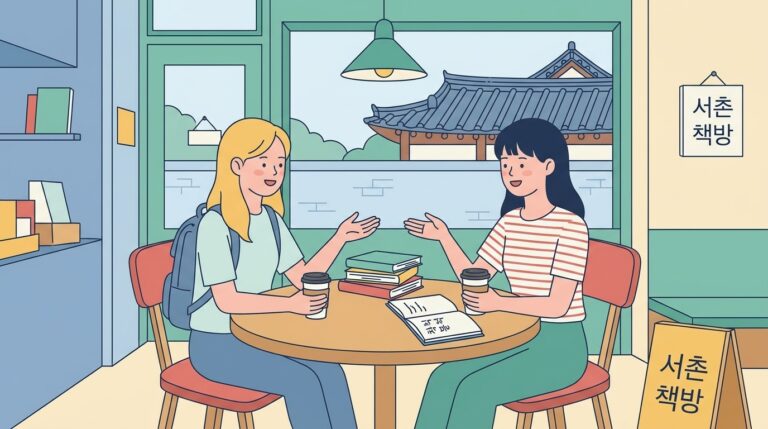
Imagine sitting in a cozy, wooden-floored book cafe tucked away in an alley of Seochon, Seoul. The aroma of freshly brewed drip coffee fills the air, and around a round table, a passionate debate unfolds about Korean authors making waves on the global stage—especially those nominated for or winning the prestigious Nobel Prize in Literature. You want to jump into the conversation and express how deeply a novel moved you, but suddenly your mind goes blank. You know words like “좋다” (good) or “재밌다” (fun), but how do you convey that an author’s writing style is “profoundly lingering” or that it “captures a sharp slice of society”?
If you have ever felt trapped between basic everyday Korean and high-level intellectual discussion, you are not alone! Expressing nuanced literary opinions in Korean is a major milestone for B2 intermediate learners. This guide was crafted based on real feedback from advanced learners who wanted to participate naturally in Seoul’s vibrant book clubs. By mastering these expressional frameworks today, you will transform from a hesitant listener into a confident speaker who can articulate deep cultural and literary insights in authentic Korean.
Phase 2: Deep Dive into 3 Core Expressions
1. 깊은 여운을 남기다
- Pronunciation: [Gipeun yeowuneul namgida] (Sounds like: ‘Gip-eun’ + ‘Yeo-woon-eul’ + ‘Nam-gi-da’, smooth like lingering notes of music)
- Meaning: Literally “To leave a deep lingering resonance.” In practice, it describes a book, movie, or artwork that stays in your heart and mind long after you finish it.
- K-Culture Moment: Used frequently on literary podcasts, news reviews, and book shows when discussing masterpieces like Han Kang’s The Vegetarian or Human Acts.
- Editor’s Insight: “여운” (yeowun) refers to the reverberation after a bell rings or a sound dies down. Applying it to literature means the story leaves an emotional echo inside you.
- Situation Spectrum: Casual ✅ | Semi-formal ✅ | Formal ✅
- 🤔 Think About It: Does your native language have a specific word for the emotional echo a story leaves behind, or do you use phrases like “it made me think”?
2. 사회의 단면을 포착하다
- Pronunciation: [Sahoeeui danmyeoneul pochakhada] (Sounds like: ‘Sa-hoe-eui’ + ‘Dan-myeon-eul’ + ‘Po-chak-ha-da’)
- Meaning: Literally “To capture a cross-section of society.” It means an author sharply depicts real social issues through fictional narrative.
- K-Culture Moment: Frequently heard during panel debates on contemporary realistic novels or acclaimed films that tackle structural social challenges in modern Korea.
- Editor’s Insight: “단면” means a cross-section or slice. Combined with “포착하다” (to capture/snap), it praises an author’s keen observation of societal realities.
- Situation Spectrum: Casual ⚠️ | Semi-formal ✅ | Formal ✅
- 🤔 Think About It: How do Korean authors turn historical or social collective trauma into universal art that resonates across borders?
3. 독창적인 문체
- Pronunciation: [Dokchangjeogin munche] (Sounds like: ‘Dok-chang-jeok-in’ + ‘Moon-che’)
- Meaning: “An original literary style/prose tone.”
- K-Culture Moment: Used by book reviewers and literature students when discussing an author’s unique voice, sentence structure, and vocabulary choices.
- Editor’s Insight: “문체” combines “문” (writing) and “체” (body/style). Praising an author’s “독창적인 문체” is one of the highest compliments in Korean literary criticism.
- Situation Spectrum: Casual ✅ | Semi-formal ✅ | Formal ✅
- 🤔 Think About It: In Korean literature, sentence endings often reflect delicate social hierarchy and emotion. How does an author’s tone affect your reading experience?
Phase 3: Textbook Korean vs. Real Korean
Situation 1: Describing a deeply moving novel
* 📖 교과서 한국어: 이 책은 매우 감동적이고 재미있습니다. (This book is very touching and interesting.)
* 🗣️ 진짜 한국어: 이 책은 읽고 나서 가슴이 먹먹해지고 깊은 여운이 남더라고요. (After reading this book, my heart felt heavy and it left such a deep lingering effect.)
* 💡 왜 다를까? While “감동적입니다” is grammatically correct, native speakers express emotional depth using sensory phrases like “가슴이 먹먹해지다” (one’s heart feels full/stuffed with emotion) to share personal empathy.
Situation 2: Commenting on an author’s keen insight
* 📖 교과서 한국어: 작가의 생각이 아주 좋습니다. (The author’s thought is very good.)
* 🗣️ 진짜 한국어: 작가의 시선이 진짜 날카롭고 현실을 잘 짚어낸 것 같아요. (I think the author’s gaze is really sharp and pinpointed reality so well.)
* 💡 왜 다를까? Using “시선” (perspective/gaze) and “짚어내다” (to point out sharply) sounds much more polished and insightful in B2-level discussions than just saying “생각이 좋다”.
Phase 4: K-Culture Deep Dive & Non-verbal Manners
4-1. Nunchi & Gestures in Literary Debates
When engaging in serious discussions in Korea, active listening (경청) is crucial. Instead of jumping in abruptly, show Nunchi by nodding gently (고개를 끄덕이다) while the other person is speaking. When expressing a differing opinion on an author’s work, tilt your head slightly and use soft hedges like “제 생각에는…” (In my view…) or “그 말씀도 맞지만…” (That point is valid too, but…) to keep the conversation harmonious.
4-2. The Global Rise of K-Literature
Korean literature has entered a golden era. Following major international awards and historic Nobel Literature recognitions, novels depicting modern anxiety, historical healing, and human resilience are captivating global readers. In trendy neighborhoods like Yeonnam-dong and Seochon, independent bookshops (독립서점) host regular book talks where young readers debate these very topics late into the night.
Phase 5: Real-Life Roleplay Scenario
Setting: A cozy book club meeting in Ikseon-dong. You are chatting with Minjun (민준), a fellow passionate reader, about a modern Korean novel nominated for an international literary award.
- 민준: 이번 노벨 문학상 후보로 거론된 작가의 신작 읽어보셨어요?
(Ibeon nobel munhaksang huboro georondeon jakga-ui sinjak ilgeobeosyeosseoyo?)
“Did you read the new release by the author nominated for the Nobel Prize in Literature?”
🎭 Holding a paperback with an intrigued smile -
You: 네, 지난주에 다 읽었어요. 정말 가슴이 먹먹해지더라고요.
(Ne, jinanjue da ilgeosseoyo. Jeongmal gaseumi meongmeokhaejideoragoyo.)
“Yes, I finished it last week. It really filled my heart with heavy emotion.”
🎭 Nodding thoughtfully while taking a sip of tea -
민준: 맞아요. 작가의 문체가 정말 독창적이지 않나요?
(Majayo. Jakga-ui munchega jeongmal dokchangjeogiji annayo?)
“Right? Isn’t the author’s writing style really original?”
🎭 Leaning forward with enthusiasm -
You: 동감이에요. 특히 한국 사회의 단면을 포착하는 시선이 날카로워요.
(Donggamieyo. Teukhi hanguk sahoe-ui danmyeoneul pochak-haneun siseoni nalkarowoyo.)
“I agree. Especially their gaze in capturing a cross-section of Korean society is so sharp.”
🎭 Gently placing a hand on the table to emphasize agreement -
민준: 어떤 장면이 가장 기억에 남으셨어요?
(Eotteon jangmyeoni gajang gieoge nameusyeosseoyo?)
“Which scene was the most memorable for you?”
🎭 Looking directly into your eyes with genuine curiosity -
You: 주인공이 과거를 회상하는 마지막 장이 깊은 여운을 남겼어요.
(Juingong-i gwagoreul hoesanghaneun majimak jang-i gipeun yeowuneul namgyeosseoyo.)
“The final chapter where the protagonist recalls the past left a deep lingering impression.”
🎭 Looking slightly upward as if reflecting on the scene -
민준: 와, 말씀하시는 걸 들으니 다시 읽어보고 싶어지네요!
(Wa, malsseumhasineun geol deureoni dasi ilgeobogo sipeojineyo!)
“Wow, hearing you talk makes me want to re-read it right away!”
🎭 Clapping softly with a warm smile -
You: 다음에 다른 작품도 같이 읽고 이야기 나눠요.
(Daume dareun jakpumdo gachi ilgo iyagi nanwoyo.)
“Let’s read another work together next time and share our thoughts.”
🎭 Smiling warmly
🔀 Interactive Branch
Question: Minjun asks for your honest critique of a controversial character in the book. How do you respond?
* Option A: “그 캐릭터는 완전 이상해요.” (That character is completely weird.)
* Option B: “호불호가 갈릴 수 있지만, 인물의 입장이 이해는 가더라고요.” (It might divide opinions, but I could understand the character’s perspective.)
* Option C: “잘 모르겠어요. 그 질문은 패스할게요.” (I don’t know. I’ll pass on that question.)
Feedback:
* Best (Option B): Excellent! Uses balanced B2 vocabulary (“호불호가 갈리다” – opinions are divided) and shows sophisticated critical thinking.
* Bad (Option A): Too blunt and oversimplified for a literary discussion.
* Risk (Option C): Shuts down the conversation topic entirely.
Phase 6: 10-Second Emotion Shadowing Drill
Practice pronouncing these sentences with natural rhythm and emotional cadence!
[🤔 Thoughtful and calm]이 책은 / 읽을수록 / 깊은 여운을 / 남기네요.
(I chaegeun / ilgeulsurok / gipeun yeowuneul / namgineyo.)[😊 Impressed and insightful]작가의 시선이 / 정말 날카롭고 / 독창적이에요.
(Jakga-ui siseoni / jeongmal nalkaropgo / dokchangjeogieyo.)[🥺 Moved and empathetic]마지막 문장을 읽고 / 가슴이 / 먹먹해졌어요.
(Majimak munjangeul ilgo / gaseumi / meongmeokhaejyeosseoyo.)
Phase 7: K-Culture Mini Dictionary
- 여운 (Yeowun) | Lingering resonance
- The emotional aftermath or lingering feeling after experiencing artwork or literature.
- 문체 (Munche) | Literary style / Prose style
- An author’s distinct tone, rhythm, and vocabulary choice in writing.
- 북카페 (Book Cafe) | Book cafe
- Popular urban spaces in Seoul combining libraries/bookstores with cozy coffee shop aesthetics.
- 번역가 (Beon-yeokga) | Translator
- Key players bringing Korean literary works to international readers while preserving cultural nuances.
Phase 8: Traveler’s Survival Kit
TOP 3 Survival Expressions for Book Lovers
- 이 작가의 다른 책도 추천해 주시겠어요?
(I jakga-ui dareun chaekdo chucheonhae jusigesseoyo?)
“Could you recommend another book by this author?”- Pro Tip: Great for asking staff at independent bookstores!
- 요즘 가장 인기 있는 소설이 뭐예요?
(Yojeum gajang ingi inneun soseori mwoyeyo?)
“What is the most popular novel these days?” - 영문 번역본도 있나요?
(Yeongmun beon-yeokbondo innayo?)
“Is there an English translation available?”
Editor’s Travel Note
When visiting Seoul, head straight to Gwanghwamun! Check out the Kyobo Book Centre store location guide to explore Korea’s largest bookstore, where you can browse bestsellers and attend author signing events.
Phase 9: “One Step Deeper” (Reflective Question)
Korean literature often touches upon deeply rooted cultural emotions like Han (한 – lingering sorrow/unresolved grief) and Jeong (정 – deep affection and bond). When modern authors write about social struggles, they don’t just depict hardship; they weave human tenderness into tragic history. This unique blend of resilience and emotional depth is precisely what captivates international readers today.
💬 Your Turn: Which Korean author or translated novel introduced you to Korean literature? Share your favorite book in the comments below!
Phase 10: FAQ & Common Mistakes
Q: Can I use “여운이 있다” instead of “여운을 남기다”?
A: Yes! Both are natural. “여운이 남다” (the lingering resonance remains) or “여운이 길다” (the resonance lasts long) are also commonly used in book discussions.
Q: Is “먹먹하다” only used when feeling sad?
A: Not strictly sad! It describes a tight or choked-up chest feeling caused by overwhelming emotion—whether touching, poignant, or sorrowful.
Q: How do I say “plot twist” in Korean during a literary discussion?
A: You can use the term “반전” (banjeon). For example: “마지막에 놀라운 반전이 있어요” (There is an amazing twist at the end).
🚨 Common Mistakes TOP 3
- Saying “이 책은 재미가 깊다” ❌
- Correct Action: Say “이 책은 깊은 여운을 남겨요” (This book leaves a deep lingering resonance) ✅
- Using informal speech (반말) with club members you just met ❌
- Correct Action: Always default to -존댓말 (e.g., “~인 것 같아요”) during book discussions ✅
- Translating “sharp perspective” as “뾰족한 시선” ❌
- Correct Action: Use “날카로운 시선” (sharp/keen gaze) when praising insight ✅
Phase 11: Action Mission & Engagement
- Bronze Mission: Practice saying “깊은 여운을 남겨요” aloud three times with proper emotional shadowing.
- Silver Mission: Write a one-sentence review of your favorite book in Korean in our comment section!
- Gold Mission: Join a online Korean reading group or talk about a book with a native speaker using today’s 3 core expressions!
🎮 K-Culture Mission: Watch an episode of a Korean arts/culture talk show or literary interview on YouTube and spot when the hosts say “문체” or “여운”!
Phase 12: Interactive Quiz Challenge
1. Fill in the blank:
작가의 시선이 정말 ______ 한국 사회의 단면을 잘 보여준다.
(a) 길어서
(b) 날카로워서
(c) 매워서
2. True or False:
“가슴이 먹먹하다” can be used when you are deeply moved by a beautiful literary climax.
(True / False)
3. Situation Choice:
How would you formally express that a novel left a long-lasting emotional effect on you?
(a) 이 책 짱이에요.
(b) 이 작품은 읽고 난 후에도 깊은 여운이 남습니다.
(c) 이 책은 진짜 너무 재밌습니다.
Click to reveal answers & explanations!
- Answer: (b) 날카로워서 – “날카로운 시선” means a sharp/keen perspective.
- Answer: True – “가슴이 먹먹하다” describes being overwhelmed with deep emotion or poignant beauty.
- Answer: (b) – Option (b) uses formal, polished B2 literary phrasing suitable for book club discussions!







