

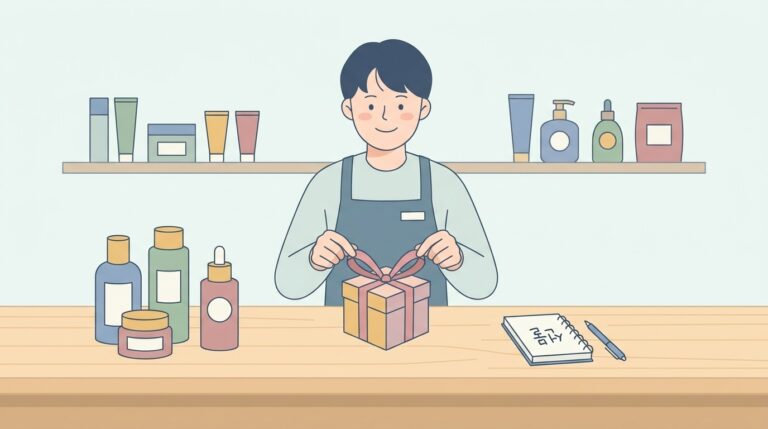
How to Request Gift Wrapping in Korea Like a Native
Phase 1: Empathy (Opening Story)
안녕하세요! 매일한글 에디터입니다. (Hello! I’m your Daily Hangul editor!)
Picture this: You are walking through a trendy boutique in Seongsu-dong or exploring the vibrant aisles of a K-beauty store in Myeongdong. You find the absolute perfect souvenir—a sleek hand cream set or a cute traditional accessory—for your best friend back home. You step up to the counter, eager to ask the clerk to package it up nicely.
You summon your Korean and say, “이거 포장해 주세요!” (Pojanghae juseyo!). But wait! The store clerk looks slightly confused for a second, wondering if you mean takeaway packaging or a gift box. You suddenly freeze—Did I use the right word? How do I ask for a ribbon? Can they remove the price tag without sounding rude?
If you’ve ever felt that subtle panic at a Korean checkout counter, take a deep breath! You are definitely not alone. Many intermediate Korean learners struggle with the polite nuances of shopping and gift requests. Asking for gift wrapping is more than just swapping items for cash—it’s an exchange of warmth and respect.
In this guide, based on real feedback from hundreds of Daily Hangul learners, we will master the exact, natural phrases and cultural manners you need so you can request gift wrapping with 100% confidence. Let’s make your K-shopping experience smooth and joyful!
Phase 2: Core Expressions Deep Dive
1. 선물용으로 포장해 주시겠어요? (Seonmuryongeuro pojanghae jusigesseoyo?)
- Pronunciation: [seon-mul-yong-eu-ro po-jang-hae ju-si-ges-seo-yo] (Sounds like: “Sun-mool-yong-oo-ro po-jahng-hae joo-si-get-seo-yo”)
- Meaning: Literal: Could you wrap this for gift use? / Nuance: “Could you please wrap this as a gift?”
- K-Culture Moment: In K-dramas, whenever the lead character buys a subtle wrist watch or necklace for their crush, they softly hand it to the clerk and say this exact line with a shy smile.
- Editor’s Insight: Using 선물용 (gift purpose) right away prevents any confusion with standard food takeout or simple bagging (포장). Adding -주시겠어요? makes you sound polished and respectful.
- Situation Spectrum: Casual ⚠️ | Semi-formal ✅ | Formal ✅
- 🤔 Think About It: How does adding the purpose of a purchase change the tone of service in your home country compared to Korea?
2. 리본도 예쁘게 묶어 주세요. (Ribondo yeppeuge muk-eo juseyo.)
- Pronunciation: [ri-bon-do ye-ppeu-ge muk-eo ju-se-yo] (Sounds like: “Ree-bon-do yeh-ppeu-geh mook-eo joo-seh-yo”)
- Meaning: Literal: Please tie the ribbon pretty too. / Nuance: “Could you tie a pretty ribbon on it as well?”
- K-Culture Moment: Seen at luxury cosmetics counters in Gangnam during holiday seasons when buying signature gift sets.
- Editor’s Insight: The word 예쁘게 (prettily) isn’t demanding—it’s a friendly, lighthearted way to ask for that extra touch of aesthetic care that Korean gift wrapping is famous for!
- Situation Spectrum: Casual ✅ | Semi-formal ✅ | Formal ⚠️
- 🤔 Think About It: Expressing appreciation for visual aesthetics is a big part of Korean gift culture. How important is packaging presentation in your culture?
3. 가격표는 떼어 주실 수 있나요? (Gagyeokpyoneun tte-eo jusil su innayo?)
- Pronunciation: [ga-gyeok-pyo-neun tte-eo ju-sil su in-na-yo] (Sounds like: “Gah-gyeok-pyo-neun deh-uh joo-sil soo een-nah-yo”)
- Meaning: Literal: Is it possible to detach the price tag? / Nuance: “Could you please remove the price tag?”
- K-Culture Moment: Preparing a birthday present for a friend or a thank-you gift for a host family.
- Editor’s Insight: 떼다 means to peel or remove. Asking this shows that you are mindful of gift etiquette—leaving the price tag on a gift is considered a minor faux pas in Korea.
- Situation Spectrum: Casual ⚠️ | Semi-formal ✅ | Formal ✅
- 🤔 Think About It: Why do you think removing price tags is a universal courtesy across different cultures?
Phase 3: Textbook Korean vs. Real Native Korean
Situation 1: Checking if gift wrapping service is available
- 📖 Textbook Korean: 선물 포장 서비스가 있습니까? (Is there a gift wrapping service?)
- 🗣️ Real Native Korean: 혹시 이거 선물 포장돼요? (By any chance, can this be gift-wrapped?)
- 💡 Why the difference?: While the textbook version is grammatically correct, real Koreans naturally start requests with 혹시 (by any chance) to sound softer, and use 포장돼요? instead of stiff noun phrases.
Situation 2: Asking for an extra small shopping bag
- 📖 Textbook Korean: 쇼핑백을 두 개 주십시오. (Please give me two shopping bags.)
- 🗣️ Real Native Korean: 봉투 하나 더 챙겨 주실 수 있으세요? (Could you pack an extra bag for me?)
- 💡 Why the difference?: 챙겨 주다 implies taking thoughtful care of your needs. Combined with the honorific -으세요, it sounds extraordinarily polite and natural.
Phase 4: K-Culture Deep Dive & Non-Verbal Manners
4-1. Nunchi (눈치) & Key Gestures
When requesting gift wrapping and completing your purchase in Korea, non-verbal cues speak louder than words:
1. Two-Handed Delivery: Always hand over your payment card and receive your gift-wrapped package using both hands (or supporting your right elbow with your left hand). This shows deep respect.
2. The Soft Eye-Contact Nod: When the clerk finishes wrapping, offer a gentle 15-degree bow with a warm smile.
3. Reading the Room (Nunchi): If there is a huge line behind you at a busy convenience store or pop-up shop, keep your gift request brief so as not to overwhelm the store clerk!
4-2. Culture Code: The Art of Korean Packaging (보자기 & Modern Aesthetics)
In Korea, wrapping a gift isn’t just about hiding the item; it symbolizes wrapping good fortune (복을 싸다). From traditional silk cloths (보자기 – Bojagi) to modern sleek pastel boxes in K-beauty shops, Koreans place high aesthetic value on packaging. When you ask for gift wrapping, retail staff take immense pride in placing ribbons and stickers neatly.
Phase 5: Real-Life Roleplay Scenario
Setting: A stylish K-Beauty boutique in Seongsu-dong. You are buying a premium hand cream for your close friend.
NPC: Friendly Store Clerk (직원)
- Clerk: [😊 smiling warmly] 손님, 계산 도와드리겠습니다.
(Hello! I can help you check out here.) - Learner: [🎁 handing over the item] 네! 혹시 이거 선물용으로 포장 가능할까요?
(Yes! By any chance, could I get this gift-wrapped?) - Clerk: [nodding kindly] 그럼요! 선물 상자랑 봉투 중에 어떤 걸로 해드릴까요?
(Of course! Would you prefer a gift box or a paper gift bag?) - Learner: [선물 상자를 가리키며] 상자로 부탁드릴게요. 혹시 가격표도 떼어 주실 수 있나요?
(Gift box, please. Could you also remove the price tag?) - Clerk: [🏷️ removing the tag carefully] 네, 가격표 떼어 드렸어요. 카드 결제 도와드릴까요?
(Sure, I removed the tag. Shall I process your card payment?) - Learner: [💳 handing the card with both hands] 네! 쇼핑백도 하나 더 챙겨 주실 수 있으세요?
(Yes! Could you also pack one extra shopping bag for me?) - Clerk: [🛍️ placing the wrapped box in a bag] 네, 여분 봉투 같이 넣어드렸습니다!
(Yes, I put an extra bag inside for you!) - Learner: [😊 bowing slightly and receiving with both hands] 감사해요! 예쁘게 포장해 주셔서 정말 감사합니다.
(Thank you! Thank you so much for wrapping it so beautifully.)
🔀 Interactive Choice Point
The clerk asks: “선물 카드도 같이 넣어드릴까요?” (Would you like me to include a gift message card as well?)
- Choice A: “네, 카드도 하나 주세요! 얼마예요?”
- Feedback (Best! ✅): Perfect! Super natural and polite. You confirmed and asked the price smoothly.
- Choice B: “아니요, 필요 없어요. 그냥 주지 마세요.”
- Feedback (Risk! ⚠️): Too direct! Say “아 괜찮습니다, 감사해요!” instead so you don’t sound abrupt.
- Choice C: “카드 쓰기 싫어요.”
- Feedback (Bad! 🚫): Sounds overly harsh and awkward at a store checkout!
Phase 6: 10-Second Emotion Shadowing Drill
Practice saying these sentences out loud with full emotional expression! Use / as your breath/pause markers.
- [😊 Friendly & Polite]
혹시 / 이거 / 선물용으로 / 포장해 주실 수 있나요?
(Hoksi / igeo / seonmuryongeuro / pojanghae jusil su innayo?) -
[✨ Excited & Expressive]
와, / 리본이 / 너무 예뻐요! / 감사합니다!
(Wa, / riboni / neomu yeppeoyo! / Gamsahamnida!) -
[🥺 Soft & Gentle Request]
혹시 / 가격표만 / 살짝 / 떼어 주실 수 있으세요?
(Hoksi / gagyeokpyoman / saljjak / tte-eo jusil su isseuseyo?)
Phase 7: K-Culture Mini Dictionary
- 선물용 (Seonmul-yong) | Gift Purpose | Used to specify that an item or packaging is intended as a present.
- 가격표 (Gagyeok-pyo) | Price Tag | The price sticker on goods that you often want removed before gifting.
- 덤 / 서비스 (Deom / Service) | Freebies / Complimentary items | Free sample gifts given by store owners in Korea as a gesture of generosity.
- 교환증 (Gyohwan-jeung) | Exchange Receipt | A gift receipt inserted inside wrapped items so the recipient can exchange sizes later.
Phase 8: Traveler’s Survival Kit
Top 3 Survival Phrases
- “선물 포장돼요?” (Can this be gift wrapped?) — Short & effective!
- “봉투 필요해요.” (I need a bag.) — Essential since plastic/paper bags cost 100-200 KRW in Korea.
- “영수증은 버려주세요.” (Please throw away the receipt.) — Useful when you don’t need tax/receipts.
Editor’s Travel Note
When shopping in shopping districts like Hongdae or Myeongdong, make sure you download the Naver Map App Download to easily find dedicated wrapping specialty shops or major department store customer service centers that offer custom gift wrapping services!
Phase 9: A Step Deeper (Korean Mindset)
In Korean culture, the presentation of a gift represents the warmth (정 – Jeong) and consideration you hold for the recipient. By requesting neat gift wrapping, taking off the price tag, and inserting an exchange receipt (교환증), you show that you care deeply about their feeling when opening it. Shopping in Korea isn’t just a transaction; it’s a social connection built on mutual politeness.
💬 Your Turn: Have you ever received a beautifully wrapped gift in Korea? What was your favorite item to wrap? Share your stories in the comments below!
Phase 10: FAQ & Common Mistakes
Q: Is gift wrapping always free in Korean stores?
A: At department stores, K-beauty chains (like Olive Young during promotions), or stationery shops, simple gift bags or boxes are often free or cost a nominal fee (around 500-1,000 KRW). Specialized luxury wrapping centers may charge more depending on materials.
Q: How do I ask for a gift exchange receipt?
A: Simply ask: “혹시 교환증도 같이 넣어주실 수 있나요?” (Could you please put an exchange receipt inside as well?)
Q: Does ‘포장’ mean food takeout or gift wrapping?
A: 포장 means wrapping/packaging in general! In a restaurant, it means food takeout. In a shop, it means gift/item packaging. Adding 선물용 (for gifts) instantly clears up any ambiguity.
🚨 Common Mistakes TOP 3
- Mistake: Saying “이거 선물 포장하세요!” (Commanding: Wrap this gift!)
- Correct Action: Use request forms like “선물 포장해 주시겠어요?”
- Mistake: Expecting plastic shopping bags for free.
- Correct Action: Korea passed eco-laws charging for single-use bags. Be ready to pay 100~200 KRW or bring your reusable tote!
- Mistake: Handing payment card with one hand carelessly.
- Correct Action: Hand your card over using two hands to show polite shopping etiquette.
Phase 11: Action Mission
- 🥉 Bronze Mission: Practice saying “선물용으로 포장해 주시겠어요?” 5 times in front of your mirror!
- 🥈 Silver Mission: Post a picture of your favorite wrapped gift on Instagram/X and tag
@DailyHangulwith the caption in Korean! - 🥇 Gold Mission: Use this exact phrase at a Korean store or local Korean supermarket in your area on your next visit!
🎮 K-Culture Mission: Watch a scene in your favorite K-drama where characters buy gifts, and spot if they use 혹시 or 선물용 at the checkout counter!
Phase 12: Interactive Quiz Challenge
Quiz 1. Situation Check
You want the store clerk to remove the price sticker before wrapping the present. What should you say?
a) 가격표 더 주세요.
b) 가격표는 떼어 주실 수 있나요?
c) 가격표를 사겠습니다.
🔍 Click to view Answer & Explanation
Answer: b) 가격표는 떼어 주실 수 있나요?
Explanation: 떼다 means to peel or remove off. Option a) asks for more price tags, and c) says you will buy the price tag!
Quiz 2. Fill-in-the-Blank
“혹시 이거 선물_______ 포장 가능할까요?”
a) 용으로
b) 에다가
c) 에서
🔍 Click to view Answer & Explanation
Answer: a) 용으로
Explanation: -용으로 indicates purpose (“for the use of”). Combined with 선물 (gift), 선물용으로 means “as a gift”.
Quiz 3. True / False Culture Quiz
In Korea, leaving the price tag on a gift is considered polite so the recipient knows how expensive it is. (True / False)
🔍 Click to view Answer & Explanation
Answer: False!
Explanation: Leaving the price tag on a gift is considered impolite. Always ask the clerk to remove it (가격표 떼어 주세요) or insert an exchange receipt without the price shown!







