

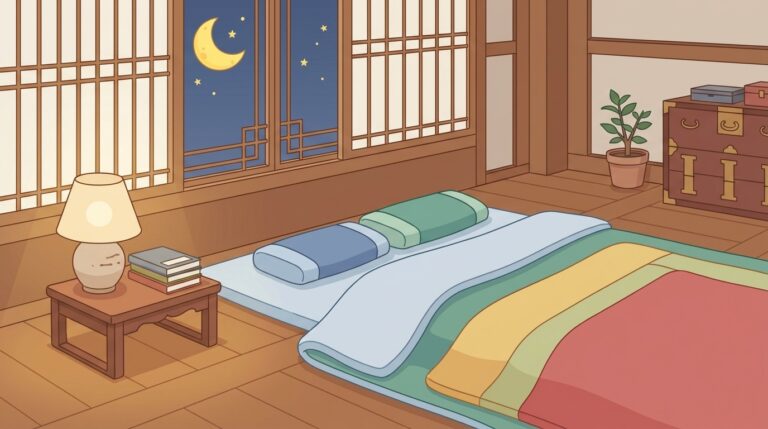
Sweet Dreams! How to Say ‘Sleep’ in Korean Like a True Local
안녕하세요! (An-nyeong-ha-se-yo!) Hello! It’s your favorite Daily Hangul editor and cultural navigator here. 💖
Have you ever watched a K-Drama where the main characters say goodnight, but it sounds completely different from the dry dictionary word you learned in your textbook? You might hear “잘 자 (jal ja)” or “꿀잠 (kkul-jam)” and wonder, “Wait, which one should I use?”
Sleep is the ultimate comfort, and in Korea, how you talk about sleep actually shows how much you care about the other person. Today, we’re going to dive into the cozy world of Korean sleep expressions, specifically tailored for beginners (A1). By the end of this guide, you’ll be able to wish your favorite K-Pop idol, your Korean friends, or even a future boss “sweet dreams” without feeling awkward!
Phase 2: Top 3 Essential Sleep Expressions
1. 잘 자요 (Jal ja-yo)
- Pronunciation: Jal jah-yo (Sounds like “Jal” + “jah” in “jar” + “yo”)
- Meaning: Sleep well (Polite & Cozy)
- K-Culture Moment: The sweet ending of a late-night phone call between K-Drama leads.
- Editor’s Insight: This is the safest, most versatile way to tell someone to sleep well. It’s polite yet warm.
- Situation Spectrum: Casual ⚠️ | Semi-formal ✅ | Formal 🚫
- 🤔 Think About It: Why does Korean have so many levels of politeness just for saying “sleep well”? It’s all about showing respect and closeness!
2. 잘 자 (Jal ja)
- Pronunciation: Jal jah
- Meaning: Sleep well / Goodnight (Casual/Intimate)
- K-Culture Moment: A text message sent with a cute heart emoji to a close friend or partner.
- Editor’s Insight: Drop the “요 (yo)” and you instantly get close! Only use this with people of the same age or younger than you.
- Situation Spectrum: Casual ✅ | Semi-formal 🚫 | Formal 🚫
- 🤔 Think About It: How would you feel if someone younger used this casual form with you without asking first?
3. 안녕히 주무세요 (An-nyeong-hi ju-mu-se-yo)
- Pronunciation: An-nyeong-hee joo-moo-seh-yo
- Meaning: Sleep peacefully (Highly Formal/Respectful)
- K-Culture Moment: Saying goodnight to parents, grandparents, or someone of higher status in a traditional household.
- Editor’s Insight: This is a completely different verb (“주무시다” instead of “자다”) used strictly to show high respect.
- Situation Spectrum: Casual 🚫 | Semi-formal 🚫 | Formal ✅
- 🤔 Think About It: Korean culture places deep value on respecting elders, which is why there’s a special word for them sleeping.
Phase 3: Textbook Korean vs. Real Korean
Situation 1: Saying you are going to sleep
- 📖 Textbook Korean: “저는 잠을 잡니다.” (Jeo-neun jam-eul jap-ni-da. – I sleep.)
- 🗣️ 진짜 (Real) Korean: “나 이제 자러 가.” (Na i-je ja-reo ga. – I’m going to bed now.)
- 💡 Why the difference? No native speaker uses the mechanical textbook form in daily chats. It sounds like a robot!
Situation 2: Asking if someone slept well
- 📖 Textbook Korean: “당신은 잘 잤습니까?” (Dang-sin-eun jal jat-seup-ni-ka? – Did you sleep well?)
- 🗣️ 진짜 (Real) Korean: “잘 잤어?” (Jal jat-eo? – Did you sleep well? / Morning!)
- 💡 Why the difference? “당신 (Dang-sin)” can actually sound confrontational or overly dramatic. Just drop the pronoun entirely!
Phase 4: K-Culture Deep Dive & Non-Verbal Manners
4-1. Nunchi & Sleep Etiquette
When sleeping in a shared space in Korea (like a guesthouse, a traditional Hanok, or a Jimjilbang bathhouse), Koreans try to be incredibly quiet (Nunchi!). Always turn off your phone sounds and bow slightly when saying “안녕히 주무세요” to your host.
4-2. The Cozy “K-Sleep” Code
Have you heard of “꿀잠 (Kkul-jam)”? It literally translates to “Honey Sleep” (sweet, deep sleep). Koreans love adding “꿀 (kkul – honey)” to things they love. On the flip side, if you couldn’t sleep, you’d say “설쳤어 (seol-chyeot-eo)” (tossed and turned).
Phase 5: Real-Life Roleplay Scenario
The Setup: You are staying at a cozy traditional Korean Hanok guesthouse in Bukchon Hanok Village. You run into the kind owner, Min-su, in the courtyard at 10:00 PM.
Characters:
* Min-su (Guesthouse Owner): Warm, helpful, and polite.
* You (Excited Traveler): Polite and trying your best!
The Conversation
- Min-su: “오늘 하루 재미있었어요?” (Did you have fun today?)
- You: “네! 진짜 재미있었어요!” (Yes! It was really fun!)
- Min-su: “내일 아침 일찍 일정이 있으시죠?” (You have an early schedule tomorrow, right?)
- You: “네, 맞아요. 🎭 [Yawning slightly] 이제 자려고요.”
- Min-su: “오늘 피곤하셨을 텐데, 일찍 쉬세요.” (You must be tired, rest early.)
- You: “네, 사장님도 안녕히 주무세요!” (Yes, you sleep peacefully too, owner!)
- Min-su: “네, 잘 자요! 좋은 꿈 꾸세요.” (Yes, sleep well! Have nice dreams.)
- You: “감사합니다. 내일 봬요!” (Thank you. See you tomorrow!)
🔀 Interactive Choice Point
Min-su wishes you goodnight. What do you reply?
* A: “너도 잘 자!” (Neo-do jal ja!)
* B: “안녕히 주무세요!” (An-nyeong-hi ju-mu-se-yo!)
* C: “주무세요.” (Ju-mu-se-yo.)
Feedback:
- Choice A (Bad 🚫): Min-su is older and the guesthouse owner! Saying “너도 잘 자” (You sleep well too, in casual language) is highly impolite here.
- Choice B (Best ✅): Perfect! It shows absolute respect to an elder/host and is naturally polite.
- Choice C (Risk ⚠️): Grammatically okay, but sounds too blunt and cold without “안녕히” (peacefully).
Phase 6: 10-Second Emotional Shadowing Drill
Try saying these with the emotional guidance below to sound like a native!
- “잘 자!” / [😊 Sweet and warm]
- Pronunciation: Jal / ja!
- “안녕히 / 주무셨어요?” / [🥺 Polite and soft in the morning]
- Pronunciation: An-nyeong-hi / ju-mu-syeot-eo-yo? (Did you sleep well?)
- “아, 진짜 / 졸려요…” / [😴 Yawningly tired]
- Pronunciation: Ah, jin-jja / jol-lyeo-yo… (Ah, I’m really sleepy…)
Phase 7: K-Culture Mini Dictionary
- 꿀잠 (Kkul-jam) | Honey Sleep | A deep, satisfying, sweet sleep.
- 낮잠 (Nat-jam) | Daytime Sleep | A nap. (e.g., “낮잠 자고 싶다” – I want to take a nap).
- 꿀꿈 (Kkul-kkum) | Honey Dream | Sweet dreams.
- 수면 바지 (Su-myeon ba-ji) | Sleeping Pants | Super soft, fluffy pajama pants that Koreans obsessively wear in winter.
Phase 8: Traveler’s Survival Kit
Survival Expressions TOP 3
- 여기 이불 더 주세요. (Yeo-gi i-bul deo ju-se-yo.) – Please give me more blankets here.
- 조금 시끄러워요. (Jo-geum si-kkeu-reo-wo-yo.) – It’s a bit noisy.
- 방이 너무 추워요. (Bang-i neo-mu chu-wo-yo.) – The room is too cold.
Editor’s Travel Note:
If you are booking a stay in Korea, make sure to search on the Naver Map App for nearby accommodations to read local reviews. Always double-check if your room has “Ondol” (traditional floor heating) during winter!
Phase 9: “A Step Deeper” (Thinking Question)
In many Western cultures, saying “Goodnight” is a simple routine. In Korea, however, checking if someone “slept peacefully” (안녕히 주무셨어요?) the next morning is a crucial part of showing care and filial piety. It stems from old times when cold winters and poor heating made surviving the night a literal blessing. To this day, asking about someone’s sleep is the ultimate sign of affection.
💬 Your Turn: How do people in your country greet each other in the morning? Is it as deeply tied to care as in Korea? Tell me in the comments below!
Phase 10: FAQ & Avoiding Misunderstandings
Q: Can I say “잘 자 (Jal ja)” to my boss if we are close?
A: Absolutely not! No matter how close you feel, “잘 자” is casual language (반말). Always use “안녕히 주무세요” or “편안한 밤 되세요” (Have a peaceful night) for anyone in a professional setting.
Q: What is the difference between “자다” and “주무시다”?
A: They mean the exact same thing (to sleep), but “주무시다” is the honorific form used only for elders, bosses, or customers to show respect.
Q: How do I say “I want to sleep”?
A: You can say “자고 싶어요” (ja-go sip-eo-yo) politely, or “자고 싶어” (ja-go sip-eo) to close friends.
🚨 Common Mistakes Warning Board
- Mistake: Saying “잘 자요” to your grandparent.
- Correct Action: Use “안녕히 주무세요” to show proper respect.
- Mistake: Saying “잠을 원해요” (I want sleep) literally translated from English.
- Correct Action: Say “졸려요” (I’m sleepy) or “자고 싶어요” instead.
Phase 11: Action Mission
- 🥉 Bronze Medal: Text “잘 자요!” to your Korean language study buddy tonight.
- 🥈 Silver Medal: Post a picture of your cozy bed on Instagram, tag us, and caption it: “오늘 밤은 꿀잠 자고 싶어요! 🛌”
- 🥇 Gold Medal: Tonight, use “안녕히 주무세요” to a Korean speaker or write it under a sweet video of your favorite idol going to bed!
Phase 12: Interactive Quiz Challenge
Test your skills! Can you get 3/3?
Q1. Which expression is best when saying goodnight to your Korean friend of the same age?
- A) 안녕히 주무세요
- B) 잘 자
- C) 잘 자요
Q2. Fill in the blank: “I had a great, sweet sleep! I had a ____!”
- A) 낮잠 (Nat-jam)
- B) 꿀잠 (Kkul-jam)
- C) 잠자리 (Jam-ja-ri)
Q3. True or False: You can say “잘 자 (Jal ja)” to your university professor if you smile cutely.
- A) True
- B) False
👀 Click here to reveal the answers!
- Q1 Answer: B) 잘 자 (Jal ja). It’s the perfect friendly, casual form for friends!
- Q2 Answer: B) 꿀잠 (Kkul-jam). Literally “Honey Sleep”!
- Q3 Answer: B) False. No matter how cute you try to be, using casual language with a professor is a huge social taboo in Korea. Stick to “안녕히 주무세요”!






