

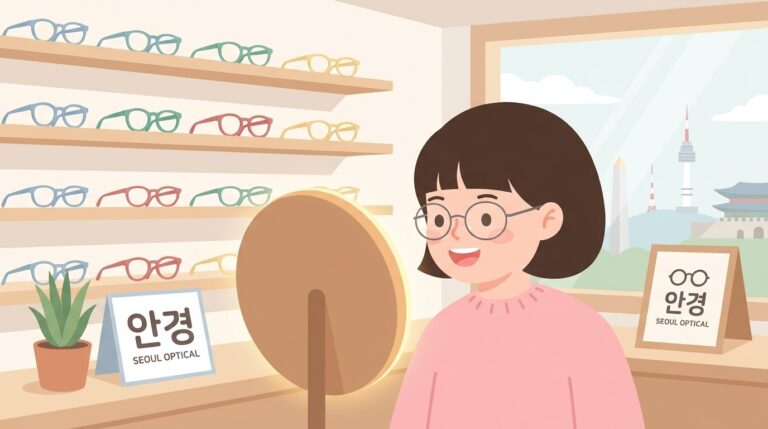
Finding Your Perfect K-Look: How to Choose Glasses Frames in Korea like a Local
Phase 1: Empathy (Welcome to the K-Glass Paradise!)
안녕하세요! (Annyeonghaseyo!) Welcome back to Daily Hangul, your cozy corner for mastering real-life Korean. I’m your Lead Editor and cultural navigator.
Have you ever watched a K-Drama and thought, “Wow, how do those actors look so effortlessly intellectual and chic in those round, metal-rimmed glasses?” If you’ve ever stepped into a Korean optical shop (안경점 – An-gyeong-jeom), you might have felt immediately overwhelmed. Hundreds of trendy, lightweight frames are laid out before you, and a polite optician is waiting to assist. You want to ask to try them on, see what fits your face shape, or ask for the price—but your mind goes blank.
Don’t worry! Today, we are conquering the art of choosing glasses frames (안경테 고르기 – An-gyeong-tae go-reu-gi). By the end of this guide, you’ll walk into any trendy store in Hongdae or Gangnam and shop for your new look with absolute confidence!
Phase 2: Top 3 Essential Expressions
Let’s look at three powerful phrases that will make you sound like a natural shopper.
1. 이거 써봐도 돼요? (I-geo sseo-bwa-do dwae-yo?)
- Pronunciation: ee-gaw suh-bwa-do dway-yo? (Sounds like “suh” in “sudden”)
- Meaning: Can I try these on?
- K-Culture Moment: In K-Dramas, characters always stand in front of the mirror, putting on different frames while their friends give them thumbs-up or thumbs-down.
- Editor’s Insight: The verb 쓰다 (sseu-da) means “to write,” “to use,” and also “to wear (on the head/face)” for glasses, hats, and umbrellas. Adding -봐도 돼요 (bwa-do dwae-yo) asks for permission politely.
- Situation Spectrum: Casual ⚠️ | Semi-formal ✅ | Formal 🚫
- 🤔 Think About It: In your native language, do you use different verbs for “wearing” glasses versus wearing clothes? In Korean, different items of clothing require completely different verbs!
2. 가벼운 테를 찾고 있어요. (Ga-byeo-un tae-reul chat-go isseo-yo.)
- Pronunciation: gah-byuh-oon teh-reul chat-go ees-suh-yo.
- Meaning: I am looking for lightweight frames.
- K-Culture Moment: Korean glasses are famous worldwide for being incredibly light, flexible, and comfortable—perfect for long study or work sessions.
- Editor’s Insight: 테 (tae) refers to the frame itself. 가볍다 (ga-byeop-da) means “lightweight.” If you want metal frames, say “금속테” (geum-sok-tae); for plastic, say “뿔테” (ppul-tae).
- Situation Spectrum: Casual ⚠️ | Semi-formal ✅ | Formal ✅
- 🤔 Think About It: Why is being lightweight so highly valued in Korean glasses culture? How does this reflect the fast-paced, screen-centric daily life of Seoul?
3. 저한테 잘 어울려요? (Jeo-han-te jal eo-ool-lyeo-yo?)
- Pronunciation: juh-han-teh jahl uh-ool-lyuh-yo?
- Meaning: Does this look good on me? / Does this suit me?
- K-Culture Moment: Used constantly when shopping with friends or asking the shop assistant for their honest “Nunchi” (tactful opinion).
- Editor’s Insight: 어울리다 (eo-ool-li-da) means “to match” or “to suit.” This is a friendly way to invite the shopkeeper’s recommendation.
- Situation Spectrum: Casual ✅ | Semi-formal ✅ | Formal 🚫
- 🤔 Think About It: How comfortable are you asking shop staff for their honest opinion in your country compared to doing so in Korea?
Phase 3: Textbook Korean vs. Real Korean
Let’s compare the rigid sentences from old grammar books with what Koreans actually say.
Situation 1: Asking to try on glasses
- 📖 Textbook: 제가 이 안경을 착용해 봐도 괜찮겠습니까? (Je-ga i an-gyeong-eul chak-yong-hae bwa-do gwaen-chan-get-seup-ni-ka?) – “Would it be acceptable if I put on these eyeglasses?” (Too formal and robotic!)
- 🗣️ Real Korean: 이거 한번 써봐도 돼요? (I-geo han-beon sseo-bwa-do dwae-yo?) – “Can I try this on real quick?”
- 💡 Why the difference? Real Koreans prefer the action verb 쓰다 (to wear) over the Sino-Korean technical term 착용하다 (to wear/equip), and soft-pedal it with 한번 (once/one time) to sound friendly.
Situation 2: Describing a trendy, round metal frame
- 📖 Textbook: 원형 모양의 금속 안경테입니다. (Won-hyeong mo-yang-ui geum-sok an-gyeong-tae-im-ni-da.) – “It is a circular-shaped metallic eyeglasses frame.”
- 🗣️ Real Korean: 동글이 안경테 (Dong-geul-i an-gyeong-tae) – “Roundy glasses frames” (Cute slang used everywhere!)
- 💡 Why the difference? Koreans love cute, friendly abbreviations. “동글이” (Dong-geul-i) turns the shape “round” into an adorable noun that even opticians use in stores.
Phase 4: K-Culture Deep Dive & Non-verbal Manners
4-1. The Art of “Try and Place” (Manners at the Optician)
In Korea, glasses are highly accessible; you can freely pick up and try on almost any frame displayed on open shelves. However, good etiquette (매너 – mae-neo) is crucial:
* The Gentle Touch: Don’t stretch the frame arms wide when putting them on. Korean titanium frames are flexible, but it’s polite to handle them gently.
* The Return Rule: If you decide not to buy a frame you just tried on, place it back exactly where you found it, or hand it politely to the optician rather than leaving it scattered.
4-2. The “Korean Glasses” Aesthetic (K-Fashion Code)
In many cultures, wearing glasses is seen as purely functional. In Korea, glasses are a major fashion accessory (패션 아이템). Round, thin-rimmed metal glasses (동글이 안경) are associated with a warm, soft, and intellectual image. Many K-pop idols wear non-prescription glasses (알 없는 안경 – frames with no lenses) just to complete their style!
Phase 5: Real-Life Roleplay Scenario
Setting: A stylish, minimalist optical shop in Hongdae called “Seoul Eyewear.”
Characters:
* 민우 (Min-woo): The friendly, trendy shop assistant (NPC).
* You (A2 Learner): Looking for a fresh new pair of everyday glasses.
Dialogue
- 민우: 어서 오세요! 편하게 써보세요.
(Eo-seo o-se-yo! Pyeon-ha-ge sseo-bo-se-yo.)
“Welcome! Please feel free to try them on.”
🎭 [Smiling warmly, gesturing towards the tables of frames] -
You: 감사합니다! 가벼운 테를 찾고 있어요.
(Gam-sa-ham-ni-da! Ga-byeo-un tae-reul chat-go isseo-yo.)
“Thank you! I am looking for lightweight frames.” -
민우: 아, 가벼운 거요? 이쪽 동글이 테가 요즘 인기가 많아요. 티타늄이라 정말 가벼워요.
(Ah, ga-byeo-un geo-yo? I-jjok dong-geul-i tae-ga yo-jeum in-gi-ga man-a-yo. Ti-ta-nyum-i-ra jeong-mal ga-byeo-wo-yo.)
“Ah, lightweight ones? These round frames are super popular these days. They are titanium, so they are really light.”
🎭 [Pointing to a tray of sleek, metallic frames] -
You: 와, 진짜 가볍네요! 이거 써봐도 돼요?
(Wa, jin-jja ga-byeop-nae-yo! I-geo sseo-bwa-do dwae-yo?)
“Wow, they really are light! Can I try these on?” -
민우: 네, 당연하죠! 거울은 이쪽에 있습니다.
(Ne, dang-yeon-ha-jyo! Geo-wool-eun i-jjo-ge it-seup-ni-da.)
“Yes, of course! The mirror is right here.”
🎭 [Guiding you to a light-up vanity mirror] -
You: 어때요? 저한테 잘 어울려요?
(Eo-tteo-yo? Jeo-han-te jal eo-ool-lyeo-yo?)
“How is it? Does it look good on me?”
🎭 [Looking at the mirror with a slightly shy smile] -
민우: 와, 진짜 잘 어울리세요! 스마트해 보여요.
(Wa, jin-jja jal eo-ool-li-se-yo! Seu-ma-teu-hae bo-yeo-yo.)
“Wow, it really suits you! You look smart.” -
You: 마음에 들어요. 이걸로 할게요!
(Ma-eum-e deul-eo-yo. I-geol-ro hal-ge-yo!)
“I like it. I will take these!”
🔀 Choose Your Path!
What will you say next?
- Choice A: “이거 얼마예요?” (I-geo eol-ma-yeo-yo?) – “How much is this?”
- Feedback (Best): Perfect! It’s simple, direct, and natural. The optician will guide you to checkout.
- Choice B: “이거 깎아주세요!” (I-geo kkak-a-ju-se-yo!) – “Please give me a discount!”
- Feedback (Risk): While common in traditional street markets, modern Korean optician shops have fixed prices (정찰제). It might make the situation a bit awkward!
- Choice C: “안경을 주세요.” (An-gyeong-eul ju-se-yo.) – “Give me glasses.”
- Feedback (Bad): While grammatically correct, it sounds too demanding and dry. “이걸로 할게요” (I’ll go with this one) is much more natural.
Phase 6: 10-Second Emotion Shadowing Drill
Practice saying these lines out loud with the correct emotion and rhythm! (The / indicates a tiny pause to sound native.)
- [😊 Politely curious]
이거 / 한번 / 써봐도 돼요?
(I-geo / han-beon / sseo-bwa-do dwae-yo?) -
[🥺 Slightly insecure but friendly]
저한테 / 잘 / 어울려요?
(Jeo-han-te / jal / eo-ool-lyeo-yo?) -
[😆 Excitedly making a choice]
우와, / 진짜 가볍네요! / 이걸로 할게요!
(Oo-wa, / jin-jja ga-byeop-nae-yo! / I-geol-ro hal-ge-yo!)
Phase 7: K-Culture Mini Dictionary
- 안경테 (An-gyeong-tae) | Eyeglasses frames
The body of the glasses. Standard fashion item in Korea. - 뿔테 (Ppul-tae) | Plastic/Horn-rimmed frames
Historically made of animal horn, now refers to any chunky plastic frame. Very popular for casual looks. - 동글이 안경 (Dong-geul-i an-gyeong) | Round glasses
Thin, metal circular glasses that give a soft, friendly, and smart appearance. - 안경점 (An-gyeong-jeom) | Optician shop
A shop in Korea where you can get eye tests, frames, and custom-made prescription lenses in under 30 minutes!
Phase 8: Survivor’s Travel Kit
Survival Vocab TOP 3
- 안경 닦이 (An-gyeong dakk-i): Glasses cloth. (Pro Tip: If you lose yours, ask: “안경 닦이 하나만 주실 수 있나요?” – Can I get one glasses cloth?)
- 도수 (Do-su): Lens prescription power. (Pro Tip: If you have your country’s prescription, show it on your phone and say: “도수 적힌 사진 있어요” – I have a picture of my prescription.)
- 시력 검사 (Si-ryeok geom-sa): Eye exam. (Pro Tip: Most Korean opticians offer this for free if you buy glasses!)
Editor’s Travel Note ✈️
If you need to find highly-rated, budget-friendly glasses shops, download the Naver Map App (never use Google Maps in Korea, as it’s not fully updated!). Search for “안경점” (optician) near your location. Korea is world-famous for preparing prescription glasses in under 20-30 minutes, so you don’t have to wait days to get your new look!
(Note: While basic eye tests are usually free with purchase, complex medical exams should be done at an eye clinic – 안과).
Phase 9: “A Step Deeper” (Reflections on Korean Culture)
In many Western countries, purchasing glasses is a long, expensive healthcare process requiring insurance and doctor appointments. In Korea, it is treated almost like buying fast fashion—highly efficient, incredibly affordable, and style-oriented. This reflects Korea’s famous 빨리빨리 (Palli-palli – Hurry, hurry) culture and its high focus on personal aesthetics. It shows how convenience and fashion merge seamlessly in everyday Korean life.
💬 Your Turn: Would you buy glasses as a fashion accessory even if you didn’t need them? Let us know in the comments below!
Phase 10: FAQ & Common Mistakes
Q: Can I get my eye exam done in English in Korea?
A: Many modern glasses shops in major tourist areas like Myeongdong, Hongdae, or Itaewon have English-speaking staff and computerized testing machines that don’t require heavy conversation. You just look at a red balloon on a screen!
Q: Do I need to make an appointment beforehand?
A: No appointment is needed! You can simply walk in, choose your frames, get your eyes tested, and walk out with finished glasses in less than an hour.
Q: Can I bring my own frames and just ask for lenses?
A: Yes! You can say: “알만 바꿀 수 있어요?” (Al-man bak-kul su isseo-yo?) which means “Can I change just the lenses?”
🚨 Common Mistakes Alert!
- Mistake 1: Saying “안경을 입다” (An-gyeong-eul ip-da).
- Correction: 입다 is only for clothes on your body. For glasses, always use 쓰다 (sseu-da).
- Mistake 2: Expecting to pay hundreds of dollars.
- Correction: Korean frames start as low as 10,000 KRW ($8 USD). Don’t look too shocked at the cheap price tags!
Phase 11: Action Mission!
- 🥉 Bronze: Practice reading the three essential expressions out loud 5 times in front of your mirror.
- 🥈 Silver: Take a picture of your current glasses and share it on social media with the caption: “가벼운 안경테를 찾고 있어요! 👓” and tag
#DailyHangul! - 🥇 Gold: When visiting Korea, step into an optical shop, try on one pair of glasses, and ask the clerk: “이거 써봐도 돼요?”
Phase 12: Interactive Quiz Challenge
Test your knowledge with these quick questions!
1. Which verb is used for “wearing” glasses in Korean?
- A) 입다 (Ip-da)
- B) 신다 (Sin-da)
- C) 쓰다 (Sseu-da)
Reveal Answer & Explanation
Correct Answer: C) 쓰다 (Sseu-da)
Explanation: 쓰다 is used for items worn on the head or face (glasses, hats, masks). 입다 is for clothes, and 신다 is for shoes!
2. What does “동글이 안경” (Dong-geul-i an-gyeong) mean?
- A) Square heavy plastic glasses
- B) Trendy round metal-rimmed glasses
- C) Sunglasses
Reveal Answer & Explanation
Correct Answer: B) Trendy round metal-rimmed glasses
Explanation: ‘동글이’ comes from ‘동그랗다’ (to be round). It’s the ultra-popular round-frame style in Korea!
See you in the next lesson! 다음에 또 만나요! (Da-eum-e tto man-na-yo!)







