

Kimchi is Not Just One Thing! Cracking the Banchan Code: From Baechu to Kkakdugi
Phase 1: Empathy (An Interactive Opening)
안녕하세요! (Annyeonghaseyo!) I’m your Daily Hangul editor and local culture navigator!
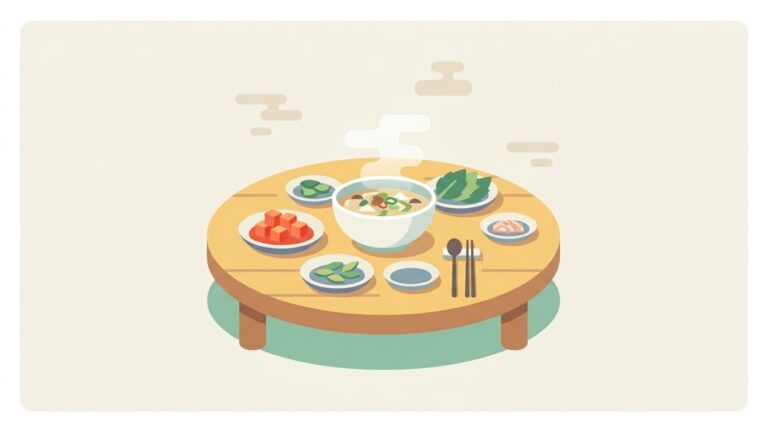
Imagine this: You are sitting in a bustling, authentic K-BBQ restaurant in Seoul. The grill is sizzling, the aroma of caramelized pork belly fills the air, and then… a small army of tiny side dishes, 반찬 (banchan), lands on your table. Among them are three different red, spicy-looking dishes.
“Wait, are these all Kimchi?” you wonder. You point to one, bite into it expecting a soft cabbage texture, but instead, get a loud, crunchy CRUNCH of radish. You try to ask the server for a refill of that specific radish one, but you only know the word “Kimchi.” They bring you more cabbage instead.
Many intermediate Korean learners feel stuck here. You know what Kimchi is, but when faced with the sheer variety of Korean table settings, you realize that simply saying “김치 (Kimchi)” doesn’t cut it anymore! Today, we are going to level up your Korean from “I eat Kimchi” to “I prefer the crisp texture of Kkakdugi with my soup.” Let’s dive in!
Phase 2: Deep Dive into 3 Essential Banchan & Kimchi Expressions
1. 배추김치 (Baechu-kimchi) – Napa Cabbage Kimchi
- Pronunciation: Bae-chu-gim-chi (Sounds like “Bay-choo” + “Gim-chee”)
- Meaning: Napa Cabbage Kimchi (The classic variety)
- K-Culture Moment: This is the iconic Kimchi you see in every K-Drama. Think of the scene in Crash Landing on You where characters gather to eat fresh Kimchi with steamed sweet potatoes.
- Editor’s Insight: If a menu or a server says just “김치 (Kimchi)” without any prefix, they 99% of the time mean Baechu-kimchi. It is the undisputed king of the Korean table.
- Situation Spectrum: Casual ✅ | Semi-formal ✅ | Formal ✅
- 🤔 Think About It: In many Western cultures, a side dish is optional or ordered separately. In Korea, Baechu-kimchi is so fundamental that serving a meal without it feels incomplete. How does your culture view “essential” side dishes?
2. 깍두기 (Kkakdugi) – Diced Radish Kimchi
- Pronunciation: Kkak-du-gi (Sounds like “Kkahk-doo-gee” with a sharp, bouncy ‘K’)
- Meaning: Cubed Radish Kimchi
- K-Culture Moment: Essential in K-Drama soup scenes. Whenever characters eat Seolleongtang (ox bone soup) or Gukbap (hot soup with rice), there is always a jar of Kkakdugi on the table.
- Editor’s Insight: Kkakdugi is loved for its sweet, refreshing crunch. Koreans judge a soup restaurant’s quality solely by the taste of its Kkakdugi.
- Situation Spectrum: Casual ✅ | Semi-formal ✅ | Formal ✅
- 🤔 Think About It: Notice how the word Kkakdu mimics the physical sound and action of chopping radish into cubes. Korean has many onomatopoeic words hidden in food names!
3. 반찬 좀 더 주실 수 있나요? (Banchan jom deo jusil su innayo?) – Could I have some more side dishes?
- Pronunciation: Ban-chan jom deo joo-sil soo een-nah-yo? (Soft ‘j’ in jom, slide the words together naturally)
- Meaning: “Could you give us a little more side dishes, please?”
- K-Culture Moment: Entering a restaurant, seeing the tiny dishes empty, and politely calling out to the Imo-nim (auntie/server) to ask for a refill.
- Editor’s Insight: The word 좀 (jom) literally means “a little,” but here it functions as a politeness marker. It softens the request so you don’t sound demanding.
- Situation Spectrum: Casual ⚠️ (Too formal for close friends) | Semi-formal ✅ (Perfect for restaurants) | Formal ✅
- 🤔 Think About It: Refilling side dishes for free is a staple of Korean hospitality (정 – Jeong). Asking politely shows you appreciate their food!
Phase 3: Textbook Korean vs. Real-Life Korean
Scenario 1: Asking for more Kimchi
- 📖 Textbook: “김치를 더 주십시오.” (Gimchi-reul deo jusipsio. – Please give me more Kimchi. [Very stiff/robotic])
- 🗣️ Real-Life: “사장님, 저희 배추김치 리필 좀 해주세요!” (Sajangnim, jeohui baechu-gimchi ripil jom hae-juseyo! – Boss, could we get a refill on the cabbage kimchi, please!)
- 💡 Why the difference? Koreans rarely use the ultra-formal “-십시오” in casual dining. Using 리필 (ripil – English ‘refill’) combined with “좀 (jom)” sounds incredibly natural and friendly.
Scenario 2: Expressing your preference for Radish Kimchi
- 📖 Textbook: “저는 깍두기를 좋아합니다.” (Jeoneun kkakdugi-reul joahamnida. – I like Kkakdugi.)
- 🗣️ Real-Life: “역시 설렁탕엔 깍두기죠!” (Yeoksi seolleongtang-en kkakdugi-jyo! – As expected, Kkakdugi is the ultimate match for Seolleongtang!)
- 💡 Why the difference? The ending -죠 (-jyo) is used when you expect the other person to agree with your taste, creating a warm, shared vibe over the meal.
Phase 4: K-Culture Deep Dive & Non-Verbal Manners
4-1. The Art of “Banchan Etiquette”
- Eye Contact & Cueing: When eating with seniors or hosts, never grab your favorite Kimchi the moment it lands. Wait for the eldest person to lift their spoon first.
- Chopstick Precision: Never stick your chopsticks vertically into your rice bowl (this mimics ancestral rituals!). Instead, lay them flat on the table or chopstick rest. When picking up slippery Kkakdugi, use the flat sides of your metal chopsticks for grip, rather than stabbing it.
4-2. The “Kimchi-Jang” Culture
In late autumn, entire families (and neighborhoods) gather for 김장 (Gimjang), the traditional process of making massive quantities of Kimchi for the winter. It’s not just food prep; it’s a UNESCO-recognized cultural heritage of sharing love. During Gimjang, it is a tradition to wrap freshly made Kimchi around boiled pork (수육 – Suyeuk) and feed it directly into each other’s mouths with bare hands. It’s the ultimate expression of Korean Jeong (affection)!
Phase 5: Real-Life Roleplay Scenario
Setting: A cozy traditional soup restaurant (Gukbap-jip) in Seoul. You are sitting with Min-ho (your Korean friend) and the friendly restaurant owner (Sajangnim).
- Sajangnim: (Setting down a hot, bubbling bowl) 국밥 나왔습니다! 맛있게 드세요.
(Gukbap nawassumnida! Masitge deuseyo.)
(Here is your soup! Enjoy your meal.) - Min-ho: (Picking up chopsticks) 와, 맛있겠다! 먼저 국물 맛보자.
(Wa, masitgetda! Meonjeo gungmul mat-boja.)
(Wow, looks delicious! Let’s taste the broth first.) - You: (Noticing the side dishes) 민호야, 이 하얗고 빨간 무 김치 이름이 뭐야?
(Minho-ya, i hayako ppalgan mu gimchi ireumi moya?)
(Minho, what is the name of this white and red radish kimchi?) - Min-ho: 아, 이거? 이건 깍두기라고 해. 먹어봐, 엄청 아삭해!
(A, igeo? Igeon kkakdugi-rago hae. Meogobwa, eomcheong asak-hae!)
(Ah, this? This is called Kkakdugi. Try it, it’s super crunchy!) - You: (Eating a piece) 🎭 [Surprised by the crunch] 진짜 아삭하다! 국밥이랑 딱 어울려.
(Jinjja asak-hada! Gukbap-irang ttak eoullyeo.)
(It’s really crunchy! It goes perfectly with the soup.) - Min-ho: 맞지? 근데 깍두기 벌써 다 먹었네. 더 달라고 할까?
(Matji? Geunde kkakdugi beolsse da meogeonne. Deo dallago halkka?)
(Right? But we already finished the Kkakdugi. Shall we ask for more?) - You: 🎭 [Politely waving to the owner] 제가 해볼게! 사장님, 저희 깍두기 리필 좀 해주세요!
(Jega hae-bolge! Sajangnim, jeohui kkakdugi ripil jom hae-juseyo!)
(I’ll try! Boss, could we get a refill on the Kkakdugi, please!) - Sajangnim: (Smiling warmly) 아이구, 잘 먹네! 여기 깍두기 듬뿍 더 드려요!
(Aigu, jal meogne! Yeogi kkakdugi deumppuk deo deuryeoyo!)
(My, you eat well! Here is a generous refill of Kkakdugi for you!)
🔀 Interactive Choice Points
What would you say next to the Sajangnim?
* Choice A: “감사합니다! 진짜 맛있어요!” (Gamsahamnida! Jinjja masisseoyo! – Thank you! It’s really delicious!)
* Choice B: “깍두기 공짜예요?” (Kkakdugi gongjja-yeyo? – Is Kkakdugi free?)
* Choice C: “배추김치는 맛이 없어요.” (Baechu-gimchireun masi eopseoyo. – The cabbage kimchi is not tasty.)
💡 Feedback on Your Choice:
- Choice A (Best): Fantastic! Complimenting the food while showing gratitude is the quickest way to win a Korean owner’s heart. They might even give you extra service (서비스)!
- Choice B (Risk): While true (banchan is free), asking this upfront can sound slightly impolite or transactional. It’s better to just enjoy the free refills naturally.
- Choice C (Bad): Oops! This is a social faux pas. In Korea, criticizing one dish while asking for another can come off as rude to the host who prepared both.
Phase 6: 10-Second Emotion Shadowing Drill
Let’s practice speaking like a local with emotional nuances. Use the slash / to pause.
- [😊 Bright & Happy]
“사장님, / 여기 / 깍두기 / 진짜 맛있어요!”
(Sajangnim, / yeogi / kkakdugi / jinjja masisseoyo!)
(Boss, the Kkakdugi here is truly delicious!) -
[🥺 Polite & Begging tone]
“저기요, / 배추김치 / 조금만 / 더 주실 수 있나요?”
(Jeogiyo, / baechu-gimchi / jogum-man / deo jusil su innayo?)
(Excuse me, could you please give us just a little more cabbage kimchi?)
Phase 7: K-Culture Mini-Dictionary
- 아삭하다 (Asak-hada) | Crunchy | Used specifically for watery, crisp vegetables like radish, cucumber, or fresh cabbage.
- 이모님 (Imo-nim) | Auntie | A warm, colloquial way to call female restaurant staff in casual dining spots.
- 밥도둑 (Bap-dodoog) | Rice Thief | A slang term for a side dish so delicious that you eat your entire bowl of rice without realizing it.
- 겉절이 (Geotjeori) | Fresh Kimchi | Unfermented, freshly seasoned Kimchi that is crispy and sweet rather than sour.
Phase 8: Survivor Kit for Travelers
Survival Expressions TOP 3
- “반찬 셀프인가요?” (Banchan selpeu-ingayo?)
- Pro Tip: Many casual restaurants have a “Self-service” corner for refills. Look for a sign saying ‘셀프’ (Self) before asking the staff.
- “안 매운 김치도 있나요?” (An maeun gimchi-do innayo?)
- Pro Tip: If spicy food is tough for you, ask if they have white, non-spicy kimchi like 백김치 (Baek-kimchi).
- “이거 더 주세요.” (Igeo deo juseyo.)
- Pro Tip: Simple and powerful. Just point to the empty dish and say this with a smile.
Editor’s Travel Note
When navigating the food scene in Korea, use Naver Map (네이버 지도) to find local restaurants instead of Google Maps, as Naver is much more updated with reviews and operating hours. Note: Tipping is absolutely not required in Korea, so don’t leave extra cash on the table!
Phase 9:
Frequently Asked Questions (FAQ)
Q: What does "배추김치 (Baechu-kimchi) - Napa Cabbage Kimchi" mean in Korean and how do you pronounce it?
A: In Korean, "배추김치 (Baechu-kimchi) - Napa Cabbage Kimchi" is pronounced [Bae-chu-gim-chi (Sounds like "Bay-choo" + "Gim-chee"] and means: Napa Cabbage Kimchi (The classic variety)
Q: What does "깍두기 (Kkakdugi) - Diced Radish Kimchi" mean in Korean and how do you pronounce it?
A: In Korean, "깍두기 (Kkakdugi) - Diced Radish Kimchi" is pronounced [Kkak-du-gi (Sounds like "Kkahk-doo-gee" with a sharp, bouncy 'K'] and means: Cubed Radish Kimchi
Q: What does "반찬 좀 더 주실 수 있나요? (Banchan jom deo jusil su innayo?) - Could I have some more side dishes?" mean in Korean and how do you pronounce it?
A: In Korean, "반찬 좀 더 주실 수 있나요? (Banchan jom deo jusil su innayo?) - Could I have some more side dishes?" is pronounced [Ban-chan jom deo joo-sil soo een-nah-yo? (Soft 'j' in jom, slide the words together naturally] and means: "Could you give us a little more side dishes, please?"







