

Master the Pulse of Korea’s Traditional Five-Day Markets (5일장)
Phase 1: Empathy (Welcome to the Heart of the Marketplace!)
안녕하세요! This is your Senior Editor from Daily Hangul (매일한글), your personal local cultural navigator!
Have you ever ventured outside the neon-lit streets of Seoul, only to find yourself in a bustling local town that suddenly feels like a vibrant festival? If so, you’ve likely stumbled upon a 5일장 (oiljang – Five-Day Market). These rotating markets are the ancient heartbeat of Korean community life, moving from town to town every five days.
For advanced learners (C1), navigating a 5일장 can be a thrilling but humbling experience. You might know your textbook shopping vocabulary, but when a local merchant (상인) shouts rapid-fire provincial dialect (사투리) or uses idiomatic terms for fresh produce, it’s easy to freeze up. The “pain point” isn’t just about paying; it’s about missing out on the warm, community-driven interactions, known as 정 (Jeong), because you don’t know how to playfully banter with the vendors.
This guide is built on real case studies of learners who wanted to go beyond simple transactions and truly connect with local vendors. By the end of this post, you’ll be able to negotiate naturally, appreciate the rich chaos of the market, and sound like a seasoned local rather than a tourist reading from a script.
Phase 2: Deep-Dive into 3 Essential Expressions
1. 떨이로 싸게 드릴게요 (tteori-ro ssage deurilgeyo)
- Pronunciation: Tteol-ee-ro ssah-geh deu-ril-geh-yo (Sounds like “tull-ee” + “ro”)
- Meaning: “I’ll give it to you cheap as a clearance deal (selling off the remaining stock).”
- K-Culture Moment: Often heard in K-Dramas set in rural seaside towns (like Our Blues or Hometown Cha-Cha-Cha), where a warm-hearted grandmother wants to pack up her stall early and go home, offering the last batch of fish or vegetables at a steal.
- Editor’s Insight: 떨이 comes from the verb 털다 (to dust off/empty). When a vendor says this, they are offering you a heartfelt deal. Refusing might seem cold, so it’s the perfect time to accept and say “감사합니다!”
- Situation Spectrum: Casual (⚠️) / Semi-formal (✅) / Formal (🚫)
- 🤔 Think About It: How does your culture view buying the “last items” left on a shelf? In Korea, buying 떨이 is seen as a win-win: you get a massive discount, and you help the elderly merchant go home early.
2. 덤으로 좀 더 얹어 주셨네요 (deom-euro jom deo eonjeo jusyeotneyo)
- Pronunciation: Dum-eu-ro jom duh uhn-juh joo-syut-neh-yo
- Meaning: “You threw in some extra items as a bonus!”
- K-Culture Moment: You buy a bag of shiny red apples, and the vendor slips in two extra plums with a wink, saying “서비스야!” (It’s a service!). You acknowledge this warm gesture with this beautiful phrase.
- Editor’s Insight: 덤 (Deom) is the ultimate linguistic manifestation of 정 (Jeong). It refers to the free extra goodies given to build a relationship. Don’t just say “Thank you”; explicitly pointing out the 덤 shows you truly understand Korean market culture.
- Situation Spectrum: Casual (✅) / Semi-formal (✅) / Formal (🚫)
- 🤔 Think About It: Is there a concept of “free extras” based entirely on human connection in your home country, or is everything strictly calculated by weight and barcode?
3. 장날이라 그런지 사람 사는 냄새가 나네요 (jangnar-ira geureonji saram saneun naemsae-ga naneyo)
- Pronunciation: Jahng-nal-ee-ra geu-run-ji sah-rahm sah-neun nem-seh-ga nah-neh-yo
- Meaning: “Since it’s market day, it really smells/feels like human life (vibrant and lively).”
- K-Culture Moment: Standing in the middle of a crowded alley, surrounded by the sizzling sound of Mungbean pancakes (녹두전), colorful umbrellas, and elderly folks laughing.
- Editor’s Insight: 사람 사는 냄새 (literally “the smell of people living”) is a beautiful, highly idiomatic poetic expression used to describe a warm, bustling, and authentic human atmosphere, contrasted with the cold, sterile feeling of modern supermarkets.
- Situation Spectrum: Casual (✅) / Semi-formal (✅) / Formal (⚠️)
- 🤔 Think About It: Why does modern society crave these traditional, slightly chaotic spaces? What is the equivalent idiom for this cozy, bustling atmosphere in your native language?
Phase 3: Textbook Korean vs. Real-Life Korean
Situation 1: Asking for a discount or extra portion
- 📖 Textbook: “깎아 주세요.” (Kkakka juseyo. – Please give me a discount.)
- 🗣️ Real-Life: “사장님, 저희 단골 할 테니까 덤 좀 팍팍 주세요!” (Sajangnim, jeohui dangol hal tenikka deom jom pakpak juseyo! – Boss, we’ll become your regulars, so please throw in some generous extras!)
- 💡 Why the difference? Directly asking to cut the price (깎다) can sometimes feel transactional or slightly stingy at small traditional stalls. Asking for 덤 (extras) with the promise of becoming a 단골 (regular customer) is a much more playful, warm, and culturally savvy way to get a deal.
Situation 2: Expressing admiration for the lively market atmosphere
- 📖 Textbook: “시장이 정말 시끄럽고 활기차네요.” (Sijangi jeongmal sikkeureopgo hwalgichaneyo. – The market is really noisy and energetic.)
- 🗣️ Real-Life: “와, 진짜 북적북적하고 인심이 넘치네요!” (Wa, jinjja bukjeok-bukjeokhago insimi neomchineyo! – Wow, it’s delightfully bustling, and the generosity of spirit is overflowing!)
- 💡 Why the difference? “시끄럽다” (noisy) has a slightly negative connotation. Onomatopoeias like 북적북적하다 (bustling) combined with 인심 (human generosity/warmth) show that you appreciate the soul of the market, not just the volume level.
Phase 4: K-Culture Deep Dive & Non-Verbal Etiquette
4-1. Nunchi & Gestures: The Art of Handing Cash
When buying goods at a 5일장, cash is king (though many accept bank transfers/계좌이체). When handing over cash to an elderly vendor, always use two hands (or support your right elbow with your left hand). It shows immense respect. Also, when they offer you a free sample of fruit or snack to taste, do not decline with a rigid shake of the head. Gently place your hand over your chest, bow slightly, and accept it with a bright smile. This non-verbal Nunchi (social sensing) instantly marks you as a cultured guest.
4-2. The Soul Food of the Market: 5일장 Food Culture
A 5일장 is not just for grocery shopping; it’s an outdoor food heaven. If you visit, you must sit on a plastic stool under a vinyl tent and try 칼국수 (hand-cut noodle soup) or 시장 통닭 (rustic whole fried chicken). This is the ultimate comfort food shown in variety shows like 2 Days 1 Night (1박 2일). Eating these foods with the ambient sounds of bargaining around you is the most authentic way to experience Korean Jeong.
Phase 5: Interactive Roleplay Scenario
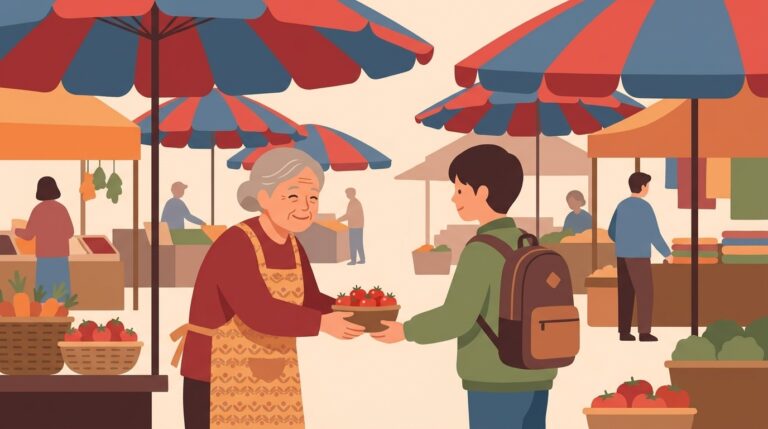
Setting: You are visiting the famous Jeongseon 5-Day Market (정선 5일장) in Gangwon Province. You stop in front of a colorful stall filled with mountain herbs and fresh cherry tomatoes. The owner, a friendly local grandmother (할머니), greets you warmly.
Characters:
- Grandmother (이모/할머니): Warm, energetic, speaks with a slight Gangwon dialect.
- You (C1 Learner): A respectful traveler looking to experience local culture and buy some fresh fruits.
1. 할머니: (Handing you a cherry tomato) "아가씨, 이것 좀 잡숴 봐! 방금 따온 거라 엄청 달아!"
   (Miss, try some of this! I just picked them, so they are incredibly sweet!)

2. You: (😊 Smiling warmly, accepting with two hands) "우와, 할머니! 진짜 탱글탱글하고 맛있네요! 직접 농사지으신 거예요?"
   (Wow, Halmoni! They are so plump and delicious! Did you farm them yourself?)

3. 할머니: (Proudly slapping her thigh) "그럼! 우리 밭에서 화학비료 안 쓰고 애지중지 키운 거여. 한 바구니 가져가!"
   (Of course! I raised them with extreme care without chemical fertilizers in our field. Take a basket!)

4. You: "안 그래도 사려고 했어요. 요즘 마트 마켓에서는 이런 싱싱한 토마토 구하기 힘들거든요. 이거 한 바구니에 얼마예요?"
   (I was actually planning to buy some. It's hard to find such fresh tomatoes in supermarkets these days. How much is one basket?)

5. 할머니: "오천 원만 줘! 원래 육천 원 받는 건데, 이뻐서 싸게 주는 거여!"
   (Just give me 5,000 won! I usually charge 6,000 won, but I'm giving it cheap because you're pretty!)

6. You: "감사합니다! 역시 장날이라 그런지 시장 인심이 정말 최고네요. 여기 오천 원이요."
   (Thank you! As expected of market day, the market generosity is truly the best. Here is 5,000 won.)

7. 할머니: (Grabbing a handful of plums and dropping them in your bag) "자, 맛만 보지 말고 이것도 가져가서 먹어! 덤이여, 덤!"
   (Here, don't just taste it, take these plums too! It's a bonus, a bonus!)

8. You: "어머나, 할머니! 이렇게 덤까지 듬뿍 주시다니... 감동이에요! 다음 장날에도 꼭 다시 올게요!"
   (Oh my, Halmoni! Giving me such a generous bonus... I'm so touched! I will definitely come back on the next market day!)
🔀 Interactive Choice:
At step 7, if the grandmother didn’t offer a bonus first, what would you say to playfully ask for one?
* A: “할머니, 조금만 깎아주시면 안 돼요?” (Halmoni, can’t you discount it a little bit?)
* B: “에이 할머니~ 저 단골 할 테니까 맛있는 사과 하나만 덤으로 얹어주세요!” (Aw, Halmoni~ I’ll be your regular, so please throw in just one sweet apple as a bonus!)
* C: “너무 비싸요. 마트가 더 싼 것 같아요.” (It’s too expensive. I think supermarkets are cheaper.)
Feedback:
- Selection B (Best): Excellent! This is highly natural, uses the playful tone “에이~”, and leverages the 단골 & 덤 concept. The grandmother will smile and gladly give you an extra!
- Selection A (Risk): A bit dry. While not rude, it makes the interaction purely financial. Traditional markets thrive on playful relationship-building.
- Selection C (Bad): Avoid at all costs! Comparing a hard-working local vendor’s fresh produce directly to corporate supermarkets is considered disrespectful and ruins the 정 (Jeong).
Phase 6: 10-Second Emotion Shadowing Drill
Practice speaking with the right pitch and emotional inflections. The / marks a natural pause.
- [😊 Expressing Delight & Warmth]
“우와! / 진짜 북적북적하고 / 사람 사는 냄새가 나네요!”
(U-wa! / Jin-jja buk-jeok-buk-jeok-ha-go / sah-rahm sah-neun nem-seh-ga nah-neh-yo!) -
[🥺 Playfully Pleading for Extras]
“사장님~ / 저 단골 할게요! / 덤 좀 / 팍팍 얹어주세요!”
(Sah-jahng-nim~ / juh dahn-gol hal-geh-yo! / deom jom / pak-pak eon-jeo-joo-seh-yo!)
Phase 7: K-Culture Mini Dictionary
- 시골 쥐 (Sigol Jwi) | Country Mouse: A humorous idiom used to describe urbanites (especially Seoulites) who get overwhelmed or amazed by rural traditions and countryside vibes.
- 인심 (Insim) | Generosity/Human Warmth: Literally “the mind of people.” It refers to the benevolent, giving spirit characteristic of traditional Korean society, especially prominent in local markets.
- 오일장 (Oiljang) | Five-Day Market: A traditional rotating market that opens once every five days (e.g., dates ending in 2, 7 or 3, 8).
- 단골손님 (Dangolsonnim) | Regular Customer: A loyal customer. In Korea, being a 단골 is a matter of pride and guarantees superior service and plenty of 덤.
Phase 8: Survivor Kit for Travelers
Survival Expressions TOP 3
- 카드 결제 되나요? (Kadeu gyeolje dwenayo?)
- Pro Tip: “Can I pay by card?” Use this politely, but be ready to use bank transfer (계좌이체) if card terminals are unavailable.
- 이거 어떻게 먹는 거예요? (Igeo eotteohge meongneun geoyeyo?)
- Pro Tip: “How do you eat/cook this?” Perfect for asking about exotic mountain herbs or regional side dishes.
- 가장 잘 나가는 걸로 주세요. (Gajang jal nageaneun geollo juseyo.)
- Pro Tip: “Please give me the best-selling one.” Use this at food stalls to get the local specialty without overthinking.
Editor’s Travel Note
Before heading out to rural areas like Jeongseon, Damyang, or Jeju, search for “[Region Name] 5일장 날짜” on search engines. To navigate, download the Naver Map App (네이버 지도) as Google Maps is not fully optimized for Korea’s local transport schedules. Disclaimer: Market schedules may vary depending on local weather conditions.
Phase 9: “A Step Deeper” (Thought-Provoking Essay)
In modern Korea, where rocket-speed online deliveries (로켓배송) can bring organic vegetables to your doorstep in six hours, why does the outdated, inefficient 5일장 still survive? The answer lies in 공동체 문화 (Community Culture).
At a 5일장, transactions are not automated or silent. You must look into the eyes of the farmer, talk about the weather, and ask how to cook the produce. It is a space where linguistic politeness meets human warmth. For advanced learners, entering a traditional market is a step toward embracing this relational culture, stepping away from the sterile convenience of modern life.
💬 Your Turn: What traditional market customs exist in your country? Do you prefer the fast convenience of supermarkets, or the warm chaos of local markets? Let us know in the comments below!
Phase 10: FAQ & Common Mistakes
Q: Can I negotiate prices aggressively like in tourist bazaars?
A: No. While mild, playful banter for 덤 (extras) or rounding down a few hundred won is common, aggressive haggling or acting like the prices are a rip-off is considered rude. Most prices at local 5일장 are already extremely reasonable and directly support the farmers.
Q: How do I know when the market is open?
A: They run on a specific 5-day cycle. For example, a “2, 7 market” opens on the 2nd, 7th, 12th, 17th, 22nd, and 27th of every month. Check regional tourism websites before visiting!
Q: I don’t speak the local dialect (사투리). Will they understand me?
A: Absolutely. While the vendors might use heavy local accents, they will understand standard Seoul Korean (표준어) perfectly. They will love your effort!
🚨 Common Mistakes Warning Sign
- Mistake 1: Refusing to taste food samples with an expressive look of disgust.
- Correct Action: If you don’t want to try it, politely smile, wave your hand slightly, and say “괜찮습니다, 감사합니다.”
- Mistake 2: Dropping honorifics because the vendor is an elderly grandmother (thinking it’s friendly).
- Correct Action: Always use polite high-respect forms (해요체 or 하십시오체) until a mutual connection is strongly established.
Phase 11: Action Mission & K-Culture Challenge
- 🥉 Bronze Mission: Practice saying “사람 사는 냄새가 나네요” with correct emotional inflection 3 times in front of a mirror.
- 🥈 Silver Mission: Write down a short comment below describing your favorite market food using the word 인심.
- 🥇 Gold Mission: Visit a local traditional market near you in Korea (or a Korean market abroad), ask the vendor “이것 좀 덤으로 더 주실 수 있어요?” with a bright smile, and share your experience!
🎮 K-Culture Mission:
Watch an episode of the show Korean Food Table (한국인의 밥상) or My Little Old Boy (미운 우리 새끼) when they visit a rural town. Spot at least one interaction where 덤 or 정 is expressed!
Phase 12: Interactive Quiz Challenge
1. Situation Quiz
You want to ask the elderly market vendor to give you some free extra pieces of garlic because you bought a large amount of potatoes. Which is the most natural, culturally appropriate way to ask?
* A) 마늘 공짜로 주세요. (Give me garlic for free.)
* B) 사장님, 여기 마늘 덤으로 몇 개만 더 주시면 안 될까요?
* C) 마늘을 할인해 주세요. (Discount the garlic.)
🔍 Click to view the Correct Answer & Explanation
Correct Answer: B
Using “덤으로” (as an extra) with “안 될까요?” (soft questioning) is incredibly polite and natural. Asking for something “공짜” (free) sounds demanding, and “할인” (discount) is too clinical for a casual market.
2. True or False
At a Korean 5일장, you should always try to slash the offered price by at least 50% to show you are a savvy shopper.
* True
* False
🔍 Click to view the Correct Answer & Explanation
Correct Answer: False
Prices are already very fair. Deep haggling hurts the livelihood of the farmers and is seen as highly disrespectful. Focus on asking for 덤 instead!







