

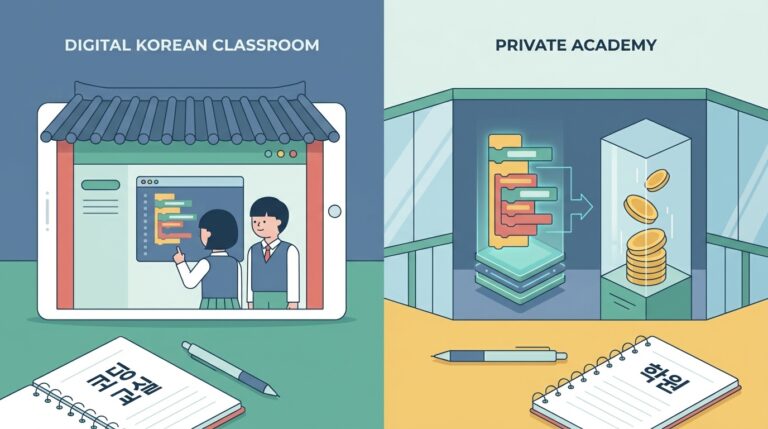
Master Debate: Evaluating the Efficacy of Korea’s Mandatory Coding Education
안녕하세요! It’s your K-culture bestie and Daily Hangul senior editor. Welcome back to our premium language lounge! Today, we are diving deep into a topic that has been heating up corporate boardrooms and family dinner tables across Korea: the efficacy of mandatory coding education (코딩 교육 의무화의 실효성 평가).
In a country powered by tech giants like Samsung and Naver, coding isn’t just a skill—it’s seen as the new literacy. But is forcing every schoolchild to learn Python actually creating future tech innovators, or is it just fueling Korea’s notorious private academy (hagwon) craze? Today, we’ll explore how to debate this complex issue like a highly articulate, C2-level native speaker.
Phase 1: Empathy & K-Culture Context
Imagine watching a K-Drama like Start-Up. You see Nam Do-san pulling all-nighters, coding his way to glory. Inspired, Korean parents rush to sign up their elementary-school kids for “coding playrooms.” However, the reality of public school coding classes often feels like a drop in the bucket compared to the intense private tutoring market.
As a C2 learner, you need to navigate these cultural nuances. When debating this topic in Korean, simply saying “Coding education is good” or “It is bad” won’t cut it. You need to analyze the underlying societal pressures, the gap between policy and infrastructure, and the concept of “education fever” (gyoyuk-yeol). Let’s master the linguistic tools to articulate these high-level arguments elegantly.
Phase 2: Key Vocabulary Deep-Dive
1. 허울뿐인 제도 (Heo-ul-ppun-in je-do)
- Pronunciation: Heo-ool-bboon-in je-do (Think of “her” but with a soft “o”, and “pool” with a tense “pp” sound)
- Meaning: A policy in name only; a nominal system lacking substance.
- K-Culture Moment: Often heard in political thrillers or news debates when analyzing flashy government initiatives that lack real-world infrastructure.
- Editor’s Insight: 허울 means an outward appearance or facade. This is the perfect C2 phrase to criticize policy implementation without sounding overly aggressive.
- Situation Spectrum: Casual (⚠️) | Semi-formal (✅) | Formal (✅)
- 🤔 Think About It: Is there a policy in your country that citizens criticize as being “just for show” (허울뿐인)?
2. 백년대계 (Baek-nyeon-dae-gye)
- Pronunciation: Baek-nyeon-dae-gye (Rhymes with “pack-neon-day-gyay”)
- Meaning: A grand, long-term plan for a hundred years (usually referring to national education).
- K-Culture Moment: Used by policymakers, scholars, and principal characters in academic dramas like Sky Castle to emphasize that education shouldn’t be changed on a whim.
- Editor’s Insight: This Hanja-based idiom (백년 = 100 years, 대계 = grand plan) highlights the cultural reverence Koreans have for education as the foundational pillar of society.
- Situation Spectrum: Casual (🚫) | Semi-formal (⚠️) | Formal (✅)
- 🤔 Think About It: Why do you think Koreans view education as a “hundred-year plan” rather than short-term training?
3. 사교육 시장의 배만 불리다 (Sa-gyo-yuk si-jang-ui bae-man bul-li-da)
- Pronunciation: Sa-gyo-yook she-jang-eui bae-man bool-ree-da (The word bae sounds like “peh” or “belly”)
- Meaning: To only line the pockets of the private education market (literally, “to only fatten the belly of the private tutoring sector”).
- K-Culture Moment: A staple phrase in documentaries discussing Korea’s intense hagwon (academy) culture and the financial burden on parents.
- Editor’s Insight: A colorful yet highly professional idiomatic expression used to criticize how public reforms often inadvertently boost private sector profits.
- Situation Spectrum: Casual (✅) | Semi-formal (✅) | Formal (✅)
- 🤔 Think About It: How does this vivid metaphor of “fattening the belly” reflect the public skepticism toward private academies?
Phase 3: Textbook Korean vs. Real Native Korean
Let’s compare how a standard textbook teaches debate vocabulary versus how a sophisticated native intellectual actually argues.
Situation 1: Expressing that a system is ineffective
- 📖 Textbook Korean: 코딩 교육은 아직 효과가 없습니다. (Coding education is not effective yet.)
- 🗣️ Real Native Korean: 현재의 코딩 의무화 교육은 전문 인력 부족으로 인해 실효성 없는 탁상공론에 그치고 있습니다. (Due to the lack of specialized instructors, the current mandatory coding education is nothing more than an ineffective, impractical desktop discussion.)
- 💡 Why the difference? C2-level Korean utilizes advanced Hanja expressions like 탁상공론 (tabletop discussion/closet philosophy) to sharply pinpoint systemic flaws.
Situation 2: Emphasizing the need for fundamental reform
- 📖 Textbook Korean: 교육 제도를 많이 바꿔야 합니다. (We must change the education system a lot.)
- 🗣️ Real Native Korean: 단기적인 실적에 급급할 것이 아니라, 근본적인 교육 패러다임의 시프트가 선행되어야 합니다. (Instead of being impatient for short-term achievements, a fundamental shift in the educational paradigm must first take place.)
- 💡 Why the difference? Natives use sophisticated vocabulary like ~에 급급하다 (to be excessively busy/anxious about) and loanwords like 패러다임 시프트 (paradigm shift) to build academic authority.
Phase 4: K-Culture Deep-Dive & Non-Verbal Manners
4-1. Debate Etiquette: The Art of Hanja Idioms & Controlled Tone
When debating in Korea, shouting or showing extreme emotional agitation is seen as a loss of control. High-level speakers maintain a calm, slightly lowered vocal pitch while strategically dropping four-character idioms (사자성어). Keep your hands gently folded on the table or use subtle, controlled hand gestures. Direct eye contact is important, but blink naturally and nod slightly when the opponent speaks to show you are processing their logic before dismantling it.
4-2. Cultural Insight: The “Hagwon” Syndrome
To truly understand this debate, you must understand the Korean obsession with early education. The moment coding became mandatory in public schools, private academies offering “Baby C/C++” classes popped up in Gangnam. Understanding this “pre-emptive learning” (선행학습) culture is key to discussing any educational policy in Korea.
Phase 5: Real-Life Roleplay Scenario
Setting: A high-level panel discussion at a Seoul Education Forum. You are arguing with Min-woo, a conservative educational policymaker.
Characters:
- Min-woo (민우): A passionate advocate for mandatory tech education.
- You (우재/지우): A critical academic arguing for structural reform.
🗣️ Dialogue:
- 민우: 🎭 (자신만만한 어조로 안경을 고쳐 쓰며) 4차 산업혁명 시대에 코딩은 국어, 영어와 같은 필수 언어입니다. 조기 의무화는 피할 수 없는 흐름입니다.
(In the era of the 4th Industrial Revolution, coding is an essential language like Korean or English. Early mandatory education is an inevitable trend.) -
You: 🎭 (차분하게 미소를 지으며 고개를 가볍게 끄덕인다) 물론 기술의 중요성에는 공감합니다만, 지금의 의무화는 구체적인 대안 없는 허울뿐인 제도에 불과합니다.
(Of course, I agree with the importance of technology, but the current mandate is nothing more than a system in name only without concrete alternatives.) -
민우: 🎭 (눈을 살짝 가늘게 뜨며) 실효성이 전혀 없다는 말씀이신가요? 학교 현장에서도 컴퓨터실을 확충하는 등 예산을 대폭 늘리고 있습니다.
(Are you saying there is no efficacy at all? We are drastically increasing budgets, such as expanding computer labs in schools.) -
You: 🎭 (자료를 가리키며 낮은 톤으로) 예산 확보가 다가 아닙니다. 현직 교사들 중 전문적으로 코딩을 가르칠 수 있는 인력이 턱없이 부족한데, 기기만 들여놓는다고 해결될까요?
(Securing a budget is not everything. There is an absolute shortage of specialized coding instructors among current teachers; will just installing devices solve this?) -
민우: 🎭 (한숨을 쉬며) 교사 연수 프로그램을 강화해 가고 있습니다. 시간이 다소 걸리더라도 가야 할 길입니다.
(We are strengthening teacher training programs. Even if it takes some time, it is the path we must take.) -
You: 🎭 (상체를 약간 앞으로 숙이며 단호하게) 그 과도기 속에서 발생하는 피해는 고스란히 아이들에게 돌아갑니다. 공교육의 공백을 메우기 위해 결국 학부모들이 대치동으로 몰리면서, 사교육 시장의 배만 불리는 꼴이 되었습니다.
(The damage caused during this transition period falls entirely on the children. To fill the gap in public education, parents end up flocking to Daechi-dong, only lining the pockets of the private education market.) -
민우: 🎭 (잠시 침묵하다가) 그렇다면 대안은 무엇입니까? 아예 코딩 교육을 포기하자는 말씀이십니까?
(Then what is the alternative? Are you suggesting we give up coding education altogether?) -
You: 🎭 (차분하지만 힘 있는 목소리로) 포기가 아니라 속도 조절입니다. 교육은 백년대계인 만큼, 교원 양성 인프라를 먼저 완벽히 구축한 후에 단계적으로 의무화하는 것이 바람직합니다.
(Not abandonment, but pacing. Since education is a grand, hundred-year plan, it is desirable to first completely build the teacher training infrastructure and then mandate it step-by-step.)
🔀 Interactive Choice Point
How would you conclude your argument in the panel debate?
- A. “We must abolish the policy immediately and let private academies handle it.”
- 🔴 Feedback (Bad): Too extreme. Demanding immediate abolition undermines your nuanced C2 stance and ignores the public sector’s role.
- B. “Let’s invest all public funds into hiring Silicon Valley developers as schoolteachers.”
- ⚠️ Feedback (Risk): Highly impractical due to budget constraints and teacher certification laws in Korea.
- C. “We need to create a tripartite governance of industry, academia, and government to slowly build sustainable educational infrastructure.”
- 🟢 Feedback (Best!): Extremely sophisticated, pragmatic, and uses high-level vocabulary appropriate for a C2 policy debate.
Phase 6: 10-Second Emotion Shadowing Drill
Practice delivery like an eloquent public debater. Pay attention to the pauses (/) and the emotional markers.
[😒 Skeptical and analytic]
“지금의 / 의무화 교육은 / 현장의 목소리를 반영하지 못한 / 허울뿐인 제도입니다.”
(Ji-geum-ui / ui-mu-hwa gyoyuk-eun / hyeon-jang-ui mok-so-ri-reul ban-yeong-ha-ji mot-han / heo-ul-ppun-in je-do-im-ni-da.)-
[🔥 Passionate and firm]
“교육은 / 백년대계인데, / 이렇게 성급하게 / 추진해서는 안 됩니다!”
(Gyo-yuk-eun / baek-nyeon-dae-gye-in-de, / i-reo-ke seong-geup-ha-ge / chu-jin-hae-seo-neun an-deom-ni-da!)
Phase 7: K-Culture Mini-Dictionary
- 대치동 (Daechi-dong) | Dae-chi-dong
- The ultimate educational mecca of Seoul. It has the highest concentration of private academies (hagwons) in the country. Mentioning “Daechi-dong” instantly evokes Korea’s intense academic competitive landscape.
- 공교육 (Gong-gyo-yuk) | Public Education
- State-funded school system. Used in contrast with 사교육 (private education) when discussing social inequality and reform.
- 탁상공론 (Tak-sang-gong-ron) | Armchair Philosophy
- Useless academic talk without practical foundation. Used to mock policymakers who write laws without visiting actual classrooms.
- 주입식 교육 (Ju-ip-sik gyo-yuk) | Rote Learning
- Cramming/Spoon-fed education. The traditional Korean style of learning that modern coding education supposedly tries to move away from, though critics argue coding is being taught the same way.
Phase 8: Survivor’s Travel Kit for Intellectuals
If you are attending educational conferences, university lectures, or networking events in Seoul, use these tools and phrases:
Survival Phrases
- 의견을 듣고 싶습니다. (I would love to hear your opinion.)
- Romanization: Ui-gyeon-eul deup-go sip-seum-ni-da.
- 어디까지나 제 사견입니다만, (This is merely my personal opinion, but…)
- Romanization: Eo-di-kka-ji-na je sa-gyeon-im-ni-da-man…
- 취지에는 전적으로 공감합니다. (I completely agree with the intent/purpose.)
- Romanization: Chwi-ji-e-neun jeon-jeok-eu-ro gong-gam-ham-ni-da.
Editor’s Travel Note
For the latest white papers, statistics, and debate topics on Korean education policies, download the Naver News App or look up official research papers on the RISS academic database portal. Ensure you cross-reference terms with native trends. Disclaimer: University lecture protocols and conference schedules may vary by season.
Phase 9: Deep Dive Essay – “Why are Koreans so obsessed with early coding?”
Korea’s rapid transition from a war-torn nation to an economic powerhouse was fueled by one major resource: human intellect. Because the country lacks natural resources, education became the only ladder for social mobility. When the IT boom hit in the late 90s, technology became synonymous with survival. Therefore, “coding education” is not merely a hobby or skill for young Koreans; it is treated as a survival tool in an increasingly precarious job market. This cultural anxiety is why any educational reform—even one meant to foster creativity—quickly transforms into a highly competitive, standardized race.
💬 Your Turn!
How is coding education handled in your home country? Is it mandated in public schools, or is it left to individual choices? Leave your thoughts in Korean below! Let’s discuss!
Phase 10: FAQ & Common Mistakes
Q: What is the difference between 실효성 (Sil-hyo-seong) and 효과 (Hyo-gwa)?
A: 효과 refers to general “effect” or “impact” (e.g., “This medicine has a great effect”). 실효성 refers to the “pragmatic viability” or “practical efficacy” of a policy, rule, or system. In debates, always use 실효성 to discuss systems.
Q: Can I use the phrase “배만 불리다” in formal academic writing?
A: While it is highly expressive and perfect for verbal debates and columns, it is slightly colloquial. For academic papers, use “사적 이익 극대화에 기여하다” (contributes to maximizing private profits).
Q: How do I politely disagree with a senior colleague in Korean during a meeting?
A: Always start with “말씀하신 취지에는 깊이 공감합니다만…” (I deeply empathize with the point you made, but…) before presenting your counter-evidence.
🚨 Common Mistakes Warning Board
- Saying “코딩 교육이 너무 나빠요” (Coding education is so bad)
- Correction: “코딩 교육 의무화의 졸속 추진이 우려됩니다.” (I am concerned about the hasty implementation of mandatory coding education.) – Much more professional.
- Confusing 공교육 (Public) with 사교육 (Private)
- Correction: Remember that 공 (Gong) represents public/governmental, while 사 (Sa) represents private.
- Overusing English terms like “Coding class is so hard”
- Correction: Use Korean debate terms like “수업의 난이도가 지나치게 높게 책정되었습니다” (The difficulty of the class is set excessively high).
Phase 11: Action Mission!
- Bronze (Beginner): Write a 3-sentence opinion using the phrase “허울뿐인” and post it in your personal diary.
- Silver (Intermediate): Record yourself speaking Phase 6’s Shadowing Drill with correct pause points and share it on Instagram or TikTok tagging
#DailyHangul. - Gold (Advanced): Draft a short, 150-word critique of mandatory educational policies using all three key phrases from Phase 2!
Phase 12: Interactive Quiz Challenge
Test your understanding of today’s C2 debating strategies!
1. Which term best describes a grand, long-term national policy for education?
- A) 탁상공론
- B) 백년대계
- C) 사교육
Reveal Answer & Explanation
Correct Answer: B) 백년대계
Explanation: Hanja word ‘백년대계’ (100-year grand plan) is specifically reserved for long-term national plans like education.
2. Fill in the blank:
“대책 없는 의무화 제도는 결국 강남 사교육 시장의 _______ 꼴이 되었습니다.”
* A) 기를 살려준
* B) 배만 불린
* C) 눈치를 보게 만든
Reveal Answer & Explanation
Correct Answer: B) 배만 불린
Explanation: ‘배만 불린’ (only lined the pockets of / fattened the belly of) is the perfect idiomatic phrase to criticize systemic educational failures benefiting private academies.
3. True or False: In a Korean formal debate, showing intense, angry facial expressions proves your passion and helps you win points.
- A) True
- B) False
Reveal Answer & Explanation
Correct Answer: B) False
Explanation: Maintaining emotional control, lower pitch, and utilizing sophisticated vocabulary like ‘허울뿐인’ or ‘실효성’ is considered the mark of an eloquent, high-level debater in Korean culture.







