

Survived the K-Speed? How to Master Korea’s ‘Pali-Pali’ Culture Like a Local
Phase 1: Empathy (Welcome to the Speed Zone! 🏃♂️💨)
안녕하세요! (Annyeonghaseyo!) It’s your Korean bestie and Daily Hangul Editor here!
Imagine this: You walk into a cozy restaurant in Seoul. You order your food, and before you even finish washing your hands in the restroom, your hot, sizzling bowl of Kimchi-jjigae is already sitting on your table. Or you order a phone charger online at 11:30 PM, and it’s waiting on your doorstep at 7:00 AM the next morning.
Welcome to Korea’s legendary 빨리빨리 (Pali-Pali – Fast, Fast!) culture.
While this incredible speed is a dream come true, many of my B1-level students tell me they often feel overwhelmed. “Everyone seems so rushed! I don’t want to hold up the line, but I don’t know what to say!”
Don’t worry! Today, we are going to learn the exact expressions that will help you blend in perfectly with this high-speed lifestyle without losing your cool. Let’s dive in!
Phase 2: Deep-Dive into Top 3 ‘Pali-Pali’ Expressions
1. 벌써 나왔어요? (Beol-sseo na-wat-eo-yo?)
- Pronunciation: Beol-sseo na-wat-eo-yo? (Sounds like “Buhl-suh nah-wah-suh-yo?“)
- Meaning: “Is it out already?” / “Is it ready already?”
- K-Culture Moment: You will hear this in almost every K-Drama when characters order coffee or food and receive it instantly.
- Editor’s Insight: Use this with a bright, pleasantly surprised smile. It acts as an indirect compliment to the restaurant staff’s efficiency.
- Situation Spectrum: Casual (⚠️ 벌써 나왔어?) | Semi-formal (✅ 벌써 나왔어요?) | Formal (✅ 벌써 나왔습니까?)
- 🤔 Think About It: In your home country, would getting your food in under 3 minutes make you feel happy or suspicious? Why do you think Koreans value this immediate service so highly?
2. 바로 해 드릴게요 (Ba-ro hae deu-ril-ge-yo)
- Pronunciation: Ba-ro hae deu-ril-ge-yo (Sounds like “Bah-ro hae deu-ril-geh-yo“)
- Meaning: “I will do it for you right away.”
- K-Culture Moment: If you ask a bank clerk, a hotel receptionist, or a store clerk for help, this is their ultimate go-to phrase.
- Editor’s Insight: The word 바로 (ba-ro) means “immediately.” When a service provider says this, it’s a verbal promise of priority.
- Situation Spectrum: Casual (🚫 바로 해줄게 – too casual for service) | Semi-formal (✅ 바로 해 드릴게요) | Formal (✅ 바로 처리해 드리겠습니다)
- 🤔 Think About It: How does the service language in your country differ when promising quick help?
3. 천천히 하셔도 돼요 (Cheon-cheon-hi ha-syeo-do dwae-yo)
- Pronunciation: Cheon-cheon-hi ha-syeo-do dwae-yo (Sounds like “Chuhn-chuhn-hee ha-syuh-doh dweh-yo“)
- Meaning: “You can take your time.”
- K-Culture Moment: Often said by polite customers when they see a cashier or delivery driver looking visibly stressed or rushed.
- Editor’s Insight: This is the ultimate “warm-hearted” phrase. Even though Korea is a Pali-Pali society, showing empathy by telling someone to take their time is highly respected.
- Situation Spectrum: Casual (⚠️ 천천히 해도 돼) | Semi-formal (✅ 천천히 하셔도 돼요) | Formal (✅ 천천히 하셔도 괜찮습니다)
- 🤔 Think About It: How does slowing down the pace for someone else show respect in a fast-paced society?
Phase 3: Textbook Korean vs. Real-Life Korean
Let’s compare what textbooks teach you versus how real Koreans actually talk in high-speed situations.
Scenario A: Asking for quick service
- 📖 Textbook Style: “음식을 빨리 주십시오.” (Eum-sik-eul ppal-li ju-sip-si-o. – Please give me the food quickly.)
- 🗣️ Real-Life Style: “바쁘시면 먼저 해 주실 수 있나요?” (Ba-ppeu-si-myeon meon-jeo hae ju-sil su in-na-yo? – If you’re not too busy, could you do this first?) or simply “혹시 빨리 될까요?” (Hok-si ppal-li dwel-kka-yo? – Is quick preparation possible, by any chance?)
- 💡 Why the difference? Directly telling someone to “hurry up” using textbook imperatives can sound demanding or rude. Real Koreans use polite softeners like 혹시 (by any chance) to remain polite while requesting speed.
Scenario B: Reacting to fast delivery
- 📖 Textbook Style: “배달이 신속합니다.” (Bae-dal-i sin-sok-ham-ni-da. – Delivery is swift.)
- 🗣️ Real-Life Style: “와, 진짜 빠르네요!” (Wa, jin-jja bpa-reu-ne-yo! – Wow, that’s incredibly fast!)
- 💡 Why the difference? “신속” is a formal, written vocabulary word. In real life, saying 진짜 빠르네요! with genuine excitement builds instant rapport with the delivery worker.
Phase 4: K-Culture Deep-Dive & Non-Verbal Manners
4-1. The “Card Handover” Etiquette (카드 주고받기)
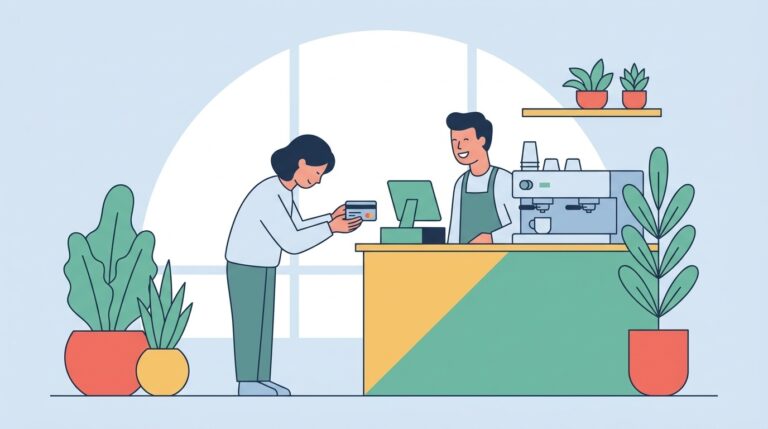
When paying at a Korean store, speed is key, but manners are mandatory.
* The Gesture: Never toss or slide your card on the counter. Instead, hold your payment card with both hands (or support your right elbow/wrist with your left hand) and hand it directly to the cashier.
* The Eye Contact: Give a quick nod and say “감사합니다” (Gam-sa-ham-ni-da) as you receive your card back. This process takes 2 seconds, maintaining both speed and respect.
4-2. Cultural Code: ‘Rocket Delivery’ (쿠팡 로켓배송)
Korea’s e-commerce is built on the concept of “dawn delivery” (새벽배송). If you order a product by midnight, it is quietly placed outside your door before 7 AM. This has shifted the psychological baseline of Korean daily life; waiting more than two days for a parcel is now considered “extremely slow”!
Phase 5: Interactive Role-Play Scenario
Setting: You are at a busy cafe near Gangnam Station during peak lunch hour. The line behind you is growing, and you want to order quickly and check if your drink can be made fast.
Characters:
- 민지 (Minji): The super-efficient Cafe Cashier (NPC).
- You: A polite, savvy expat trying to order in B1 Korean.
Dialogue:
- 민지: 어서 오세요! 주문 도와드릴게요.
(Eo-seo o-se-yo! Ju-mun do-wa-deu-ril-ge-yo.)
(🎭 Smiling professionally, finger hovering over the POS screen)
“Welcome! I can take your order.” -
You: 안녕하세요. 아이스 아메리카노 한 잔 주세요.
(An-nyeong-ha-se-yo. A-i-seu A-me-ri-ka-no han jan ju-se-yo.)
(🎭 Smiling and pointing gently at the menu)
“Hello. One iced Americano, please.” -
민지: 매장에서 드시고 가시나요? 아니면 테이크아웃이세요?
(Mae-jang-es-eo deu-si-go ga-si-na-yo? A-ni-myeon te-i-keu-a-ut-i-se-yo?)
(🎭 Tilting head slightly)
“Are you having it here, or is it for takeout?” -
You: 테이크아웃이요. 혹시 이거 빨리 나올까요? 저 기차 시간이 얼마 안 남아서요.
(Te-i-keu-a-ut-i-yo. Hok-si i-geo ppal-li na-ol-kka-yo? Jeo gi-cha si-gan-i ol-ma an nam-as-eo-yo.)
(🎭 Checking your watch with a slightly worried look)
“Takeout, please. By any chance, will it come out quickly? My train leaves soon.” -
민지: 아, 기차 타셔야 하는군요! 바로 준비해 드릴게요. 1분만 기다려 주세요.
(A, gi-cha ta-syeo-ya ha-neun-gun-yo! Ba-ro jun-bi-hae deu-ril-ge-yo. Il-bun-man gi-da-ryeo ju-se-yo.)
(🎭 Typing rapidly on the POS screen)
“Ah, you have a train to catch! I’ll make it for you right away. Please wait just one minute.” -
You: 정말 감사합니다!
(Jeong-mal gam-sa-ham-ni-da!)
(🎭 Handing over your payment card with both hands)
“Thank you so much!” -
민지: (30 seconds later) 주문하신 아메리카노 나왔습니다! 조심히 가세요!
(Ju-mun-ha-sin a-me-ri-ka-no na-wat-seum-ni-da! Jo-sim-hi ga-se-yo!)
(🎭 Handing over the cup with a cup holder already attached)
“Here is your ordered Americano! Safe travels!” -
You: 와, 벌써 나왔어요? 감사합니다! 수고하세요!
(Wa, beol-sseo na-wat-eo-yo? Gam-sa-ham-ni-da! Su-go-ha-se-yo!)
(🎭 Bowing slightly and taking the cup with both hands)
“Wow, is it ready already? Thank you! Keep up the good work!”
🔀 Interactive Choice Point
What do you do if you notice the cashier is visibly overwhelmed with a long queue?
- A. Say: “빨리 좀 주세요!” (Ppal-li jom ju-se-yo! – Hurry up, please!)
- B. Say: “바쁘신데 천천히 하셔도 돼요.” (Ba-ppeu-sin-de cheon-cheon-hi ha-syeo-do dwae-yo. – You’re busy, so you can take your time.)
- C. Just stay quiet and tap your fingers on the counter impatiently.
Feedback:
- Select A (Bad): Saying “빨리 좀 주세요” in a busy environment sounds demanding and can make the staff panic or feel disrespected. Avoid this unless there is an actual emergency.
- Select B (Best!): Saying “천천히 하셔도 돼요” shows incredible empathy. The cashier will appreciate your kindness amidst the high-stress rush hour.
- Select C (Risk): Tapping your fingers creates a tense atmosphere. In Korea, silent pressure can sometimes feel heavier than spoken words!
Phase 6: 10-Second Emotion Shadowing Drill
Practice speaking like a native! Follow the pauses (/) and try to mimic the emotional tones.
- [😲 Pleasantly Surprised & Impressed]
“와… / 벌써 나왔어요? / 진짜 / 빠르네요!”
(Wa… / beol-sseo na-wat-eo-yo? / jin-jja / bpa-reu-ne-yo!) -
[😊 Warm, Considerate, and Kind]
“괜찮으니까, / 바쁘시면 / 천천히 하셔도 돼요!”
(Gwen-chan-eu-ni-kka, / ba-ppeu-si-myeon / cheon-cheon-hi ha-syeo-do dwae-yo!)
Phase 7: K-Culture Mini-Dictionary
- 빨리빨리 (Pali-Pali) | Fast, Fast | The cultural mindset of speed, efficiency, and promptness that defines modern South Korean lifestyle.
- 새벽배송 (Saebyeok-Baesong) | Dawn Delivery | A logistics service where items ordered before midnight are delivered to the customer’s doorstep by 7:00 AM.
- 수고하세요 (Sugo-haseyo) | Keep up the hard work | A polite phrase used when leaving a shop, restaurant, or workplace to acknowledge the efforts of the worker.
- 대기 번호 (Daegi Beonho) | Waiting Number | The queue ticket number you receive at banks, busy restaurants, or clinics to ensure a swift queuing process.
- 키오스크 (Ki-o-seu-keu) | Kiosk | Self-service touchscreens widely used in Korean cafes and fast-food joints to speed up the ordering process.
Phase 8: Survivor Kit for Travelers
Survival Expressions TOP 3:
- 금방 돼요? (Geum-bang dwae-yo?)
- Pro Tip: Ask this to check if a dish or service will be finished quickly (e.g., before your bus arrives).
- 포장해 주세요. (Po-jang-hae ju-se-yo.)
- Pro Tip: Use this when you are in a rush and need your food packed “to-go.”
- 영수증은 안 주셔도 돼요. (Yeong-su-jeung-eun an ju-syeo-do dwae-yo.)
- Pro Tip: Tells the cashier “You don’t have to give me the receipt,” saving an extra 3 seconds for both of you!
🗺️ Editor’s Travel Note:
To navigate Korea at local speed, download the Naver Map App for real-time subway/bus arrival down to the second, and make sure your credit card has NFC or contactless payment enabled, as cash slows down the queue!
(Note: App features and schedules are subject to change based on local transit updates.)
Phase 9: “A Step Deeper” (Cultural Reflection)
Korea’s “Pali-Pali” culture is often credited as the engine behind the country’s rapid economic miracle (the Miracle on the Han River). In a single generation, Korea transformed from a war-torn nation into a global tech leader. However, this extreme speed can sometimes create invisible social pressure to constantly move forward. By understanding both the efficiency and the stress behind “Pali-Pali,” you gain a much deeper appreciation for the hardworking individuals who keep Korea running smoothly.
💬 Your Turn: Have you ever experienced Korea’s speed firsthand? Or do you prefer a slower, more relaxed lifestyle? Share your thoughts in the comments below!
Phase 10: FAQ & Common Mistakes
Q: Can I say “빨리빨리!” (Pali-pali!) directly to service staff if I am in a hurry?
A: Generally, no. Saying “빨리빨리” directly to a server, cashier, or taxi driver can sound highly demanding, pushy, and impolite. Instead, use a softer phrase like “죄송하지만 제가 조금 바빠서요” (Joe-song-ha-ji-man je-ga jo-geum ba-ppa-seo-yo – I’m sorry, but I’m in a bit of a hurry) to express your situation politely.
Q: Why do cashiers hand me my card back so quickly without looking at me?
A: It is rarely out of rudeness! In Korea, efficiency and not holding up the line is considered the ultimate service courtesy to both you and the customers waiting behind you. They are focusing on processing your transaction as quickly as possible.
Q: When is it appropriate to say “천천히 하셔도 돼요”?
A: It is perfect when you see someone rushing on your account—like a delivery rider carrying heavy boxes, a senior citizen cashier trying to scan barcodes, or a barista managing a sudden rush of orders. It shows high emotional intelligence!
🚨 Common Mistakes Alert:
- Mistake 1: Tossing your card on the payment counter instead of handing it over.
- Correct Action: Always hand over your card with both hands or use the dedicated payment tray.
- Mistake 2: Saying “빨리 하세요” (Do it quickly) to someone older than you.
- Correct Action: Never use imperative command forms with elders. Use “바쁘시면 먼저 처리해 주실 수 있나요?” (Could you process this first if you are busy?).
- Mistake 3: Standing at the counter deciding your order during busy lunch rushes.
- Correct Action: Decide your menu choice while waiting in line so you can order instantly when you reach the cashier.
Phase 11: Action Mission
- Bronze Medal 🥉: Read the 10-second shadowing drill sentences out loud 5 times using the correct emotional undertone.
- Silver Medal 🥈: Share this post on your social media with the hashtag
#DailyHanguland write down your favorite Korean speed-culture story! - Gold Medal 🥇 / K-Culture Mission: Watch a modern K-Drama or vlog and spot at least one moment where a character uses “바로” (immediately) or says “수고하세요” when leaving a store!
Phase 12: Interactive Quiz Challenge
1. Situational Judgment
If you want to tell a busy delivery rider that they don’t need to hurry up, what is the most natural and polite way to say it?
* A) 빨리빨리 가세요! (Pali-pali ga-se-yo!)
* B) 천천히 오셔도 돼요. (Cheon-cheon-hi o-syeo-do dwae-yo.)
* C) 왜 이렇게 느려요? (Wae i-reoh-ge neu-ryeo-yo?)
Click for the Correct Answer & Explanation
Correct Answer: B
Explanation:







