

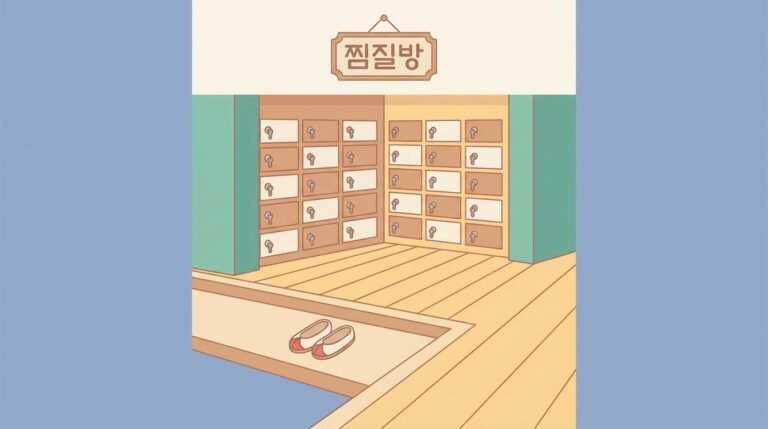
Master the Jjimjilbang Entry: How to Secure Your Shoe Locker Key Like a Local
Phase 1: Empathy (Welcome to the Jjimjilbang!)
안녕하세요! (Annyeonghaseyo!) It’s your K-Culture Navigator and bestie from Daily Hangul.
Imagine this: You’ve just walked into a cozy, warm Korean sauna (Jjimjilbang, 찜질방) after a long day of walking around Seoul. Your feet are tired, and you can already smell the roasted eggs. But as soon as you step through the glass doors, you are greeted by rows of hundreds of tiny lockers and a busy receptionist pointing at them.
Suddenly, you freeze. “Where do I put my shoes? How do I ask for my locker key? What if I lock myself out?”
Don’t worry! Every beginner feels a bit lost during their first Jjimjilbang visit. Securing your shoe locker key (신발장 열쇠) is your very first “mission” of the day, and getting it right sets the tone for a relaxing spa experience. Based on real feedback from our community of learners, we’ve put together this quick, super-practical guide so you can stride in with confidence. Let’s master the first step together!
Phase 2: Deep Dive into 3 Key Expressions
Here are the three most essential expressions you will need at the entrance. Let’s break them down!
1. 신발장 키 주세요 (Sin-bal-jang ki ju-se-yo)
- Pronunciation: Seen-bal-jang kee joo-seh-yo (Sounds like “Seen-bal” + “jang” + “key” + “juice” with an ‘eh-yo’)
- Meaning: Please give me the shoe locker key.
- K-Culture Moment: You will see this in almost every Korean healing variety show (like Running Man or I Live Alone) when members arrive at a bathhouse for a retreat.
- Editor’s Insight: “키” (ki) is the English word “key” adapted into Korean. While some places use the traditional word “열쇠” (yeol-soe), “키” (ki) is much more common in modern daily life.
- Situation Spectrum: Casual ⚠️ | Semi-formal ✅ | Formal ✅
- 🤔 Think About It: In many Western countries, you carry your shoes to a changing room. Why do you think Korean culture separates shoes right at the entrance? (Hint: It’s connected to the traditional floor-sitting culture, Ondol!)
2. 제 열쇠가 안 열려요 (Je yeol-soe-ga an yeol-lyeo-yo)
- Pronunciation: Jeh yuhl-sweh-gah ahn yuhl-lyuh-yo (Sounds like “Je” + “yuhl-sweh” + “gah” + “ahn” + “yuhl-lyuh-yo”)
- Meaning: My key won’t open (the locker).
- K-Culture Moment: The classic sitcom moment where a character tries to open someone else’s locker by mistake and gets flustered.
- Editor’s Insight: “안” (an) is a magic short negative prefix in Korean. Placing it before “열려요” (opens) instantly communicates “it does not open.”
- Situation Spectrum: Casual ⚠️ | Semi-formal ✅ | Formal ✅
3. 몇 번에 넣어요? (Myeot beon-e neo-hyeo-yo?)
- Pronunciation: Myuht buhn-eh nuh-uh-yo? (Sounds like “Myuht” + “bun” + “eh” + “nuh-uh-yo”)
- Meaning: Which number (locker) should I put it in?
- K-Culture Moment: When friends go together and compare locker numbers to see if they got lockers right next to each other.
- Editor’s Insight: “몇 번” (myeot beon) means “which number.” This is a highly versatile phrase you can use at restaurants, ticket booths, and bus stops!
- Situation Spectrum: Casual ⚠️ | Semi-formal ✅ | Formal ✅
Phase 3: Textbook Korean vs. Real Korean
Let’s look at how textbooks teach this versus how real locals actually talk.
Situation 1: Asking where to put your shoes
- 📖 Textbook Korean: 신발을 어디에 보관해야 합니까? (Sin-bareul eo-di-e bo-gwan-hae-ya hap-ni-ka?) – “Where must I store my shoes?” (Too formal, sounds like a military manual!)
- 🗣️ Real Korean: 신발 어디에 넣어요? (Sin-bal eo-di-e neo-hyeo-yo?) – “Where do I put my shoes?”
- 💡 Why is it different? Real-life Korean prefers short, active verbs like “넣다” (to put in) over big, Sino-Korean vocabulary like “보관하다” (to store).
Situation 2: Informing the clerk that you lost your key
- 📖 Textbook Korean: 신발장 열쇠를 분실하였습니다. (Sin-bal-jang yeol-soe-reul bun-sil-ha-yeot-seup-ni-da.) – “I have misplaced my shoe locker key.”
- 🗣️ Real Korean: 키 잃어버렸어요. (Ki ireu-buh-ryuht-suh-yo.) – “I lost my key.”
- 💡 Why is it different? “잃어버리다” is the natural, everyday spoken word for “to lose,” whereas “분실” is mostly used on printed warning signs.
Phase 4: K-Culture Deep Dive & Non-Verbal Etiquette
4-1. Nunchi (눈치) & Body Language at the Entrance
When you enter a Jjimjilbang, do not walk onto the tiled floor with your outdoor shoes! This is a major social taboo in Korea.
* The Gesture: Look for the step-up boundary. Take off your shoes before stepping onto the clean wooden or tiled floor.
* Key Placement: Put your shoes into any open shoe locker (usually one with a key still inserted), lock it, and bring that exact key to the reception desk. They will exchange it for your bathhouse/clothes locker key!
4-2. The Key is Your Wallet!
In modern Korean Jjimjilbangs, the locker key you receive at the desk is embedded with an electronic chip. You will use this wristband key to tap and pay for delicious food (like sikhye and ramen) inside the facility. You pay the total bill when you leave. So, never lose your key wristband!
Phase 5: Real-Life Roleplay Scenario
Setting: The bright entrance of “Spaland Jjimjilbang.” You are standing at the front desk with your shoe locker key. The receptionist (Ji-su) is ready to help you.
- Ji-su (Staff): 안녕하세요! 이용해 보신 적 있으세요? (An-nyeong-ha-se-yo! I-yong-hae bo-sin jeok it-seu-se-yo?)
🎭 Smiling politely, waiting behind the counter.
(Hello! Have you visited us before?) - You: 아니요, 처음이에요. (A-ni-yo, cheo-eum-i-e-yo.)
🎭 Smiling back a bit nervously.
(No, it’s my first time.) - Ji-su (Staff): 네, 신발 먼저 넣으시고 그 열쇠 주세요. (Ne, sin-bal meon-jeo neo-heu-si-go geu yeol-soe ju-se-yo.)
🎭 Pointing to the shoe lockers on the left.
(Okay, please put your shoes in first and give me that key.) - You: 몇 번에 넣어요? (Myeot beon-e neo-hyeo-yo?)
🎭 Looking at the rows of lockers.
(Which number do I put it in?) - Ji-su (Staff): 아무 데나 빈 곳에 넣으시면 돼요. (A-mu de-na bin got-e neo-heu-si-myeon dway-yo.)
🎭 Making a gentle circle gesture with her hand.
(You can put them in any empty space.) - You: 아, 알겠습니다. (A, al-get-seup-ni-da.)
🎭 Nods, puts shoes in locker #45, locks it, and returns with the key.
(Ah, I understand.) - You: 여기 신발장 키요. (Yeo-gi sin-bal-jang ki-yo.)
🎭 Handing over the shoe locker key with both hands.
(Here is the shoe locker key.) - Ji-su (Staff): 감사합니다. 옷장 키하고 옷 여기 있습니다! (Gam-sa-hap-ni-da. Ot-jang ki-ha-go ot yeo-gi it-seup-ni-da!)
🎭 Handing you a matching wristband key and a set of comfy pajamas.
(Thank you. Here is your clothes locker key and your clothes!)
🔀 Interactive Choice Point
Now you have your key, but you realize your locker is on the upper level and you prefer a lower one. What do you say?
* Option A: 저기요, 이거 바꿔줘! (Jeo-gi-yo, i-geo ba-kko-jweo!)
* Option B: 혹시 밑에 칸으로 바꿔 주실 수 있어요? (Hok-si mit-e kan-eu-ro ba-kko ju-sil su it-eoh-yo?)
* Option C: 그냥 쓸게요. (Geu-nyang sseul-ge-yo.)
Feedback:
- Best Choice (Option B): Excellent! “혹시… 수 있어요?” (Is it possible to…?) is the ultimate polite request phrase in Korea. You will get a friendly smile and a new key!
- Risk (Option A): Uh-oh! “바꿔줘” is casual banmal. Using this with staff might sound demanding or impolite.
- Passive (Option C): Safe, but you might struggle with a high locker if you have heavy bags. Speak up with Option B next time!
Phase 6: 10-Second Emotion Shadowing Drill
Let’s practice saying these with the perfect Korean emotional vibe. Focus on the pauses (/)!
- [😊 Friendly & Confident]
신발 / 어디에 / 넣어요?
(Sin-bal / eo-di-e / neo-hyeo-yo?) -
[🥺 Slightly Worried & Polite]
저기요, / 열쇠가 / 안 열려요.
(Jeo-gi-yo, / yeol-soe-ga / an yeol-lyeo-yo.) -
[😄 Polite & Helpful]
여기 / 신발장 / 키요!
(Yeo-gi / sin-bal-jang / ki-yo!)
Phase 7: K-Culture Mini-Dictionary
- 신발장 (Sin-bal-jang): Shoe locker/cabinet. Found at the entrance of Jjimjilbangs, traditional restaurants, and homes.
- 열쇠 / 키 (Yeol-soe / Ki): Key. Used interchangeably, but “키” is extremely common in modern commercial services.
- 옷장 (Ot-jang): Clothes locker. The larger locker inside the changing room where you store your clothes and bags.
- 찜질복 (Jjim-jil-bok): The comfortable t-shirt and shorts set provided by the Jjimjilbang for you to wear in the public lounge.
Phase 8: Survivor’s Kit for Travelers
Survival Phrases TOP 3
- 수건 더 주세요 (Su-geon deo ju-se-yo): “Please give me more towels.” (Useful since men’s and women’s towel rules can differ!)
- 식혜 하나 주세요 (Sik-hye ha-na ju-se-yo): “One sweet rice punch, please.” (The ultimate Jjimjilbang drink!)
- 이거 어떻게 써요? (I-geo eo-tteoh-ge sseo-yo?): “How do I use this?” (Perfect when you don’t know how to scan your wristband key.)
🗺️ Editor’s Travel Note
Before heading out to famous spots like Aquafield or Cimer, make sure to download the Naver Map App to check live reviews and holiday opening hours. Many Jjimjilbangs have slightly higher weekend rates, so keep that in mind! Note: Business hours and fees can change, so check the app before visiting.
Phase 9: “A Step Deeper” (Reflections on Korean Culture)
In many parts of the world, public spaces require high surveillance because of safety concerns. However, in Korea, you will see people leaving their phones on tables at cafes or keeping shoes in unlocked cubbies. The Jjimjilbang shoe locker system relies heavily on a high level of mutual trust and respect for shared community spaces. By putting your shoes away properly, you are participating in this beautiful culture of shared trust!
💬 Your Turn: Have you ever experienced a “no shoes” zone in your country? Let us know in the comments below!
Phase 10: FAQ & Avoiding Common Mistakes
Q: Can I wear my own comfortable socks inside the Jjimjilbang?
A: Yes, you can wear clean socks, but most people prefer going barefoot inside the heated rooms to absorb the heat directly from the floor!
Q: What should I do if I lose my wristband key?
A: Report it to the front desk immediately! Because the key acts as your credit card inside, you want to block it before anyone else accidentally uses it. A lost key fee may apply.
Q: Do I need to carry cash for food inside?
A: In 90% of modern Seoul Jjimjilbangs, you pay for everything with your wristband key and settle the bill at the exit. However, keeping 10,000 KRW in cash is handy for older, local neighborhood spots.
🚨 Common Mistakes Warning Board
- Mistake 1: Walking into the shoe area with your outdoor sneakers on.
- Correct Action: Take off your shoes at the designated stone step before walking onto the wood/linoleum floor.
- Mistake 2: Keeping the shoe locker key in your pocket.
- Correct Action: Give it directly to the front desk receptionist; they need it to activate your main locker!
- Mistake 3: Forgetting your locker number.
- Correct Action: Take a quick picture of your wristband number with your phone before putting your phone in the locker.
Phase 11: Action Mission!
- Bronze Mission (Self-Practice): Record your voice saying “신발 어디에 넣어요?” three times with a bright smile.
- Silver Mission (Social Share): Share this guide with a friend you want to visit a Jjimjilbang with!
- Gold Mission (Real Life): Go to a local Jjimjilbang or a Korean restaurant with a shoe locker, and confidently hand over your key while saying “여기 열쇠요!”
Phase 12: Interactive Quiz Challenge
Test your knowledge before you pack your towel!
1. Which phrase means “Where do I put my shoes?”
- A) 키 잃어버렸어요
- B) 신발 어디에 넣어요?
- C) 옷장 어디에요?
2. True or False: You should walk with your dirty shoes directly to the reception desk.
- True / False
🎉 Click here to see the answers!
Answers & Explanations:
1. Correct Answer: B (“신발 어디에 넣어요?”). Option A means “I lost my key,” and Option C means “Where is the clothes locker?”
2. Correct Answer: False! You must take your shoes off at the entrance step and place them in the shoe locker first!







