

Don’t Blow Your Wallet! How to Advise Friends to Save Money in Korean (CEFR B1)
Phase 1: Empathy (Story-driven Opening)
안녕하세요! (Annyeonghaseyo!) It’s your favorite Daily Hangul editor and your personal cultural navigator.
Imagine this: You are hanging out with your Korean bestie, Minji, at a trendy cafe in Hongdae. She is scrolling through her phone, eyes sparkling, looking at a designer bag she absolutely cannot afford. She sighs, “Ah, I should just buy it. Life is short!” You know she’s already struggling with her rent this month. You want to tell her to save her money, but you hesitate.
In English, you might say, “Hey, watch your budget!” or “Save your money.” But in Korean, directly telling someone how to spend their money can sound a bit intrusive if you don’t use the right tone and nuance. In Korea’s tightly-knit society, giving financial advice requires a delicate balance of deep care, warm nagging (잔소리 – jansori), and friendly humor.
Today, we will master how to advise someone to save money in Korean without sounding like a boring textbook or an overbearing boss. Let’s dive in!
Phase 2: Deep Dive into 3 Key Expressions
1. 돈 좀 아껴 써. (Don jom akkyeo sseo.)
- Pronunciation: Don (like “dawn” but shorter) jom (soft “j”) ah-kkyeo (ah + k-yeo) sseo (tense “s” sound, like “ss”).
- Meaning: Save your money. / Spend a bit more sparingly.
- K-Culture Moment: You will hear this constantly in family K-Dramas where a mother is nagging her college-student son who keeps ordering late-night fried chicken.
- Editor’s Insight: 돈 (don) means money, 아끼다 (akkida) means to save/cherish, and 쓰다 (sseuda) means to use. The magic word here is 좀 (jom – a bit). Adding 좀 softens the command, making it sound like a friendly suggestion rather than a harsh order.
- Situation Spectrum: Casual ✅ | Semi-formal ⚠️ | Formal 🚫
- 🤔 Think About It: In Korean culture, saving money isn’t just about personal wealth; it is often tied to showing maturity and preparing for a shared future with family. How does this compare to your culture?
2. 충동구매하지 말고 잘 생각해 봐. (Chungdong-gumae-haji malgo jal saenggakhae bwa.)
- Pronunciation: Choong-dong (impulse) goo-mae (purchase) hah-jee mahl-go (don’t do and) jahl (well) saeng-gahk-hae (think) bwah (try/look).
- Meaning: Don’t buy on impulse; think about it carefully.
- K-Culture Moment: This is the ultimate line whispered between friends standing in front of a flashy pop-up store in Seoul’s Seongsu-dong.
- Editor’s Insight: 충동구매 (chungdong-gumae) is a Sino-Korean vocabulary word for “impulse buying.” Using this word shows you have a solid intermediate vocabulary, and pairing it with ~하지 말고 (don’t do X, do Y) offers a logical alternative.
- Situation Spectrum: Casual ✅ | Semi-formal ✅ | Formal ⚠️
- 🤔 Think About It: Koreans love smart shopping (called 가성비 – gasongbi, cost-effectiveness). Advising against impulse buys is seen as being a genuinely loyal friend.
3. 지갑 사정도 생각해야지. (Jigap sajeong-do saenggak-haeyaji.)
- Pronunciation: Jee-gahp (wallet) sah-jung-doh (situation/circumstances too) saeng-gahk-haeh-yah-jee (should think about).
- Meaning: You should consider your wallet’s situation (your budget).
- K-Culture Moment: A colleague says this over lunch when you suggest going to an expensive steakhouse instead of the usual kimchi stew place.
- Editor’s Insight: This is a beautiful, indirect, and empathetic way to say “You are broke.” By referencing the “wallet’s situation” (지갑 사정), you shift the focus away from the person’s personal failure to a humorous external object—their wallet.
- Situation Spectrum: Casual ✅ | Semi-formal ✅ | Formal 🚫
- 🤔 Think About It: Why do you think Koreans prefer using indirect metaphors like “the wallet’s situation” over saying “you don’t have money”?
Phase 3: Textbook Korean vs. Real-World Korean
Let’s compare the dry sentences found in standard classrooms with the vibrant phrases Koreans actually use.
Situation A: When a friend wants to buy another cup of expensive coffee.
- 📖 Textbook Korean: 돈을 저축하는 것이 좋습니다. (Don-eul jeochuk-haneun geot-i joseumnida.) – “Saving money is good.” (Too robotic, sounds like an economics textbook!)
- 🗣️ Real-World Korean: 커피값도 무시 못 해. 아끼자! (Keopi-gapt-do musi mot hae. Akkija!) – “Coffee prices add up (cannot be ignored). Let’s save!”
- 💡 Why the difference? Koreans use the phrase ~도 무시 못 해 (cannot be ignored) to point out small, repetitive expenses that accumulate over time.
Situation B: When a friend is spending recklessly because it’s payday.
- 📖 Textbook Korean: 소비를 줄이십시오. (Sobi-reul jurisipsio.) – “Please reduce your consumption.” (Sounds like a government public service announcement!)
- 🗣️ Real-World Korean: 너 그러다가 손가락만 빨고 살게 될걸? (Neo georadaga songarak-man ppalgo salge doelgeol?) – “You’ll end up sucking your fingers (having nothing to eat) if you keep that up!”
- 💡 Why the difference? 손가락만 빨다 (sucking one’s fingers) is a hilarious, vivid idiom meaning to have no money left for food. It is perfect for close friends.
Phase 4: K-Culture Deep Dive & Non-Verbal Manners
4-1. Nunchi (눈치) & Gestures
When giving financial advice, your body language is just as important as your words.
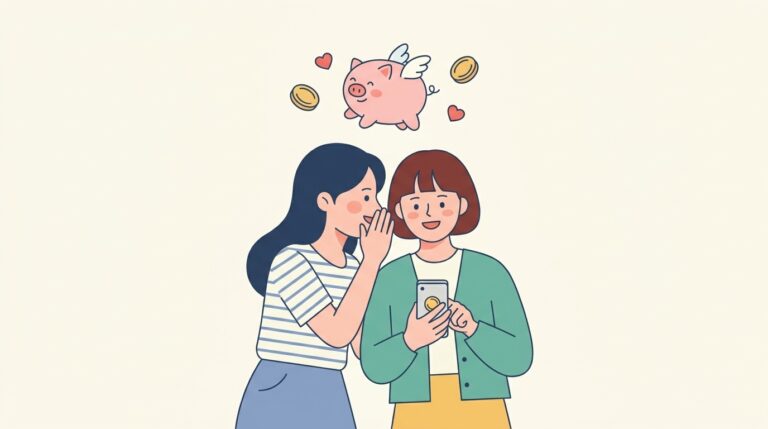
* The “Half-Whisper” Tilt: Tilt your head slightly towards your friend and lower your voice. Money is a sensitive topic; speaking loudly in public about their budget will ruin their 체면 (chemyeon – face/honor).
* The Gentle Hand Wave: Gently wave your index finger side-to-side (not aggressively) when saying “아유, 안 돼” (Ayu, an dwae – “Oh, no way”) to keep the mood lighthearted.
4-2. The “N-Bread” (N빵) Culture
In Korea, splitting the bill is often called N빵 (N-ppang). If you notice a friend is struggling financially, don’t awkwardly tell them to save money during a meal. Instead, apply the N-ppang culture gracefully or say, “내가 쏠게!” (Naega ssolge! – “My treat!”) with the understanding that they will buy you a cheap coffee later to save face.
Phase 5: Real-Life Roleplay Scenario
Meet Minwoo: Your Korean classmate who is obsessed with buying limited-edition K-Pop merchandise but is always complaining about being broke.
- Minwoo: 아, 이번에 방탄소년단 한정판 굿즈 새로 나왔는데… 살까?
(Ah, ibeon-e BTS hanjeongpan gutjeu saero nawanneunde… salka?)
🎭 [Eyes glued to his phone, looking anxious yet excited]
“Ah, BTS limited-edition merch just dropped… Should I buy it?” - You: 또? 너 지난주에도 앨범 사지 않았어?
(Tto? Neo jinanju-edo aelbeom saji anasseo?)
🎭 [With a friendly, teasing smile]
“Again? Didn’t you buy an album last week too?” - Minwoo: 그건 일반판이고, 이건 한정판이란 말이야! 이번 기회 놓치면 끝이야.
(Geugeon ilbanpan-igo, igeon hanjeongpan-iran mariya! Ibeon gihwoe nochimyeon kkeut-iya.)
🎭 [Whining and shaking your arm slightly]
“That was the regular version, this is the limited edition! If I miss this chance, it’s over.” - You: 지갑 사정도 생각해야지. 너 이번 달 방세 낼 돈은 있어?
(Jigap sajeong-do saenggak-haeyaji. Neo ibeon dal bangse nael don-eun isseo?)
🎭 [Lowering your voice playfully, tapping his empty wallet]
“You have to consider your wallet’s situation. Do you even have money for rent this month?” - Minwoo: 알바 월급 나오면 채워 넣으면 되지!
(Alba wolgeup naomyeon chaewo neoeumyeon doeji!)
🎭 [Trying to justify himself with an optimistic shrug]
“I can just refill it when my part-time job salary comes in!” - You: 충동구매하지 말고 잘 생각해 봐. 한 달 동안 삼각김밥만 먹고 살래?
(Chungdong-gumae-haji malgo jal saenggakhae bwa. Han dal dong-an samgak-gimbap-man meokgo sallae?)
🎭 [Looking deep into his eyes with fake seriousness]
“Don’t buy on impulse; think about it. Do you want to survive only on convenience store triangle kimbap for a month?” - Minwoo: 으… 삼각김밥은 지겨운데.
(Eu… samgak-gimbap-eun jigyeounde.)
🎭 [Frowning, visualizing the sad meals]
“Ugh… I am sick of triangle kimbap.” - You: 그러니까 돈 좀 아껴 써. 우리 내일 학식 먹으면서 같이 예산 짜보자.
(Geureonikka don jom akkyeo sseo. Uri naeil haksik meogeumyeonseo gachi yesan jjaboza.)
🎭 [Patting his shoulder warmly]
“So, save your money. Let’s eat school cafeteria food tomorrow and plan a budget together.”
🔀 Interactive Choice Point
What do you do next when Minwoo hesitates?
* A. “야, 그냥 사! 인생 한 번뿐이야!” (Hey, just buy it! YOLO!)
* 🚫 Feedback: Bad choice! You just ruined your whole lesson about saving money. (But highly realistic if you are also a bad influence!)
* B. “안 사면 내가 떡볶이 사줄게.” (If you don’t buy it, I’ll buy you Tteokbokki.)
* ✅ Feedback: Best choice! A classic Korean negotiation tactic. You save his wallet and get to hang out over comfort food.
* C. “돈 없으면 빌려줄까?” (Do you want me to lend you money?)
* ⚠️ Feedback: High risk! Lending money to friends in Korea can often strain relationships. Keep money separate if possible!
Phase 6: 10-Second Emotion Shadowing Drill
Practice saying these with the exact emotional intonation of a native speaker. The slashes / represent minor pauses.
[🥺 Worried and warningly]
너 그러다가 / 손가락만 빨게 될걸?
(Neo georadaga / songarak-man ppalgo salge doelgeol?)-
[🤗 Warmly nagging, like an older sibling]
커피값도 / 무시 못 해. / 돈 좀 아껴 써!
(Keopi-gapt-do / musi mot hae. / Don jom akkyeo sseo!)
Phase 7: K-Culture Mini Dictionary
- 지름신 (Jireum-sin) | The God of Impulse Buying | Combining “지르다” (to impulse buy/commit) and “신” (God). Used when you feel possessed to buy things. (e.g., “지름신 강림했어” – The shopping god has descended upon me).
- 거지방 (Geoji-bang) | “Beggar” Chatrooms | A hilarious modern KakaoTalk trend where anonymous people join a group chat to share their daily spending and brutally roast each other’s expenses to encourage saving.
- 티끌 모아 태산 (Tikkeul moa taesan) | Dust gathers to make a mountain | The Korean equivalent of “every penny counts.”
- 가성비 (Gaseongbi) | Cost-effectiveness | The ultimate praise for a product or meal that offers high satisfaction for a low price.
Phase 8: The Traveler’s Survival Kit
When traveling on a budget in Korea, use these to keep your finances in check!
- 이거 할인돼요? (Igeo harin-dwaeyo?) | Is there a discount on this? | Pro Tip: Good for traditional markets or cosmetic shops.
- 영수증 필요 없어요. (Yeongsujeung piryo eopseoyo.) | I don’t need a receipt. | Pro Tip: Fast-paced convenience store etiquette.
- 더 저렴한 거 있어요? (Deo jeoryeomhan geo isseoyo?) | Do you have anything cheaper?
🎒 Editor’s Travel Note: To travel like a pro, skip expensive taxis and use the efficient subway network. Download the Naver Map App to find the fastest routes, and always check for “1+1” (one-plus-one) deals at convenience stores like GS25 or CU!
Phase 9:
Frequently Asked Questions (FAQ)
Q: What does "돈 좀 아껴 써. (Don jom akkyeo sseo.)" mean in Korean and how do you pronounce it?
A: In Korean, "돈 좀 아껴 써. (Don jom akkyeo sseo.)" is pronounced [Don (like "dawn" but shorter] and means: Save your money. / Spend a bit more sparingly.
Q: What does "충동구매하지 말고 잘 생각해 봐. (Chungdong-gumae-haji malgo jal saenggakhae bwa.)" mean in Korean and how do you pronounce it?
A: In Korean, "충동구매하지 말고 잘 생각해 봐. (Chungdong-gumae-haji malgo jal saenggakhae bwa.)" is pronounced [Choong-dong (impulse] and means: Don't buy on impulse; think about it carefully.
Q: What does "지갑 사정도 생각해야지. (Jigap sajeong-do saenggak-haeyaji.)" mean in Korean and how do you pronounce it?
A: In Korean, "지갑 사정도 생각해야지. (Jigap sajeong-do saenggak-haeyaji.)" is pronounced [Jee-gahp (wallet] and means: You should consider your wallet's situation (your budget).







