

Step into Your Best Self: Asking for Photo Retouching in Korea (보정해 달라고 하기)
Phase 1: Empathy (공감) — The Quest for the Perfect ‘Insaeng-Shat’
안녕하세요! (An-nyeong-ha-se-yo!) Hello, my lovely K-culture besties! It’s your Daily Hangul editor and your personal cultural navigator here.
Imagine this: You are standing in a trendy, sleek photo studio in Hongdae or Gangnam. You just took your very first professional profile picture or a fun ‘Insaeng-neot-cut’ (life four-cuts) photo. The lighting was great, but you notice a sudden pimple on your chin, or maybe you wish your shoulders looked a bit more relaxed. You want to ask the photographer to touch it up a little, but you freeze. “How do I say ‘photoshop’ in a polite Korean way without sounding too demanding?”
Don’t worry! In Korea, photo retouching (보정 – bo-jeong) is an art form and a completely standard part of the photo studio experience. Photographers expect you to ask! Today, we are going to learn how to ask for those magic touch-ups naturally, confidently, and politely, using simple A2-level Korean. Let’s make sure your photos turn out exactly how you want them!
Phase 2: Key Expressions (핵심 표현 3선)
Here are three magic sentences you can use at any Korean photo studio. Let’s look at them closely!
1. 자연스럽게 보정해 주세요. (Ja-yeon-seu-reop-ge bo-jeong-hae ju-se-yo.)
- Pronunciation: “Jah-yuhn-seu-ruhp-geh bo-jung-hae joo-seh-yo” (Think of ‘ja-yeon’ like ‘giant’ without the ‘t’, and ‘bo-jeong’ like ‘bo’ in ‘boat’ + ‘jung’ in ‘jungle’).
- Meaning: “Please edit/retouch it naturally.”
- K-Culture Moment: You will hear this in almost every K-Beauty and makeover show. When stars get their profile cards done, they always ask for ja-yeon-seu-reop-ge (natural) edits to avoid looking like a completely different person!
- Editor’s Insight: 보정 (bo-jeong) means ‘calibration’ or ‘adjustment’, which sounds much more professional than saying ‘photoshop’ (포토샵).
- Situation Spectrum: Casual (⚠️) | Semi-formal (✅) | Formal (✅)
- 🤔 Think About It: In many Western cultures, heavy editing can sometimes be seen as sensitive. However, in Korea, cooperative editing (bo-jeong) is seen as a fun, collaborative process between you and the artist to present your best self.
2. 피부 톤 좀 정리해 주세요. (Pi-bu ton jom jeong-ri-hae ju-se-yo.)
- Pronunciation: “Pee-boo ton jom jung-ree-hae joo-seh-yo” (Pronounce ‘ton’ like the English word ‘tone’, and ‘jeong-ri’ like ‘jung-lee’).
- Meaning: “Please clean up/even out my skin tone.”
- K-Culture Moment: This is the ultimate secret phrase used by K-drama actors. It gently asks the editor to remove temporary blemishes, dark circles, or redness without changing your actual facial features.
- Editor’s Insight: 정리하다 (jeong-ri-hada) means ‘to tidy up’ or ‘organize’. Asking to ‘tidy up’ your skin tone sounds incredibly polite and natural!
- Situation Spectrum: Casual (⚠️) | Semi-formal (✅) | Formal (✅)
3. 여기 배경 조금만 지워 주실 수 있어요? (Yeo-gi bae-gyeong jo-geum-man ji-wo ju-sil su isseo-yo?)
- Pronunciation: “Yuh-gee bae-gyung jo-geum-mahn jee-wo joo-shil soo eet-suh-yo?” (‘Bae-gyeong’ sounds like ‘beh-gyung’).
- Meaning: “Could you please erase the background here a little bit?”
- K-Culture Moment: Perfect for when an accidental photobomber or a stray trash can ruins your perfect travel photo at a Hanok village studio.
- Editor’s Insight: Using 조금만 (jo-geum-man – just a little) makes your request sound soft and humble, making the photographer much more willing to help.
- Situation Spectrum: Casual (⚠️) | Semi-formal (✅) | Formal (✅)
Phase 3: Textbook vs. Real Korean (교과서 vs. 진짜 한국어)
Let’s compare textbook-style Korean with what real locals say at the studio!
Situation 1: Asking to make your face look slimmer
- 📖 Textbook Korean: 얼굴을 작게 만들어 주십시오. (Eol-gul-eul jak-ge man-deul-eo ju-ship-si-o.)
- Translation: “Make my face small, please.” (Sounds very robotic and aggressively demanding!)
- 🗣️ Real Korean: 얼굴 라인 살짝만 다듬어 주세요. (Eol-gul ra-in sal-jjak-man da-deum-eo ju-se-yo.)
- Translation: “Please slightly touch up my face line.”
- 💡 Why the difference? 다듬다 (da-deum-da) means ‘to trim’ or ‘to neat-en’. It sounds much softer and implies you just want a quick, elegant trim of the jawline rather than an extreme structural change.
Situation 2: Asking for a change
- 📖 Textbook Korean: 수정을 원합니다. (Su-jeong-eul won-hap-ni-da.)
- Translation: “I want a correction.”
- 🗣️ Real Korean: 여기 조금만 더 만져 주실 수 있어요? (Yeo-gi jo-geum-man deo man-jyeo ju-sil su isseo-yo?)
- Translation: “Could you work on this part a little bit more?”
- 💡 Why the difference? 만지다 (man-ji-da) literally means ‘to touch’. In creative fields like photography and design, it is a friendly, professional slang meaning ‘to edit/fine-tune’.
Phase 4: K-Culture Deep-Dive & Non-verbal Manners
4-1. Nunchi & Gestures: The Art of Pointing Politely
When asking for edits, Nunchi (눈치 – situational tact) is key.
* The Two-Finger Point: Never point aggressively with a single index finger at the screen. Instead, use a soft, open palm or gently point near the screen with two fingers (index and middle together) to indicate the area you’d like adjusted.
* The Head Tilt & Smile: Tilt your head slightly and say “혹시… (hok-si – by any chance…)” before making a request. This immediately softens your tone!
* The Bow of Gratitude: A slight nod or bow when they apply your feedback will guarantee they put extra effort into your final print.
4-2. The Korean Photo Studio Culture
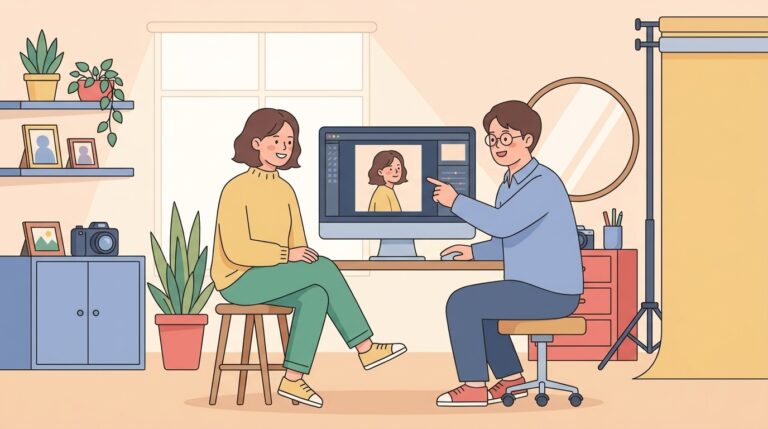
In Korea, going to a photo studio is not just for passports. It is a popular hobby called 인생사진 (Insaeng-sajin – Life Photo). Many studios offer one-on-one live retouching where you sit right next to the editor. You watch them work their magic in Photoshop in real-time! This is why knowing these phrases is so useful—you will be talking directly to the editor as they work.
Phase 5: Real-Life Roleplay Scenario (실전 롤플레이)
Setting: “Haru Studio” in Hongdae. You are sitting next to Min-su, a friendly local photo editor with trendy glasses, looking at a huge monitor.
- Min-su (Editor): 사진 다 찍었습니다! 이쪽으로 와서 같이 보실까요?
(Sa-jin da jjig-eot-seup-ni-da! I-jjog-eu-ro wa-seo gat-i bo-sil-kka-yo?)
“We are done shooting! Shall we come over here and look together?” -
You: 🎭 [Smiles excitedly, sitting down] 와, 잘 나왔네요! 감사합니다.
(Wa, jal na-wat-ne-yo! Gam-sa-hap-ni-da.)
“Wow, it came out so well! Thank you.” -
Min-su (Editor): 어떤 부분을 주로 보정해 드릴까요?
(Eo-tteon bu-bun-eul ju-ro bo-jeong-hae deu-ril-kka-yo?)
“Which parts would you like me to focus on retouching?” -
You: 🎭 [Pointing softly at your forehead] 음… 피부 톤 좀 정리해 주세요.
(Eum… pi-bu ton jom jeong-ri-hae ju-se-yo.)
“Hmm… please even out my skin tone.” -
Min-su (Editor): 네, 피부 잡티 깨끗하게 지워 드릴게요. 또 원하시는 곳 있으세요?
(Ne, pi-bu jap-ti kkae-kkeut-ha-ge ji-wo deu-ril-ge-yo. Tto won-ha-si-neun got isseo-se-yo?)
“Sure, I’ll cleanly erase the blemishes. Any other areas you want?” -
You: 🎭 [Gesturing to your jawline] 얼굴 라인도 살짝만 다듬어 주세요.
(Eol-gul ra-in-do sal-jjak-man da-deum-eo ju-se-yo.)
“Please slightly touch up my face line too.” -
Min-su (Editor): 🎭 [Clicking fast on his mouse] 이 정도면 괜찮으신가요?
(I jeong-do-myeon gwen-chan-eu-sin-ga-yo?)
“Is this about right?” -
You: 🎭 [Clapping hands happily] 네! 너무 자연스럽고 마음에 들어요!
(Ne! Neo-mu ja-yeon-seu-reop-go ma-eum-e deul-eo-yo!)
“Yes! It is so natural and I love it!”
🔀 Interactive Choice Point
Min-su asks: “Should I make your eyes a bit bigger too? (눈도 조금 키워 드릴까요?)” How do you respond?
* A) “네, 엄청 크게 해 주세요!” (Yes, make them super big!)
* ⚠️ Risk: Your photo might end up looking like an anime character, losing that beautiful ‘natural’ look.
* B) “아니요, 눈은 괜찮아요. 자연스러운 게 좋아요.” (No, my eyes are fine. I like it natural.)
* ✅ Best: Extremely polite, clear, and ensures your photo still looks like you!
* C) “마음대로 하세요.” (Do whatever you want.)
* 🚫 Bad: Sounds very cold and dismissive in Korean. Avoid this!
Phase 6: 10-Second Emotion Shadowing Drill (감정 섀도잉)
Let’s practice speaking with the right rhythm and emotion! Pay attention to the pauses (/).
- [🥺 Polite & Hopeful]
피부 톤 좀 / 정리해 주세요.
(Pi-bu ton jom / jeong-ri-hae ju-se-yo.) -
[😊 Bright & Friendly]
자연스럽게 / 보정해 주세요!
(Ja-yeon-seu-reop-ge / bo-jeong-hae ju-se-yo!) -
[🙏 Super Polite Request]
얼굴 라인 / 살짝만 / 다듬어 주실 수 있어요?
(Eol-gul ra-in / sal-jjak-man / da-deum-eo ju-sil su isseo-yo?)
Phase 7: K-Culture Mini Dictionary (미니 사전)
- 보정 (Bo-jeong) | Retouching/Editing
- Used everywhere in Korea from photo studios to wedding planning. It implies fixing details elegantly.
- 원본 (Won-bon) | Raw/Original Photo
- The unedited photo. Some studios charge extra if you want to download all the won-bon files.
- 인생샷 (Insaeng-syat) | Life Shot
- Slang for “the best photo of your life.”
- 포토샵 (Po-to-syap) | Photoshop
- Used as a verb occasionally (e.g., “포토샵 해 주세요”), but 보정 sounds much more natural at a professional studio.
Phase 8: Travel Survival Kit (여행자 생존 키트)
Survival Expressions TOP 3
- 이거 메일로 보내 주실 수 있어요? (I-geo me-il-lo bo-nae ju-sil su isseo-yo?)
- “Could you send this to me via email?” (Crucial for keeping digital copies!)
- 인쇄하는 데 얼마나 걸려요? (In-swae-ha-neun de ol-ma-na geol-ryeo-yo?)
- “How long does it take to print?”
- 카드 결제 돼요? (Ka-deu gyeol-je dwae-yo?)
- “Can I pay by card?”
Editor’s Travel Note
Most trendy photo studios in Seoul require reservations. I highly recommend downloading the Naver Map App to search for highly-rated studios (“사진관” or “스튜디오”) near you. Many of them accept reservations directly through the app!
(Note: Studio prices and operating hours may change, so always double-check online before visiting!)
Phase 9: A Step Deeper (한 발 더 깊이)
In Korea, presenting a clean, neat appearance in photos—especially for passports, resumes, or social media—is considered a sign of respect and self-care. Because of this, the photo editing process is highly respected as a professional craft. Next time you visit a studio, think of it as a creative collaboration between you and the editor!
💬 Your Turn: Have you ever taken a photo at a Korean studio? Or would you love to try? Let us know in the comments below!
Phase 10: FAQ & Common Mistakes (자주 묻는 질문)
Q: Can I ask the editor to edit my body shape too?
A: Yes! You can say “비율 조금만 좋게 해 주세요” (Bi-yul jo-geum-man jo-g-ge hae ju-se-yo) which means “Please make my proportions look slightly better.”
Q: Is ‘Photoshop’ considered a rude word?
A: Not rude, but using “보정 (bo-jeong)” makes you sound much more like a local who respects the photographer’s professional craft.
Q: Do I need to pay extra for retouching?
A: Usually, basic retouching is included in the package price, but detailed, customized edits or requesting the original files (won-bon) might cost extra. Always ask first!
🚨 Common Mistakes Alert!
- Mistake 1: Saying “예쁘게 해 주세요” (Ye-ppeu-ge hae ju-se-yo – Make me pretty).
- Why: It’s too vague! The editor won’t know what you want.
- Correction: Say “자연스럽게 보정해 주세요” (Please edit it naturally).
- Mistake 2: Pointing with your finger too close to the editor’s screen.
- Why: It can be distracting or accidentally touch their screen.
- Correction: Keep a polite distance and point softly.
Phase 11: Action Mission (액션 미션)
- Bronze Medal 🥉: Practice saying “자연스럽게 보정해 주세요” three times out loud in front of your mirror.
- Silver Medal 🥈: Take a selfie, look at one thing you’d tweak, and say the correct Korean phrase for it (e.g., “피부 톤 좀 정리해 주세요!”).
- Gold Medal 🥇: Visit a local self-photo booth (like Life Four Cuts) or a professional studio in Korea and successfully use one of today’s phrases!
Phase 12: Interactive Quiz Challenge (퀴즈 챌린지)
1. What is the most natural Korean word for “photo retouching/editing”?
- A) 포토샵 (Po-to-syap)
- B) 보정 (Bo-jeong)
- C) 페인팅 (Pe-in-ting)
👉 Click here for the Answer!
Correct Answer: B) 보정 (Bo-jeong)
Explanation: While ‘포토샵’ is understood, ‘보정’ is the professional, polite term used at photo studios.
2. True or False: Saying “얼굴 라인 살짝만 다듬어 주세요” means you want a natural jawline touch-up.
👉 Click here for the Answer!
Correct Answer: True
Explanation: 다듬다 means to trim or tidy up, making it the perfect polite phrase for a natural jawline touch-up!






