

Master the Library: How to Request and Find Books Like a Native Korean Speaker
Phase 1: Empathy (Welcome, Bookworms! 📚)
안녕하세요! (Annyeonghaseyo!) I’m your Daily Hangul editor, your personal guide to navigating the beautiful, poetic world of Korean literature and daily life.
Imagine this: You’re walking into a stunning, multi-story library in Seoul—perhaps the famous Starfield Library in Coex, or the serene Seoul Metropolitan Library. You want to dive into the trendy world of Korean novels, maybe search for the original Korean edition of Almond (아몬드) or The Vegetarian (채식주의자). But as you approach the search terminal, or the librarian’s desk, your heart beats a little faster. How do I ask if they have this book? What if they don’t have it—how do I officially request a purchase?
Many intermediate (B2) learners struggle here. You know basic Korean, but you lack the specific, polite public service vocabulary to seamlessly ask for assistance, check book availability, or submit a “desired book request” (희망 도서 신청 – huimang doseo sincheong).
Today, we are going to unlock the exact, high-frequency phrases that will make you look like a seasoned library patron in Korea. No more awkward translating in your head. Let’s get started!
Phase 2: Key Expressions Deep Dive 💡
Here are the top 3 expressions you need to master to navigate any Korean library with absolute confidence.
1. 혹시 이 책 재고가 있나요? (Hoksi i chaek jaegoga innayo?)
- Pronunciation: Hok-si ee chaek jae-go-ga een-nah-yo? (Like “Hok-see” + “ee check” + “jago-gah” + “in-nah-yo”)
- Meaning: “By any chance, is this book in stock / available on the shelves?”
- K-Culture Moment: You will hear this in K-Dramas like Our Beloved Summer or Romance is a Bonus Book when characters search for rare poetry books in local libraries.
- Editor’s Insight: While “재고” (jaego) literally means “inventory” or “stock” (often used in retail), Koreans frequently use it in libraries to ask if a book is physically available for borrowing right now, rather than being checked out.
- Situation Spectrum: Casual (⚠️) | Semi-formal (✅) | Formal (✅)
- 🤔 Think About It: In your culture, do you ask library staff about “inventory” or do you use a different word like “available”? Why do you think Korean uses a retail-adjacent term like “재고”?
2. 희망 도서로 신청하고 싶어요. (Huimang doseoro sincheonghago sipeoyo.)
- Pronunciation: Hui-mang do-seo-ro seen-cheong-ha-go sip-eo-yo.
- Meaning: “I would like to request this as a desired book (for purchase/acquisition).”
- K-Culture Moment: Korean public libraries are incredibly community-focused. If they don’t have a book, citizens can easily request it, and the library will buy it for them.
- Editor’s Insight: “희망 도서” (huimang doseo) literally translates to “hope/wish book.” It’s the official system term. If you use this exact phrase, the librarian will instantly know you want to fill out the acquisition request form.
- Situation Spectrum: Casual (🚫) | Semi-formal (✅) | Formal (✅)
- 🤔 Think About It: How does the term “hope book” (희망 도서) reflect the Korean cultural attitude toward community and personal wishes compared to the cold English term “purchase request”?
3. 대출 중인 책 예약할 수 있을까요? (Daechul jung-in chaek yeyakhalsu isseulkkayo?)
- Pronunciation: Dae-chul joong-een chaek yae-yak-hal-su ees-seul-kka-yo?
- Meaning: “Can I reserve/hold a book that is currently checked out?”
- K-Culture Moment: In university-themed K-dramas, you often see competitive students reserving major textbooks ahead of exam weeks using this exact phrase.
- Editor’s Insight: “대출” (daechul) means loan/borrowing. “예약” (yeyak) means reservation. Putting them together shows B2-level syntactic fluidity.
- Situation Spectrum: Casual (⚠️) | Semi-formal (✅) | Formal (✅)
- 🤔 Think About It: How does reservation priority work in your local library? Is it as fast-paced as in Korea?
Phase 3: Textbook Korean vs. Real Korean 🗣️
Let’s compare the stiff textbook phrases with what natural Korean speakers actually say.
Scenario 1: Asking where the search computer is
- 📖 Textbook: 도서 검색 컴퓨터는 어디에 있습니까? (Doseo geomsaek keompyuteoneun eodie isseumnikka?) – Too formal, sounds like a military manual.
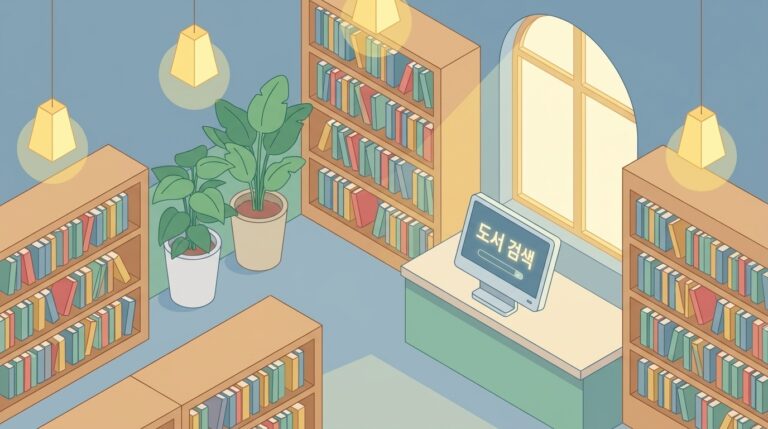
- 🗣️ Real Korean: 혹시 도서 검색 대는 어디에 있어요? (Hoksi doseo geomsaekdaeneun eodie isseoyo?) – Warm, natural, and uses “검색대” (geomsaekdae – search station/counter) instead of the long “검색 컴퓨터”.
- 💡 Why the difference? Koreans prefer spatial nouns like “~대” (stand/counter) rather than naming the machine (“컴퓨터”) itself when asking for locations.
Scenario 2: Asking if a book can be borrowed
- 📖 Textbook: 이 책을 빌릴 수 있습니까? (I chaek-eul billil su isseumnikka?) – Grammatically correct, but sounds slightly robotic.
- 🗣️ Real Korean: 이 책 대출 가능한가요? (I chaek daechul ganeunghangayo?) – Uses the Sino-Korean noun “대출 가능” (loan available) which sounds incredibly polished, professional, and natural for a B2 speaker.
Phase 4: K-Culture Deep Dive & Non-Verbal Manners 🤫
4-1. Library Etiquette & Gestures
- The Two-Handed Hand-off: When handing your library card (회원증 – hoewonjeung) or a book to the librarian, always use both hands (or support your right elbow with your left hand). This is a vital sign of respect in public spaces.
- Lowering Your Voice (소곤소곤 – Sogon-sogon): If you must speak to the librarian at the desk, lean in slightly and speak in a controlled whisper. Koreans value “민폐 끼치지 않기” (not causing a nuisance to others) highly in quiet public zones.
4-2. The Korean “Book-nic” Culture
Did you know that Korean libraries have evolved into architectural masterpieces and social hubs? Places like the Forest of Wisdom (지혜의 숲) in Paju Book City are designed for cultural healing. Knowing how to request books there elevates your travel experience from a mere tourist to a cultural insider.
Phase 5: Real-Life Roleplay Scenario 🎭
Setting: The main desk of the Mapo Mapo Library (마포평생학습관). You are talking to Min-ji (민지), a friendly but busy librarian.
- 민지 (Librarian): 어서 오세요. 무엇을 도와드릴까요?
(Eoseo oseyo. Mueoseul dowadeurilkkayo?)
“Welcome. How can I help you?” -
You (User): 🎭 [Politely smiling, holding your phone showing a book title]
저 혹시… 이 소설책 찾고 있는데, 서가에 안 보여서요. 재고가 있나요?
(Jeo hoksi… i soseolchaek chatgo inneunde, seogae an boyeoseoyo. Jaegoga innayo?)
“Uh, by any chance… I’m looking for this novel, but I don’t see it on the shelves. Is it in stock?” -
민지 (Librarian): 아, 잠시만요… 검색해 볼게요. 아, 이 책은 지금 대출 중이네요.
(Ah, jamsimanyo… geomsaekhae 볼게요. Ah, i chaekeun jigeum daechul jung-ineyo.)
“Ah, one moment… let me search it. Oh, this book is currently checked out.” -
You (User): 🎭 [Looking slightly disappointed but eager]
아, 아쉽네요. 혹시 대출 중인 책 예약할 수 있을까요?
(Ah, aswipneyo. Hoksi daechul jung-in chaek yeyakhalsu isseulkkayo?)
“Ah, that’s too bad. By any chance, can I reserve a book that’s checked out?” -
민지 (Librarian): 예약은 이미 인원이 다 찼어요. 대신 ‘희망 도서 신청’을 하시면 새 책을 신청해 드릴 수 있어요.
(Yeyakeun imi inwoni da chasseoyo. Daesin ‘huimang doseo sincheong’eul hasimyeon sae chaekeul sincheonghae deuril su isseoyo.)
“The reservation queue is actually full. Instead, if you do a ‘desired book request,’ we can order a new copy for you.” -
You (User): 🎭 [With a bright, surprised expression]
정말요? 외국인 회원도 희망 도서로 신청하고 싶어요. 신청서 어디 있나요?
(Jeongmalyo? Oegugin hoewondo huimang doseoro sincheonghago sipeoyo. Sincheongseo eodi innayo?)
“Really? Can foreign members also request a desired book? Where is the application form?” -
민지 (Librarian): 네, 물론이죠! 도서관 웹사이트나 여기 QR 코드로 신청서 작성해 주시면 됩니다.
(Ne, mullonijyo! Doseogwan websaituna yeogi QR kodeuro sincheongseo jakseonghae jusimyeon doemnida.)
“Yes, of course! You can fill out the form on our library website or via this QR code here.” -
You (User): 🎭 [Nodding gratefully and taking a picture of the QR]
아, 그렇군요! 정말 감사합니다. 지금 바로 신청해 볼게요.
(Ah, geureokunyo! Jeongmal gamsahamnida. Jigeum baro sincheonghae 볼게요.)
“Ah, I see! Thank you so much. I will apply right now.”
🔀 Choose Your Path!
How would you respond if Min-ji said the book was restricted to in-library reading only?
* A: “그냥 몰래 집에 가져가면 안 돼요?” (Can’t I just sneakily take it home?)
* B: “그럼 여기서 읽고 갈게요. 열람실은 어디에 있어요?” (Then I’ll read it here. Where is the reading room?)
* C: “안 빌려줄 거면 왜 비치해 놨어요?” (Why display it if you won’t let me borrow it?)
🧐 Feedback on Your Choice:
- A (Risk!): Absolutely not! Stealing library books is illegal and will ruin your library membership permanently.
- B (Best! 👍): Perfect! It shows you respect the library rules and seamlessly shifts to asking for the reading room (열람실 – yeollamsil).
- C (Bad 😭): Too aggressive and culturally rude!
Phase 6: 10-Second Emotion Shadowing Drill 🎙️
Practice saying these with the exact emotional nuances of a native speaker. Pay attention to the pauses (/).
- [🥺 Disappointed but polite]
아, 대출 중이구나… / 혹시 예약 / 가능한가요?
(Ah, daechul jung-iguna… / hoksi yeyak / ganeunghangayo?)
“Ah, it’s checked out… / By any chance, is reservation / possible?” -
[😊 Bright & Grateful]
우와, / 희망 도서 신청이 / 정말 되네요! / 감사합니다!
(Uwa, / huimang doseo sincheongi / jeongmal doenaeyo! / Gamsahamnida!)
“Wow! / The desired book request / actually works! / Thank you!”
Phase 7: K-Culture Mini-Dictionary 📖
- 서가 (Seoga) | Bookshelf / Bookstacks | Used specifically in libraries and large bookstores to denote the physical shelves (e.g., “서가 번호” – Shelf number).
- 연체 (Yeonche) | Overdue / Late return | The absolute nightmare of library lovers. (e.g., “책 연체되면 안 돼요” – You shouldn’t let the book be overdue).
- 상호대차 (Sangho-daecha) | Inter-library Loan | A super useful system in Korea where you can request a book from another library to be delivered to your local library branch.
- 반납 (Bannap) | Return | Returning borrowed books. You will often see the “무인 반납기” (automatic return machine) outside the library door.
Phase 8: Survival Kit for Travelers 🎒
Survival Phrases TOP 3
- 회원증 만들고 싶어요. (Hoewonjeung mandeulgo sipeoyo.)
- “I want to make a library membership card.” (Bring your Alien Registration Card or Passport!)
- 반납일이 언제까지예요? (Bannap-iri eonjekajiyeyo?)
- “When is the due date?”
- 희망 도서 신청 결과를 문자로 받을 수 있나요? (Huimang doseo sincheong gyeolgwareul munjaro badeul su innayo?)
- “Can I receive the desired book request result via text message?”
Editor’s Travel Note 🗺️
To find public libraries near you, don’t use global maps! Download the Naver Map App (네이버 지도) which shows real-time operating hours, book search services, and even how busy the study rooms are. Note: Library services and operating times can change during national holidays, so please double-check before visiting.
Phase 9:
Frequently Asked Questions (FAQ)
Q: What does "혹시 이 책 재고가 있나요? (Hoksi i chaek jaegoga innayo?)" mean in Korean and how do you pronounce it?
A: In Korean, "혹시 이 책 재고가 있나요? (Hoksi i chaek jaegoga innayo?)" is pronounced [Hok-si ee chaek jae-go-ga een-nah-yo? (Like "Hok-see" + "ee check" + "jago-gah" + "in-nah-yo"] and means: "By any chance, is this book in stock / available on the shelves?"
Q: What does "희망 도서로 신청하고 싶어요. (Huimang doseoro sincheonghago sipeoyo.)" mean in Korean and how do you pronounce it?
A: In Korean, "희망 도서로 신청하고 싶어요. (Huimang doseoro sincheonghago sipeoyo.)" is pronounced [Hui-mang do-seo-ro seen-cheong-ha-go sip-eo-yo.] and means: "I would like to request this as a desired book (for purchase/acquisition)."
Q: What does "대출 중인 책 예약할 수 있을까요? (Daechul jung-in chaek yeyakhalsu isseulkkayo?)" mean in Korean and how do you pronounce it?
A: In Korean, "대출 중인 책 예약할 수 있을까요? (Daechul jung-in chaek yeyakhalsu isseulkkayo?)" is pronounced [Dae-chul joong-een chaek yae-yak-hal-su ees-seul-kka-yo?] and means: "Can I reserve/hold a book that is currently checked out?"







