

Hold On a Second! How to Ask Someone to Wait on the Phone in Korean
Phase 1: Empathy (An On-Screen Emergency)
안녕하세요! (Annyeonghaseyo!) Hello there! I’m your Daily Hangul editor and cultural navigator.
Picture this: You are in Seoul, and your phone rings. It’s a delivery courier, or maybe a Korean friend’s mom calling to confirm dinner plans. Your heart rates spikes. You understand what they are saying, but you need a quick 10 seconds to look up an address, grab a pen, or just gather your thoughts. You want to say “Hold on a second!” but your mind goes blank. You end up saying “Uh… wait…” in English, or worse, hanging up in a panic.
Don’t worry! This is a classic rite of passage for every Korean learner. Today, we are going to master 3 simple, natural ways to ask someone to wait on the phone. By the end of this guide, you’ll handle these mini phone-pauses like a true Seoulite!
Phase 2: Core Expressions Deep Dive
1. 잠깐만요 (Jam-kkan-man-yo)
- Pronunciation: Jahm-kahn-mahn-yo (Sounds like “Jahm” + “kahn” + “mahn” + “yo”)
- Meaning: Just a moment, please.
- K-Culture Moment: You’ve definitely heard this in K-Dramas! It’s that moment when the lead character is running after someone and shouts “Jamkkanmanyo!” to stop the elevator door.
- Editor’s Insight: This is the absolute Swiss Army knife of Korean waiting phrases. It’s polite enough for strangers but casual enough for friends.
- Situation Spectrum: Casual (⚠️ – with friends, you drop the ‘-yo’ to make it Jamkkanman), Semi-formal (✅), Formal (🚫 – use a more respectful form in business).
- 🤔 Think About It: Koreans love speed (the famous Pali-pali culture), but saying Jamkkanmanyo politely signals that you respect their time while asking for a brief pause.
2. 잠시만요 (Jam-si-man-yo)
- Pronunciation: Jahm-shee-mahn-yo (Sounds like “Jahm” + “shee” (as in sheet) + “mahn” + “yo”)
- Meaning: Hold on a second, please. (Slightly softer than Jamkkanmanyo)
- K-Culture Moment: Used constantly by waiters in busy restaurants in Hongdae as they squeeze past you with a hot pot of stew.
- Editor’s Insight: Jam-si means “a brief instant” and sounds slightly more elegant and soft than Jam-kkan. If you want to sound extra polite on the phone to an older person or a customer service agent, this is your go-to.
- Situation Spectrum: Casual (⚠️), Semi-formal (✅), Formal (✅).
- 🤔 Think About It: Why does changing one syllable from kkan to si make it softer? In Korean, soft sibilant sounds (‘s’) often carry a gentler, more formal nuance than plosive sounds (‘kk’).
3. 기다려 주세요 (Gi-da-ryeo ju-se-yo)
- Pronunciation: Gee-dah-ryuh joo-seh-yo
- Meaning: Please wait for me.
- K-Culture Moment: Often heard in K-Pop songs when a singer asks their love interest to wait for them to return.
- Editor’s Insight: This comes from the verb gidirida (to wait) combined with ju-se-yo (please do it for me). On the phone, it sounds direct and clear.
- Situation Spectrum: Casual (🚫), Semi-formal (✅), Formal (✅).
- 🤔 Think About It: This expression explicitly asks the other person to perform the action of “waiting” for you. It’s highly cooperative!
Phase 3: Textbook Korean vs. Real-World Korean
Let’s compare what textbooks teach with what Koreans actually say on the phone when they need a moment.
Situation A: You need to grab a pen to write down a number
- 📖 Textbook Korean: 잠시만 기다려 주십시오. (Jam-si-man gi-da-ryeo ju-sip-si-o. – Please wait for a moment.) -> Too stiff, sounds like a pre-recorded subway announcement!
- 🗣️ Real-World Korean: 아, 네! 잠깐만요! (Ah, ne! Jam-kkan-man-yo! – Oh, yes! Just a second!)
- 💡 Why the difference? Real-life phone calls are fast-paced. A quick “Ah, ne!” (Oh, yes!) followed by “Jamkkanmanyo!” keeps the flow natural and warm.
Situation B: When a friend calls while you are paying at a convenience store
- 📖 Textbook Korean: 내가 지금 바쁘니까 기다려라. (Nae-ga ji-geum ba-ppeu-ni-kka gi-da-ryeo-ra. – Wait because I am busy.) -> Grammatically correct but sounds incredibly demanding and robotic.
- 🗣️ Real-World Korean: 어, 나 잠깐만! (Eo, na jam-kkan-man! – Oh, hold on a sec for me!)
- 💡 Why the difference? Among friends, dropping the polite particle yo and using eo (yeah) instead of ne (yes) is essential for showing closeness (Banmal).
Phase 4: K-Culture Deep Dive & Non-Verbal Manners
4-1. The “Hand Scale” Gesture
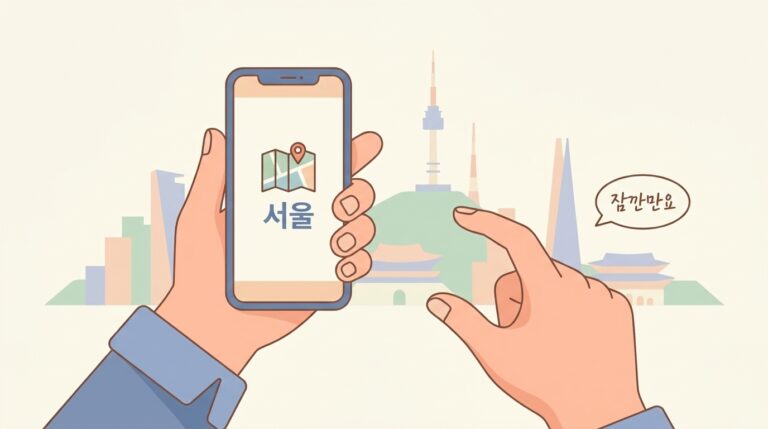
Even though you are on a phone call (especially if it’s a video call!), Koreans will often raise one hand, palm facing the screen/forward, and gently pinch their thumb and index finger together to indicate “a tiny bit” (조금 – jo-geum). This physical gesture naturally softens your tone of voice!
4-2. The “Busy-ness” Honorific
In Korean culture, showing that you are trying to be quick (pali-pali) is actually a sign of respect. When you ask someone to wait, adding a small sigh or a busy-sounding “Uh…” shows that you are actively working to resolve the delay, rather than just making them wait carelessly.
Phase 5: Real-Life Roleplay Scenario
Setting: You ordered a delicious Korean fried chicken delivery, but the delivery rider calls you because they are lost near your apartment building in Seoul.
Characters:
- Delivery Rider (배달원): A busy, friendly neighborhood uncle (Ahjussi).
- You (학습자): A hungry expat trying to guide him to your door.
Dialogue:
- Rider: 여보세요? 주문하신 치킨 배달왔는데, 몇 호예요?
(Yeo-bo-se-yo? Ju-mun-ha-sin chi-kin bae-dal-wat-neun-de, myeot-ho-ye-yo?)
“Hello? I’m here with your chicken delivery, what unit number is it?” -
You: 🎭 [Surprised and checking your door key]
어… 잠깐만요!
(Eo… Jam-kkan-man-yo!)
“Oh… Just a moment, please!” -
Rider: 네, 천천히 찾아서 말씀해 주세요.
(Ne, cheon-cheon-hi cha-jas-seo mal-sseum-hae ju-se-yo.)
“Sure, take your time and let me know.” -
You: 🎭 [Looking up the apartment building door passcode]
아! 네, 백이호예요.
(Ah! Ne, baek-i-ho-ye-yo.)
“Ah! Yes, it’s unit 102.” -
Rider: 아, 102호요? 공동현관 비밀번호도 있나요?
(Ah, baek-i-ho-yo? Gong-dong-hyeon-gwan bi-mil-beon-ho-do it-na-yo?)
“Ah, 102? Is there a building entrance passcode too?” -
You: 🎭 [Fumbling with your phone notes]
잠시만요… 찾고 있어요.
(Jam-si-man-yo… chat-go is-seo-yo.)
“Hold on a second… I’m looking for it.” -
Rider: 네, 알겠습니다.
(Ne, al-get-seum-ni-da.)
“Okay, got it.” -
You: 🎭 [Finding the code and speaking clearly]
열쇠 일 이 삼 사 번이에요!
(Yeol-soe il i sam sa beon-i-e-yo!)
“It’s key symbol, 1, 2, 3, 4!”
🔀 Choose Your Next Move!
What do you say if you can’t find the code at all and need more than a minute?
- Option A: “죄송해요, 조금만 기다려 주세요!” (Joe-song-hae-yo, jo-geum-man gi-da-ryeo ju-se-yo! – I’m sorry, please wait just a little bit!)
- Option B: “바빠요. 기다려.” (Ba-ppa-yo. Gi-da-ryeo. – I’m busy. Wait.)
- Option C: “전화 끊을게요!” (Jeon-hwa kkeun-eul-ge-yo! – I’ll hang up!)
Feedback:
- Best (Option A): perfect! It apologizes for the delay and uses polite honorifics. The delivery rider will happily wait.
- Bad (Option B): Too rude! It drops formal speech and sounds like you are ordering him around.
- Risk (Option C): He might not be able to get in, and your delicious chicken will get cold outside!
Phase 6: 10-Second Emotion Shadowing Drill
Practice these with the right emotion to sound like a native speaker! The / represents a tiny pause.
- [🥺 apologetic and polite]
죄송해요, / 잠깐만요!
(Joe-song-hae-yo, / jam-kkan-man-yo!) -
[😊 friendly and bright]
아! / 잠시만요!
(Ah! / Jam-si-man-yo!) -
[🏃♂️ rushed but respectful]
어, / 조금만 / 기다려 주세요!
(Eo, / jo-geum-man / gi-da-ryeo ju-se-yo!)
Phase 7: K-Culture Mini Dictionary
- 배달 (Bae-dal) | Delivery | Korea has one of the best food delivery systems in the world, operating 24/7 in most cities.
- 여보세요 (Yeo-bo-se-yo) | Hello (on the phone) | Used exclusively when answering phone calls. Literally means “Look here.”
- 아저씨 (Ah-jeos-si) | Mister / Middle-aged man | A friendly, common way to refer to delivery drivers or taxi drivers in everyday conversation.
- 빨리빨리 (Pali-pali) | Hurry, hurry! | The famous Korean lifestyle trait of doing everything quickly and efficiently.
Phase 8: Traveler’s Survival Kit
Survival Phrases TOP 3:
- 잠깐만요! (Jam-kkan-man-yo!) – Just a second! (Universal lifesaver)
- 영어로 해주세요. (Yeong-eo-ro hae-ju-se-yo.) – Please speak in English.
- 죄송합니다. (Joe-song-ham-ni-da.) – I am sorry.
Editor’s Travel Note:
If you are traveling in Korea, you will definitely need to order taxis or food. We highly recommend downloading the Kakao T taxi app for easy navigation and communication with drivers without needing complex phone calls!
Phase 9: “Going One Step Deeper” (Reflections on Korean Courtesy)
In Korean culture, the words you choose on the phone show how much you care about the other person’s comfort. Asking someone to wait using polite forms like Jam-si-man-yo acknowledges that their time is valuable. It shows that even though you are in a rush, you are prioritizing polite communication.
💬 Your Turn: Have you ever panicked on a phone call in another language? What did you say? Let us know in the comments below!
Phase 10: FAQ & Avoiding Mistakes
Q: Can I use “기다려 (Gi-da-ryeo)” to an older delivery driver?
A: Absolutely not! Dropping the polite endings to an older person is considered very rude in Korea. Always use 기다려 주세요 (Gi-da-ryeo ju-se-yo) or 잠시만요 (Jam-si-man-yo).
Q: What is the difference between 잠깐만 (Jam-kkan-man) and 잠시만 (Jam-si-man)?
A: Jam-kkan-man is slightly more active and casual. Jam-si-man is softer, making it the preferred choice in formal customer service settings.
Q: How do I say “wait a little bit”?
A: You can say 조금만 기다려 주세요 (Jo-geum-man gi-da-ryeo ju-se-yo). Jo-geum-man means “just a little bit.”
🚨 Common Mistakes Alert:
- Saying “Wait!” in English loudly: This can sound aggressive. Use a soft Jamkkanmanyo instead.
- Hanging up because you are nervous: The caller might think the line dropped and call back instantly. Just say Jamkkanmanyo!
- Using “Banmal” (informal speech) to strangers: Avoid saying just Jamkkanman without the -yo to people you don’t know.
Phase 11: Action Mission
- 🥉 Bronze Medal: Say Jam-kkan-man-yo! out loud 5 times in front of your mirror with a friendly smile.
- 🥈 Silver Medal: Write down our shadowing drills on a sticky note and paste it next to your desk.
- 🥇 Gold Medal: The next time a Korean delivery or call comes, use Jam-si-man-yo successfully!
Phase 12: Interactive Quiz Challenge
1. Which phrase is the softest and most polite way to ask a caller to wait?
- A) 잠깐만 (Jam-kkan-man)
- B) 잠시만요 (Jam-si-man-yo)
- C) 기다려 (Gi-da-ryeo)
Reveal Answer & Explanation
Correct Answer: B
Jam-si-man-yo is the softest and most polite option here because it contains the polite particle ‘-yo’ and the soft sibilant ‘si’. Option A and C are casual speech (Banmal) and should only be used with close friends.
2. Fill in the blank: “조금만 _______ 주세요” (Please wait a little bit)
- A) 가요 (ga-yo)
- B) 먹어요 (meog-eo-yo)
- C) 기다려 (gi-da-ryeo)
Reveal Answer & Explanation
Correct Answer: C
기다려 (gi-da-ryeo) means “wait.” The full phrase 조금만 기다려 주세요 translates to “Please wait a little bit.”







