

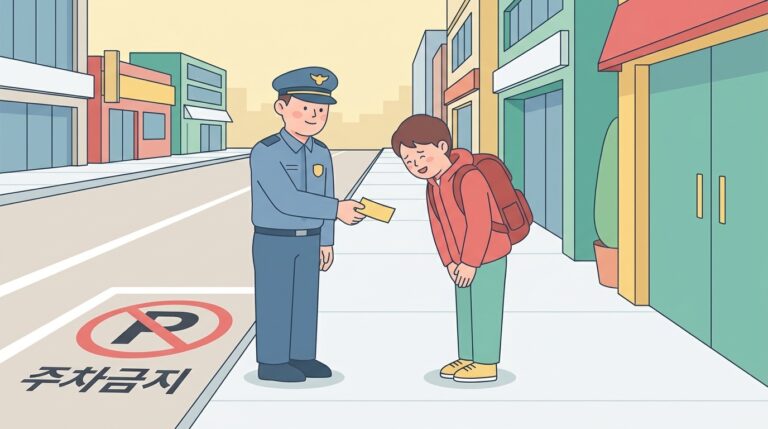
Oh No, Not a Fine! Navigating Rules and Penalties in Korea Like a Local
Phase 1: Empathy (An Actor’s Entrance)
안녕하세요! (Annyeonghaseyo!) Welcome back to Daily Hangul! It’s your favorite K-culture navigator and chief editor here.
Imagine this: You are walking down the vibrant, neon-lit streets of Hongdae. You just finished a delicious meal of 삼겹살 (samgyeopsal) and want to quickly discard your takeout coffee cup. You spot a pile of boxes on a street corner, toss your cup there, and keep walking. Suddenly, a polite but firm officer taps your shoulder, pointing at a sign that reads 무단투기 금지 (No Littering/Illegal Dumping). Before you know it, you are looking at a ticket for a 벌금 (beolgeum – fine).
Don’t panic! It happens to the best of us. Whether it’s accidentally riding the subway without tapping, disposing of trash in the wrong bag, or jaywalking on a quiet street, navigating local regulations in a foreign country can be tricky. Today, we’re going to master the exact Korean expressions you need when you make a mistake, have to pay a fine, or need to ask about the rules. Let’s turn this stressful moment into a major Korean language win!
Phase 2: Deep-Dive Into Top 3 Expressions
Let’s look at the three most crucial phrases you need when discussing rules and penalties in Korea.
1. 벌금을 내야 돼요 (beol-geum-eul nae-ya dwae-yo)
- Pronunciation: beol-geum-eul nae-ya dwae-yo (Sounds like: “bowl-goom-eul ney-yah dway-yo”)
- Meaning: I have to pay a fine. (Directly: “Fine [object marker] must pay.”)
- K-Culture Moment: You often hear this in K-dramas when a character gets caught illegally parking their car or when they break a strict roommate agreement.
- Editor’s Insight: The verb 내다 (naeda) means “to pay” or “to submit.” Combining it with the grammatical structure -아/어/여야 되다 (must/have to) creates a strong sense of obligation.
- Situation Spectrum: Casual: 벌금 내야 돼 (⚠️) | Semi-formal: 벌금 내야 돼요 (✅) | Formal: 벌금을 납부하셔야 합니다 (✅)
- 🤔 Think About It: In your home country, what is the most common minor offense that results in a fine? How does that compare to Korea’s strict trash-sorting (분리수거 – bunrisugeo) fines?
2. 제 실수예요. 몰랐어요. (je sil-su-yeo-yo. mol-las-seo-yo)
- Pronunciation: jeh shil-soo-yeh-yo. mohl-laht-suh-yo (Sounds like: “jeh shil-soo-yeh-yo. mole-laht-suh-yo”)
- Meaning: It’s my mistake. I didn’t know.
- K-Culture Moment: The go-to phrase for polite foreigners when they accidentally break a minor public rule, such as entering a restricted zone in a palace.
- Editor’s Insight: Koreans highly appreciate honesty and quick admission of mistakes. Saying “몰랐어요” (I didn’t know) with a polite bow can sometimes ease the tension and lead to a warning instead of a heavy ticket!
- Situation Spectrum: Casual: 내 실수야. 몰랐어. (⚠️) | Semi-formal: 제 실수예요. 몰랐어요. (✅) | Formal: 제 불찰입니다. 미처 알지 못했습니다. (✅)
- 🤔 Think About It: Why do you think acknowledging a mistake politely is so valued in Korean public life?
3. 혹시 여기 주차하면 안 돼요? (hok-si yeo-gi ju-cha-ha-myeon an dwae-yo?)
- Pronunciation: hok-shi yuh-gi joo-cha-ha-myuhn ahn dway-yo?
- Meaning: Excuse me, is parking not allowed here? / Can I not park here?
- K-Culture Moment: Asking the building security guard (경비원 아저씨 – gyeongbiwon ajeossi) before leaving your rental car on the side of the road.
- Editor’s Insight: Using 혹시 (hok-si – by any chance) softens the question. -면 안 돼요 (is it not allowed) is the standard way to ask if something is prohibited.
- Situation Spectrum: Casual: 여기 주차하면 안 돼? (🚫) | Semi-formal: 혹시 여기 주차하면 안 돼요? (✅) | Formal: 혹시 이곳에 주차하면 안 되는 것입니까? (✅)
- 🤔 Think About It: How does asking “Is it not allowed?” sound different from asking “Can I park here?” in your native language?
Phase 3: Textbook Korean vs. Real-Life Korean
Let’s compare what textbooks teach with how Koreans actually talk in these situations.
Situation 1: Expressing that you got a ticket
- 📖 Textbook Korean: 과태료를 부과받았습니다. (gwa-tae-ryo-reul bu-gwa-bad-at-seub-ni-da – “I was imposed with a fine.”)
- 🗣️ Real-Life Korean: 딱지 끊겼어요. (ttak-ji kkeun-gyeot-seo-yo – “My ticket got cut/I got ticketed.”)
- 💡 Why the difference? ‘딱지’ (ttakji) literally means a sticker or paper card, referring to the physical paper ticket slapped on your windshield. ‘끊기다’ means to be cut or issued. Saying “딱지 끊겼어요” is the ultimate natural way to say you got fined.
Situation 2: Asking if something is okay
- 📖 Textbook Korean: 여기에 쓰레기를 버려도 괜찮습니까? (yeo-gi-e sseu-re-gi-reul beot-yeo-do gwaen-chan-seub-ni-kka – “Is it okay if I discard trash here?”)
- 🗣️ Real-Life Korean: 여기 쓰레기 버리면 안 돼요? (yeo-gi sseu-re-gi beo-ri-myeon an dwae-yo? – “Am I not allowed to throw trash here?”)
- 💡 Why the difference? Real-life Korean often frames rules negatively (“Am I not allowed to?”) because it sounds more cautious and respectful of existing public boundaries.
Phase 4: K-Culture Deep-Dive & Non-Verbal Manners
4-1. Nunchi & Gestures
When apologizing or dealing with an officer/warden in Korea, your posture matters as much as your words:
* The Two-Hand Rule: If you are handing over your ID or receiving a ticket, always use two hands. Using one hand can seem dismissive or rude.
* The Soft Bow: A slight 15-degree bend of the upper body while saying “죄송합니다” (죄송합니다 – I am sorry) shows sincerity.
* Eye Contact: Avoid staring too intensely. Keep soft eye contact, occasionally looking down to show regret.
4-2. The Trash Fine Phenomenon (쓰레기 무단투기)
Korea is famous for its extremely strict recycling system called 분리수거 (bunrisugeo). If you put food waste in the general trash bag, or throw away recyclable plastic in a black plastic bag, local district offices use CCTV cameras to track you down and issue a fine of up to 200,000 KRW! Always buy the official district trash bags (종량제 봉투 – jongryangje bongtu) at any convenience store.
Phase 5: Real-Life Roleplay Scenario
Setting: A quiet street in Mapo-gu, Seoul. You parked your rental car quickly to grab a coffee, but a traffic warden (주차단속원 – juchadansokwon) is writing a ticket.
Character NPC: Mr. Kim (김 주무관), a diligent and rule-abiding district warden.
- Mr. Kim: 여기 주차하시면 안 되는 구역입니다. 단속 대상이에요.
(yeo-gi ju-cha-ha-si-myeon an doe-neun gu-yeok-im-ni-da. dan-sok dae-sang-i-e-yo.)
(🎭 Firmly pointing at the yellow line on the road)
“This is a no-parking zone. You are subject to a fine/crackdown.” -
You: 아, 정말요? 🎥 제 실수예요. 몰랐어요.
(ah, jeong-mal-yo? je sil-su-ye-yo. mol-las-seo-yo.)
(🎭 Putting hands together apologetically)
“Oh, really? It’s my mistake. I didn’t know.” -
Mr. Kim: 황색 실선은 주차 금지 구역이라 딱지 끊어야 합니다.
(hwang-saek sil-seon-eun ju-cha geum-ji gu-yeok-i-ra ttak-ji kkeun-eon-ya ham-ni-da.)
“Yellow solid lines are no-parking zones, so I have to issue a ticket.” -
You: 혹시 벌금을 얼마나 내야 돼요?
(hok-si beol-geum-eul ol-ma-na nae-ya dwae-yo?)
“By any chance, how much fine do I have to pay?” -
Mr. Kim: 승용차 기준 4만 원 나옵니다.
(seung-yong-cha gi-jun sa-man won na-om-ni-da.)
“For a regular sedan, it comes out to 40,000 KRW.” -
You: 아… 그렇군요. 바로 이동하면 안 될까요?
(ah… geu-reoh-gun-yo. ba-ro i-dong-ha-myeon an doel-kka-yo?)
(🎭 Looking pleadingly)
“Ah… I see. Can I move the car immediately?” -
Mr. Kim: 이미 전산에 등록되어서 어쩔 수 없습니다. 여기 고지서입니다.
(i-mi jeon-san-e deung-rok-doe-eo-seo eo-jjeol su eops-seub-ni-da. yeo-gi go-ji-seo-im-ni-da.)
(🎭 Handing over the paper slip with both hands)
“It’s already registered in the system, so there’s nothing I can do. Here is the notice.” -
You: 네, 알겠습니다. 다음부터는 조심할게요.
(ne, al-get-seub-ni-da. da-eum-bu-teo-neun jo-sim-hal-ge-yo.)
(🎭 Accepting the paper with both hands and bowing slightly)
“Yes, I understand. I’ll be careful from next time.”
🔀 Interactive Choice Point
What will you say to Mr. Kim now?
* Choice A: “이거 취소해 주세요!” (i-geo chwi-so-hae ju-se-yo! – “Cancel this!”)
* Choice B: “혹시 어디서 내야 돼요?” (hok-si eo-di-seo nae-ya dwae-yo? – “Where should I pay it by any chance?”)
* Choice C: “안 내면 어떻게 돼요?” (an nae-myeon eo-tteo-ke dwae-yo? – “What happens if I don’t pay?”)
Feedback:
- Choice A (Bad): High risk of sounding demanding. Fines once in the system cannot be manually canceled by wardens.
- Choice B (Best): Practical and polite. He will explain how to pay via virtual bank transfer.
- Choice C (Risk): Although a valid question, asking “what if I don’t pay” right away might sound rebellious.
Phase 6: 10-Second Emotion Shadowing Drill
Practice these lines out loud with the right dramatic feeling!
[🥺 Regretful and polite]
“제 실수예요 / 몰랐어요…”
(je sil-su-ye-yo / mol-las-seo-yo)
Pause at the slash! Say it softly with a gentle head tilt.-
[😮 Surprised but accepting]
“앗, 딱지 / 끊겼어요?”
(at, ttak-ji / kkeun-gyeot-seo-yo?)
Give a short gasp at “앗” (at) and raise the pitch slightly at the end. -
[💸 Resigned to fate]
“벌금을 / 내야겠네요.”
(beol-geum-eul / nae-ya-get-ney-yo)
Sigh slightly as you drop your pitch at the end.
Phase 7: K-Culture Mini Dictionary
- 딱지 (Ttak-ji): A ticket/fine sticker. Originally folded paper toy, now used colloquially for parking/speeding tickets.
- 과태료 (Gwa-tae-ryo): Administrative fine (for minor violations like parking, smoking in non-smoking areas).
- 무단횡단 (Mu-dan-hoeng-dan): Jaywalking. Highly regulated in major Seoul intersections!
- 종량제 봉투 (Jong-ryang-je bong-tu): Official government trash bags. You must buy these to throw away general household waste.
Phase 8: Survivor’s Travel Kit
Survival Phrases TOP 3
- 여기 주차해도 돼요? (yeo-gi ju-cha-hae-do dwae-yo?) – “Can I park here?”
- 벌금 카드 돼요? (beol-geum ka-deu dwae-yo?) – “Can I pay the fine with a credit card?”
- 여기 담배 피우면 안 돼요? (yeo-gi dam-bae pi-u-myeon an dwae-yo?) – “Is smoking not allowed here?”
Editor’s Travel Note
Always make use of reliable navigation apps in Korea. If you are driving a rental car, use the Naver Map App which alerts you loudly in English whenever you approach speed cameras, school zones (where speed limits are strictly 30km/h), or areas known for illegal parking monitoring.
Phase 9:
Frequently Asked Questions (FAQ)
Q: What does "벌금을 내야 돼요 (beol-geum-eul nae-ya dwae-yo)" mean in Korean and how do you pronounce it?
A: In Korean, "벌금을 내야 돼요 (beol-geum-eul nae-ya dwae-yo)" is pronounced [beol-geum-eul nae-ya dwae-yo (Sounds like: "bowl-goom-eul ney-yah dway-yo"] and means: I have to pay a fine. (Directly: "Fine [object marker] must pay.")
Q: What does "제 실수예요. 몰랐어요. (je sil-su-yeo-yo. mol-las-seo-yo)" mean in Korean and how do you pronounce it?
A: In Korean, "제 실수예요. 몰랐어요. (je sil-su-yeo-yo. mol-las-seo-yo)" is pronounced [jeh shil-soo-yeh-yo. mohl-laht-suh-yo (Sounds like: "jeh shil-soo-yeh-yo. mole-laht-suh-yo"] and means: It's my mistake. I didn't know.
Q: What does "혹시 여기 주차하면 안 돼요? (hok-si yeo-gi ju-cha-ha-myeon an dwae-yo?)" mean in Korean and how do you pronounce it?
A: In Korean, "혹시 여기 주차하면 안 돼요? (hok-si yeo-gi ju-cha-ha-myeon an dwae-yo?)" is pronounced [hok-shi yuh-gi joo-cha-ha-myuhn ahn dway-yo?] and means: Excuse me, is parking not allowed here? / Can I not park here?







