

Stay out of the Fine Zone! Navigating Korea’s Fishing Restrictions Like a Pro
안녕하세요! Welcome back to Daily Hangul, your trusty companion for navigating the beautiful, intricate, and sometimes surprising world of Korean language and culture. I’m your resident culture navigator!
Have you ever dreamed of casting a line into the serene Han River under the twinkling lights of Seoul, or finding a quiet rocky cliff in Busan to catch some fresh sea bream? Fishing (낚시 – nak-si) is incredibly popular in Korea. But here is the catch: Korea is a densely populated country with highly protected water resources, meaning there are strict environmental rules. If you set up your gear in the wrong spot, you might be greeted not by a fish, but by an officer handing you a hefty fine (과태료 – gwa-tae-ryo).
Today, we are going to dive into the essential Korean vocabulary and cultural nuances you need to avoid those “No Fishing” zones, talk your way through an inspection with polite confidence, and understand the eco-conscious mindset of Korean anglers.
Phase 2: Core Expressions Deep Dive
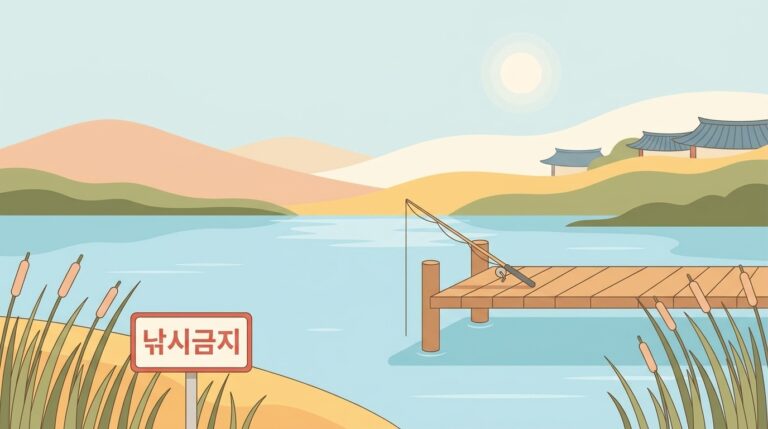
1. 낚시 금지 구역 (nak-si geum-ji gu-yeok)
- Pronunciation: nak-shee geum-jee goo-yeok (Rhymes with “key” and “shock”)
- Meaning: No-Fishing Zone (Strictly prohibited area)
- K-Culture Moment: You will see this bold red-and-yellow sign standing guard near reservoirs, city streams (like Cheonggyecheon), and certain harbor walls. In K-Dramas, characters who try to sneak a romantic fishing moment in these zones are inevitably chased away by a neighborhood patrol officer blowing a whistle.
- Editor’s Insight: Geum-ji (금지) means prohibition, and gu-yeok (구역) means zone or district. If you see geum-ji written anywhere in Korea, it’s a hard boundary.
- Situation Spectrum: Casual: ⚠️ | Semi-formal: ✅ | Formal: ✅
- 🤔 Think About It: How does your home country mark off restricted natural areas? Is it usually a suggestion, or is it strictly enforced like in Korea?
2. 벌금이 부과됩니다 (beol-geum-i bu-gwa-doem-ni-da)
- Pronunciation: buhl-gum-ee boo-gwa-dem-nee-dah (The ‘beol’ sounds a bit like the insect ‘bee’ but with a ‘uhl’ sound)
- Meaning: A fine will be imposed / charged.
- K-Culture Moment: This is the ominous warning text written at the bottom of official signs. In Korea, fines for illegal fishing can range from 50,000 KRW to upwards of 3,000,000 KRW depending on the protection level of the waters.
- Editor’s Insight: While beol-geum (벌금) is the general word for “fine” or “penalty,” the official legal term used for administrative fines (like fishing out of season) is often gwa-tae-ryo (과태료). Knowing the difference shows high-level fluency!
- Situation Spectrum: Casual: 🚫 | Semi-formal: ⚠️ | Formal: ✅
- 🤔 Think About It: Why do you think Korea uses financial penalties so prominently for environmental conservation?
3. 단속 나왔습니다 (dan-sok na-wat-seum-ni-da)
- Pronunciation: dahn-sok nah-wat-seum-nee-dah
- Meaning: We are out here conducting an inspection / crackdown.
- K-Culture Moment: Picture yourself peaceful fishing, when suddenly officers wearing high-visibility vests approach you. This is the classic phrase they use to introduce themselves before checking your permit or your spot.
- Editor’s Insight: Dan-sok (단속) means crackdown, enforcement, or policing. When someone says “단속 나왔습니다,” they are politely but firmly telling you that they are performing an official check.
- Situation Spectrum: Casual: 🚫 | Semi-formal: ✅ | Formal: ✅
- 🤔 Think About It: How would you respond calmly and politely in your own language when approached by park rangers or authorities?
Phase 3: Textbook Korean vs. Real Korean
Sometimes, what you learn in grammar books sounds too clinical when you’re actually out by the water. Let’s compare!
Scenario 1: Warning a friend about a restricted area
- 📖 Textbook: “이곳은 낚시가 금지된 장소입니다.” (I-goseun nak-siga geum-ji-doen jang-so-im-ni-da.)
- Translation: This place is a prohibited fishing location.
- 🗣️ Real Korean: “여기 낚시 금지 구역이라 던지면 안 돼요!” (Yeo-gi nak-si geum-ji gu-yeok-i-ra deon-ji-myeon an dwae-yo!)
- Translation: Throwing [your line] in here is a no-go, it’s a restricted zone!
- 💡 Why the difference? Real anglers use the verb 던지다 (deon-ji-da – to cast/throw) to refer to casting their line, rather than using the formal noun “낚시 행위” (fishing activity).
Scenario 2: Asking if a spot is okay to fish in
- 📖 Textbook: “여기에서 낚시를 해도 안전합니까?” (Yeo-gi-e-seo nak-si-reul hae-do an-jeon-hap-ni-ka?)
- Translation: Is it safe to fish here?
- 🗣️ Real Korean: “여기 혹시 대 깔아도 되는 곳이에요?” (Yeo-gi hok-si dae kkal-ah-do doe-neun got-i-e-yo?)
- Translation: By any chance, is this a spot where I can set up my rods?
- 💡 Why the difference? “대 깔다” (dae kkal-da) is a very authentic insider slang meaning “to set up/unfold your fishing rods” (dae being short for nak-si-dae – fishing rod). Using this makes you sound like a local pro!
Phase 4: K-Culture Deep Dive & Non-Verbal Manners
4-1. Nunchi (눈치) & Gesture Etiquette on the Water
If a local official or another angler approaches you and gently points their index finger downward toward the ground while shaking their head, they are signaling “You shouldn’t be doing that here” without making a loud scene. This is a quiet, non-confrontational way of protecting your Nunchi (social face).
When caught in a minor misunderstanding, the best posture is to slightly bow your head, pull back your rod immediately, and use both hands to present your ID if asked. Showing immediate cooperation (협조 – hyeop-jo) goes a very long way in Korea.
4-2. The “No-Trash” Culture (쓰레기 되가져가기)
Korea’s fishing community is extremely passionate about “Clean Fishing” (클린 낚시). Leaving even a single bait bag or plastic bottle behind is considered a major taboo. Many fishing spots have local residents who actively monitor visitors. If you pack up your trash neatly in a designated local garbage bag (sre-gi bong-tu), locals will often warmly recommend the best hidden spots nearby!
Phase 5: Real-Life Roleplay Scenario
Setting: A beautiful dock near a reservoir in Gangwon-do. You just cast your rod, but a local district officer (구청 직원 – gu-cheong jik-won) wearing an armband approaches you.
Characters:
* 민우 (Min-woo): The friendly but firm local inspector.
* You (B2 Learner): An enthusiastic foreign angler trying to follow the rules.
The Conversation
- 민우: “안녕하세요. 혹시 여기 낚시 금지 구역인 거 모르셨나요?”
(An-nyeong-ha-se-yo. Hok-si yeo-gi nak-si geum-ji gu-yeok-in geo mo-reu-shyeot-na-yo?)
🎭 (Points politely to a small wooden sign hidden behind the grass)
“Hello. By any chance, did you not know that this is a no-fishing zone?” -
You: “아, 진짜요? 표지판이 잘 안 보여서 몰랐습니다. 죄송합니다.”
(Ah, jin-jja-yo? Pyo-ji-pan-i jal an bo-yeo-seo mol-rat-seum-ni-da. Joe-song-ham-ni-da.)
🎭 (Looking genuinely surprised and bowing slightly)
“Oh, really? I couldn’t see the sign well, so I didn’t know. My apologies.” -
민우: “여기는 상수원 보호구역이라서 단속 대상이에요. 벌금이 나올 수 있습니다.”
(Yeo-gi-neun sang-su-won bo-ho-gu-yeok-i-ra-seo dan-sok dae-sang-i-e-yo. Beol-geum-i na-ol su it-seum-ni-da.)
🎭 (Checking his clip board objectively)
“This is a water supply protection area, so it is subject to enforcement. You could be fined.” -
You: “처음 와서 잘 몰랐는데, 바로 대 접겠습니다. 한 번만 봐주실 수 없을까요?”
(Cheo-eum wa-seo jal mol-rat-neun-de, ba-ro dae jeop-get-seum-ni-da. Han beon-man bwa-ju-sil su eops-eul-kka-yo?)
🎭 (Quickly starting to pack up the gear to show cooperative intent)
“It’s my first time here so I didn’t know well. I will pack up my rods immediately. Could you please let me off just this once?” -
민우: “네, 다행히 아직 고기를 잡으신 건 아니니까 이번에는 구두 경고만 드릴게요.”
(Ne, da-haeng-hi a-jik go-gi-reul jab-eu-sin geon a-ni-ni-ka i-beon-e-neun gu-du gyeong-go-man deu-ril-ge-yo.)
🎭 (Smiling gently, relieved that you are not being defensive)
“Yes, fortunately, since you haven’t actually caught any fish yet, I will only give you a verbal warning this time.” -
You: “정말 감사합니다! 혹시 이 근처에 허가된 낚시터가 어디 있는지 아시나요?”
(Jeong-mal gam-sa-ham-ni-da! Hok-si i geun-cheo-e heo-ga-doen nak-si-teo-ga eo-di in-neun-ji a-si-na-yo?)
🎭 (Asking respectfully for alternative options)
“Thank you so much! By any chance, do you know where a permitted fishing site is located around here?” -
민우: “저기 다리 건너편 하류 쪽은 괜찮아요. 거기서 하세요.”
(Jeo-gi da-ri geon-neo-pyeon ha-ryu jjok-eun gwaen-chan-a-yo. Geo-gi-seo ha-se-yo.)
🎭 (Pointing across the bridge with a friendly gesture)
“The downstream area across that bridge over there is fine. You can fish there.” -
You: “친절하게 알려주셔서 감사합니다! 안전하게 낚시하겠습니다.”
(Chin-jeol-ha-ge al-ryeo-ju-syeo-seo gam-sa-ham-ni-da! An-jeon-ha-ge nak-si-ha-get-seum-ni-da.)
🎭 (Bowing gratefully and carrying the packed gear)
“Thank you for kindly letting me know! I will fish safely.”
🔀 Interactive Choice Point
What would you do if the officer still insists on writing a fine ticket?
- A. “외국인이라 법을 전혀 몰랐어요!” (I didn’t know the law at all because I’m a foreigner!)
- Feedback (Risk): Claiming ignorance as a foreigner might occasionally work for minor things, but in environmental protection zones, the law applies equally. It’s better to show remorse and cooperation instead of relying on foreign status.
- B. “바로 치우고 갈 테니까 봐주세요.” (I’ll pack up and leave immediately, so please let me off.)
- Feedback (Best): Action speaks louder than words. Showing immediate intent to pack up (대 접다) is the most respectful and effective way to get a verbal warning (구두 경고) instead of a fine.
- C. “여기 표지판이 너무 안 보여서 제 잘못이 아니에요!” (The sign was so invisible, it’s not my fault!)
- Feedback (Bad): Arguing with a civil servant or public officer (공무원) about municipal sign placements will likely lead to them strictly applying the maximum fine. Avoid confrontation.
Phase 6: 10-Second Emotion Shadowing Drill
Let’s practice speaking like a native speaker under pressure! Pay attention to the pauses (/) and the emotional cues.
- [🥺 Urgently but politely pleading for a break]
“몰랐어요… / 다음부터는 / 꼭 / 확인하고 / 할게요.”
(Mol-rat-eo-yo… / da-eum-bu-teo-neun / kkok / hwag-in-ha-go / hal-ge-yo.)
Translation: I really didn’t know… From now on, I will absolutely make sure to check first. -
[😊 Expressing deep relief and gratitude]
“경고만 주셔서 / 진짜 / 다행이에요! / 감사합니다!”
(Gyeong-go-man ju-shyeo-seo / jin-jja / da-haeng-i-e-yo! / Gam-sa-ham-ni-da!)
Translation: It is such a relief that you only gave me a warning! Thank you so much!
Phase 7: K-Culture Mini Dictionary
- 상수원 보호구역 (sang-su-won bo-ho-gu-yeok) | Water Source Protection Zone
- Reservoirs and streams that provide drinking water to millions of households. Fishing, swimming, and camping here are strictly banned to prevent chemical pollution.
- 손맛 (son-mat) | “Hand-taste” (The thrill of the catch)
- A fascinating compound word! It refers to the physical vibration and thrill felt in your hands when a fish bites and struggles against the rod.
- 짬낚 (jjam-nak) | Quick fishing in between schedules
- A portmanteau of jjam (spare time) and nak-si (fishing). It means sneaking away for 1 or 2 hours of fishing during lunch or after work.
- 입질 (ip-jil) | A nibble / fish bite
- Literally “mouth action” by a fish. When your float bobbers up and down, you say “입질이 오네요!” (The fish are biting!).
Phase 8: Survivor’s Travel Kit
Survival Phrases TOP 3
- “여기 낚시 가능한가요?” (Yeo-gi nak-si ga-neung-han-ga-yo?)
- Pro Tip: Ask this to nearby locals or shop owners before even unpacking your rod.
- “벌금 얼마예요?” (Beol-geum eol-ma-yeo-yo?)
- Pro Tip: Use this when asking about the consequences of fishing in borderline municipal waters.
- “쓰레기 버리는 데 어디 있어요?” (Sseu-re-gi beo-ri-neun de eo-di it-seo-yo?)
- Pro Tip: Shows you are an eco-friendly angler. Locals will respect you immediately!
Editor’s Travel Note
Before heading out, make sure to download the National Fishing Land Navigation App (어신 – Eo-sin) or check local district office websites. These platforms provide real-time maps outlining safe zones, banned zones, and prohibited species sizes. Note: Regulations may change seasonally depending on spawning cycles, so checking apps before casting is highly recommended.
Phase 9:
Frequently Asked Questions (FAQ)
Q: What does "낚시 금지 구역 (nak-si geum-ji gu-yeok)" mean in Korean and how do you pronounce it?
A: In Korean, "낚시 금지 구역 (nak-si geum-ji gu-yeok)" is pronounced [nak-shee geum-jee goo-yeok (Rhymes with "key" and "shock"] and means: No-Fishing Zone (Strictly prohibited area)
Q: What does "벌금이 부과됩니다 (beol-geum-i bu-gwa-doem-ni-da)" mean in Korean and how do you pronounce it?
A: In Korean, "벌금이 부과됩니다 (beol-geum-i bu-gwa-doem-ni-da)" is pronounced [buhl-gum-ee boo-gwa-dem-nee-dah (The 'beol' sounds a bit like the insect 'bee' but with a 'uhl' sound] and means: A fine will be imposed / charged.
Q: What does "단속 나왔습니다 (dan-sok na-wat-seum-ni-da)" mean in Korean and how do you pronounce it?
A: In Korean, "단속 나왔습니다 (dan-sok na-wat-seum-ni-da)" is pronounced [dahn-sok nah-wat-seum-nee-dah] and means: We are out here conducting an inspection / crackdown.







