

Lightning Fast! Navigating Korea’s Public Services with ‘Ppalli-Ppalli’ (빨리빨리)
Phase 1: Empathy (공감)
안녕하세요! Welcome back to Daily Hangul (매일한글), your trusty local culture navigator! 👋
Picture this: You are studying or working in Seoul, and you suddenly need an official Certificate of Residence (주민등록등본 – jumin-deungnok-deungbon) to open a bank account or sign a rental contract. Back home, this might involve booking an appointment weeks in advance, standing in a painful queue, and waiting 5 to 7 business days for a piece of paper.
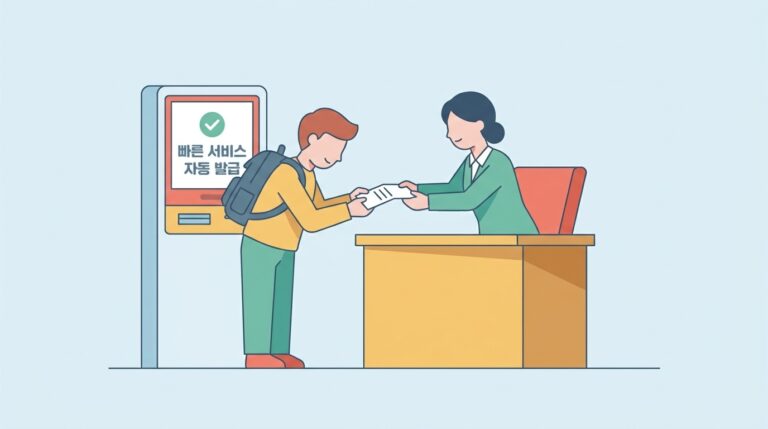
You nervously walk into a Korean Community Center (주민센터 – jumin-senteo). You pull a number ticket, wait exactly 45 seconds, and hand your ID to the officer. Before you can even finish checking your Instagram feed, they hand you the stamped document.
“Wait, that’s it? Is it really over?”
You have just experienced the legendary Ppalli-Ppalli (빨리빨리 – Hurry, Hurry) Culture in its purest form: Korean public administration. Today, we are going to learn how to navigate these lightning-fast public services with confidence, natural B1-level Korean, and a smile! 😊
Phase 2: Key Expressions (핵심 표현 3선)
1. 바로 발급돼요? (Baro balgeup-dwaeyo?)
- Pronunciation: Bah-ro bal-geup-dwae-yo? (Sounds like “Bah-ro” as in barrow + “bal-geup” as in ball-goop + “dwae-yo” like dway-yo)
- Meaning: Can it be issued right away? / Is it issued immediately?
- K-Culture Moment: In dramas, you often see characters rushing into a district office (구청 – gucheong) to get marriage certificates or business licenses, frantically asking the clerk if they can get it right now.
- Editor’s Insight: 발급 (balgeup) means “issuance” of official documents. Combining it with 바로 (baro), which means “immediately” or “directly,” shows that you want to know if there’s any waiting period. It’s polite but gets straight to the point.
- Situation Spectrum: Casual: ⚠️ (바로 발급돼?) | Semi-formal: ✅ (바로 발급돼요?) | Formal: ✅ (바로 발급됩니까?)
- 🤔 Think About It: How long does it take to get an official document in your country? Why do you think Koreans value speed so highly even in government services?
2. 무인발급기 어디에 있어요? (Muin-balgeup-gi eodie isseoyo?)
- Pronunciation: Moo-in-bal-geup-gi eo-di-e itt-eo-yo? (Sounds like Moo-inn + ball-goop-ghee + eo-dee-eh + it-suh-yo)
- Meaning: Where is the automated document kiosk?
- K-Culture Moment: If you visit a Korean subway station or district office, you’ll see large yellow/blue touch-screen machines. These are 무인민원발급기 (automated civil service kiosks) where you can print almost any government certificate in under a minute using fingerprint authentication!
- Editor’s Insight: 무인 (muin) means “unmanned/automated” and 기 (gi) means “machine.” Asking for this machine shows you are a savvy local who doesn’t want to wait in the teller line.
- Situation Spectrum: Casual: ⚠️ (무인발급기 어디 있어?) | Semi-formal: ✅ (무인발급기 어디에 있어요?) | Formal: ✅ (무인발급기 위치가 어떻게 됩니까?)
- 🤔 Think About It: Would you feel comfortable using your fingerprint to instantly print official legal documents from a kiosk in a subway station?
3. 혹시 영문으로도 출력 가능할까요? (Hoksi yeong-mun-euro-do chullyeok ganeung-hal-kkayo?)
- Pronunciation: Hok-shi young-moon-eu-ro-do chool-ryeok gah-neung-hal-kah-yo? (Sounds like Hoke-shee + yung-moon-oo-ro-do + chool-yuck + gah-nung-hal-kah-yo)
- Meaning: By any chance, is it possible to print it in English too?
- K-Culture Moment: When foreigners apply for visas, bank accounts, or international schools, they often need English versions of Korean certificates. Almost all standard Korean certificates can be instantly printed in English!
- Editor’s Insight: 출력 (chullyeok) is the word for “printing/output.” Adding 혹시 (hoksi – by any chance) and the soft ending -ㄹ까요? (-l-kkayo?) makes your request sound incredibly polite and natural.
- Situation Spectrum: Casual: 🚫 (영문으로 뽑아줘) | Semi-formal: ✅ (혹시 영문으로도 출력 가능할까요?) | Formal: ✅ (영문 발급도 가능한지 여쭤보고 싶습니다.)
- 🤔 Think About It: Why is it helpful that Korean administrative systems are so well-integrated with English translation options?
Phase 3: Textbook vs. Real Korean (교과서 vs. 진짜 한국어)
Situation 1: Asking if you have to wait long
- 📖 Textbook Korean: 서류를 받으려면 얼마나 기다려야 합니까? (Seoryureul badeuryeomeon eolmana gidaryeoya hamnikka? – “How long must I wait to receive the document?”)
- 🗣️ Real Korean: 금방 나와요? (Geumbang nawayo? – “Will it come out shortly/right away?”)
- 💡 Why the difference? While the textbook version is grammatically perfect, it sounds too stiff and robotic for a busy community center. Real Koreans use the word 나오다 (naoda – to come out) to describe documents being printed or prepared, combined with 금방 (geumbang – soon/shortly).
Situation 2: Asking for help with the self-service kiosk
- 📖 Textbook Korean: 이 기계의 사용법을 가르쳐 주십시오. (I gigye-ui sayongbeobeul gareuchyeo jusipsio. – “Please teach me the usage method of this machine.”)
- 🗣️ Real Korean: 이것 좀 도와주시겠어요? (Igeot jom dowajusigesseoyo? – “Could you help me with this briefly?”)
- 💡 Why the difference? Saying “teach me the usage method” sounds like you are asking for a formal training session. In real life, saying 이것 좀… (igeot jom… – this, please…) with a polite request for help is much softer, warmer, and immediately gets the officer to tap the screen for you!
Phase 4: K-Culture Deep Dive & Non-verbal Manners (비언어적 매너)
4-1. The Body Language of Speed (눈치 & 제스처)
- The Two-Handed Pass: Even though everything moves at lightning speed (Ppalli-Ppalli), Korean etiquette never takes a backseat. When you hand over your ID card (신분증 – sinbunjeung) or receive your printed document, always use two hands. Using one hand can make you look impatient or rude.
- The Fingerprint Press: When using the automated kiosk, you will be asked to scan your right index finger. A common mistake is pressing too lightly. Press down firmly and wait for the green light! 🟢
4-2. The Tech Magic Behind the Speed
This speed isn’t magic; it’s the result of Korea’s ultra-advanced e-government system called Gov24 (정부24). Korea has one of the highest digital administration rates in the world. Almost every citizen’s data is digitized, allowing various government departments to share verification instantly. That’s why you don’t have to wait days for background verification!
Phase 5: Real-Life Roleplay Scenario (실전 롤플레이)
Setting: Mapo-gu Community Center (마포구 주민센터). You need a Certificate of Entry & Exit (출입국사실증명서) to prove your recent travels for a visa renewal. You are standing in front of a friendly but extremely efficient public officer, Min-su (민수).
Min-su: 어서 오세요. 무엇을 도와드릴까요?
        (Welcome. How can I help you?)

You: 🎭 [Politely handing over your passport with both hands]
     안녕하세요, 출입국사실증명서 발급받으러 왔어요.
     (Hello, I came to get a Certificate of Entry & Exit issued.)

Min-su: 아, 네. 신분증 확인 도와드릴게요... 네, 확인되셨고요. 바로 발급 가능합니다.
        (Ah, yes. I will help verify your ID... Yes, verified. It can be issued right away.)

You: 🎭 [Relieved and smiling]
     아, 다행이네요! 혹시 바로 발급돼요?
     (Ah, thank you! By any chance, is it issued right away?)

Min-su: 네, 1분만 기다려 주세요. 금방 나옵니다. 수수료는 2,000원입니다.
        (Yes, please wait just one minute. It will come out shortly. The fee is 2,000 won.)

You: 🎭 [Tapping your card on the payment reader]
     네, 카드로 결제할게요. 혹시 영문으로도 출력 가능할까요?
     (Yes, I will pay by card. By any chance, is it possible to print it in English too?)

Min-su: 네, 영문으로 처리해 드렸습니다. 여기 서류 나왔습니다!
        (Yes, I processed it in English for you. Here is your document!)

You: 🎭 [Receiving the paper with both hands and bowing slightly]
     우와, 진짜 빠르네요! 감사합니다. 수고하세요!
     (Wow, that's really fast! Thank you. Have a great day!)
🔀 Interactive Choice Point
The clerk hands you the document, but you notice a minor typo in your middle name. What do you say?
- Choice A: “이거 틀렸어요. 다시 해주세요.” (Igeo teullyeosseoyo. Dasi haejuseyo. – “This is wrong. Do it again.”)
- 🔴 Feedback (Bad): Too direct and borderline rude. It can make the officer defensive.
- Choice B: “저기요, 영문 이름 철자가 조금 다르게 나온 것 같아요.” (Jeogiyo, yeongmun ireum cheoljaga jogeum dareuge naon geot gatayo. – “Excuse me, I think the English name spelling came out a bit differently.”)
- 🟢 Feedback (Best): Soft, polite, and uses passive phrasing (came out differently) to avoid blaming the clerk directly. They will happily fix it instantly!
- Choice C: “그냥 쓸게요. 귀찮으니까요.” (Geunyang sseulgeyo. Gwichaneunikkayo. – “I’ll just use it. Because it’s a hassle.”)
- ⚠️ Feedback (Risk): Typographic errors on official documents can cause serious visa or banking rejections later. Don’t compromise just to avoid speaking up!
Phase 6: 10-Second Emotion Shadowing Drill (감정 섀도잉)
Practice saying these with the right emotion and rhythmic pauses (/ marks a short pause):
- [😊 Amazed & Super Happy]
- 우와, / 진짜 / 바로 나오네요! / 최고예요!
- Uwa, / jinjja / baro naoneyo! / choegoyeyo!
- (Wow, / it really comes out / right away! / You are the best!)
- [🥺 Politely Worried]
- 혹시… / 영문으로 발급하면 / 오래 걸릴까요?
- Hoksi… / yeong-mun-euro balgeuphamyeon / orae geollilkayo?
- (By any chance… / if I get it in English / will it take long?)
Phase 7: K-Culture Mini-Dictionary (미니 사전)
- 주민센터 (Jumin-senteo) | Community Center: Officially known as 행정복지센터 (Administrative Welfare Center). It is the neighborhood hub for registering address changes, obtaining local services, and issuing government documents.
- 등본 (Deungbon) | Certified Copy of Register: Short for 주민등록등본. This is the most common residency certificate required for almost all administrative tasks in Korea.
- 무인민원발급기 (Muin-minwon-balgeup-gi) | Auto Civil Service Kiosk: Self-service machines found in subway stations and offices. They offer discounted fees compared to talking to a human clerk!
- 수고하세요 (Sugohaseyo) | Keep up the good work: A polite greeting said to working staff when you leave. Literally means “Please continue to trouble yourself,” used as a warm “Thank you for your service!”
Phase 8: Survivor’s Travel Kit (여행자를 위한 생존 키트)
Survival Expressions TOP 3
- 외국인 등록증도 괜찮아요? (Oegugin deungnokjeung-do gwenchanayo?)
- Pro Tip: Use this to ask “Is an Alien Registration Card (ARC) okay?” instead of a passport.
- 대기 번호표 어디서 뽑아요? (Daegi beonhopyo eodiseo ppobayo?)
- Pro Tip: “Where do I pull a waiting number ticket?” (Always do this first when you walk in!)
- 수수료는 얼마예요? (Susuryeoneun eolmayeyo?)
- Pro Tip: “How much is the service fee?” (Usually ranging from 200 to 2,000 KRW; credit cards are widely accepted.)
📝 Editor’s Travel Note
Before heading to a community center, download the Naver Map App to find the nearest 주민센터 (Community Center). Most centers are open from 9:00 AM to 6:00 PM, Monday through Friday. If you need standard documents, try looking for the yellow 무인발급기 (Kiosk) inside major subway stations—it will save you time and money! (Note: Kiosk operating hours may vary depending on the subway station schedule).
Phase 9: A Step Deeper (생각 질문)
Korea’s administrative speed is a source of immense national pride. It reflects a society that values collective efficiency, punctuality, and mutual respect for each other’s time. In Korea, making someone wait unnecessarily is often viewed as a lack of consideration. However, this hyper-speed can sometimes put immense pressure on public workers to perform flawlessly under tight timelines.
💬 Your Turn: Do you prefer a system that is incredibly fast and digitized like Korea’s, or do you prefer a slower, more face-to-face personal approach? Let us know in the comments below!
Phase 10: FAQ & Misconception Prevention
Q: Can tourists get official documents at a local community center?
A: Generally, no. Most official certificates are for registered residents (citizens and foreign residents holding an ARC). However, tourists can visit to ask for directions, obtain local maps, or seek general assistance.
Q: Can I pay for my document fees with a foreign credit card?
A: Yes, almost all community centers and automated kiosks accept major international credit cards (Visa, Mastercard). However, keeping a few 1,000 KRW cash bills handy is always a safe backup!
Q: Is the English version of a document exactly the same as the Korean one?
A: Yes, the content is identical. However, make sure your name matches the spelling on your passport exactly to avoid verification issues later.
🚨 Common Mistakes Alert!
- Mistake 1: Standing in line without pulling a number ticket (대기표).
- Correct Action: Walk in, look for the ticket machine (usually near the entrance), press the button for 민원 (Civil Services), and get your number first!
- Mistake 2: Leaving without saying goodbye to the busy worker.
- Correct Action: Always say a warm, polite “감사합니다. 수고하세요!” as you pick up your documents.
Phase 11: Action Mission!
- 🥉 Bronze Mission: Practice saying “바로 발급돼요?” out loud three times until your tongue feels natural with the rhythm.
- 🥈 Silver Mission: Share this post on your Instagram Story and tag @DailyHangul with your answer to today’s cultural question!
- 🥇 Gold Mission: Next time you need to go to a Korean convenience store, subway kiosk, or office, try using the polite soft ending “~ㄹ까요?” instead of just “~요?”!
Phase 12: Interactive Quiz Challenge!
Test your knowledge of Korean administrative speed and culture!
1. Which machine should you look for if you want to print a document on your own in a subway station?
🔍 Click to reveal the answer
Answer: 무인발급기 (Muin-balgeup-gi)
Explanation: ‘무인’ means unmanned/automated, and ‘발급기’ means issuing machine. Looking for this will save you time and money!
2. True or False: Asking “금방 나와요?” is considered rude to Korean public clerks.
🔍 Click to reveal the answer
Answer: False
Explanation: It is a very natural, everyday way to ask if the document will be ready shortly. Just make sure to say it with a friendly, polite tone!







