

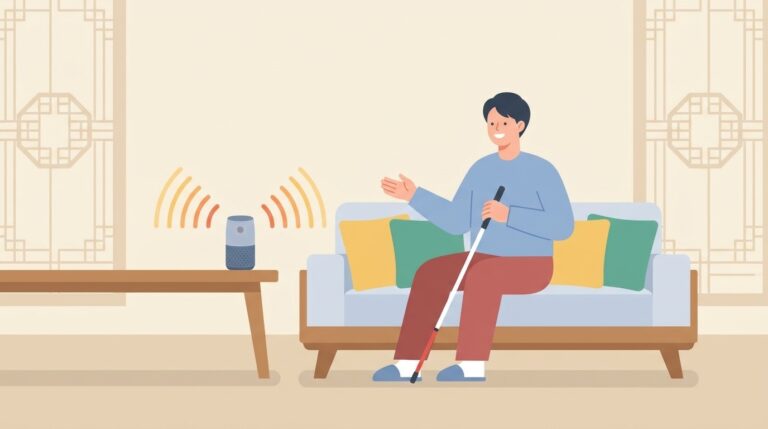
K-Culture Tech: How AI Voice Recognition is Opening New Worlds in Korea
Phase 1: Empathy (스토리 몰입형 오프닝)
안녕하세요! Daily Hangul‘s Chief Editor and your personal Korean culture navigator is here. Have you ever watched a heartwarming K-Drama scene where a character with a visual impairment seamlessly navigates a bustling Seoul smart home, or orders food at a high-tech kiosk just by speaking?
In Korea, a country where technology moves at a breakneck speed, voice recognition technology (음성 인식 기술) is no longer just a luxury for hands-free typing. It is becoming a vital lifeline of accessibility (장애인을 위한 음성 기술). Imagine visiting Korea as an advanced learner, wanting to discuss these deep social changes with local friends, but feeling stuck with only basic textbook vocabulary. Today, we’re diving deep into the sophisticated Korean terms used in modern tech, accessibility, and social welfare. This guide is based on real-world feedback from C1 learners who wanted to discuss meaningful social topics beyond just ordering K-BBQ!
Phase 2: Deep-Dive into 3 Essential Expressions (핵심 표현 3선 심층 분석)
Let’s look at three high-level, natural terms that will instantly elevate your Korean conversations from intermediate to advanced.
1. 장벽을 허물다 (Jang-byeok-eul heo-mul-da)
- Pronunciation: Jang-byeok-eul heo-mul-da (Sounds like “Jahng-byuk-ool huh-mool-da”—rhymes with English “dull” at the end)
- Meaning: Lit. “To tear down a wall” -> To break down barriers.
- K-Culture Moment: You will often hear this in Korean tech documentaries or news specials covering startups that develop screen readers (화면 낭독기) or AI-guided navigation apps for the visually impaired.
- Editor’s Insight: While “장벽을 없애다” (to eliminate barriers) is correct, “허물다” (to demolish/tear down a physical wall) adds a powerful, emotional, and poetic nuance. It implies actively and physically dismantling a systemic obstacle.
- Situation Spectrum: Casual (⚠️ – too heavy for casual gossip) | Semi-formal (✅) | Formal (✅)
- 🤔 Think About It: How does the physical metaphor of “tearing down a wall” compare to “breaking down barriers” in your own language?
2. 귀가 되어 주다 (Gwi-ga doe-eo ju-da)
- Pronunciation: Gwi-ga dwe-uh joo-da (Sounds like “Gwee-gah dweh-uh joo-dah”)
- Meaning: Lit. “To become someone’s ears” -> To listen on behalf of someone / provide auditory support.
- K-Culture Moment: Used in warm social campaigns where speech-to-text (STT) apps automatically translate spoken Korean into real-time subtitles for the deaf during university lectures.
- Editor’s Insight: Koreans love using body parts metaphorically to express empathy (e.g., 발이 넓다 – to have a wide foot/be well-connected). Saying a technology “귀가 되어 준다” beautifully humanizes the software.
- Situation Spectrum: Casual (✅ – sweet to say to a friend) | Semi-formal (✅) | Formal (✅)
- 🤔 Think About It: In Korean culture, serving as someone’s “eyes” or “ears” emphasizes collective responsibility over individual isolation.
3. 기술의 사각지대 (Gi-sul-ui sa-gak-ji-dae)
- Pronunciation: Gee-sul-ee sah-gahk-jee-dae (“ui” is pronounced like “ee” when indicating possession)
- Meaning: Lit. “The blind spot of technology” -> Tech inequality / Those left behind by tech advancements.
- K-Culture Moment: Featured heavily in social critique dramas where elderly characters or disabled characters struggle to use purely touch-screen automated kiosks without voice-guidance features.
- Editor’s Insight: “사각지대” (blind spot) is a crucial C1 vocabulary word. It is used to describe any area neglected by social safety nets or fast-paced modern developments.
- Situation Spectrum: Casual (⚠️) | Semi-formal (✅) | Formal (✅)
- 🤔 Think About It: As smart cities grow, how do we prevent the creation of digital blind spots in our own communities?
Phase 3: Textbook Korean vs. Real-World Korean (교과서 한국어 vs 진짜 한국어)
Situation 1: Explaining that a voice app helps disabled people.
- 📖 Textbook: “이 음성 인식 앱은 장애인들에게 도움을 줍니다.” (This voice recognition app gives help to disabled people. A bit stiff and overly simplistic.)
- 🗣️ 진짜 한국어: “이 음성 지원 앱 덕분에 배리어프리(Barrier-free) 환경에 한 걸음 더 가까워졌어요.” (Thanks to this voice support app, we’ve moved one step closer to a barrier-free environment.)
- 💡 Why the difference?: Advanced Korean speakers frequently adopt the loanword “배리어프리” (Barrier-free) when discussing modern accessibility tech. It sounds professional and current.
Situation 2: Expressing frustration at a kiosk that doesn’t have voice control.
- 📖 Textbook: “이 기계는 목소리로 작동하지 않아서 나쁩니다.” (This machine is bad because it does not operate by voice.)
- 🗣️ 진짜 한국어: “음성 안내 기능이 없으니까 기기 조작이 아예 불가능하더라고요.” (Since there’s no voice guidance feature, operating the device was completely impossible.)
- 💡 Why the difference?: Using “기기 조작” (device manipulation/operation) and the grammar “-더라고요” (expressing personal observation) makes your Korean sound incredibly fluent, natural, and analytical.
Phase 4: K-Culture Deep Dive & Non-Verbal Manners (K-Culture 딥다이브 & 비언어적 매너)
4-1. Eyes, Hands, and Heart: Etiquette in Tech-Aided Spaces
When discussing accessibility in Korea, your posture matters as much as your words.
* The “Both Hands” Rule (두 손): If you are helping someone with a visual impairment use an app on their phone, always hand the phone back using both hands with a slight bow.
* Gentle Speech (부드러운 어조): When testing voice recognition systems or speaking to voice assistants, Koreans often maintain a polite, clear, and calm tone, rather than shouting commands aggressively.
4-2. The “K-Barrier-Free” Wave
Korea’s top tech giants are racing to integrate advanced AI voice recognition for social good. For instance, Naver and Kakao have rolled out features where AI calls elderly citizens living alone to check on their health through natural conversation (“CLOVA CareCall”). This fusion of “Jeong” (정 – deep cultural affection) and cutting-edge artificial intelligence shows how technology is culturally adapted in Korea to serve as a communal safety net.
Phase 5: Real-World Roleplay Scenario (실전 롤플레이 시나리오)
Here is a conversation between 민우 (Min-woo), an accessibility app developer, and 지민 (Ji-min), an advocate discussing a new voice-controlled smart home device.
- Character Profile: Min-woo is passionate but realistic; Ji-min is deeply empathetic and always advocates for the marginalized.
- 민우: 이번에 개발한 AI 음성 비서가 시각장애인 분들께 큰 힘이 되었으면 좋겠어요.
(I hope the AI voice assistant we developed this time can be of great help to visually impaired people.) - 지민: 🎭 (밝게 웃으며 두 손을 모으고) 정말 멋진 시도예요! 특히 가전제품 제어가 어려운 분들에게 진짜 귀가 되어 주겠네요.
(That is such a wonderful initiative! Especially for those who struggle to control home appliances, it will truly become their ears.) - 민우: 맞아요. 하지만 아직 사투리 인식률이나 미세한 소음 제어 같은 과제들이 남아 있어요.
(True. But we still have challenges left like dialect recognition rates and subtle noise control.) - 지민: 🎭 (고개를 끄덕이며 진지한 표정으로) 그렇군요. 그래도 기술이 발전할수록 사회적 장벽을 허무는 데 기여한다는 건 확실해요.
(I see. Still, it’s certain that as technology advances, it contributes to breaking down social barriers.) - 민우: 🎭 (안도의 한숨을 쉬며) 그렇게 말씀해 주시니 힘이 나네요. 소외되는 분이 없도록 계속 보완해야죠.
(Hearing you say that gives me strength. We must keep improving it so no one is left behind.) - 지민: 맞아요. 우리 사회가 기술의 사각지대에 있는 분들을 절대 놓치면 안 되니까요.
(Exactly. Because our society must never lose sight of those in the blind spots of technology.) - 민우: 네, 이번 피드백 세션에서도 당사자분들의 목소리를 최대한 반영하려고요.
(Yes, we plan to reflect the voices of the users themselves as much as possible in this feedback session.) - 지민: 🎭 (응원의 눈빛을 보내며) 응원할게요! 진정한 배리어프리 세상이 머지않았네요.
(I’ll cheer you on! A truly barrier-free world is not far off.)
🔀 Interactive Choice Point
How would you respond to Min-woo’s efforts?
- Option A: “기술 개발도 좋지만, 정부 지원금이 더 중요한 것 아니에요?” (Tech development is good, but isn’t government subsidy more important?)
- Option B: “진심으로 응원해요. 이 기술이 많은 분들의 일상을 바꿀 수 있을 거예요.” (I sincerely support you. This technology will be able to change many people’s daily lives.)
- Option C: “기계가 너무 어려워서 어르신들은 절대 못 쓸 것 같은데요.” (The machine is too difficult, so I think elderly people can never use it.)
🧐 Feedback on your choice:
- Best (Option B): Excellent! This shows empathy, matches the C1 level tone, and naturally encourages the speaker.
- Risk (Option C): While realistically valid, bringing this up too bluntly might sound overly pessimistic and dismissive of their hard work.
- Bad (Option A): This shifts the topic too abruptly to political/financial issues, which might make the conversation unnecessarily tense.
Phase 6: 10-Second Emotion Shadowing Drill (10초 감정 섀도잉 드릴)
Practice speaking like a native with emotional context and proper pauses (/).
- [🥺 Deeply empathetic and warm]
- “기술이 발전할수록 / 소외되는 사람 없이 / 모두가 함께 행복했으면 좋겠어요.”
- Gi-sul-i bal-jeon-hal-su-rok / so-oe-doe-neun sa-ram eop-si / mo-du-ga ham-kke haeng-bok-haet-seu-myeon jo-ket-seo-yo.
- (As technology develops, I hope everyone can be happy together without anyone being left behind.)
- [🔥 Passionate and determined]
- “우리가 만드는 서비스가 / 누군가에게는 / 세상과 소통하는 유일한 창구예요.”
- U-ri-ga man-deu-neun seo-bi-seu-ga / nu-gun-ga-e-ge-neun / se-sang-gwa so-tong-ha-neun yu-il-han chang-gu-yeo-yo.
- (The service we create is, for someone, the only window to communicate with the world.)
Phase 7: K-Culture Mini Dictionary (K-Culture 미니 사전)
- 배리어프리 (Barrier-Free): Removing physical and digital obstacles for the disabled and elderly in daily life.
- 화면 낭독기 (Screen Reader): Software that reads out text displayed on a screen for visually impaired users; a key focus of voice tech accessibility.
- 디지털 소외계층 (Digitally Marginalized Group): Individuals (often elderly or disabled) who struggle to adapt to modern smart technologies.
- 정 (Jeong – 情): The warm feeling of attachment, bonding, and communal love that drives many Korean tech companies to build social-good features.
Phase 8: Survivor Kit for Travelers (여행자를 위한 생존 키트)
If you are traveling in Korea and want to assist someone or ask about accessibility features:
- Survival Expression 1: “혹시 이 앱에 음성 안내 기능이 있나요?” (Does this app happen to have a voice guidance feature?)
- Survival Expression 2: “도움이 필요하시면 말씀해 주세요.” (Please let me know if you need any help.)
- Survival Expression 3: “휠체어 전용 경사로가 어디에 있나요?” (Where is the ramp for wheelchairs?)
Editor’s Travel Note:
When traveling around Seoul, download the Seoul Metro Subway Map App (지하철 노선도 앱) which features real-time lift location updates and voice guidance routes for accessibility. Korea’s public transit is incredibly advanced, but knowing these terms will help you assist others or navigate smoothly!
Phase 9: “Going Deeper” Reflection (한 발 더 깊이)
In Korea, the concept of 공동체 의식 (community consciousness) is deeply rooted. When high-tech solutions like voice recognition are introduced, the conversation quickly shifts to how this tech can protect the most vulnerable. It’s not just about efficiency; it’s about making sure the collective “we” (우리) moves forward together.
💬 Your Turn: How does your home country tackle digital exclusion? Do you think voice technology is doing enough to tear down social barriers? Leave a comment below in Korean or English—let’s discuss!
Phase 10: FAQ & Avoiding Common Mistakes (FAQ & 오해 방지)
Q: Is “장애인” (jang-ae-in) the polite term to use in Korea?
A: Yes, “장애인” (person with a disability) is the standard, respectful, and legally official term in Korea. Avoid outdated terms and always use people-first language when discussing accessibility.
Q: Can I use “귀가 되어 주다” for non-disabled situations?
A: Absolutely! You can say it poetically to a close friend who always listens to your worries: “내 얘기를 잘 들어줘서, 항상 나의 귀가 되어줘서 고마워.” (Thank you for always listening to my stories and being my ears.)
Q: What is the difference between “음성 인식” and “음성 안내”?
A: “음성 인식” (Voice Recognition) is the technology where the machine listens and understands your voice. “음성 안내” (Voice Guidance/Directions) is when the machine speaks to guide you.
🚨 Common Mistakes Alert!
- Incorrect: 장애우 (Jang-ae-woo)
- Why it’s wrong: While well-intentioned (meaning “disabled friend”), disability advocacy groups in Korea advise against it because it can sound patronizing, as if treating adults with disabilities as children who always need “friends.”
- Correct Action: Use 장애인 (Jang-ae-in) in all formal and informal settings.
Phase 11: Action Mission & Engagement (액션 미션 & 참여 유도)
- 🥉 Bronze Mission: Write a comment below using the phrase “장벽을 허물다” to describe a technology you love.
- 🥈 Silver Mission: Share this post on your socials with the hashtag
#DailyHanguland tag a friend who loves Korean technology. - 🥇 Gold Mission: Next time you use a voice assistant (Siri, Bixby, Google), switch the language setting to Korean and practice giving it instructions! Try saying: “오늘 날씨 어때?” (How is the weather today?)
Phase 12: Interactive Quiz Challenge (인터랙티브 퀴즈 챌린지)
Test your C1 Korean skills!
Q1. What is the most natural term for “the blind spot of technology/society”?
a) 기술의 어두운 구석
b) 기술의 사각지대
c) 기술의 안 보이는 곳
Q2. Fill in the blank:
“AI 음성 기술은 시각장애인의 눈과
______(이)가 되어 줍니다.”
🎉 Click here to reveal the Answers & Explanations!
- Q1 Answer: b) 기술의 사각지대
- Explanation: “사각지대” (blind spot) is the idiomatic and professional term widely used in Korean media and official reports.
- Q2 Answer: 귀 (Gwi – Ears)
- Explanation: “귀가 되어 주다” is the beautiful metaphorical phrase meaning to serve as the ears for someone who cannot hear or needs auditory assistance.







