

Scrub Away Your Worries: How to Ask for a Body Scrub (‘Ttae-reul Milda’) at a Korean Sauna like a Local!
Phase 1: Empathy (Your First Step into the Steamy World of K-Sauna!)
Annyeonghaseyo (안녕하세요)! It’s your K-culture bestie and Daily Hangul Editor here!
Imagine this: You are relaxing in a warm, soothing bath at a Korean Jjimjilbang (찜질방, Korean sauna) or Mokyoktang (목욕탕, bathhouse). You see people coming out of a private corner with glowing, baby-soft skin. You know they just got a legendary Korean body scrub—known as 때 밀기 (ttae milgi). You desperately want to try it, but you see a specialized scrub therapist—the Sesasisa (세신사) or warmly called Imo (이모, auntie)—and sudden panic hits. “How do I ask for this? What if I say the wrong thing naked?”
Don’t worry! This is a super common fear for beginners. Today, we are going to learn the absolute easiest, most natural A1-level Korean phrases so you can confidently get the best skin-glowing treatment of your life. Let’s dive in!
Phase 2: Three Essential Expressions to Save Your Skin!
Here are the top three simple phrases you need to know. Even as a complete beginner, you can master these!
1. 때 밀어 주세요. (Ttae mireo juseyo.)
- Pronunciation: Ttae (like “te” in “test”) mi-reo (me-ruh) ju-se-yo (joo-seh-yo).
- Meaning: “Please scrub my body (remove dead skin).”
- K-Culture Moment: In K-Dramas, you often see characters going to the bathhouse together after a long, hard week to bond. One friend will sit behind the other and say, “Let me scrub your back!” (때 밀어 줄게!)
- Editor’s Insight: This is the absolute golden formula. Ttae (때) means dead skin cells, and milda (밀다) means to push or scrub. Juseyo (주세요) is the magic word for “please.”
- Situation Spectrum:
- Casual: 🚫 (Don’t use with strangers!)
- Semi-formal (Polite): ✅ 때 밀어 주세요. (Perfect for the bathhouse staff!)
- Formal: ⚠️
- 🤔 Think About It: In many Western cultures, showing dead skin might feel embarrassing. But in Korea, shedding ttae together is a healthy, cleansing ritual of renewal and deep friendship. How does your culture view deep exfoliation?
2. 아파요? (Apayo?)
- Pronunciation: Ah-pah-yo? (Sounds like “Uh-oh” combined with “pa-yo”).
- Meaning: “Does it hurt?” / “It hurts!”
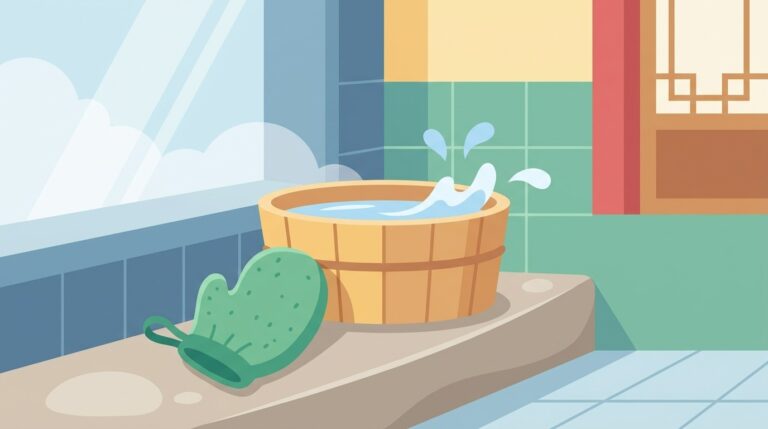
- K-Culture Moment: The Italian towel (이태리타월)—the famous green, sandpaper-like glove used for scrubbing—looks intimidating. First-timers often look at it wide-eyed and ask the therapist, “Apayo?”
- Editor’s Insight: This double-duty word can be a question (Apayo? = “Does it hurt?”) or a statement (Apayo. = “It hurts.”). If the Imo is scrubbing too hard, just say Apayo! with a little grimace. They will immediately soften their touch!
- Situation Spectrum:
- Casual: ⚠️
- Semi-formal: ✅ 아파요. (Simple and clear!)
- Formal: ⚠️
3. 살살 해주세요. (Salsal hae-juseyo.)
- Pronunciation: Sal-sal (like “sal-sa” without the ‘a’ at the end) hae-ju-se-yo.
- Meaning: “Please do it gently.”
- K-Culture Moment: When children go to the bathhouse with their parents, they often whine, “Salsal hae-juseyo!” because their skin is sensitive.
- Editor’s Insight: Salsal (살살) is a beautiful Korean mimic word (mimicking a soft, gentle action). If you have sensitive skin, say this before the scrub begins!
- Situation Spectrum:
- Casual: 🚫
- Semi-formal: ✅ 살살 해주세요. (Super polite and sweet!)
- Formal: ⚠️
Phase 3: Textbook Korean vs. Real Korean
Let’s compare what textbooks teach you versus what real Koreans actually say in the steam!
Situation 1: Asking for the service
- 📖 Textbook Korean: “전신 각질 제거 서비스를 받고 싶습니다.” (Jeonsin gakjil jegeo seobiseu-reul batgo sipseumnida. – “I would like to receive a full-body exfoliation service.”)
- 🗣️ Real Korean: “때 밀어 주세요.” (Ttae mireo juseyo. – “Please scrub my skin.”)
- 💡 Why the difference? The textbook version is way too technical, long, and sounds like a medical textbook. Real locals just ask for ttae directly!
Situation 2: Checking if it’s too strong
- 📖 Textbook Korean: “마사지 강도가 너무 강합니다.” (Masaji gangdoga neomu ganghamnida. – “The intensity of the massage is too strong.”)
- 🗣️ Real Korean: “아파요!” (Apayo! – “It hurts!”) or “살살 해주세요.” (Salsal haejuseyo. – “Gently, please.”)
- 💡 Why the difference? When you are lying on a table being scrubbed, you don’t have time for long sentences! Short, emotional words are much more effective.
Phase 4: K-Culture Deep Dive & Spa Manners
4-1. Nunchi (눈치) & Bathhouse Etiquette
- Soak First! You cannot get a scrub immediately. You must soak in the hot tub for at least 15 to 20 minutes to soften your skin (ttae). If you go straight to the table, the therapist will kindly tell you to go soak first!
- The Cue: When it is your turn, the therapist will call out your locker number or simply wave at you. Lie down on the vinyl table and completely relax. Do not try to help them lift your limbs; let your body go totally limp like noodle dough!
4-2. The Secret K-Spa Item: The Green Towel
Why is the famous scrubbing glove called an “Italy Towel” (이태리타월)? Back in the 1960s, a Korean inventor imported a viscose fabric from Italy and created this unique, textured cloth. It became an instant nationwide sensation! Today, it is a symbol of Korean home and spa culture.
Phase 5: Real-Life Roleplay Scenario
Setting: A cozy local neighborhood bathhouse (Mokyoktang). You have just soaked in the hot water for 20 minutes. You walk over to the scrub table where the experienced therapist (Imo) is waiting.
- Imo: 손님, 몇 번이세요? (Sonnim, myeot beon-iseyo?)
🎭 (Friendly, looking at your wrist key) “Customer, what is your key number?” - You: 삼십오 번이요. (Samsip-o beon-iyo.)
🎭 (Pointing to your wristband) “Number 35.” - Imo: 네, 여기 누우세요. 뜨거운 물에 많이 들어갔다 왔어요? (Ne, yeogi nu-useyo. Tteugeoun mure mani deureogatta wasseoyo?)
🎭 (Patting the vinyl table) “Okay, lie down here. Did you soak a lot in the hot water?” - You: 네, 이십 분 동안 있었어요. (Ne, isip bun dongan isseosseoyo.)
🎭 (Nodding happily) “Yes, I was in there for 20 minutes.” - Imo: (Starts scrubbing your arm vigorously) 아파요? (Apayo?)
🎭 (Curious, adjusting her grip) “Does it hurt?” - You: 조금 아파요. 살살 해주세요. (Jogeum apayo. Salsal hae-juseyo.)
🎭 (Smiling nervously) “A little painful. Please do it gently.” - Imo: 아이구, 미안해요. 이제 괜찮아요? (Aigu, mianhaeyo. Ije gwaenchanhayo?)
🎭 (Softening her strokes) “Oh, sorry. Is it okay now?” - You: 네, 시원해요! 감사합니다. (Ne, siwonhaeyo! Gamsahamnida.)
🎭 (Sighing with relief) “Yes, it feels refreshing! Thank you.”
🔀 Interactive Choice Point!
What would you say if the therapist asks you to flip over (“뒤로 누우세요”) but you didn’t understand?
* Option A: Just lay there stiffly and say nothing. (Bad: Imo will be confused!)
* Option B: Say “한 번 더 말해 주세요” (Han beon deo marhae juseyo – “Please say it once more”). (Best: Polite, clear, and gives you a chance to understand!)
* Option C: Stand up and walk away. (Risk: You will miss half of your scrub!)
Phase 6: 10-Second Emotion Shadowing Drill
Let’s practice speaking with real Korean feelings! Pay attention to the pauses (/).
- [🥺 Whining a bit because it hurts]
- 아파요! / 살살 / 해주세요.
- A-pa-yo! / Sal-sal / hae-ju-se-yo.
- [😊 Feeling incredibly refreshed after the scrub]
- 우와, / 진짜 / 시원해요!
- U-wa, / jin-jja / si-won-hae-yo!
Phase 7: K-Culture Mini Dictionary
- 세신사 (Sesinsa) | Scrub Therapist | The professional licensed specialist who skillfully exfoliates your skin.
- 이태리타월 (Itaeri Tawol) | Italy Towel | The exfoliating glove, usually bright green or yellow with black stripes.
- 목욕탕 (Mokyoktang) | Public Bathhouse | A traditional, gender-segregated neighborhood public bath.
- 시원하다 (Siwonhada) | Refreshing/Cool | Used both for cool temperatures and for that amazing, relieving feeling after a hot bath or a hard scrub.
Phase 8: Traveler’s Survival Kit
Survival Phrases TOP 3
- 얼마예요? (Eolmayeyo?) – “How much is it?” (Ask this at the counter before buying your scrub ticket).
- 감사합니다. (Gamsahamnida.) – “Thank you.” (Always say this to your therapist!).
- 등만 밀어 주세요. (Deung-man mireo juseyo.) – “Please scrub only my back.” (If you are too shy for a full-body scrub!).
Editor’s Travel Note:
To find the best local bathhouses, avoid Google Maps as it lacks updated local business details in Korea. Instead, search for “목욕탕” or “찜질방” directly on the Naver Map App to find top-rated neighborhood gems near you!
Phase 9: “Going One Step Deeper” (Reflective Thought)
In Korea, the physical act of scrubbing away old skin (ttae) represents starting fresh. Families go together to wash away the worries of the past week. It shows a level of physical comfort and communal trust that is unique to Korean society. It might feel scary to be undressed around strangers at first, but once you step in, you realize no one is judging you—everyone is just there to heal and relax.
💬 Your Turn: Would you dare to try a full-body scrub in Korea? Tell us in the comments below!
Phase 10: FAQ & Common Mistakes
Q: Can I get a scrub if I have a sunburn?
A: No, it is highly recommended to avoid a scrub if your skin is sunburned, irritated, or has open wounds. The Italy towel is abrasive!
Q: Do I need to bring my own exfoliating glove?
A: No, the therapist will use their own professional, sanitized gloves. However, you can buy colorful ones at the front desk for home use as a souvenir!
Q: Is it customary to tip the therapist?
A: No! Tipping is not part of Korean culture. You pay for the scrub service at the front reception desk (or sometimes directly to the therapist with cash/card), but no extra tip is required.
🚨 Common Mistakes Warning Board
- Mistake 1: Going to the scrub table dry.
- Correct Action: Soak in the hot tub for 15-20 minutes first!
- Mistake 2: Tensing up your muscles during the scrub.
- Correct Action: Keep your body completely relaxed like jelly.
- Mistake 3: Saying “No” when they splash water on you.
- Correct Action: Let them do it! They are washing away the exfoliated skin.
Phase 11: Action Mission!
- Bronze Mission: Practice saying “때 밀어 주세요” out loud 3 times in front of the mirror.
- Silver Mission: Share this post on Instagram and tag a friend you want to visit a K-spa with!
- Gold Mission: Pack your bags, book a ticket, visit a local Korean Jjimjilbang, and successfully order a scrub using today’s phrases!
Phase 12: Interactive Quiz Challenge
Test your new K-sauna skills!
1. Which phrase means “Please do it gently”?
- A) 때 밀어 주세요
- B) 살살 해주세요
- C) 아파요
2. True or False: You should get a body scrub immediately after walking into the bathhouse without soaking.
- True / False
🎉 Click here for Answers & Explanations!
- Correct Answer: B) 살살 해주세요. (A is to ask for the scrub, C is “it hurts”).
- Correct Answer: False. You must soak for 15-20 minutes to soften your skin, or the scrub won’t work well!







