

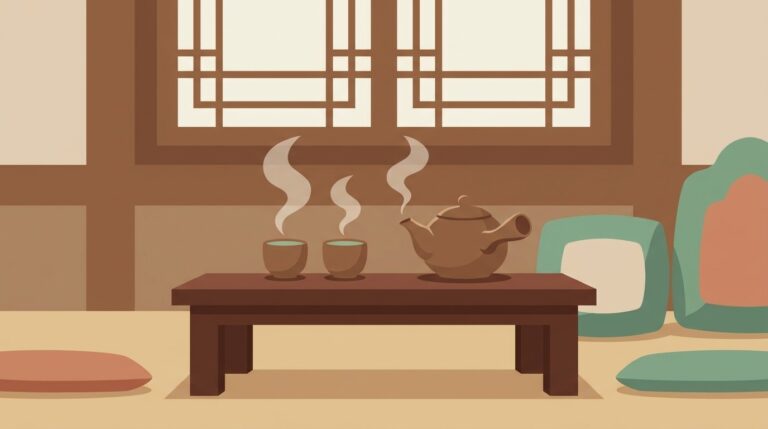
Master the Art of Korean Tea Etiquette: Sip Like a True Local
Phase 1: Empathy (An Invitation to the Quiet Side of Seoul)
안녕하세요! It’s your K-culture navigator and Daily Hangul editor. Imagine this: you’ve stepped out of the bustling, neon-lit streets of Insadong and into a wooden, clay-walled hanok (traditional house) tea place. The smell of roasted grains and mountain soil fills the air. A master in traditional hanbok places a beautiful, minimalist porcelain set before you. You want to ask how to brew the tea without sounding like a tourist, and you definitely don’t want to break any unspoken social rules.
At the C1 level, you aren’t just looking for survival Korean; you want to connect on a deeper, cultural level. Based on feedback from our global community, many advanced learners feel intimidated by the subtle gestures and refined vocabulary of the Korean tea ceremony, known as 다도 (Dado – Way of Tea). Today, we’ll make you feel right at home at the tea table!
Phase 2: Deep Dive into 3 Essential Expressions
1. 차를 우리다 (Cha-reul u-ri-da)
- Pronunciation: Cha-reul oo-ree-da (Rhymes with the “oo” in “cool” and “ri” in “ring”)
- Meaning: To steep/brew tea (literally, to extract the essence of tea leaves).
- K-Culture Moment: In historical dramas (사극, sageuk), you will often see a court lady or a scholar calmly steeping tea while discussing royal politics.
- Editor’s Insight: Do not confuse this with
끓이다(kkeul-hi-da – to boil). In Korea, you boil the water, but you steep (우리다) the tea leaves. Using this verb shows you respect the delicate nature of the leaves. - Situation Spectrum: Casual (✅) | Semi-formal (✅) | Formal (✅)
- 🤔 Think About It: Why does Korean have distinct verbs for boiling water, brewing coffee (내리다), and steeping tea (우리다)? How does this reflect the traditional view of ingredients?
2. 찻잔을 데우다 (Chat-jan-eul de-u-da)
- Pronunciation: Chat-jan-eul deh-oo-da (The ‘t’ in chat is almost silent, serving as a glottal stop: chah-jan)
- Meaning: To warm the teacup.
- K-Culture Moment: Essential in high-end traditional teahouses in Gyeongju where masters teach the art of keeping the temperature consistent.
- Editor’s Insight: Pouring hot water into a cold cup ruins the delicate flavor profile of green tea. Warming the cup first is the hallmark of a mindful host.
- Situation Spectrum: Casual (⚠️) | Semi-formal (✅) | Formal (✅)
- 🤔 Think About It: In your culture, is warming the vessel a common practice, or do we prioritize speed over temperature precision?
3. 마음을 가다듬다 (Ma-eum-eul ga-da-deum-da)
- Pronunciation: Mah-eum-eul gah-dah-deum-dah (“deum” sounds like “dumb” but with a flat Korean ‘eo’ sound)
- Meaning: To compose one’s mind/settle one’s thoughts.
- K-Culture Moment: Frequently used in modern K-Dramas when characters go on temple stays to escape the high-pressure corporate life of Seoul.
- Editor’s Insight: This phrase highlights that Dado is not just a culinary process but a meditative practice.
- Situation Spectrum: Casual (✅) | Semi-formal (✅) | Formal (✅)
- 🤔 Think About It: How does physical ritual, like pouring water, help in structuring emotional clarity in your daily life?
Phase 3: Textbook Korean vs. Real Conversational Korean
Scenario 1: Asking how long to steep the tea
- 📖 Textbook: “이 녹차는 몇 분 동안 우려야 합니까?” (How many minutes must I steep this green tea?)
- 🗣️ 진짜 한국어: “이 잎차는 한 몇 분 정도 우리면 제맛이 날까요?” (For about how many minutes should I steep these tea leaves to get the true, best flavor?)
- 💡 Why the difference? C1 speakers use
제맛(je-mat – the authentic/true flavor) and the soft ending~ㄹ까요?to sound polished, curious, and respectful of the tea’s quality rather than asking for a rigid instruction manual.
Scenario 2: Declining a refill because you are full
- 📖 Textbook: “배가 불러서 더 마실 수 없습니다.” (I cannot drink more because my stomach is full.)
- 🗣️ 진짜 한국어: “차 향을 충분히 즐겨서, 저는 요만큼만 마셔도 좋을 것 같아요.” (I have fully enjoyed the aroma of the tea, so I think even just this little bit is perfect for me.)
- 💡 Why the difference? Refusing directly can seem slightly abrupt in high-context Korean social situations. Pointing to the sensory satisfaction (
차 향) and using a soft hedge (좋을 것 같아요) lets you decline gracefully.
Phase 4: K-Culture Deep Dive & Non-Verbal Etiquette
4-1. Nunchi & Gestures: The Two-Handed Rule
When handling tea utensils, especially the small teapot (다관, dagwan) and the cups, always use both hands.
* For pouring: Place your right hand on the handle/body of the teapot, and gently place the fingers of your left hand on the lid’s knob (정, jeong) to keep it from falling.
* For drinking: Cradle the small cup with your right hand and support the bottom gently with the fingertips of your left hand. Avoid looking directly at the host while taking your first sip; instead, look slightly down at the beautiful color of the tea.
4-2. The Korean Aesthetic of “Emptying” (비움의 미학)
In traditional Korean tea culture, you never fill a cup to the brim. Typically, a cup is filled to about seven-tenths (70%) of its capacity. The remaining 30% is said to be filled with the warmth of friendship and mutual respect. This concept is closely tied to the Buddhist philosophy of letting go of greed.
Phase 5: Real-Life Roleplay Scenario
The Setting
You are visiting a beautiful mountain temple in Gangwon-do for a temple stay. You are sitting floor-to-floor with 혜원 스님 (Venerable Hyewon), a calm and wise Buddhist monk who is demonstrating the steps of traditional tea preparation.
- 스님: “어서 오세요. 먼 길 오시느라 고생하셨습니다. 차 한잔하면서 피로를 좀 푸시지요.”
(Welcome. You worked hard traveling such a long way. Let’s relieve some fatigue over a cup of tea.) - 학습자 (You): “🎭 (Gently bowing while kneeling) 초대해 주셔서 감사합니다, 스님. 산사(mountain temple)의 공기가 정말 맑네요.”
(Thank you for inviting me, Venerable. The mountain temple air is truly clear.) - 스님: “다도는 마음을 가다듬는 좋은 수행이지요. 먼저 뜨거운 물로 다관과 찻잔을 가볍게 데우겠습니다.”
(Dado is a good practice for composing the mind. First, I will lightly warm the teapot and teacups with hot water.) - 학습자 (You): “🎭 (Watching carefully) 아, 찻잔을 미리 데워 두면 차의 온도가 더 오래 유지되겠군요.”
(Ah, if you warm the teacups in advance, the temperature of the tea will be maintained longer.) - 스님: “맞습니다. 오늘 마실 차는 어린 찻잎으로 만든 세작(Sejak)입니다. 물 온도가 너무 높으면 떫은맛이 나니 한 김 식혀서 우려야 합니다.”
(Correct. The tea we are having today is Sejak, made of young tea leaves. If the water temperature is too high, it tastes astringent, so we must cool the steam down a bit before steeping.) - 학습자 (You): “🎭 (Nodding slowly) 한 김 식힌 물을 다관에 부은 뒤에는 얼마나 기다려야 하나요?”
(After pouring the slightly cooled water into the teapot, how long should we wait?) - 스님: “모래시계가 두 번 내릴 동안, 즉 일 분 반 정도가 적당합니다. 자, 한 번 잔을 받아 보시겠습니까?”
(While the hourglass runs down twice, meaning about a minute and a half, is appropriate. Now, would you like to receive a cup?) - 학습자 (You): “🎭 (Carefully raising both hands to receive the cup) 감사히 마시겠습니다. 향이 아주 그윽하네요.”
(I will drink with gratitude. The aroma is very deep and elegant.)
🔀 Interactive Choice Points
Question: The monk offers you a third cup, but you feel your stomach is too full. How do you respond?
* A) “배가 터질 것 같아서 더는 못 마시겠습니다!” (My stomach is about to burst, so I can’t drink anymore!)
* B) “스님, 정성은 감사하지만 사양하겠습니다.” (Monk, I appreciate your sincerity, but I will decline.)
* C) “차 향이 너무 좋아서 벌써 온몸이 따뜻해졌습니다. 스님 덕분에 깊은 맛을 충분히 느꼈으니 이 잔으로 족합니다.” (The tea aroma is so wonderful that my whole body has already become warm. Thanks to you, I have fully tasted its deep flavor, so this cup is enough.)
Feedback:
- A (Bad): Too raw and casual for a temple setting. It breaks the serene flow of the tea ceremony.
- B (Risk): Grammatically correct, but sounds somewhat cold and business-like in a spiritual setting.
- C (Best!): Poetic, highly respectful, and perfectly aligned with the C1 level. It expresses gratitude while politely setting a boundary.
Phase 6: 10-Second Emotion Shadowing Drill
Let’s practice advanced prosody and natural pauses (/) to convey the calm elegance of a tea room.
[😊 Gently and appreciatively]
“차 향이 / 은은해서 / 마음이 / 편안해지네요.”
(Cha hyang-i / eun-eun-hae-seo / maeum-i / pyeon-an-hae-ji-ne-yo.)
Insight: Keep your tone soft and elongated on “은은해서” (soft/subtle).-
[🤫 Humbly and respectfully]
“부족하지만 / 제가 한 번 / 차를 / 우려 보아도 / 되겠습니까?”
(Bu-jok-ha-ji-man / je-ga han beon / cha-reul / u-ryeo boa-do / doe-get-seup-ni-ka?)
Insight: Lower your vocal pitch slightly to show deep politeness when offering to brew.
Phase 7: K-Culture Mini Dictionary
- 다관 (Dagwan | 茶罐): The traditional Korean ceramic teapot, usually with a wooden or ceramic side handle.
- 숙우 (Sugu | 熟盂): The cooling bowl. Boiling water is poured here first to cool down before hitting the delicate green tea leaves.
- 세작 (Sejak | 細雀): High-grade traditional green tea harvested in early spring, meaning “sparrow’s tongue” due to the shape of the tiny leaves.
- 차우림 (Chaurim): The act of steeping tea. Often used in modern contexts to describe infusers or cozy tea cafes.
Phase 8: Traveler’s Survival Kit
Survival Phrases TOP 3
- “뜨거운 물 좀 더 리필할 수 있을까요?” (Could I get a hot water refill?)
- Pro Tip: Use this at tea houses in Insadong so you can steep your leaves a second or third time.
- “전통 다도 체험은 예약이 필수인가요?” (Is a reservation mandatory for the traditional tea ceremony experience?)
- Pro Tip: Useful for planning temple stays or cultural centers.
- “이 차는 카페인이 없는 편인가요?” (Is this tea relatively caffeine-free?)
- Pro Tip: Handy if you are sensitive to caffeine during late-night tea room visits.
Editor’s Travel Note
When you go to Korea, don’t just rely on typical tourist maps. Use the KakaoMap App to search for “전통찻집” (traditional teahouse) in neighborhoods like Samcheong-dong or Bukchon Hanok Village to find quiet spots tucked away from major roads. Please note: Opening hours for historical teahouses can change seasonally.
Phase 9: “Going Deeper” (Reflections on Korean Tea Culture)
In Western cultures, coffee is often consumed on the go, as fuel for productivity. In contrast, Korean Dado is built on the concept of 정중동 (Jeong-jung-dong): finding movement within stillness. The silence between pours is not awkward; it is an active space for mutual connection and introspection. Showing mastery of this silence is the ultimate mark of an advanced Korean speaker.
💬 Your Turn: Have you ever attended a tea ceremony? What is your favorite tea to drink when you want to settle your thoughts? Let us know in the comments below!
Phase 10: FAQ & Avoiding Misunderstandings
Q: Can I grab the teacup immediately after the host pours it?
A: It is polite to wait until the host invites you with a phrase like “차 드세요” (Please have some tea) or “드시지요” (Please enjoy). Grabbing it immediately can signal impatience.
Q: Is Korean green tea brewed at the same temperature as black tea?
A: No. Korean green teas, especially premium ones like Sejak or Ujeon, require lower water temperatures (around 60°C to 70°C). Pouring boiling water directly onto them burns the leaves and ruins the subtle sweet tones.
Q: Should I finish the tea in one gulp?
A: Absolutely not. Traditionally, you sip a single cup of tea in three steps: first, enjoy the color with your eyes; second, enjoy the aroma with your nose; third, savor the taste slowly on your tongue.
🚨 Common Mistakes Alert
- Holding the cup with only one hand: Holding the cup with one hand can look casual or even slightly disrespectful in formal settings. Correction: Support the base of the cup with your left hand.
- Blowing loudly on the tea to cool it: Making blowing sounds is considered unrefined. Correction: Let the tea cool naturally in the cup before drinking.
- Clanking utensils: Making metallic or ceramic clattering sounds with your spoon or lid is bad manners. Correction: Handle all ceramics gently and silently.
Phase 11: Action Mission
- 🥉 Bronze: Practice holding a small cup with both hands in front of your mirror while saying “향이 참 좋네요” (The aroma is really nice).
- 🥈 Silver: Post a photo of your tea or coffee on social media using the caption:
오늘 하루도 마음을 가다듬으며 화이팅! 🍵(Starting today by composing my mind, fighting!) - 🥇 Gold: Visit a traditional Korean teahouse or a tea shop in your city and order your tea using the verb
우리다instead of끓이다.
Phase 12: Interactive Quiz Challenge
1. Situational Judgment
- Question: You are served hot tea at a traditional Hanok hotel. The cup is extremely hot to the touch. What is the most polite action?
- A) Complain loudly about the temperature.
- B) Gently hold the dry outer rim of the cup with your fingers, support the base with your left hand, and wait a moment for it to cool.
- C) Pour some cold water directly into the cup.
Click here for the Answer & Explanation
Correct Answer: B
Waiting patiently for the cup to cool naturally matches the tranquil ethos of the tea ceremony. Adding cold water or complaining ruins the social harmony (Inhwa).
2. Fill-in-the-Blank
- Question: “좋은 찻잎일수록 물을 살짝 ( ) 우려야 떫은맛이 안 납니다.”
- A) 식혀서 (sik-hyeo-seo)
- B) 끓여서 (kkeul-hyeo-seo)
Click here for the Answer & Explanation
Correct Answer: A
식혀서 means “cooling down.” You must cool the water slightly so the high-quality leaves do not become bitter.
3. True or False
- Question: In Korea, filling a guest’s cup completely to the brim shows maximum generosity and deep respect. (True / False)
Click here for the Answer & Explanation
Correct Answer: False
Actually, leaving about 30% of the cup empty (비움) is traditional etiquette, showing that you leave space for feelings and conversation.







