

Step Into a Time Machine: Mastering the Charm of Korea’s ‘Nopo’ (Historic Restaurants)
안녕하세요! (An-nyeong-ha-se-yo!) Your Korean bestie and Daily Hangul’s Chief Editor is back! 👋
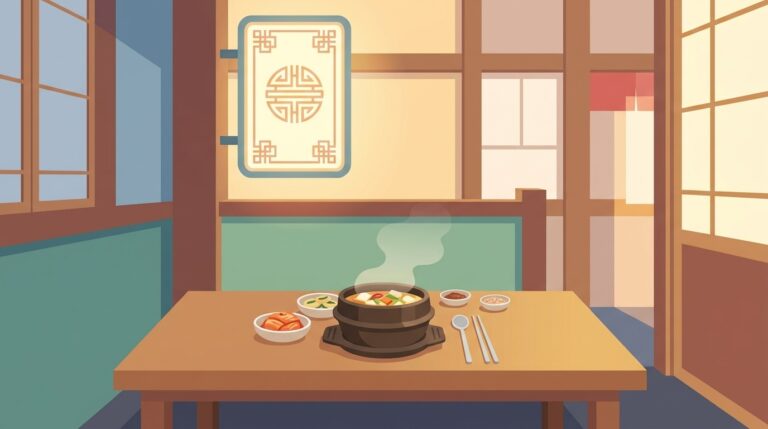
Imagine walking down a shiny, neon-lit street in Seoul. Suddenly, you turn into a narrow, dim alleyway. The smell of rich, simmering broth fills the air. You spot a faded, retro sign, sliding wooden doors, and inside, a crowd of locals laughing over steaming dishes. Welcome to a 노포 (Nopo)—a historic, decades-old restaurant that has survived the rapid waves of modernization.
But let’s be honest. For many intermediate learners, stepping into a Nopo can feel a bit intimidating. There are no English menus, no touch-screen kiosks, and the busy owner (often a fierce but warm grandma, or Imo) expects you to order with confidence.
Today, we are going to unlock the secret language of Korea’s oldest eateries. By the end of this guide, you’ll not only order like a true local but also understand the deep, soulful culture behind every bite. Let’s dive in! 🍲
Phase 2: Core Expression Deep Dive
To survive and thrive in a Nopo, you need more than just standard textbook phrases. Here are the top three expressions that will instantly make you sound like an experienced Korean foodie.
1. 여기 뭐가 제일 맛있어요? (Yeo-gi mwo-ga je-il mas-it-eo-yo?)
- Pronunciation: Yuh-gi mwo-gah jay-il mah-shi-suh-yo? (Flow like: yuh-gi-mwo-gah-jay-il-mah-shis-suh-yo?)
- Meaning: “What is the most delicious item here?” / “What’s your signature dish?”
- K-Culture Moment: You’ve probably seen this in K-Dramas when the main characters visit a local spot and want the absolute best. Instead of staring blankly at a wall menu written in hand-run calligraphy, they look the owner in the eyes and ask this confidently.
- Editor’s Insight: Nopo menus are usually short—sometimes featuring only one or two items. Asking this shows respect for their mastery. It says, “I trust your craft.”
- Situation Spectrum: Casual ✅ | Semi-formal ✅ | Formal ⚠️
- 🤔 Think About It: In your home country, do you usually ask servers for recommendations, or do you prefer deciding solely based on the menu reviews? How does asking the chef directly change the dining vibe?
2. 이모, 저희 사리 추가할게요! (I-mo, jeo-hui sa-ri chu-ga-hal-ge-yo!)
- Pronunciation: Ee-mo, juh-hui sah-ri choo-gah-hal-gay-yo! (Make sure “Imo” sounds affectionate but clear, like Ee-moh!)
- Meaning: “Auntie, we’d like to add extra noodles/toppings!”
- K-Culture Moment: In classic K-Food culture, particularly with stews like Budae Jjigae (Army Stew) or Dakgalbi (Spicy Stir-fried Chicken), adding ramen or rice cakes midway is a sacred ritual.
- Editor’s Insight: Imo literally means maternal aunt, but in a Nopo, it is the ultimate honorific for female owners. Sa-ri (사리) refers to extra noodle/topping portions. Using this shows you know the flow of a traditional Korean meal.
- Situation Spectrum: Casual ✅ | Semi-formal ✅ | Formal 🚫 (Too casual for high-end dining!)
- 🤔 Think About It: Why do you think Koreans use family terms like “Auntie” (Imo) or “Uncle” (Samchon) for restaurant staff? What does this say about the concept of community (Jeong, 情) in Korea?
3. 국물 좀 더 주실 수 있을까요? (Guk-mul jom deo ju-sil su is-seul-kka-yo?)
- Pronunciation: Gook-mool jom duh joo-shil soo ees-seul-kah-yo? (Softly roll the l sounds to sound extra polite.)
- Meaning: “Could we get a little more broth, please?”
- K-Culture Moment: In Korean drinking culture (Anju culture), keeping the soup warm and plentiful while sipping on Soju is key. A good Nopo will gladly refill your broth for free!
- Editor’s Insight: Jom (좀) means “a little,” but here it acts as a politeness cushion. Asking for a broth refill is a very natural request in Korea, but using jom makes you sound incredibly polite and natural.
- Situation Spectrum: Casual ✅ | Semi-formal ✅ | Formal ✅
- 🤔 Think About It: Free refills of side dishes and soup broth are staples of Korean hospitality. How does this compare to the extra charges often found in Western restaurants?
Phase 3: Textbook Korean vs. Real Korean
Let’s look at how textbooks teach food ordering versus how real locals talk in a noisy, vibrant Nopo.
Situation 1: Ordering the house specialty
- 📖 Textbook: “이 가게에서 가장 인기 있는 요리를 추천해 주시겠습니까?” (Can you please recommend the most popular dish in this establishment?)
- 🗣️ Real Korean: “이모, 여기 보통 뭐 많이 먹어요?” (Imo, what do people usually get here?)
- 💡 Why the difference? The textbook version is grammatically perfect but feels like an interview. In a busy Nopo, short, friendly, and direct questions get you the best service.
Situation 2: Asking for the bill
- 📖 Textbook: “계산서를 가져다주시겠습니까?” (Could you please bring me the bill?)
- 🗣️ Real Korean: “사장님, 저희 계산할게요!” (Boss, we’ll pay now!)
- 💡 Why the difference? In Korea, you rarely wait at the table for a bill to be brought to you. Instead, you call out that you are ready to pay and usually walk up to the counter near the exit.
Phase 4: K-Culture Deep Dive & Non-Verbal Manners
4-1. The Art of “Nunchi” (눈치) in a Nopo
In an old-school diner, space is tight. You might be sharing a long table with strangers, or sitting on the floor (On-dol).
* The Gesture: When calling the owner, do not raise your hand high and wave aggressively. Instead, make eye contact, raise your hand slightly to chest level, and say “사장님!” (Sa-jang-nim! / Boss!) with a warm smile.
* Space Etiquette: If the place is packed, keep your bags tucked under your stool or chair. If you see someone trying to squeeze past, lean in to make space. This silent cooperation is highly appreciated.
4-2. The Soul of “Jeong” (정) in Old Alleys
Why do young Koreans flock to rusty, faded Nopo instead of modern cafes? It’s because of 정 (Jeong)—a deep feeling of attachment, warmth, and shared history. In a Nopo, the plates might not match, and the floor might creak, but the food is made with a grandmother’s devotion. Eating here is a cultural rebellion against fast-paced, digital life.
Phase 5: Real-Life Roleplay Scenario
Setting: Mapo Jin-jja Seolleongtang (A legendary, 50-year-old Ox Bone Soup place).
NPC: Grandma Kim (72, the passionate owner who loves chatty customers but hates wasted food).
[Scene: Steam rising from a giant iron pot near the entrance. You walk in.]

Grandma Kim: 어서 와요! 몇 명이야?
(Eo-seo wa-yo! Myeot myeong-i-ya?)
"Welcome! How many of you?"

Learner: [😊 Nodding politely] 두 명이요! 이모, 저희 어디 앉을까요?
(Du myeong-i-yo! I-mo, jeo-hui eo-di an-jeul-kka-yo?)
"Two people! Imo, where should we sit?"

Grandma Kim: [👉 Points to a small corner table] 저기 구석에 편하게 앉아.
(Jeo-gi gu-seok-e pyeon-ha-ge an-ja.)
"Sit comfortably over there in the corner."

Learner: [🪑 Sitting down] 감사합니다! 이모, 여기 보통 뭐 많이 먹어요?
(Gam-sa-ham-ni-da! I-mo, yeo-gi bo-tong mwo man-i meog-eo-yo?)
"Thank you! Imo, what do people usually order here?"

Grandma Kim: [💪 Proudly pats her chest] 우리 집은 설렁탕이지! 보통으로 줄까, 특으로 줄까?
(U-ri jib-eun seol-leong-tang-i-ji! Bo-tong-eu-ro jul-kka, teuk-eu-ro jul-kka?)
"Our house specialty is Seolleongtang! Should I give you regular or large/premium?"

Learner: [🥄 Setting up chopsticks] 특 하나랑 보통 하나 주세요! 그리고 사리도 추가할게요.
(Teuk ha-na-rang bo-tong ha-na ju-se-yo! Geu-ri-go sa-ri-do chu-ga-hal-ge-yo.)
"One premium, one regular, please! And we'd like to add extra noodles too."

Grandma Kim: [😄 Chuckling] 아이구, 먹을 줄 아네! 금방 갖다 줄게.
(Ai-gu, meog-eul jul a-ne! Geum-bang gat-da jul-ge.)
"Aigo, you really know how to eat! I'll bring it right out."

Learner: [🙌 Bowing slightly] 네, 기대돼요! 맛있게 해주세요.
(Ne, gi-dae-dwae-yo! Mas-it-ge hae-ju-se-yo.)
"Yes, I'm excited! Please make it delicious."
🔀 Interactive Choice Point
Your soup arrives, but you notice there is no salt in it (traditional Seolleongtang comes unsalted so you can season it yourself). What do you do?
- A) Add a mountain of salt and pepper without tasting it first.
- Feedback (Bad): Grandma Kim might sigh. In Korea, always taste the broth first, then add salt gradually! Use: “먼저 국물 맛볼게요.” (I’ll taste the broth first.)
- B) Wave and shout “저기요! 싱거워요!” (Excuse me! This is bland!)
- Feedback (Risk): This sounds a bit rude. It’s meant to be bland so you can customize it!
- C) Politely ask for salt if it’s not on the table: “이모, 소금 좀 주실 수 있을까요?”
- Feedback (BEST): Perfect. It shows you know the food culture and respects the cooking process.
Phase 6: 10-Second Emotion Shadowing Drill
Let’s practice speaking with real Korean emotion! Focus on the rhythm and pauses (/).
- [😋 Excited and Hungry]
이모! / 여기 / 보통 뭐 / 많이 먹어요?
(Ee-mo! / Yeo-gi / bo-tong mwo / man-i meog-eo-yo?) -
[🙏 Super Polite Request]
사장님, / 국물 좀 / 더 주실 수 / 있을까요?
(Sa-jang-nim, / guk-mul jom / deo ju-sil su / is-seul-kka-yo?) -
[💖 Warm Appreciation to Owner]
진짜 / 잘 먹었습니다! / 또 올게요!
(Jin-jja / jal meog-eot-seum-ni-da! / Tto ol-ge-yo!)
Phase 7: K-Culture Mini-Dictionary
- 노포 (Nopo | No-po): Historic, long-running restaurants that often look outdated but serve legendary food.
- 사리 (Sari | Sah-ri): Toppings like noodles, rice cakes, or dumplings added to stews/soups.
- 이모 (Imo | Ee-moh): Maternal aunt; used affectionately to call female staff in casual eateries.
- 국물 (Gukmul | Gook-mool): Broth/soup. Vital in Korean dining, often refilled for free.
Phase 8: Survivor Kit for Travelers
Survival Phrases TOP 3
- “여기 한 명 더 앉아도 돼요?” (Yeo-gi han myeong deo an-ja-do dwae-yo?)
- Pro Tip: “Can one more person sit here?” Essential for crowded shared tables.
- “이거 앞접시 좀 주세요.” (I-geo ap-jeop-si jom ju-se-yo.)
- Pro Tip: “Please give me a small sharing plate.” Great for sharing big dishes.
- “이모, 남은 거 포장 돼요?” (I-mo, nam-eun geo po-jang dwae-yo?)
- Pro Tip: “Can I pack the leftovers?” Note: some very old Nopo might not have takeout containers, but it’s always worth asking!
Editor’s Travel Note
Before heading out, make sure to download the Naver Map App or KakaoMap. Google Maps is famously unreliable for walking directions in Korea’s tiny alleys. Nopo are often hidden in winding pathways where GPS can glitch—keep your eyes open for old, weathered signs!
(Note: Street conditions and operating hours of old shops can change without prior notice.)
Phase 9: “Going Deeper” (Thought Provoking)
In Western dining, the goal of a restaurant is often to provide a private, undisturbed space for the diner. In Korea’s Nopo, however, dining is a shared, communal experience. You sit close to strangers, hear the clinking of Soju glasses from the next table, and chat casually with the owner. It represents a culture that values shared warmth over strict boundaries.
💬 Your Turn: Would you feel comfortable eating in a crowded restaurant sharing a table with strangers? Let me know in the comments below!
Phase 10: FAQ & Misconceptions
Q: Can I pay with credit cards at historic Nopos?
A: Generally, yes! South Korea is highly cashless. However, some very small, ancient Nopo run by elderly owners might prefer cash or bank transfers. It is always wise to keep 10,000 to 20,000 KRW in cash just in case.
Q: Is it okay to stay long and talk after finishing the meal?
A: If there is a long line outside (which is common for famous Nopo), it is polite to pay and leave shortly after eating so others can sit. This is called K-Manners!
Q: Can I order just one portion of a stew?
A: Many Nopo hotpot/stew places require a minimum of 2 portions (indicated as 2인분 이상 주문 가능 on the menu). If traveling solo, look for soup-based dishes (gukbap) instead!
🚨 Common Mistakes Board
- Mistake 1: Waiting at the table for the bill.
- Correct Action: Take your table tag or simply walk up to the cash register to pay.
- Mistake 2: Calling a young server “Imo”.
- Correct Action: Use “저기요” (Excuse me) or “사장님” (Boss) instead. “Imo” is strictly for middle-aged or older female staff.
- Mistake 3: Not using the spoon for soup.
- Correct Action: In Korea, do not lift the bowl to drink soup directly. Use your spoon!
Phase 11: Action Mission
- 🥉 Bronze: Read the core expressions aloud 5 times in front of a mirror with the emotion indicators.
- 🥈 Silver: Take a screenshot of a Nopo scene from your favorite K-Drama, and identify what food they are eating.
- 🥇 Gold: When you visit Korea, find a Nopo in Euljiro or Mapo, ask the owner “여기 뭐가 제일 맛있어요?”, and share your delicious success story on Instagram tagging
#DailyHangul!
Phase 12: Interactive Quiz Challenge
Test your Nopo survival skills!
1. What does the term “사리” (Sari) refer to?
a) Chopsticks
b) The bill
c) Extra toppings like noodles or rice cakes
2. True or False: You should wait for the server to bring the bill to your table at a busy Nopo.
Click here to check the answers!
- Answer: c) Sari is the magic word for adding ramen, glass noodles, or tteokbokki toppings to your soup!
- Answer: False. In Korea, you should walk up to the front counter/register to pay your bill after you finish eating.







