

Master the Art of Korean TRPGs: Strategic Expressions for Immersive Roleplay
Phase 1: Empathy (Story-Driven Opening)
안녕하세요! (Annyeonghaseyo!) It’s your K-Culture Navigator and favorite Korean study buddy from Daily Hangul!
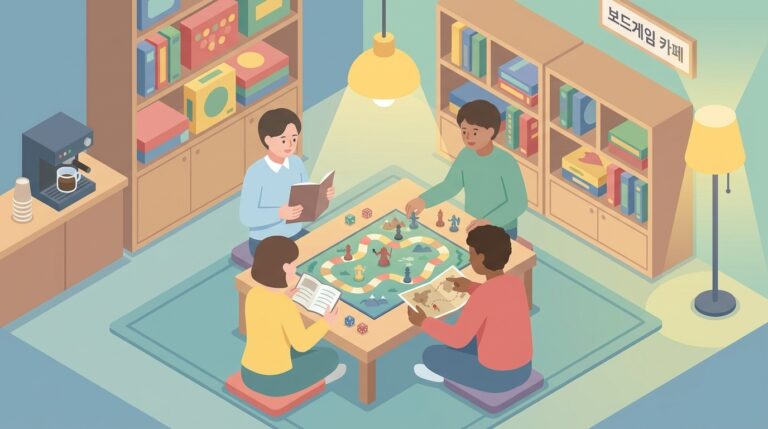
Imagine this: You’ve been invited to a cozy board game café in Hongdae by your new Korean friends. The neon lights outside are buzzing, the aroma of sweet Dalgona lattes fills the air, and on the table lies a beautifully designed TRPG (Tabletop Role-Playing Game) rulebook. Your friends are excitedly creating their characters, laughing and throwing around terms like “캐붕” (character collapse) and “과몰입” (over-immersive state).
Suddenly, the Game Master (GM) looks at you and asks: “이번 턴에 어떤 행동을 취하시겠어요?” (What action will you take this turn?)
Your heart races. You know exactly what strategic move you want to make in English, but how do you express a complex, tactical decision in natural C1-level Korean without sounding like a robotic translation tool? Translating your strategy word-for-word often kills the dramatic tension and ruins the immersion of roleplay.
Don’t worry! Today, we are going to dive deep into the world of Korean TRPGs and strategic board gaming. Based on feedback from our premium learners who struggled to blend into local gaming groups, we’ve put together the ultimate guide to help you sound like a seasoned Korean tactician. Let’s get into character!
Phase 2: Deep Dive into 3 Essential Expressions
To command the table and strategize effectively, you need more than just textbook grammar. Here are three high-level expressions that will make you sound incredibly natural and tactically sharp.
1. 허점을 노리다 (Heojeomeul norida)
- Pronunciation: Heo-jeom-eul no-ri-da (Sounds like “her-jum-eul no-ree-da”)
- Meaning: To exploit a loophole / To target a blind spot or weakness
- K-Culture Moment: You’ll hear this constantly in Korean historical dramas (사극) when military strategists plan an ambush, or in modern K-Dramas like Squid Game where characters analyze the rules to find a winning loophole.
- Editor’s Insight: “허점” (heojeom) refers to a flaw, gap, or weakness in defense. “노리다” means to aim for or keep an eye on. In TRPGs, use this when you notice the enemy boss has lowered their guard or when the GM leaves a loophole in their scenario design.
- Situation Spectrum: Casual (✅) / Semi-formal (✅) / Formal (⚠️ – Use 허점을 공략하다 in formal business strategy contexts)
- 🤔 Think About It: How does your native language describe taking advantage of a tactical gap? Is it as visual as “aiming for an empty point” (허점)?
2. 판을 짜다 (Paneul jjada)
- Pronunciation: Pan-eul jja-da (Sounds like “pahn-eul jah-da”)
- Meaning: To set the stage / To orchestrate a scheme / To lay out a grand strategy
- K-Culture Moment: In K-Pop survival shows, viewers often praise clever contestants for “판을 잘 짠다” (setting up a great narrative/strategy to win votes).
- Editor’s Insight: “판” (pan) represents the game board, the scene, or the entire situation. “짜다” means to weave or frame. When you say “판을 짜다,” you aren’t just making a single move; you are masterminding the entire flow of the game.
- Situation Spectrum: Casual (✅) / Semi-formal (✅) / Formal (🚫)
- 🤔 Think About It: Why do you think Korean uses the word for “weaving a board” to describe strategic planning? Think about how it implies interconnectedness.
3. 판세를 뒤흔들다 (Panseeul dwiheundeulda)
- Pronunciation: Pan-se-eul dwi-heun-deul-da (Sounds like “pahn-seh-eul dwee-heun-deul-da”)
- Meaning: To shake up the game / To turn the tables / To completely shift the power dynamic
- K-Culture Moment: Frequently used in Korean political thrillers or sports commentary when an underdog makes a game-changing move.
- Editor’s Insight: “판세” (panse) is the current state of affairs or the momentum of the game. “뒤흔들다” means to shake violently. Use this when you are about to execute a high-risk, high-reward move (like casting a massive AoE spell or revealing a hidden plot twist) that changes everything.
- Situation Spectrum: Casual (✅) / Semi-formal (✅) / Formal (✅)
- 🤔 Think About It: Contrast this with “turning the tables.” While the English idiom suggests reversing positions, the Korean term focuses on shaking the entire structural foundation of the situation.
Phase 3: Textbook Korean vs. Real-World Korean
Let’s look at how standard dictionary expressions compare to the vivid language actual Korean gamers use at the table.
Situation 1: Proposing a coordinated team attack
- 📖 Textbook Korean: “우리는 함께 공격해야 합니다.” (We must attack together.)
- 🗣️ Real-World Korean: “이번 턴에 합을 맞춰서 들어가야 해요.” (We need to synchronize our timing/actions and go in this turn.)
- 💡 Why the difference? “합을 맞추다” originally comes from martial arts choreography, meaning to sync actions perfectly. It shows deep tactical coordination rather than just a simple “attack.”
Situation 2: Expressing that a plan is too risky
- 📖 Textbook Korean: “이 계획은 너무 위험합니다.” (This plan is too dangerous.)
- 🗣️ Real-World Korean: “이건 너무 무리수를 두는 것 같아요.” (I feel like this is placing a bridge too far / playing an overly risky move.)
- 💡 Why the difference? “무리수” (murisu) is a term from the ancient strategy game of Go (바둑). It refers to a bad, overreaching move that invites disaster. It sounds much more strategic than the generic “위험하다.”
Phase 4: K-Culture Deep Dive & Non-Verbal Manners
4-1. Nunchi (눈치) & Table Manners
In Korean TRPG circles, being a good player is all about “팀플레이” (Team play) and “배려” (consideration).
* The Nod of Agreement: When another player is explaining their complex backstory or strategy, lean in slightly, make eye contact, and nod while saying “아~ 그렇구나” (Ah, I see). This shows you are actively co-creating the story.
* Dice Etiquette: Never roll your dice before the GM asks you to. Doing so is seen as rushing the narrative and lacking “눈치” (situational awareness).
4-2. The Rise of “TTRPG” Culture in Korea
While board game cafés have been a staple of Korean youth culture since the early 2000s, TTRPGs (called TRPGs in Korea) have exploded in popularity recently through online actual-play channels on YouTube and Twitch. Shows featuring voice actors roleplaying complex scenarios have made “과몰입” (deep emotional immersion) a badge of honor among Gen Z gamers.
Phase 5: Real-Life Roleplay Scenario
Setting: A dark dungeon room. The party is facing a giant stone golem guarding a mysterious portal.
Characters:
* 민우 (Min-woo – GM): Descriptive and intense.
* 지아 (Ji-a – Rogue): Agile and opportunistic.
* You (Wizard): The tactical mastermind of the party.
민우 (GM): [👁️ 매섭게 눈을 빛내며] 골렘이 거대한 석조 주먹을 들어 올립니다. 다음 타겟은 지아님입니다. 어떻게 하시겠습니까?
(The golem raises its giant stone fist. The next target is Ji-a. What would you like to do?)
지아 (Rogue): [😨 잔뜩 긴장한 목소리로] 앗, 제 체력으로는 저 주먹 한 방이면 바로 비명횡사예요! 마법사님, 도와주세요!
(Ah, with my HP, one hit from that fist and I'm instantly dead! Wizard, help me!)
You: [🧠 차분하게 테이블을 내려다보며] 걱정 마세요. 제가 이번 턴에 판세를 뒤흔들어 볼 테니까요.
(Don't worry. I will try to shake up the game this turn.)
민우 (GM): [😏 흥미롭다는 듯이] 오, 어떤 마법을 준비하시려고요? 주문 슬롯은 다 쓰시지 않았나요?
(Oh, what magic are you preparing? Didn't you use up all your spell slots?)
You: [🧙♂️ 미소를 지으며] 대신 지형지물을 이용하겠습니다. 저 천장의 고대 마법 수정이 보입니다. 골렘의 머리 위에 있죠?
(Instead, I'll use the terrain features. I see the ancient magic crystal on the ceiling. It's right above the golem's head, right?)
민우 (GM): [😲 무릎을 탁 치며] 아! 천장의 수정 수정을 조준하시겠다는 거군요?
(Ah! You mean you're going to aim for the ceiling crystal?)
You: [🔥 단호하게] 맞습니다. 골렘의 방어력이 높지만, 위쪽의 낙하 데미지까지는 방어하지 못할 겁니다. 바로 그 허점을 노리겠습니다!
(Correct. The golem's defense is high, but it won't be able to defend against falling damage from above. I will target exactly that blind spot!)
지아 (Rogue): [🙌 안도의 한숨을 쉬며] 역시! 판을 짜는 실력이 보통이 아니시네요. 믿고 대기하겠습니다!
(As expected! Your ability to set the stage is no joke. I'll trust you and standby!)
🔀 Interactive Branching Decision
The GM asks you to roll for your spell accuracy. You rolled a mediocre number. How do you respond to keep the narrative favorable?
* A) “제 운명은 여기까지인가 봐요. 그냥 맞을게요.” (I guess this is my fate. I’ll just take the hit.)
* B) “혹시 협동 보너스나 지형적 이점을 활용해서 보정치를 얻을 수 있는 판을 짤 수 있을까요?” (Is there any way we can set the stage to get a modifier by utilizing a cooperative bonus or environmental advantage?)
* C) “에이, 주사위가 이상해요. 다시 던지게 해주세요!” (Hey, the dice are weird. Let me roll again!)
🔀 Feedback:
- Best (B): Brilliant! Using “판을 짜다” to ask the GM for tactical negotiation fits the C1 level perfectly and keeps the cooperative spirit alive.
- Bad (C): Avoid this. Demanding a re-roll breaks table manners and shows a lack of respect for the rules.
- Risk (A): While realistic, it shuts down the tactical discussion too early without exploring other strategic options.
Phase 6: 10-Second Emotion Shadowing Drill
Practice saying these with the exact emotional intonation noted. Pay attention to the pauses (/).
[🧠 Extremely confident and calm]- 이번 턴에 / 판세를 뒤흔들어 / 보겠습니다.
- I-beon teon-e / pan-se-eul dwi-heun-deul-eo / bo-get-seum-ni-da.
[🔥 Focused and sharp]- 상대의 / 허점을 노리는 것이 / 유일한 해결책입니다.
- Sang-dae-ui / heo-jeom-eul no-ri-neun geo-si / yu-il-han hae-gyeol-chaek-im-ni-da.
Phase 7: K-Culture Mini-Dictionary
- 과몰입 (Gwa-mol-ip): Over-immersion. When you get so into your TRPG character that you actually feel their sadness or anger.
- 룰치킨 (Rul-chi-kin): Rule Lawyer. A player who strictly clings to the literal wording of the rules to gain an advantage, often ruining the fun.
- 캐붕 (Kae-bung): Character Collapse. Short for 캐릭터 붕괴. Acting out of character or breaking the established personality of your role.
- 세션 (Se-syeon): Session. A single gaming meeting or playthrough of a TRPG scenario.
Phase 8: Survivor Kit for Travelers
Survival Expressions TOP 3
- 이거 규칙이 어떻게 되나요? (I-geo gyu-chik-i eo-tteo-ke doe-na-yo?)
- Pro Tip: Ask this when joining a game midway. It translates to “What are the rules for this?”
- 제 차례인가요? (Je cha-rye-in-ga-yo?)
- Pro Tip: Use this to politely ask “Is it my turn?”
- 협동 플레이 해봐요! (Hyeop-dong peul-le-i hae-bwa-yo!)
- Pro Tip: “Let’s do some cooperative play!”
🗺️ Editor’s Travel Note:
To find local board game cafes or open TRPG communities in Seoul, search for “보드게임 카페” on the Naver Map App. Many premium cafes in Sinchon and Hongdae host open tables for newcomers!
Phase 9: A Step Deeper (Cultural Insight)
In Korean culture, the phrase “판을 짜다” is not just confined to games. It reflects a collective mindset that values structural preparation and long-term harmony over individual impulsive moves. When playing games with Koreans, you will notice that they highly value the “그림” (the overall picture/aesthetic of the play) over simply winning.
💬 Your Turn: Have you ever played a tabletop role-playing game or a highly strategic board game? How does your culture view strategic planning compared to individual spontaneity? Let us know in the comments below!
Phase 10: FAQ & Common Mistakes
Q: Can I use “허점을 노리다” in everyday conversations?
A: Yes! It is incredibly versatile. You can use it when discussing business strategies (e.g., finding a niche market), sports, or even when playing a casual video game with friends.
Q: What is the difference between “판을 짜다” and “계획을 세우다”?
A: “계획을 세우다” (to make a plan) is general and personal. “판을 짜다” implies setting up a larger, dynamic system or environment that involves influencing other people’s actions and movements.






