

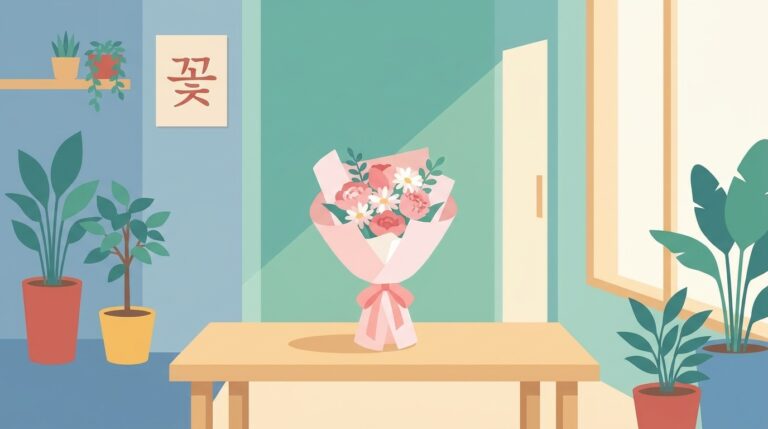
Flower Bouquets in Korea: How to Gift Flowers Like a K-Drama Lead
Phase 1: Empathy (스토리 몰입형 오프닝)
안녕하세요! (Annyeonghaseyo! – Hello!) I’m your Daily Hangul editor and your personal Korean culture guide! ‐‐
Imagine this: You are walking down the vibrant streets of Hongdae or Gangnam, and you see beautiful, aesthetic flower shops with bouquets wrapped in delicate pastel papers. You want to buy one for a friend’s graduation, a host’s dinner invitation, or maybe even a romantic date. But as you step closer, your heart races. How do I ask for a nice bouquet without sounding like a textbook robot? What if I choose the wrong flowers?
Don’t worry! Gifting flowers (‘꺼ᅢ다발’ – kkotdabal) in Korea is a beautiful, highly stylized art. This guide is built from real-world questions from A1 learners just like you, designed to give you the exact words and cultural confidence to buy flowers like a true local!
Phase 2: Key Expressions (핵심 표현 3선 심층 분석)
1. 꺼ᅢ다발 하나 꺼ᅦ더새버.
- Pronunciation: Kkotdabal hana kkumyeojuseyo. (Sounds like: Kkot-dah-bal hah-nah kkoo-myuh-joo-seh-yo)
- Meaning: Please make/decorate a flower bouquet for me.
- K-Culture Moment: This is the magic phrase used in almost every romance K-Drama when the lead actor rushes into a florist shop right before a big confession scene.
- Editor’s Insight: While textbook Korean might teach you ‘꺼ᅢ다발가 사고 시퍼어요’ (I want to buy a bouquet), saying ‘꺼ᅦ더새버’ (Please wrap/decorate it beautifully) signals that you appreciate the florist’s artistic skill.
- Situation Spectrum: Casual ⚠️ | Semi-formal ✅ | Formal ✅
- 히어 Think About It: In many Western countries, people often buy loose flowers and arrange them at home. In Korea, professional wrapping (포장 – pojang) is considered a key part of the gift’s respect and sincerity. How does this compare to your country?
2. 어프게 포장해저새버.
- Pronunciation: Yeoppeuge pojanghaejuseyo. (Sounds like: Yuh-ppeu-geh poh-jahng-hae-joo-seh-yo)
- Meaning: Please wrap it prettily.
- K-Culture Moment: You will hear this everywhere in Seoul’s stylish flower shops. Korean florists are world-famous for their layering of translucent paper and elegant ribbons.
- Editor’s Insight: The word ‘거프게’ means “prettily” or “beautifully.” It is an active way of showing trust in the florist’s aesthetic taste.
- Situation Spectrum: Casual ✅ | Semi-formal ✅ | Formal 🚫
- 히어 Think About It: Why is presentation so crucial when giving gifts in Korea? It shows “Jeong” (정 – deep affection) and respect for the recipient.
3. 선물할 거예요.
- Pronunciation: Seonmulhal geoyeyo. (Sounds like: Sun-mool-hal guh-yeh-yo)
- Meaning: It’s going to be a gift.
- K-Culture Moment: Usually said when the florist asks who the flowers are for, so they can choose the right color palette and message card.
- Editor’s Insight: This short phrase automatically prompts the florist to offer you a tiny complimentary card (메시지 카드 – meseji kadeu) to write a sweet note.
- Situation Spectrum: Casual ✅ | Semi-formal ✅ | Formal ✅
- 히어 Think About It: Sharing your intention helps build a warm, micro-connection with the shop owner.
Phase 3: Textbook vs. Real Korean (교과서 vs. 진짜 한국어)
Situation 1: Asking for a bouquet
- 효과서 하ᄂ구거 (Textbook): “꺼ᅢ다발가 이스반니가?” (Do you have a flower bouquet?)
- 신자 하ᄂ구거 (Real Life): “꺼ᅢ다발 하ᄂ나 해저새버.” (Could you make me a flower bouquet?)
- 히ᅥ 다를까? (Why is it different?): Asking if they “have” bouquets sounds like they are pre-made objects. Florists prefer to assemble fresh arrangements on the spot, so asking them to “make” (해저새버) one is more natural.
Situation 2: Expressing your budget
- 효과서 하ᄂ구거 (Textbook): “가개ᄀ은 삼만 원이바니다.” (The price is 30,000 KRW.)
- 신자 하ᄂ구거 (Real Life): “삼만 원 마춘어로 해저새버.” (Please make it to fit 30,000 KRW.)
- 히ᅥ 다를까? (Why is it different?): ‘마춘어로’ means “matching the budget of.” It is the standard, polite way to customize your flowers without feeling awkward about money.
Phase 4: K-Culture Deep Dive & Non-Verbal Manners (비언어적 매너)
4-1. Nunchi (눈치) & Gestures
- The Two-Handed Hand-off: When you receive the finished bouquet from the florist or hand it to your friend, always use both hands. Using one hand can seem casual or dismissive.
- A Slight Bow: A gentle head nod accompanied by a warm smile makes the gift feel twice as heartfelt.
4-2. Cultural Code: Yellow Roses & Red Carnations
- In Korea, flower meanings (꺼ᅢ말 – kkotmal) are popular! Be careful: Yellow roses can signify jealousy or friendship, while red carnations are strictly saved for Parents’ Day (어배니날 – eobeoninal) or Teachers’ Day in May.
Phase 5: Real-life Roleplay Scenario (실전 롤플레이)
Setting: A cozy, modern flower shop near Ehwa Womans University station.
Characters:
* You: A warm-hearted visitor wanting a beautiful gift.
* Sora (소라): The friendly florist wearing a linen apron.
Sora: 어서오세요! 어떤 꽃 찾으세요?
      (Eoseo-oseyo! Eotteon kkot chajuseyo?)
      [🎭 Smiling warmly behind the counter]
      "Welcome! What kind of flowers are you looking for?"

You:  꽃다발 하나 꾸며주세요.
      (Kkotdabal hana kkumyeojuseyo.)
      [🎭 Looking around at the fresh flowers]
      "Please make a flower bouquet for me."

Sora: 네, 특별히 원하시는 색상이 있으세요?
      (Ne, teukbyeolhi wonhasineun saeksangi isseuseyo?)
      [🎭 Holding a bunch of soft pink roses]
      "Sure, do you have a specific color in mind?"

You:  분홍색이랑 하얀색으로 해주세요.
      (Bunhongsaegirang hayansaeguro haejuseyo.)
      [🎭 Pointing gently to the pink and white flowers]
      "Please do it with pink and white."

Sora: 네, 아주 예쁘겠네요. 누구한테 주실 거예요?
      (Ne, aju yeppeugentneyo. Nugu-hante jusil geoyeyo?)
      [🎭 Gathering the flowers on the table]
      "Yes, that will look very pretty. Who is it for?"

You:  친구한테 선물할 거예요.
      (Chingu-hante seonmulhal geoyeyo.)
      [🎭 Smiling warmly]
      "It's going to be a gift for my friend."

Sora: 포장은 어떻게 해드릴까요?
      (Pojangeun eotteoke haedeurilkkayo?)
      [🎭 Showing pastel wrapping papers]
      "How would you like the wrapping?"

You:  예쁘게 포장해주세요. 감사합니다!
      (Yeppeuge pojanghaejuseyo. Gamsahamnida!)
      [🎭 Offering a slight polite bow]
      "Please wrap it prettily. Thank you!"
🔀 Choose Your Path!
What will you say when paying?
* A) “이거 얼마예요?” (Igeo eolmayeyo? – How much is this?)
* Feedback (Best): Direct, highly natural, and standard for everyday transactions!
* B) “돈 여기 있습니다.” (Don yeogi isseumnida. – Here is the money.)
* Feedback (Bad): Too rigid and slightly unnatural. Instead, just hand over your card with both hands and say “카드요” (Kadeuyo – Card, please).
* C) “깎아주세요!” (Kkakkajuseyo! – Please give me a discount!)
* Feedback (Risk): Avoid this in modern boutique flower shops. Prices are fixed and bargaining might feel impolite here.
Phase 6: 10-Second Emotion Shadowing Drill (섀도잉 드릴)
Practice reading these out loud with the correct feeling! The slash / represents a tiny pause.
- [😊 Excited & Bright]
*
Frequently Asked Questions (FAQ)
Q: What does "꺼ᅢ다발 하나 꺼ᅦ더새버." mean in Korean and how do you pronounce it?
A: In Korean, "꺼ᅢ다발 하나 꺼ᅦ더새버." is pronounced [Kkotdabal hana kkumyeojuseyo. (Sounds like: Kkot-dah-bal hah-nah kkoo-myuh-joo-seh-yo] and means: Please make/decorate a flower bouquet for me.
Q: What does "어프게 포장해저새버." mean in Korean and how do you pronounce it?
A: In Korean, "어프게 포장해저새버." is pronounced [Yeoppeuge pojanghaejuseyo. (Sounds like: Yuh-ppeu-geh poh-jahng-hae-joo-seh-yo] and means: Please wrap it prettily.
Q: What does "선물할 거예요." mean in Korean and how do you pronounce it?
A: In Korean, "선물할 거예요." is pronounced [Seonmulhal geoyeyo. (Sounds like: Sun-mool-hal guh-yeh-yo] and means: It's going to be a gift.







