

Master the Korean Laundromat: How to Choose the Perfect Wash Cycle Like a Local!
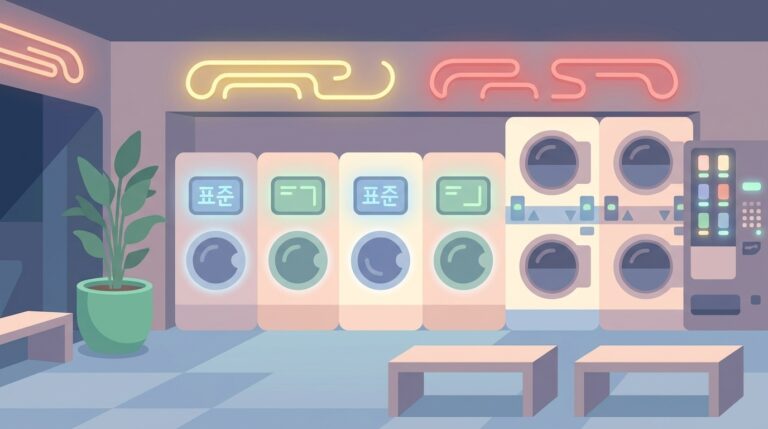
안녕하세요! (An-nyeong-ha-se-yo!) I’m your Daily Hangul editor and your personal K-life navigator. Have you ever stood frozen in front of a high-tech Korean washing machine at a 24-hour coin laundry (빨래방 – ppal-lae-bang), holding a basket of dirty clothes, staring at a screen full of options like ‘표준’, ‘찌든 때’, or ‘섬세’?
Don’t worry! You aren’t the first to feel overwhelmed. One of our learners, Sarah, once wanted to wash her delicate knit sweaters but accidentally selected the heavy-duty ‘high temp’ cycle because she just pressed the biggest glowing button. Her sweaters came out fitting her teddy bear instead! Today, we will make sure that never happens to you. By the end of this guide, you’ll navigate Korean laundromat screens like a pro.
Phase 2: Key Expressions Deep Dive
1. 표준코스로 해 주세요. (Pyo-jun-ko-seu-ro hae ju-se-yo.)
- Pronunciation: Pyo-jun-ko-seu-ro (sounds like “pure-june-course-ro”) hae ju-se-yo.
- Meaning: Please set it to the standard cycle.
- K-Culture Moment: You’ll see this option highlighted in bright green or blue on almost every laundromat touch screen. It’s the ‘default’ setting that K-drama characters use when they are doing their weekly chores.
- Editor’s Insight: ‘표준’ (Pyo-jun) means “standard” or “normal”. If you are washing regular t-shirts, jeans, and socks, just touch this button. Adding ‘로 해 주세요’ (-ro hae ju-se-yo) is a polite way of saying “Please do it via/with…”
- Situation Spectrum: Casual ✅ | Semi-formal ✅ | Formal ⚠️
- 🤔 Think About It: In Korea, efficiency is highly valued. Why do you think most laundromats default to a 35-minute “Standard” cycle compared to longer cycles in other countries?
2. 온수로 선택할게요. (On-su-ro seon-taek-hal-ge-yo.)
- Pronunciation: On-su-ro (sounds like “on-sue-ro”) seon-taek-hal-ge-yo (sounds like “sun-teck-hal-ge-yo”).
- Meaning: I will select hot/warm water.
- K-Culture Moment: In winter, selecting ‘온수’ (Warm/Hot water) is essential for getting oily food stains (like K-BBQ or Tteokbokki sauce) out of your clothes.
- Editor’s Insight: ‘온수’ (On-su) literally means “warm/hot water” (溫水). If you want cold water to prevent shrinking, look for ‘냉수’ (Naeng-su / 冷水).
- Situation Spectrum: Casual ✅ | Semi-formal ✅ | Formal 🚫
3. 섬세 의류는 어떻게 해요? (Seom-se ui-ryu-neun eo-tteo-ke hae-yo?)
- Pronunciation: Seom-se (“sum-say”) ui-ryu-neun (“we-ryu-nun”) eo-tteo-ke hae-yo? (“uh-tuh-kay hey-yo”).
- Meaning: How do I wash delicate clothes?
- K-Culture Moment: If you bought beautiful, delicate clothes from shopping districts like Hongdae or Myeongdong, this is the phrase you need to protect them!
- Editor’s Insight: ‘섬세’ (Seom-se) means “delicate/fine”, and ‘의류’ (Ui-ryu) means “clothing”. If the machine doesn’t have a ‘섬세’ button, look for ‘울코스’ (Wool-ko-seu / Wool cycle).
- Situation Spectrum: Casual ✅ | Semi-formal ✅ | Formal ⚠️
Phase 3: Textbook Korean vs. Real Korean
Situation 1: Asking how to start the machine
- 📖 Textbook: 세탁기를 어떻게 작동합니까? (Se-tak-gi-reul eo-tteo-ke jak-dong-hap-ni-ka? – “How do you operate the washing machine?”)
- 🗣️ Real Korean: 이거 어떻게 시작해요? (I-geo eo-tteo-ke si-jak-hae-yo? – “How do I start this?”)
- 💡 Why is it different? The textbook uses the highly formal and technical word ‘작동’ (operation). Real humans at a neighborhood laundromat just point and ask “How do I start this?” using ‘시작해요’ (start).
Situation 2: Asking about drying
- 📖 Textbook: 건조기를 사용하고 싶습니다. (Geon-jo-gi-reul sa-yong-ha-go sip-seup-ni-da. – “I wish to use the clothes dryer.”)
- 🗣️ Real Korean: 건조기는 얼마예요? (Geon-jo-gi-neun eol-ma-yeo? – “How much is the dryer?”)
- 💡 Why is it different? Instead of declaring your desires formally, locals ask directly about the price to prepare their coins or mobile pay.
Phase 4: K-Culture Deep Dive & Non-verbal Manners
4-1. Nunchi (눈치) & Laundromat Etiquette
- The “Quick Move” (빨리빨리): When your wash cycle ends, make sure you are there to take your clothes out immediately. Leaving clothes inside a finished machine while others are waiting is considered bad manners. Use your Nunchi (social situational awareness) to time your return!
- The Nod: If someone is using a machine you want, don’t stare. Simply make brief eye contact, do a slight polite head nod, and point to the machine to ask if they are almost done.
4-2. The Cozy “Ppal-lae-bang” Culture
In K-Dramas (like Twenty-Five Twenty-One or Crash Landing on You), the laundromat is a romantic, cozy space where characters share coffee from a vending machine, read comic books, or chat while waiting for their clothes. Many modern Korean laundromats have free Wi-Fi, air conditioning, phone chargers, and cozy tables!
Phase 5: Real-Life Roleplay Scenario
Setting: Clean & Wash Coin Laundromat in Mapo, Seoul. You are standing in front of a giant touch screen. A friendly local regular (Min-woo) is folding his laundry nearby.
Characters:
* You (A2 Learner)
* Min-woo (Helpful Local NPC)
- You: 저기요… 이거 코스 어떻게 골라요?
(Jeo-gi-yo… i-geo ko-seu eo-tteo-ke gol-la-yo?)
🎭 (Pointing shyly at the screen with a confused look)
“Excuse me… how do I choose a cycle for this?” -
Min-woo: 아, 보통은 표준코스로 많이 해요. 옷 종류가 어떻게 돼요?
(Ah, bo-tong-eun pyo-jun-ko-seu-ro ma-ni hae-yo. Ot jong-ryu-ga eo-tteo-ke dwae-yo?)
🎭 (Smiling warmly, stepping closer to help)
“Ah, usually people go with the standard cycle. What kind of clothes do you have?” -
You: 그냥 티셔츠하고 청바지예요.
(Geu-nyang ti-syeo-tsu-ha-go cheong-ba-ji-ye-yo.)
🎭 (Showing your laundry basket)
“Just t-shirts and jeans.” -
Min-woo: 그러면 표준 누르시면 돼요. 물 온도는요?
(Geu-reo-myeon pyo-jun nu-reu-si-myeon dwae-yo. Mul on-do-neun-yo?)
🎭 (Pointing to the 'Standard' button on screen)
“Then you can just press ‘Standard’. What about the water temperature?” -
You: 온수로 선택할게요. 아, 세제도 넣어야 해요?
(On-su-ro seon-taek-hal-ge-yo. Ah, se-je-do neo-eo-ya hae-yo?)
🎭 (Looking around for detergent packets)
“I’ll select warm water. Oh, do I need to put detergent in too?” -
Min-woo: 아니요, 세제는 자동으로 나와요!
(An-i-yo, se-je-neun ja-dong-eu-ro na-wa-yo!)
🎭 (Waving hands back and forth to say 'no need')
“No, the detergent comes out automatically!” -
You: 와, 정말 편하네요! 고맙습니다.
(Wa, jeong-mal pyeon-ha-ne-yo! Go-map-seup-ni-da.)
🎭 (Sighing with relief and bowing slightly)
“Wow, that’s really convenient! Thank you.” -
Min-woo: 별말씀을요. 잘 하실 거예요!
(Byeol-mal-sseu-meul-yo. Jal ha-sil geo-ye-yo!)
🎭 (Giving you a friendly thumbs up)
“You’re welcome. You’ll do great!”
🔀 Interactive Choice Point!
Min-woo asks: “물 온도는요? (What about water temperature?)” How do you respond?
- Choice A: “아무거나 해주세요.” (Ah-mu-geo-na hae-ju-se-yo. / Just do whatever.)
- 🔴 Feedback: A bit too passive! The machine needs a physical touch selection, and Min-woo won’t know your clothes’ fabric.
- Choice B: “온수로 선택할게요.” (On-su-ro seon-taek-hal-ge-yo. / I’ll select warm water.)
- 🟢 Feedback (Best!): Perfect. It clearly states your choice politely and keeps the process moving smoothly.
- Choice C: “뜨거워요 물!” (Tteu-geo-wo-yo mul! / Hot water!)
- ⚠️ Feedback (Risk): Grammatically incorrect and sounds like you are shouting “The water is burning hot!”. It might scare poor Min-woo!
Phase 6: 10-Second Emotion Shadowing Drill
Practice speaking with the right rhythm and emotion! Pay attention to the / pauses.
[😊 Relieved & Friendly]
표준코스로 / 해 주세요!
(Pyo-jun-ko-seu-ro / hae ju-se-yo!)-
[🤔 Curious & Hesitant]
이거 어떻게 / 시작해요?
(I-geo eo-tteo-ke / si-jak-hae-yo?) -
[😮 Surprised & Happy]
와! / 세제가 / 자동으로 나와요?
(Wa! / Se-je-ga / ja-dong-eu-ro na-wa-yo?)
Phase 7: K-Culture Mini Dictionary
- 세탁기 (Se-tak-gi) | Washing Machine | The core appliance. Usually front-loading in commercial Korean laundromats.
- 건조기 (Geon-jo-gi) | Clothes Dryer | Highly popular because many Korean apartments do not have space for large hanging racks.
- 동전 교환기 (Dong-jeon Gyo-hwan-gi) | Coin Changer | A machine that swaps your 10,000 won bills into 500 won coins.
- 카드 충전기 (Ka-deu Chung-jeon-gi) | Card Recharger | Modern laundromats let you issue a loyalty card and tap to pay.
Phase 8: Survivor Kit for Travelers
Survival Vocab TOP 3
- 세탁 (Se-tak): Washing (Look for this icon on the screen)
- 헹굼 (Heng-gum): Rinsing
- 탈수 (Tal-su): Spinning/Drying process
💡 Editor’s Travel Note:
To find the nearest laundromat in Korea, don’t use Google Maps (it often misses local spots). Instead, search for “빨래방” on the Naver Map App for instant, accurate locations and opening hours.
Phase 9: Deep Thoughts
In Korea, doing laundry at a public laundromat became a trend alongside the rise of “one-room” (studio apartment) living for young people. Because space is limited, the neighborhood Ppal-lae-bang has evolved into a stylish community hub. It reflects Korea’s transformation from private home-centered chores to shared, highly advanced urban spaces.
💬 Your Turn: Does your country have cozy laundromats where people hang out, or is it strictly a quick chore? Let us know in the comments!
Phase 10: FAQ & Common Mistakes
Q: Do I need to buy my own laundry detergent before going?
A: No! Most modern Korean coin laundromats automatically inject liquid detergent and fabric softener during the cycle. Check the screen or signs: if it says ‘세제 자동 투입’ (Automatic Detergent Injection), you don’t need to add anything.
Q: Can I pay with my overseas credit card?
A: It depends. Older coin laundromats only take 500 won coins. Newer ones accept Korean mobile pay or localized loyalty cards. It is always wise to keep 5,000 to 10,000 won in cash for coins just in case.
🚨 Common Mistakes Warning Board
- Mistake 1: Putting delicate wool clothes in ‘찌든 때’ (Heavy Stain/Hot Water) cycle.
- Correct Action: Use ‘울코스’ (Wool Course) or ‘섬세’ (Delicate) to avoid shrinking.
- Mistake 2: Opening the dryer door mid-cycle without pressing pause.
- Correct Action: Press ‘일시정지’ (Pause) first, then open the door.
Phase 11: Action Mission!
- Bronze: Read the key expressions out loud 3 times.
- Silver: Bookmark this page so you can open it next time you are standing inside a Korean laundromat.
- Gold: Go to Instagram or TikTok, find a video of a Korean coin laundry, and try to spot the words 표준 or 건조기 on the screen!
Phase 12: Interactive Quiz Challenge
1. What does ‘표준코스’ mean?
- A) Wool cycle
- B) Quick cycle
- C) Standard cycle
2. True or False: You must always buy separate powder detergent at a Korean coin laundry.
- A) True
- B) False
🔍 Click here to check the Answers & Explanations!
-
Correct Answer: C
Explanation: ‘표준’ (Pyo-jun) means Standard. It’s your best friend for everyday laundry! -
Correct Answer: B (False)
Explanation: Most modern laundromats inject detergent automatically (‘자동 투입’). Look at the signs before buying extra!







