

Master the Art of Korean Currency Exchange: Ask for the Best Rates and Fees Like a Local!
Phase 1: Empathy (Your Gateway to Stress-Free Exchange)
안녕하세요! (Annyeonghaseyo!) I’m your Daily Hangul lead editor, your trusty Korean native bestie!
Imagine this: You’ve just landed in Seoul. You’re standing in front of a sleek bank teller counter in Myeongdong, or perhaps you’re watching a K-Drama where the main lead effortlessly manages their finances. You want to get the absolute best bang for your buck, but the neon signs flashing “환전 (Exchange)”, “우대율 (Preferential Rate)”, and “수수료 (Commission/Fee)” look like a complex puzzle.
Many intermediate Korean learners feel a spike of anxiety here. You know basic Korean, but “financial Korean” feels like a whole different beast! You don’t want to just accept any rate; you want to ask if they have a special “exchange rate prime” (환전 우대 – hwanjeon udae) that locals always look for.
Don’t worry! Today, we are going to master the exact phrasing and cultural hacks that will save you money and make you sound incredibly savvy. Our community of learners has tested these tips in actual Seoul banks, and they’ve reported saving enough on fees to buy an extra cup of dalgona latte! Let’s dive in.
Phase 2: Deep Dive into 3 Essential Expressions
1. 환전 우대율이 어떻게 돼요? (Hwan-jeon u-dae-ryu-ri eo-tteo-ke dwae-yo?)
- Pronunciation: Hwan-jeon oo-dae-ryool-ee uh-ttuh-keh dwae-yo? (Think of “oo-dae” sounding like “woo-day”)
- Meaning: What is the preferential exchange rate discount?
- K-Culture Moment: You will hear this in busy financial districts or travel-vlogs where savvy travelers ask bank clerks for the best rates before exchanging large sums of money.
- Editor’s Insight: In Korea, “우대율” (udae-ryul) refers to the percentage discount applied to the bank’s transaction margin. Asking for this directly shows you understand how Korean banking works!
- Situation Spectrum: Casual 🚫 | Semi-formal ⚠️ | Formal ✅
- 🤔 Think About It: In your country, do banks openly offer a “preferential rate discount” to walk-in customers, or is it a fixed rate?
2. 수수료는 따로 붙나요? (Su-su-ryo-neun tta-ro but-na-yo?)
- Pronunciation: Soo-soo-ryoh-neun tta-roh boot-nah-yo? (Make sure to double the ‘t’ sound in “tta-ro” like a sharp “t” in “star”)
- Meaning: Are there separate commission fees applied?
- K-Culture Moment: In K-Dramas featuring smart characters managing business, they always clarify hidden costs. Use this to avoid unexpected deductions!
- Editor’s Insight: “수수료” (su-su-ryo) is the magic word for any service charge or transaction fee in Korea. Saying “따로 붙나요?” (Does it attach separately?) is the most natural way to ask if fees are extra.
- Situation Spectrum: Casual ⚠️ | Semi-formal ✅ | Formal ✅
- 🤔 Think About It: Why is it important to ask about fees separately even when the exchange rate looks incredibly good?
3. 우대 쿠폰이 있는데 적용해 주시겠어요? (U-dae ku-pon-i in-neun-de jeog-yong-hae ju-si-ges-seo-yo?)
- Pronunciation: Oo-dae koo-pohn-ee een-neun-deh juhg-yong-hae joo-shee-get-suh-yo?
- Meaning: I have a discount coupon, could you apply it for me?
- K-Culture Moment: Many Korean travel apps and tourist maps offer “환전 우대 쿠폰” (Exchange Rate Discount Coupons). Showing this to a bank clerk in Seoul is a classic pro-traveler move.
- Editor’s Insight: “적용하다” (jeog-yong-hada) means ‘to apply’. Using “주시겠어요?” is a highly polite, intermediate-level request form that guarantees a warm smile from the teller.
- Situation Spectrum: Casual 🚫 | Semi-formal ✅ | Formal ✅
- 🤔 Think About It: How does utilizing mobile coupons change the way we interact with traditional brick-and-mortar banks?
Phase 3: Textbook Korean vs. Real-Life Korean
Situation 1: Asking if there’s a discount on the exchange fee
- 📖 Textbook Korean: 환전 할인을 받을 수 있습니까? (Hwanjeon harineul badeul su itseumnikka? – Can I receive an exchange discount? – Too formal, sounds like a grammar book)
- 🗣️ Real-Life Korean: 혹시 환전 우대 받을 수 있을까요? (Hoksi hwanjeon udae badeul su isseulkkayo? – By any chance, could I get a preferential rate?)
- 💡 Why is it different? Adding 혹시 (by any chance) softens the request, making it sound polite and natural rather than demanding. Koreans love using “우대” instead of a simple “할인” (discount) in banking contexts.
Situation 2: Asking about the final amount you will receive
- 📖 Textbook Korean: 제가 받을 금액은 얼마입니까? (Jega badeul geumegeun eolmaimnikka? – How much is the amount I will receive? – Stiff and robotic)
- 🗣️ Real-Life Korean: 수수료 떼고 최종적으로 얼마 받나요? (Susuryo ttego choejongjeogeuro eolma bannayo? – After deducting the fees, how much do I get in the end?)
- 💡 Why is it different? 떼다 (tte-da) literally means ‘to strip off’ or ‘deduct’. Saying “수수료 떼고” is incredibly native, showing you want the practical, bottom-line figure.
Phase 4: K-Culture Deep Dive & Non-Verbal Manners
4-1. Nunchi & Physical Gestures
When exchanging money in a Korean bank:
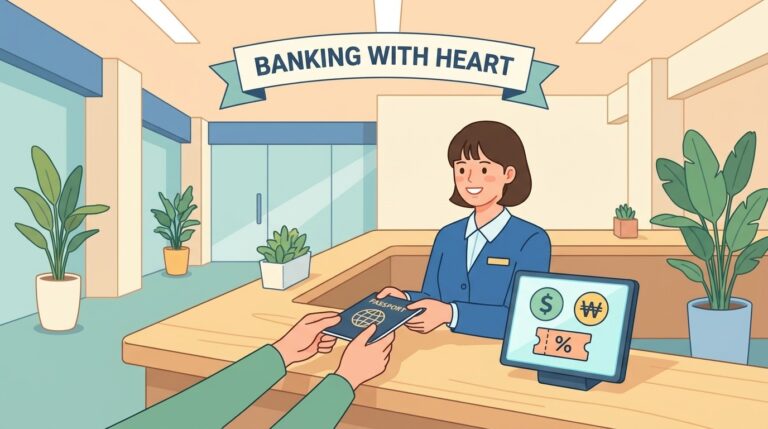
* Two-Handed Respect: Always hand over your passport, cash, or phone screen (with the coupon) using both hands. This simple gesture of respect (Jeon-tong ye-ui) instantly warms up the banker’s attitude toward you.
* Nunchi (눈치) Rule: Look around the bank lobby. If it’s extremely crowded, keep your questions concise. If it’s quiet, feel free to ask the teller, “우대 혜택 더 받을 수 있는 방법이 있을까요?” (Is there any way to get more preferential benefits?). They might recommend a mobile app download that saves you even more!
4-2. The Korean Digital Banking Trend
Koreans rarely carry cash nowadays due to the highly advanced cashless society (credit cards, KakaoPay, Naver Pay). However, for travelers, cash is still vital for traditional markets (like Mangwon Market or Gwangjang Market). Banks compete to offer high “우대율” (up to 90% for major currencies like USD, JPY, EUR) via their mobile apps to attract customers. Knowing this culture helps you negotiate better!
Phase 5: Real-Life Roleplay Scenario
Setting: A bustling branch of Hana Bank in Myeongdong, Seoul.
Characters:
* 민지 (Minji): The friendly but professional bank clerk (NPC).
* You (The Smart Traveler): An intermediate Korean learner looking to exchange USD to KRW.
민지: 어서 오세요! 고객님, 오늘 어떤 업무 도와드릴까요?
      (Welcome! How can I help you today, valued customer?)

You: 🎭 (Smiling politely, handing over your passport with both hands)
     안녕하세요, 달러를 원화로 바꾸고 싶은데요. 환전 우대율이 어떻게 돼요?
     (Hello, I'd like to change USD to KRW. What is the preferential exchange rate?)

민지: 아, 달러시군요! 기본 우대율은 50% 적용해 드리고 있어요.
      (Ah, USD! We apply a basic preferential rate of 50%.)

You: 혹시 여행객 전용 우대 쿠폰이 있는데, 이것도 적용해 주시겠어요?
     (By any chance, I have a tourist discount coupon. Could you apply this as well?)

민지: 🎭 (Takes your phone to check the screen with both hands)
      네, 확인했습니다! 이 쿠폰을 적용하시면 우대율 80%까지 올려드릴 수 있어요.
      (Yes, confirmed! If we apply this coupon, we can raise the rate to 80%.)

You: 정말요? 감사합니다! 그럼 수수료는 따로 안 붙나요?
     (Really? Thank you! Then, are there no separate fees applied?)

민지: 네, 우대율에 수수료 할인이 이미 포함되어 있어서 따로 청구되는 수수료는 없습니다.
      (Yes, the fee discount is already included in the preferential rate, so there is no separate fee charged.)

You: 아, 다행이네요. 그럼 수수료 빼고 최종적으로 얼마 받는지 영수증으로 확인해 주시겠어요?
     (Ah, that's a relief. Then, could you confirm the final amount I will receive after fees via a receipt?)

민지: 네, 잠시만 기다려 주세요. 여기 계산된 명세서입니다!
      (Sure, please wait a moment. Here is the calculated statement!)
🔀 Interactive Choice Points
How will you respond to Minji when she hands you the cash?
* Choice A: “고마워요, 수고해요!” (Casual / Slightly impolite to a bank worker)
* Choice B: “감사합니다. 안녕히 계세요!” (Standard / Safe and polite)
* Choice C: “우대해 주셔서 정말 감사합니다! 덕분에 기분 좋게 여행할 수 있겠어요.” (Best / Expresses deep appreciation and boosts mutual mood)
💡 Feedback on Choices:
- Choice A (Risk): Using 반말 (casual language) to bank staff can sound condescending. Avoid this!
- Choice B (Bad/Neutral): Perfectly fine and polite, but doesn’t build that warm human connection.
- Choice C (Best): Super native, highly polite, and shares a bit of warm human connection (정 – Jeong). The teller will remember you warmly!
Phase 6: 10-Second Emotion Shadowing Drill
Practice saying these lines with the indicated emotional flow to sound natural! / represents a natural pause.
[😊 Excited and polite]
혹시 / 환전 우대 쿠폰 있는데 / 적용해 주시겠어요?
(Hoksi / hwanjeon udae kupon inneunde / jeogyonghae jusigesseyo?)-
[🤔 Curious and clear]
수수료 떼고 / 최종적으로 / 얼마 받나요?
(Susuryo ttego / choejongjeogeuro / eolma bannayo?) -
[💖 Warmly appreciative]
우대해 주셔서 / 정말 감사합니다!
(Udaehae jusyeoseo / jeongmal gamsahamnida!)
Phase 7: K-Culture Mini Dictionary
- 원화 (Won-hwa): Korean Won (₩). The official currency of South Korea.
- 환율 (Hwan-yul): Exchange Rate. Keep an eye on “실시간 환율” (real-time exchange rate) apps.
- 주거래 은행 (Ju-geo-rae Eun-haeng): Primary Bank. If you reside in Korea, using your primary bank for currency exchange gets you the highest automated discounts.
- 지점 (Ji-jeom): Bank Branch. Branches at airports (인천공항 지점) usually have worse rates than city branches (e.g., Myeongdong or Gangnam).
Phase 8: Survival Kit for Travelers
Survival Expressions TOP 3
- “소액권으로 섞어서 주세요.” (So-aek-gwon-euro seokk-eoseo juseyo.)
- Meaning: Please mix in some small bills. (Highly useful so you don’t end up with only 50,000 KRW bills in street markets!)
- “동전은 괜찮습니다.” (Dong-jeon-eun gwaenchansumnida.)
- Meaning: I don’t need the coins. (When the exchange leaves you with tiny change you don’t want to carry around.)
- “영수증 봉투에 넣어주세요.” (Yeongsujeung bongtuye neoeojuseyo.)
- Meaning: Please put the receipt in an envelope.
Editor’s Travel Note
Before exchanging cash at the physical bank counter, check the real-time rates on Naver Currency Converter. Airport banks typically charge the highest service fees. If you need immediate cash upon arrival, exchange just enough for your bus fare, then visit a major bank branch in downtown Seoul for the rest. (Note: Exchange rates fluctuate constantly; online rates are for reference only.)
Phase 9: Go One Step Deeper
In Korea, negotiation isn’t done through haggling with the teller, but through finding loopholes of kindness—such as searching for digital coupons, showing a travel pass, or using corporate partnerships. Koreans value “준비성” (preparedness). By politely presenting a coupon or asking about preferential options, you are actively participating in Korea’s culture of smart, economical living (알뜰생활 – alteul saenghwal).
💬 Your Turn: Have you ever exchanged money at a foreign bank? What was the hardest part of the conversation? Share your stories in the comments below!
Phase 10: FAQ & Avoiding Mistakes
Q: Can I use mobile coupons at any bank branch?
A: Generally, yes, but some coupons are specific to certain brands like KEB Hana, Woori, or Shinhan Bank. Make sure to check the logo on your digital coupon before lining up!
Q: Is passport required for currency exchange in Korea?
A: Yes! By law, all banks in South Korea require a physical passport (not a copy or photo) to process foreign currency transactions for tourists.
Q: Do small neighborhood banks carry USD or other currencies?
A: Major tourist area branches carry multiple currencies, but small local neighborhood banks might have limited cash reserves. Stick to major branches in popular areas for currency exchange.
🚨 Common Mistakes Alert
- Mistake: Handing over cash and passport with one hand.
- Correct Action: Hand them over with both hands to show respect.
- Mistake: Asking “달러 얼마예요?” (How much is dollar?).
- Correct Action: Ask specifically “오늘 달러 환율이 어떻게 돼요?” (What is the USD exchange rate today?) to sound precise.
- Mistake: Forgetting to ask for “우대율” (Preferential rate).
- Correct Action: Always ask! Even without a coupon, tellers can sometimes apply a basic discount of 30-50% if you ask politely.
Phase 11: Action Mission & Engagement
- Bronze Mission: Read the expressions in Phase 6 out loud three times using the emotion guides.
- Silver Mission: Save a screenshot of this guide on your phone for your next visit to a Korean bank.
- Gold Mission: Next time you are in Korea, use the phrase “환전 우대율이 어떻게 돼요?” at a local bank and share your successful rate in our comments!
🎮 K-Culture Mission: Watch a modern Korean office-romance drama. See if you can spot a scene where characters talk about bank apps or transferring money! How do they do it?
Phase 12: Interactive Quiz Challenge
Test your knowledge before your next adventure!
Question 1: What does “우대율” (U-dae-ryul) mean in currency exchange?
- A) The interest rate of savings accounts
- B) The preferential discount rate applied to the currency exchange fee
- C) The penalty fee for late transactions
Reveal Answer & Explanation
Answer: B) The preferential discount rate applied to the currency exchange fee
Explanation: “우대율” is the rate of discount a bank gives you on their commission margin. The higher the percentage (e.g., 90% is great!), the cheaper your transaction will be!
Question 2: Fill in the blank: “수수료는
______ 붙나요?” (Are fees applied separately?)
* A) 아주 (Aju)
* B) 따로 (Ttaro)
* C) 벌써 (Beolsseo)
Reveal Answer & Explanation
Answer: B) 따로 (Ttaro – separately)
Explanation: “따로 붙나요?” means “Do they attach separately?”. This is the natural way to ask if there are hidden, extra fees.
Question 3: True or False: You should always use informal Korean (반말) to sound friendly to bank clerks.
- A) True
- B) False
Reveal Answer & Explanation
Answer: B) False
Explanation: In Korea, you must always use polite, formal, or semi-formal language (존댓말) with service staff. Doing so ensures you receive the best respect and service in return!







