

Master the Art of Saying ‘No’ with ‘Jeong’ (情) — How to Refuse Politely in Korean
Phase 1: Empathy (스토리 몰입형 오프닝)
안녕하세요! (Annyeonghaseyo!) Welcome back to your favorite Korean culture guide. It’s your Daily Hangul editor here!
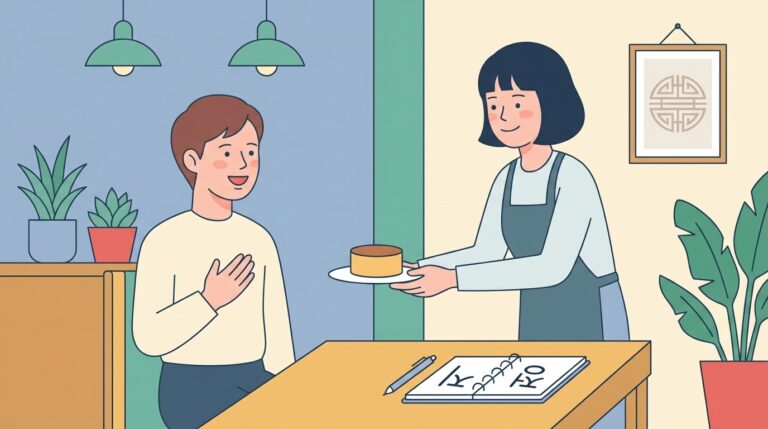
Picture this: You are studying at a cozy cafe in Seoul. Your lovely classmate, Min-ji, smiles warmly and hands you a piece of homemade matcha cake. “I baked this for you!” she says with eyes full of Jeong (정)—that warm, sticky feeling of affection, bonding, and mutual duty that defines Korean relationships.
Here’s the catch: You are severely allergic to matcha. Or maybe you just ate a massive bowl of Dakgalbi and feel like you might explode.
In your home country, a simple “No, thank you, I’m full!” works perfectly. But in Korea, if you reject her directly with “아니요, 안 먹어요” (No, I won’t eat it), you can practically hear the glass shattering in the air. The atmosphere goes ice-cold. Why? Because you didn’t just reject the cake; you rejected her Jeong.
Many of my intermediate students tell me, “I find myself saying ‘Yes’ to things I don’t want in Korea just because I don’t want to hurt anyone’s feelings!”
Don’t worry, my friend. Today, we are going to master the delicate art of the “Soft Korean Refusal.” You will learn how to protect your boundaries without breaking the invisible thread of Jeong. Let’s dive in!
Phase 2: Core Expressions (핵심 표현 3선 심층 분석)
1. 마음만 받을게요 (Ma-eum-man bat-eul-ge-yo)
- Pronunciation: Mah-eum-mahn bahd-eul-geh-yo (Sounds like “Mom-mahn baht-uhl-gheh-yo”)
- Meaning: “I will accept only your heart (intentions).”
- K-Culture Moment: In the classic K-Drama Reply 1988, neighbors constantly exchange dishes. If someone offers too much, a character might gently push the container back, saying, “아이구, 마음만 받을게요” (Oh, I’ll just take your warm heart).
- Editor’s Insight: This is the ultimate shield. By saying this, you are telling the other person: “I recognize your affection (Jeong), and I am accepting that love, even if I cannot physically accept the object or favor.”
- Situation Spectrum: Casual (✅) / Semi-formal (✅) / Formal (⚠️)
- 🤔 Think About It: In English, we focus on the physical object (“I can’t accept this gift”). Why do you think Koreans focus on the “heart” or “mind” (마음) instead?
2. 제가 요즘 ~ 중이라서요 (Je-ga yo-jeum ~ jung-i-ra-seo-yo)
- Pronunciation: Cheh-gah yo-jeum … joong-ee-rah-suh-yo (Sounds like “Cheh-gah yo-jum … jung-ee-lah-suh-yo”)
- Meaning: “Because I am in the middle of [doing something] these days…”
- K-Culture Moment: You are out with colleagues at a Korean BBQ, and they keep pouring Soju. You want to stop. You say, “제가 요즘 약을 먹는 중이라서요…” (Because I am taking medicine these days…).
- Editor’s Insight: Koreans rarely say a flat “No.” Instead, they leave the sentence trailing off with “~라서요…” (because…). It softens the blow by letting the other person fill in the unspoken “so I cannot do it” in their head.
- Situation Spectrum: Casual (✅) / Semi-formal (✅) / Formal (✅)
- 🤔 Think About It: Leaving sentences unfinished (cliffs) is a sign of politeness in Korea. How does this compare to your culture?
3. 어쩌죠? 다음에는 꼭 같이 해요 (Eo-jjeo-jyo? Da-eum-en-eun kkok gat-i hae-yo)
- Pronunciation: Uh-jjuh-jyo? Dah-eum-ehn-uhn kkok gah-chee hae-yo
- Meaning: “Oh, what should we do? Let’s definitely do it together next time.”
- K-Culture Moment: A friend invites you to an impromptu Han River picnic, but you have a mountain of homework.
- Editor’s Insight: “어쩌죠?” (What to do?) shows that you are just as sad about saying no as they are. Adding “다음에는 꼭” (Definitely next time) preserves the relationship for the future.
- Situation Spectrum: Casual (✅) / Semi-formal (✅) / Formal (🚫)
- 🤔 Think About It: Is “next time” always a literal promise, or is it a social cushion? (Hint: It’s usually a cushion!)
Phase 3: Textbook Korean vs. Real Korean (교과서 vs. 진짜 한국어)
Scenario 1: Rejecting food/drink when you are full
- 📖 Textbook: “배가 불러서 먹을 수 없습니다.” (I cannot eat because I am full. – Too robotic and cold!)
- 🗣️ Real Korean: “진짜 먹고 싶은데, 제가 배가 너무 불러서 아쉬워요!” (I really want to eat it, but I’m so full, what a pity!)
- 💡 Why the difference? Real Korean prioritizes expressing your desire to accept their kindness first, framing the refusal as an unfortunate tragedy beyond your control.
Scenario 2: Turning down an invitation to hang out
- 📖 Textbook: “시간이 없어서 못 갑니다.” (I cannot go because I have no time. – Sounds like you don’t care.)
- 🗣️ Real Korean: “아~ 가고 싶은데, 오늘 선약이 있어서요. 다음에 꼭 불러주세요!” (Ah~ I want to go, but I have a previous engagement today. Please invite me next time!)
- 💡 Why the difference? Using “선약” (seonyak – previous appointment) is a universally respected social excuse in Korea that saves face for both parties.
Phase 4: K-Culture Deep Dive & Non-verbal Manners (비언어적 매너)
4-1. The “Body Nunchi” (몸짓 눈치)
In Korea, how you look when saying no is 80% of the communication.
1. The Hand Wave: Do not raise your hand high. Keep your hand near your chest and gently wave it side-to-side while slightly tilting your head.
2. The Inward Breath: Sucking in air through your teeth (Sss-) before speaking shows you are deeply pondering how to minimize their disappointment.
3. The Soft Bow: A slight 15-degree bow of the head while apologizing softens any refusal instantly.
4-2. The Cultural Code of
Frequently Asked Questions (FAQ)
Q: What does "마음만 받을게요 (Ma-eum-man bat-eul-ge-yo)" mean in Korean and how do you pronounce it?
A: In Korean, "마음만 받을게요 (Ma-eum-man bat-eul-ge-yo)" is pronounced [Mah-eum-mahn bahd-eul-geh-yo (Sounds like "Mom-mahn baht-uhl-gheh-yo"] and means: "I will accept only your heart (intentions)."
Q: What does "제가 요즘 ~ 중이라서요 (Je-ga yo-jeum ~ jung-i-ra-seo-yo)" mean in Korean and how do you pronounce it?
A: In Korean, "제가 요즘 ~ 중이라서요 (Je-ga yo-jeum ~ jung-i-ra-seo-yo)" is pronounced [Cheh-gah yo-jeum ... joong-ee-rah-suh-yo (Sounds like "Cheh-gah yo-jum ... jung-ee-lah-suh-yo"] and means: "Because I am in the middle of [doing something] these days..."
Q: What does "어쩌죠? 다음에는 꼭 같이 해요 (Eo-jjeo-jyo? Da-eum-en-eun kkok gat-i hae-yo)" mean in Korean and how do you pronounce it?
A: In Korean, "어쩌죠? 다음에는 꼭 같이 해요 (Eo-jjeo-jyo? Da-eum-en-eun kkok gat-i hae-yo)" is pronounced [Uh-jjuh-jyo? Dah-eum-ehn-uhn kkok gah-chee hae-yo] and means: "Oh, what should we do? Let's definitely do it together next time."







