

Step into a Korean Service: How to Attend a Worship Service in Korea with Confidence!
안녕하세요! (An-nyeong-ha-se-yo!) Your trusted Daily Hangul editor and local culture navigator is here! Have you ever wanted to attend a church, temple, or religious service in Korea, but felt too nervous to step inside?
Perhaps you are worried: “Where do I sit?”, “What do I say when someone welcomes me?”, or “Is my Korean natural enough?” You are not alone! Many of our global learners have shared how they wanted to join a local community but felt held back by the language barrier and cultural etiquette. Today, we are going to unlock the essential phrases and cultural ‘Nunchi’ (눈치 – situational wit) you need to feel right at home in a Korean worship service. Let’s dive in!
Phase 2: Key Expressions Deep Dive
1. 예배 시작했어요? (Ye-bae si-jak-hae-sseo-yo?)
- Pronunciation: Ye-bae (Sounds like ‘yeah-beh’) si-jak-hae-sseo-yo? (Sounds like ‘she-jack-heh-suh-yo’)
- Meaning: “Has the service started?”
- K-Culture Moment: In K-Dramas like Save Me or Reply 1988, community gatherings often center around neighborhood religious spaces. Asking this politely to an usher at the entrance is your first step to blending in.
- Editor’s Insight: Ye-bae (예배) specifically refers to a Christian/Protestant or Catholic worship service. If you are visiting a Buddhist temple, the equivalent term for service or ceremony is Beop-hoe (법회).
- Situation Spectrum: Casual (⚠️ – 예배 시작했어?) | Semi-formal (✅ – 예배 시작했어요?) | Formal (✅ – 예배 시작했습니까?)
- 🤔 Think About It: In your home country, do people arrive early for services, or is it normal to slip in late? In Korea, arriving 10-15 minutes early is highly valued!
2. 주보 하나만 주세요. (Ju-bo ha-na-man ju-se-yo.)
- Pronunciation: Ju-bo (Sounds like ‘jew-bo’) ha-na-man (Sounds like ‘hah-nah-mahn’) ju-se-yo (Sounds like ‘jew-she-yo’)
- Meaning: “Please give me one weekly bulletin/pamphlet.”
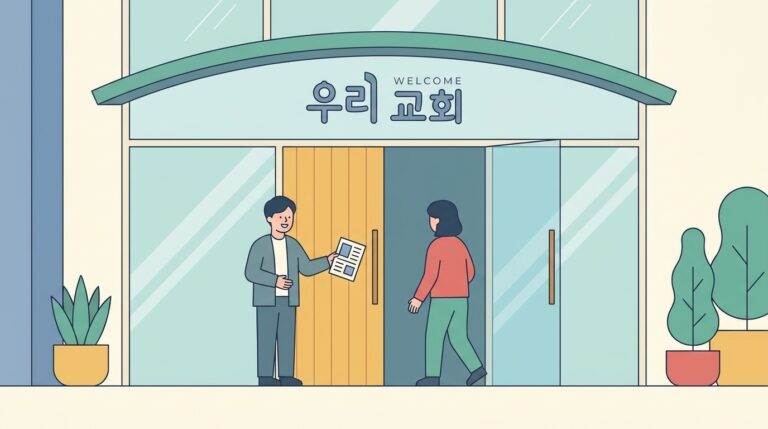
- K-Culture Moment: When entering a Korean church, the first thing you will see is a friendly usher handing out a paper bulletin called Ju-bo (주보). It contains the order of service, lyrics, and weekly news.
- Editor’s Insight: Adding -man (만) means “only” or “just,” which softens your request to sound polite and natural: “Just one bulletin, please.”
- Situation Spectrum: Casual (🚫) | Semi-formal (✅ – 주보 하나만 주세요) | Formal (✅ – 주보 하나 부탁드립니다)
- 🤔 Think About It: Paper bulletins are a huge part of Korean church culture. They often double as notebooks for sermon notes! Do churches in your country use paper or digital screens?
3. 처음 왔어요. (Cheo-eum wa-sseo-yo.)
- Pronunciation: Cheo-eum (Sounds like ‘chuh-um’) wa-sseo-yo (Sounds like ‘wah-suh-yo’)
- Meaning: “I am here for the first time.”
- K-Culture Moment: When welcoming newcomers, Korean churches are incredibly enthusiastic! Saying this phrase will instantly signal to the volunteers that you might need a little extra help or guidance.
- Editor’s Insight: Cheo-eum (처음) means “the first time.” Saying this with a warm smile is the ultimate icebreaker.
- Situation Spectrum: Casual (⚠️) | Semi-formal (✅ – 처음 왔어요) | Formal (✅ – 처음 방문했습니다)
- 🤔 Think About It: Why is sharing that it’s your first time so helpful in Korean culture? Because Koreans love showing hospitality (Jeong – 정) to guests!
Phase 3: Textbook Korean vs. Real Korean
Let’s compare what dry textbooks teach you versus how real Koreans actually talk in these settings.
Situation 1: Asking where to sit
- 📖 Textbook Korean: 어디에 앉아야 합니까? (Eo-di-e an-ja-ya hap-ni-ka? – “Where must I sit?”)
- 🗣️ Real Korean: 어디에 앉으면 돼요? (Eo-di-e an-jeo-myeon dwae-yo? – “Where can I sit? / Where is it best to sit?”)
- 💡 Why the difference? The textbook version sounds like a military command. Using -myeon dwae-yo? (면 돼요) sounds much softer, more natural, and polite for an A2 learner.
Situation 2: Greeting someone after the service
- 📖 Textbook Korean: 만나서 반갑습니다. (Man-na-seo ban-gap-seub-ni-da. – “Nice to meet you.”)
- 🗣️ Real Korean: 오늘 예배 너무 좋았어요. (O-neul ye-bae neo-mu jo-at-seo-yo. – “Today’s service was really wonderful.”)
- 💡 Why the difference? While “Nice to meet you” is correct, sharing a brief, positive impression of the service builds an instant, warm connection with the church members.
Phase 4: K-Culture Deep Dive & Non-verbal Manners
4-1. Church Nunchi (눈치) & Gestures
- The Two-Handed Hand-off: When an usher hands you the Ju-bo (bulletin) or when you offer a donation/offering, always use two hands (or support your right wrist/forearm with your left hand). Doing things with one hand can look casual or disrespectful in a religious setting.
- Slight Bow: When entering the main chapel, a slight, respectful 15-degree bow to the ushers or people sitting next to you shows great manners.
4-2. The “Newcomer’s Welcoming” Culture
If you visit a Korean church, be prepared for Sae-ga-jok (새가족 – “New Family”) welcoming! Many churches have a dedicated lounge where they treat newcomers to warm coffee or tea and snacks. It’s not a high-pressure environment, but rather a warm manifestation of Jeong (정 – deep affection and community bond).
Phase 5: Real-Life Roleplay Scenario
Meet Ji-won, a warm and helpful church usher at a local church in Seoul.
- Character: Ji-won (지지원) – A cheerful volunteer usher who wears a bright smile and loves welcoming international visitors.
The Dialogue
- Ji-won: 안녕하세요! 오늘 처음 오셨어요?
(An-nyeong-ha-se-yo! O-neul cheo-eum o-shyeot-seo-yo?)
“Hello! Are you here for the first time today?” - You: 🎭 [Smiling politely] 네, 처음 왔어요. 예배 시작했어요?
(Ne, cheo-eum wa-sseo-yo. Ye-bae si-jak-hae-sseo-yo?)
“Yes, it’s my first time. Has the service started?” - Ji-won: 아니요, 아직 안 했어요. 여기 주보 받으세요.
(A-ni-yo, a-jik an hae-sseo-yo. Yeo-gi ju-bo ba-deu-se-yo.)
“No, not yet. Here is a weekly bulletin.” - You: 🎭 [Receiving the bulletin with both hands] 감사합니다. 어디에 앉으면 돼요?
(Gam-sa-hap-ni-da. Eo-di-e an-jeo-myeon dwae-yo?)
“Thank you. Where should I sit?” - Ji-won: 편한 자리에 앉으시면 돼요. 앞쪽에 자리가 많아요.
(Pyeon-han ja-ri-e an-jeu-si-myeon dwae-yo. Ap-jjo-ge ja-ri-ga man-a-yo.)
“You can sit in any comfortable seat. There are many open seats near the front.” - You: 저기요, 혹시 영어 예배도 있어요?
(Jeo-gi-yo, hok-si yeong-eo ye-bae-do i-sseo-yo?)
“Excuse me, by any chance is there an English service too?” - Ji-won: 네! 오전 11시에 영어 예배가 따로 있어요.
(Ne! O-jeon yeol-han-si-e yeong-eo ye-bae-ga tta-ro i-sseo-yo.)
“Yes! We have a separate English service at 11 AM.” - You: 아, 정말요? 알려주셔서 감사합니다!
(Ah, jeong-mal-yo? Al-려-ju-shyeo-seo gam-sa-hap-ni-da!)
“Ah, really? Thank you for letting me know!”
🔀 Interactive Choice Point
After the service, Ji-won asks you: “오늘 예배 어떠셨어요?” (How was the service today?) How will you respond?
- A) “진짜 재미없었어요.” (Jin-jja jae-mi-eop-sseo-yo.)
- B) “오늘 예배 너무 좋았어요. 마음이 편안해요.” (O-neul ye-bae neo-mu jo-at-sseo-yo. Ma-eum-i pyeon-an-hae-yo.)
- C) “다음에 안 올래요.” (Da-eum-e an ol-lae-yo.)
Feedback:
- Best Choice – B: Perfect! This politely expresses that you enjoyed the service and felt peaceful (ma-eum-i pyeon-an-hae-yo).
- Bad Choice – A: “It was really boring.” Ouch! Even if you didn’t understand everything, this is too blunt in Korean culture.
- Risk Choice – C: “I won’t come next time.” While honest, it shuts down the relationship too abruptly and might make the usher feel bad.
Phase 6: 10-Second Emotion Shadowing Drill
Practice speaking with natural Korean rhythm and feelings! Pay attention to the pauses (/).
- [😊 With a warm, polite smile]
- 네, / 처음 왔어요. / 잘 부탁드립니다.
- (Ne, / cheo-eum wa-sseo-yo. / jal bu-tak-deu-rip-ni-da.)
- “Yes, / it’s my first time. / Please guide me well.”
- [🥺 Curious and respectful]
- 혹시 / 영어 예배는 / 몇 시에 있어요?
- (Hok-si / yeong-eo ye-bae-neun / myeot si-e i-sseo-yo?)
- “By any chance, / the English service, / what time is it?”
Phase 7: K-Culture Mini Dictionary
- 예배 (Ye-bae) | Worship Service | Typically used by Protestants and Catholics.
- 교회 (Gyo-hoe) | Church | The building or community of Christian believers.
- 성당 (Seong-dang) | Catholic Cathedral/Church | Specifically refers to Roman Catholic places of worship.
- 주보 (Ju-bo) | Weekly Bulletin | The pamphlet given at the entrance detailing the service order and notices.
Phase 8: Traveler’s Survival Kit
Survival Expressions TOP 3
- 화장실 어디에 있어요? (Hwa-jang-sil eo-di-e i-sseo-yo?) – “Where is the restroom?” (Pro Tip: Most churches have restrooms on every floor, but they might require a passcode written in the Ju-bo!)
- 사진 찍어도 돼요? (Sa-jin jji-geo-do dwae-yo?) – “Can I take photos?” (Pro Tip: It is usually polite to ask before taking photos inside a historic cathedral or Buddhist temple hall.)
- 신발 벗어야 돼요? (Sin-bal beot-eo-ya dwae-yo?) – “Do I need to take off my shoes?” (Pro Tip: Some traditional temple halls or small prayer rooms require removing shoes.)
📌 Editor’s Travel Note: To locate beautiful historic churches, cathedrals, or temples near you, download the Naver Map App which provides the most accurate pedestrian directions in Korea. Note: App features and interfaces are subject to update by the developer.
Phase 9: “A Step Deeper” (Cultural Insights)
In Korea, churches and temples are not just spiritual centers; they are massive social hubs. For many Koreans, their religious community is where they find lifelong friends, network, study together, and even find marriage partners! This deep community focus stems from the historical Korean value of 정 (Jeong) and 우리 (Uri – “We/Our”) culture, where collective belonging is highly cherished.
💬 Your Turn: Have you ever visited a church or religious place in another country? How was the experience compared to your home country? Let us know in the comments below!
Phase 10: FAQ & Avoiding Common Mistakes
Q: Can non-believers attend a church or temple service in Korea?
A: Yes, absolutely! Korean religious spaces are highly welcoming to visitors, tourists, and seekers. Just dress respectfully and try to follow along with when people stand or sit.
Q: Do I have to give offering/money during the service?
A: No, giving an offering (heon-geum – 헌금) is entirely voluntary. If a basket is passed around or there is a box at the entrance, you can simply pass it along politely.
Q: Can I speak English inside the church?
A: Many larger churches in major cities like Seoul have dedicated foreign language ministries (English, Chinese, Spanish). However, at smaller neighborhood churches, speaking basic Korean like “처음 왔어요” will make your visit go much smoother!
🚨 Common Mistakes Warning Board
- Mistake 1: Entering the sanctuary wearing a hat.
- Correct Action: Please take off caps or hats out of respect before the service begins.
- Mistake 2: Using only one hand to take the bulletin from elders/ushers.
- Correct Action: Use both hands with a slight bow of your head.
- Mistake 3: Talking loudly or taking photos during silent prayer.
- Correct Action: Maintain quiet etiquette and wait for designated times to take pictures.
Phase 11: Action Mission
- Bronze Mission: Speak “처음 왔어요” (Cheo-eum wa-sseo-yo) out loud 5 times in front of your mirror with a welcoming smile.
- Silver Mission: Write down the phrase “어디에 앉으면 돼요?” on your phone notes so you can easily access it when you visit a Korean community space.
- Gold Mission: Find a local Korean church or temple near you (or online) and watch a short clip of a service to identify how people greet each other!
Phase 12: Interactive Quiz Challenge
Test your knowledge with these quick cultural and language questions!
1. Which phrase should you say when an usher welcomes you for the first time?
- A) 어디에 앉아요? (Where do I sit?)
- B) 처음 왔어요. (I am here for the first time.)
- C) 주보 주세요. (Give me a bulletin.)
Click for the Answer & Explanation!
Correct Answer: B
Saying “처음 왔어요” (I am here for the first time) is the warmest and most polite way to introduce yourself to the ushers!
2. True or False: You should always receive the weekly bulletin (주보) with both hands.
- A) True
- B) False
Click for the Answer & Explanation!
Correct Answer: A (True)
Using both hands is a vital sign of respect in Korean etiquette, especially when interacting with community elders or volunteers!







