

Master Seollal Bowing: How to Greet Ancestors on Korean New Year (A1 Guide)
Phase 1: Empathy & Connection (Your First Seollal Experience)
안녕하세요! (Annyeonghaseyo!) Hello! I’m your Daily Hangul editor and your personal cultural navigator.
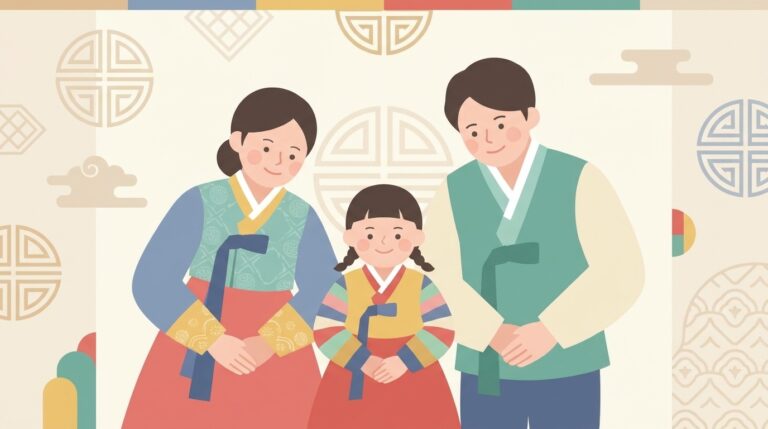
Imagine this: It’s Lunar New Year (설날 – Seollal) morning in Korea. The house is filled with the rich aroma of warm rice cake soup (떡국 – tteokguk). Your Korean friend’s family is wearing beautiful, colorful Hanbok (한복). Suddenly, everyone lines up in front of a table beautifully set with fruits and traditional dishes. They look at you and say, “Let’s bow to our ancestors!”
Panic sets in. How do I bow? What do I say? Will I make a mistake and look disrespectful?
Don’t worry at all! Every Korean learner has been there. Bowing to ancestors (차례 – charye) is a beautiful, heartfelt tradition about remembering family roots, not a strict test. Today, we’ll learn the 3 easiest phrases and simple gestures to help you feel confident and blending in like a true local. Let’s dive in!
Phase 2: Core Expressions Deep Dive (The Big Three)
Here are three essential phrases you can use during Seollal.
1. 새해 복 많이 받으세요! (Saehae bok mani badeuseyo!)
- Pronunciation: “Sae-hae bok mah-nee bah-deu-seh-yo!” (Sounds like “Sae-hae” + “poke” with a ‘b’ + “mah-nee” + “bah-deu-say-yo”)
- Meaning: “Please receive a lot of good fortune in the New Year!”
- K-Culture Moment: You will see your favorite K-Pop idols wearing Hanbok and saying this together in holiday greeting videos on YouTube!
- Editor’s Insight: This is the ultimate Seollal magic phrase. You can say it to ancestors during the ceremony in your heart, and say it out loud to living family members.
- Situation Spectrum: Casual (⚠️ with close friends, you say 새해 복 많이 받아), Semi-formal (✅), Formal (✅)
- 🤔 Think About It: In many Western cultures, people wish for “happiness” or “health”. Why do you think Koreans specifically wish for “복” (fortune/blessings)?
2. 감사합니다. (Gamsahabnida.)
- Pronunciation: “Gam-sa-ham-nee-da.” (The ‘b’ sound in ‘hab’ softens to ‘m’ before ‘n’.)
- Meaning: “Thank you.”
- K-Culture Moment: When a character in a K-Drama bows deeply to their grandparents or at an ancestral altar to show gratitude.
- Editor’s Insight: Ancestor worship in Korea is about saying “Thank you for giving me life and watching over me.”
- Situation Spectrum: Casual (🚫), Semi-formal (✅), Formal (✅)
- 🤔 Think About It: How does your culture show respect and thankfulness to ancestors or past generations?
3. 잘 부탁드립니다. (Jal butakdeurimnida.)
- Pronunciation: “Jal boo-tak-deu-rim-nee-da.” (Sounds like “Jal” + “boo-tack” + “deu-rim-nee-dah”)
- Meaning: “I kindly ask for your favor/guidance in the future.”
- K-Culture Moment: Said when starting a new year, hoping the ancestors will protect the family and bring good luck.
- Editor’s Insight: This shows a humble heart, asking ancestors to look after the family for the upcoming year.
- Situation Spectrum: Casual (🚫), Semi-formal (⚠️), Formal (✅)
- 🤔 Think About It: Koreans believe family bonds continue even after death. Does this phrase reflect that belief?
Phase 3: Textbook Korean vs. Real Korean
Let’s look at how textbooks teach Seollal greetings versus how Koreans actually talk during the holiday!
Scenario 1: Greeting elders after bowing
- 📖 Textbook Korean: “안녕하십니까? 새해에도 건강하십시오.” (Annyeonghasimnikka? Saehaeedo geonganghasipsio. – “How do you do? Please be healthy in the New Year.”)
- 🗣️ Real Korean: “새해 복 많이 받으세요! 건강하시고요!” (Saehae bok mani badeuseyo! Geonganghasigoyo! – “Happy New Year! And please stay healthy!”)
- 💡 Why the difference? Textbook expressions can sound too stiff, like a military report. Real Koreans prefer a warm, polite, yet soft tone with family.
Scenario 2: When receiving pocket money (세뱃돈 – Sebaetdon) from elders
- 📖 Textbook Korean: “재물을 주셔서 대단히 감사합니다.” (Jaemureul jusyeoseo daedanhi gamsahabnida. – “Thank you very much for giving me financial assets.”)
- 🗣️ Real Korean: “우와, 감사합니다! 예쁘게 잘 쓸게요!” (Uwa, gamsahabnida! Yeppeuge jal sseulgeyo! – “Wow, thank you! I will use it wisely/beautifully!”)
- 💡 Why the difference? Saying “재물” (assets) is incredibly awkward! Saying “예쁘게 잘 쓸게요” shows you appreciate the gift warmly.
Phase 4: K-Culture Deep Dive & Non-Verbal Etiquette
4-1. The Art of the Big Bow (세배 – Sebae)
During Seollal, we perform a deep bow called Sebae.
* Hand Placement (Very Important!):
* Men: Place your left hand on top of your right hand.
* Women: Place your right hand on top of your left hand.
* (Tip: If doing a bow to deceased ancestors during the memorial service, the hand placement is reversed, but for general New Year bows to living elders, follow the rule above!)
* Posture: Slowly kneel, bring your hands to your forehead (for women) or floor (for men), and bend your upper body forward deeply. Hold for 1-2 seconds, then slowly rise.
4-2. The K-Drama Connection
In the hit K-Drama Reply 1988, you see the neighborhood families gathering, bowing to their parents, and eating tteokguk together. This holiday is all about warm, chaotic family love!
Phase 5: Real-Life Roleplay Scenario
Meet Ji-hoon (지훈), your Korean friend. He invited you to his family home for Seollal!
8-Turn Dialogue
- Ji-hoon: “어서 와! 우리 집에 온 걸 환영해.” (Welcome! Welcome to my house.)
- You:
🎭 (Smiling brightly)“초대해 주셔서 감사합니다, 지훈 씨!” (Thank you for inviting me, Ji-hoon!) - Ji-hoon: “지금 할아버지께 세배(bow) 드릴 시간인데, 같이 할래?” (We are bowing to grandfather now, want to join?)
- You:
🎭 (Nervous but excited)“네! 하고 싶어요. 그런데 세배 어떻게 해요?” (Yes! I want to. But how do I bow?) - Ji-hoon: “쉽게 알려줄게. 손을 모으고 나를 따라서 몸을 깊이 숙이면 돼.” (I’ll show you easily. Just put your hands together and follow me to bow deeply.)
- You:
🎭 (Doing the bow carefully)“이렇게요?” (Like this?) - Ji-hoon: “완벽해! 이제 일어나면서 인사하자.” (Perfect! Now let’s stand up and greet.)
- You:
🎭 (With a warm smile)“새해 복 많이 받으세요!” (Happy New Year!)
🔀 Interactive Choice Point
Now, Ji-hoon’s grandmother hands you a New Year’s envelope with pocket money! What do you do?
* A) “우와! 돈이다! 감사합니다!” (Wow! Money! Thank you!)
* B) Receive it with both hands, bow slightly, and say “감사합니다. 새해 복 많이 받으세요.”
* C) “괜찮습니다, 돈은 필요 없습니다.” (No thank you, I don’t need money.) and push her hand away.
Feedback:
- Best Choice (B): Perfect! Receiving gifts with both hands shows maximum respect in Korea. Saying thank you and wishing her blessings is the ultimate polite response.
- Risk Choice (A): Too blunt! Pointing out the money directly (우와! 돈이다!) can make you look a bit greedy, though elders might find it funny because you are a foreigner.
- Bad Choice (C): Oh no! Refusing an elder’s gift too strongly can make them feel embarrassed or rejected. Accept it with gratitude!
Phase 6: 10-Second Emotion Shadowing Drill
Let’s practice speaking like a native speaker! Pay attention to the pauses (/) and emotions.
[😊 Excited & Polite]“새해 복 / 많이 받으세요!” (Saehae bok / mani badeuseyo!)[🥺 Humble & Sweet]“예쁘게 / 잘 쓸게요. / 감사합니다!” (Yeppeuge / jal sseulgeyo. / Gamsahabnida!)[🙏 Respectful & Clear]“올 한 해도 / 잘 부탁드립니다!” (Ol han haedo / jal butakdeurimnida!)
Phase 7: K-Culture Mini Dictionary
- 설날 (Seollal): Lunar New Year, one of the most important traditional holidays in Korea.
- 세배 (Sebae): The traditional deep bow performed to elders on Seollal.
- 세뱃돈 (Sebaetdon): New Year’s pocket money given to children/younger family members after they bow.
- 떡국 (Tteokguk): Rice cake soup. Koreans believe eating a bowl of tteokguk on Seollal makes you officially one year older!
Phase 8: Survival Kit for Travelers
Survival Phrases TOP 3
- “화장실 어디에 있어요?” (Hwajangsil eodie isseoyo?) – Where is the restroom?
- “이거 맛있어요!” (Igeo masisseoyo!) – This is delicious! (Great to say to your host family!)
- “도와주셔서 감사합니다.” (Dowajusyeoseo gamsahabnida.) – Thank you for helping me.
Editor’s Travel Note
If you travel to Korea during Seollal, many shops in Seoul might close for 2-3 days as people head to their hometowns. Make sure to download the Naver Map App to check which restaurants and spots are open. Don’t worry, major palaces like Gyeongbokgung are open and offer free admission on Seollal day!
Phase 9:
Frequently Asked Questions (FAQ)
Q: What does "새해 복 많이 받으세요! (Saehae bok mani badeuseyo!)" mean in Korean and how do you pronounce it?
A: In Korean, "새해 복 많이 받으세요! (Saehae bok mani badeuseyo!)" is pronounced ["Sae-hae bok mah-nee bah-deu-seh-yo!" (Sounds like "Sae-hae" + "poke" with a 'b' + "mah-nee" + "bah-deu-say-yo"] and means: "Please receive a lot of good fortune in the New Year!"
Q: What does "감사합니다. (Gamsahabnida.)" mean in Korean and how do you pronounce it?
A: In Korean, "감사합니다. (Gamsahabnida.)" is pronounced ["Gam-sa-ham-nee-da." (The 'b' sound in 'hab' softens to 'm' before 'n'.] and means: "Thank you."
Q: What does "잘 부탁드립니다. (Jal butakdeurimnida.)" mean in Korean and how do you pronounce it?
A: In Korean, "잘 부탁드립니다. (Jal butakdeurimnida.)" is pronounced ["Jal boo-tak-deu-rim-nee-da." (Sounds like "Jal" + "boo-tack" + "deu-rim-nee-dah"] and means: "I kindly ask for your favor/guidance in the future."







